François Boucher
He painted the eighteenth century's idea of heaven: all cream, pink, and dove-grey.

Style and technique
Boucher painted a world without shadows. Or rather, he understood shadow as just another kind of warm colour — a deeper rose, a cooler blue-grey — rather than an absence of light. Every surface in his canvases glows: the skin of his Venus figures, the satin of his curtains, the fur of his lapdogs, the feathers in every shepherdess's hat. The total effect is luxurious to the point of surfeit, and that was precisely the point.
He was the official painter to the court of Louis XV and the personal favourite of Madame de Pompadour, the king's chief mistress, who owned dozens of his works and had him design tapestry cartoons for the Beauvais and Gobelins manufactories. His aesthetic was not accidental but absolutely deliberate: the visual vocabulary of absolute monarchy in its most comfortable and self-satisfied form.
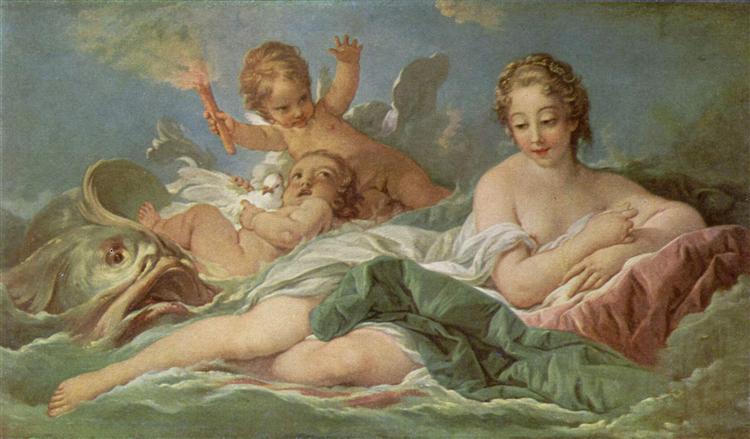
His mythology is relentlessly pleasurable. His Venus is never severe or distant; she is a warm, slightly plump young woman, comfortably horizontal, attended by putti who are barely restraining their smiles. His pastoral scenes have shepherdesses in impossible silks and shepherds with ribbon-trimmed hats — nobody in his countryside is poor, cold, or tired.
Technically he was superbly skilled. He drew with exceptional fluency — the Louvre holds hundreds of his chalk drawings, and they show a gift for line that his painting sometimes conceals under its decorative surfaces. His colour was widely admired even by rivals: the specific pale azure that dominates many of his skies and draperies became known throughout Europe as 'Boucher blue'.
His influence moved through the decorative arts as much as through painting: his designs for Sèvres porcelain, tapestries, and interior panels shaped French taste across the second half of the eighteenth century in ways that are still visible in every antique shop.
Life and legacy
Boucher was born on 29 September 1703 in Paris, the son of a lacemaker. He trained under his father and then under the painter François Lemoyne before winning the Prix de Rome in 1723, aged twenty. He spent four years in Rome but found the ancient monuments less useful than the paintings of Pietro da Cortona and the decorative Baroque ceiling tradition. He returned to Paris in 1731 and was admitted to the Royal Academy the same year.
His rise was rapid and almost unimpeded. He received large royal commissions, was appointed director of the Gobelins tapestry factory in 1755, and in 1765 became First Painter to the King — the highest official title in the French arts establishment. He also taught extensively, and his students included Jean-Honoré Fragonard, who would develop his sensibility in a more overtly erotic direction.
Madame de Pompadour was the central relationship of his career. She was introduced to his work around 1745 and immediately became his most important patron, commissioning portraits, mythological scenes, and decorative ensembles for her various residences. He painted her several times in direct portraits, and she appears in his work as an ideal of the cultivated aristocratic woman — reading, at her dressing table, surrounded by the objects of polite civilization.
His career peaked in the 1750s and 1760s. By the late 1760s, the philosophical tide in France had turned against him. Diderot, the great encyclopedist and art critic, attacked his work repeatedly in his Salon reviews — finding it morally vapid, technically shallow, and symptomatic of the decadence of a corrupted court. These attacks stung but did not entirely diminish his reputation in his lifetime.
With the French Revolution eighteen years away, his world — the world of the ancien régime's ease and pleasure — was already beginning to feel precarious. The severe Neoclassicism of Jacques-Louis David would soon sweep his aesthetic off the walls of fashionable Paris and replace it with something that could not have been more different.
Five famous paintings
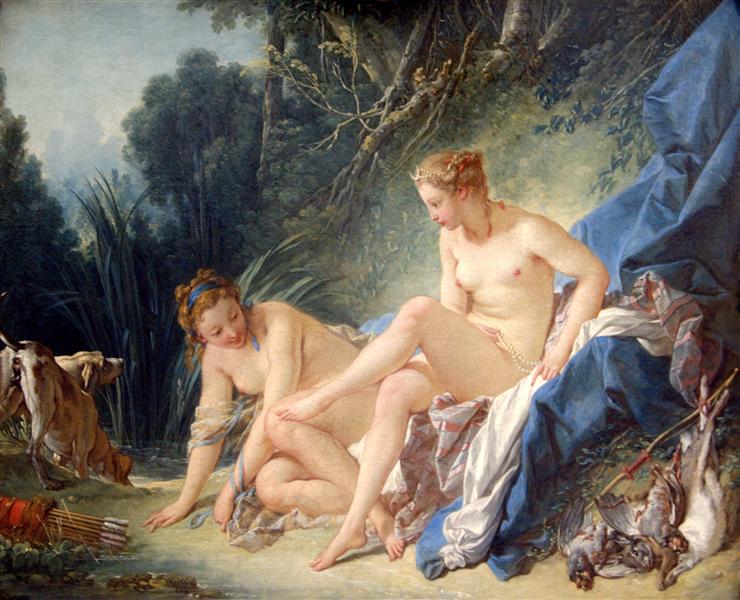
Diana Resting after her Bath 1742
Two naked women — Diana the huntress and a companion — rest by a pool after bathing. Diana sits slightly higher, her foot raised as her attendant removes something from it; her quiver and hunting dogs lie nearby. The painting is a pretext for two beautifully rendered female nudes in a landscape, and Boucher makes no real attempt to disguise this. What saves it from mere titillation is the quality of the flesh painting: the light falls differently on the two bodies, cooler on the companion, warmer on Diana, and the contrast gives the composition an unexpected visual complexity. It hangs in the Louvre in Paris.
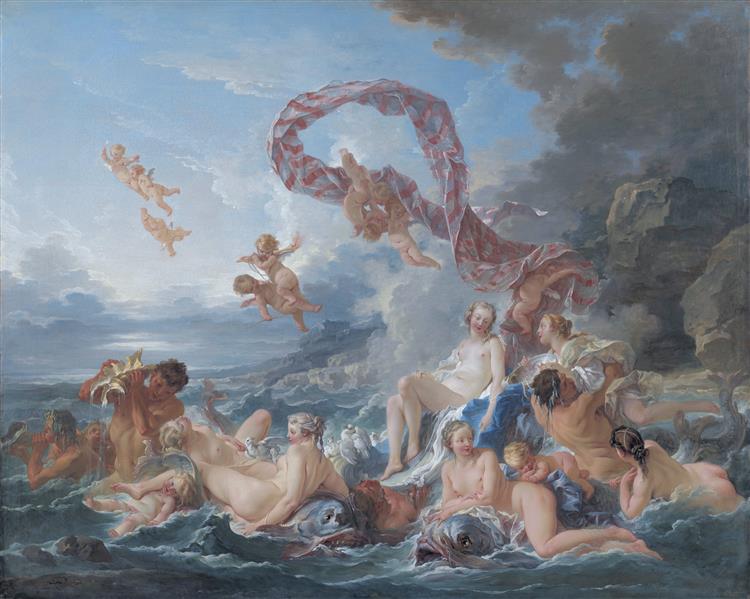
The Triumph of Venus 1740
A large horizontal canvas — 130 by 162 centimetres — showing Venus rising from the sea, surrounded by tritons, nereids, dolphins, and a cloud of putti. The composition is a direct homage to Rubens's similar treatments, but Boucher has flattened the temperature from Flemish warm gold to his characteristic pale blue-and-rose. Venus herself is not quite Titian's classical beauty but a softer, more approachable figure, almost smiling at the viewer. The sea beneath her is a pale, luminous green. It was painted for the Swedish court and hangs in the Nationalmuseum in Stockholm.
Blonde Odalisque 1752
A young woman — probably Marie-Louise O'Murphy, one of Louis XV's mistresses — lies face down on a chaise longue, her body turned towards the viewer, her face turned to the right. She is entirely nude except for a pale ribbon in her hair. The setting is a divan scattered with silk cushions. There is no mythological pretence here: this is a direct erotic portrait, commissioned almost certainly for Louis XV himself. It was followed by a second version. The figure was reused in a later engraving. The painting hangs in the Alte Pinakothek in Munich.
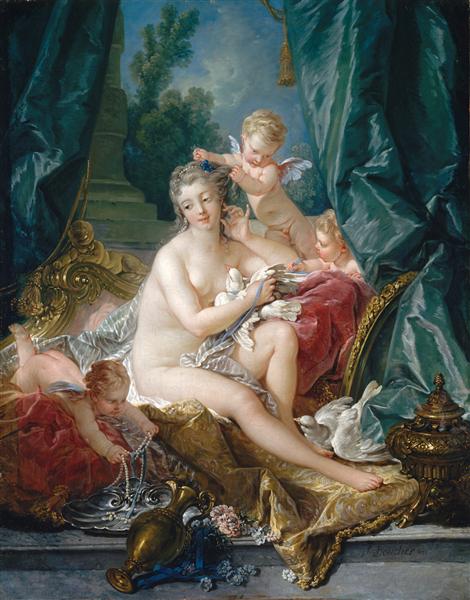
The Bath of Venus 1751
A late version of Boucher's favourite subject, painted for Madame de Pompadour's apartments at Bellevue. Venus reclines in a landscape or grotto setting while putti attend her — one holds a mirror, another pours water. The colour is at its most refined: the pale skin against warm gold fabric against a blue-grey grotto wall. The painting demonstrates Boucher's ability to organise a complex multi-figure composition around a single luminous centre. It hangs in the Metropolitan Museum of Art in New York.
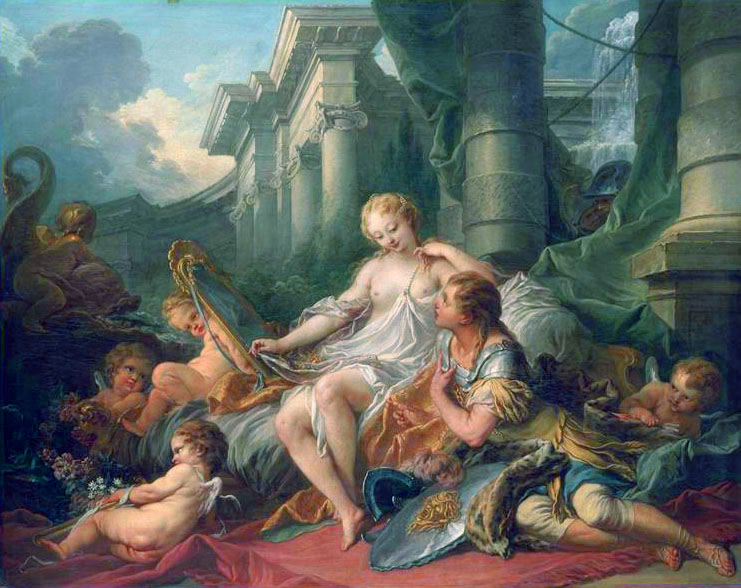
Rinaldo and Armida 1734
An early work, painted when Boucher was thirty-one and establishing his mythological-pastoral mode. From Tasso's epic poem 'Jerusalem Delivered': the crusader knight Rinaldo falls under the spell of the sorceress Armida and is held captive in her enchanted garden. Boucher shows him asleep, his head in her lap, in a luminous landscape of blue sky and golden light. The garden has the peculiar quality of all his landscapes: it is slightly too green, too warm, too perpetually afternoon. Armida looks down at him with an expression caught between desire and guilt.