Jean-Honoré Fragonard
He painted the gallant age at full speed, then watched the Revolution bury it.
Style and technique
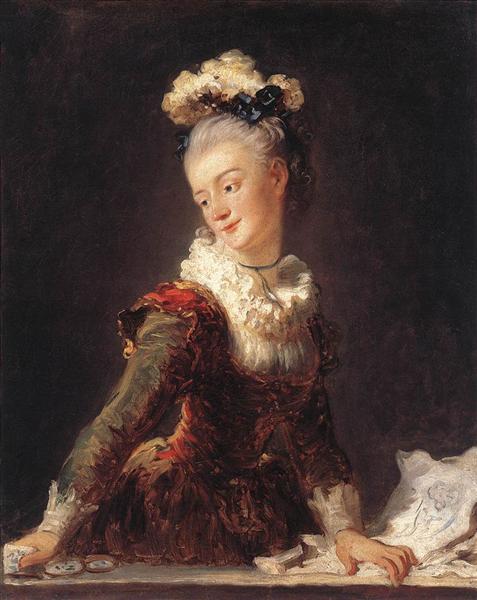
Fragonard painted faster than almost anyone. His late sketches and bozzetti move with a calligraphic speed that makes the surface of the canvas look almost like an improvisation — a few loaded strokes for a face, a comma of white for a highlighted fold. His brushwork is the most visible, most athletic, and most pleasurable in the French eighteenth century.
He learned this from his teacher Boucher and pushed it much further. Where Boucher built his surfaces in careful glazes to achieve a porcelain smoothness, Fragonard drew with the brush — one stroke, one decision, no corrections. The bravura is not accidental; he worked this way even in his large commissioned paintings, which often have a freshness and improvisational energy that his more deliberate contemporaries entirely lacked.
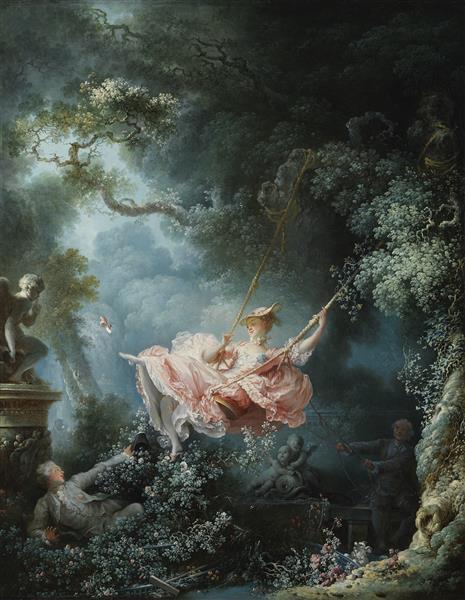
The subject matter is more overtly erotic than Boucher's and more tied to specific narrative moments. 'The Swing' (1767), his most famous painting, shows a young woman swinging high in a garden while her lover, lying in the bushes, looks up her skirts as her shoe flies off her foot. The bishop pulling the rope at the back is almost certainly her husband. The painting was commissioned as exactly this scenario by a French nobleman who specified the composition in writing. Fragonard delivered it straight.
His colour is lighter and cooler than Boucher's: pale gold, cream, sharp rose, the particular pearly grey of a cloudy afternoon. The landscapes behind his garden scenes are barely landscapes at all — they are impressions of green, suggestions of parkland, the minimal environment necessary to frame the action.
A significant body of his work consists of large decorative panels — specifically the four 'Progress of Love' panels (1771–73), now in the Frick Collection in New York — intended for Madame du Barry's pavilion at Louveciennes but rejected by her, possibly for being aesthetically old-fashioned when she received them.
Life and legacy
Fragonard was born on 5 April 1732 in Grasse, a perfume-manufacturing town in the hills above Nice. His father, a glovemaker's assistant, moved the family to Paris when Jean-Honoré was six. He began training briefly under Jean-Siméon Chardin — who reportedly found him too raw to teach — before passing to François Boucher, who recognised his talent immediately.
At eighteen he won the Prix de Rome with a large painting and spent five years in Italy, where he made the decisive discovery that most French painters missed: he fell completely in love with the Baroque frescoes of Pietro da Cortona and Tiepolo, with their flying figures and luminous ceilings, rather than with the Antique sculpture his scholarship was intended to teach him. He returned to Paris in 1761 with a head full of Italian warmth and a sketchbook full of studies from the gardens of the Villa d'Este at Tivoli — the gardens that would haunt his work for the rest of his career.
His official career began promisingly: he was accepted to the Academy in 1765 with a large mythological painting, 'Coresus Sacrificing Himself to Save Callirhoe', which was so well received that Louis XV wanted it copied for the Gobelins tapestry manufactory. But the world of official Salon painting quickly bored him. The private commissions were more interesting and more lucrative: the aristocracy wanted the kind of intimate, explicitly sensual subjects that would never pass through an academic jury.
Through the 1760s and 1770s he became the most sought-after painter in fashionable Paris. He married Marie-Anne Gérard in 1769; she was a miniaturist and a competent painter herself, and her younger sister Marguerite moved in with them and became one of Fragonard's most important models. The domestic arrangement was happy, productive, and slightly unconventional.
His friend the painter Jacques-Louis David, now the dominant figure in French art, helped him secure a minor administrative post in the new government's arts bureaucracy. But the severe Neoclassical aesthetic of the Republic had no place for Fragonard's perfumed gardens and swinging girls. He was irrelevant, and he knew it.
He died on 22 August 1806 in Paris, aged seventy-four, having survived long enough to watch Napoleon crown himself Emperor. He left a body of work that was entirely unfashionable at his death and only began to be revalued in the mid-nineteenth century, when collectors in France and America recognised in his work the most complete visual record of a world that no longer existed.
Five famous paintings
The Swing 1767
The painting that defines Fragonard and the Rococo simultaneously. A young woman in a billowing pink-and-white silk dress swings high in an overgrown garden; her shoe has flown off her foot and arcs through the air. Her young lover lies in the bushes at lower left, positioned directly below her, and looks up. An older man — possibly her husband — pulls the rope of the swing from the right background. The garden is impossibly lush: green and dark and theatrical. A small statue of Cupid at left raises a finger to his lips. The painting was commissioned by the Baron de Saint-Julien, who specified the composition in writing. It hangs in the Wallace Collection in London.
The Love Letter 1770
A young woman, elegantly dressed, pauses at a writing table and looks over her shoulder at the viewer with a small, confident smile. She holds a letter she is about to send — or has just received. A small dog sits in her lap. The painting is a study in knowing glances and implied narrative: who sent the letter? who is she waiting for? The brushwork is at its most fluent — the lace of her cuffs, the satin of her dress, the flowers in the vase behind her are all rendered in a few swift, certain strokes. It hangs in the Metropolitan Museum of Art in New York.
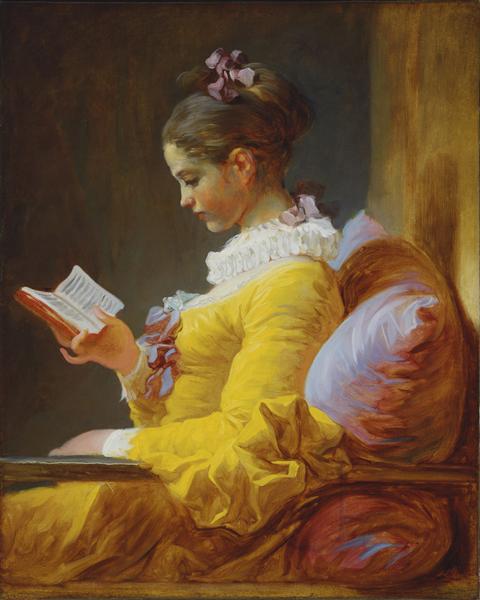
The Reader 1776
A young woman in a yellow dress and white bonnet sits slightly turned away from the viewer, reading a book she holds in both hands. The painting is almost entirely yellow: the dress, the light, the book, the warm ground. A small yellow highlight catches the tip of her nose. It is an intimate, informal subject rendered with extraordinary speed and confidence: the face is suggested in about a dozen strokes, and each stroke is visible and correct. The painting was probably a personal work rather than a commission, which may explain its unusual freedom. It hangs in the National Gallery of Art in Washington D.C.
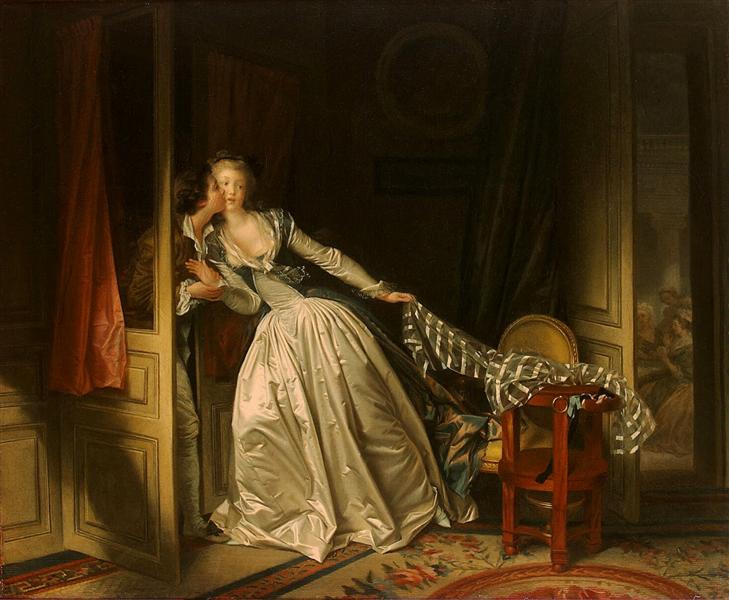
The Stolen Kiss 1787
A late work from the final years before the Revolution. A young man has slipped through a doorway into a hall where a young woman is sitting; he leans behind her, grasps her shoulder, and kisses her — she turns slightly, neither resisting nor fully participating, her expression exactly balanced between surprise and complicity. Through the open doorway behind them, people can be seen at a table in the next room. The painting hangs in the Hermitage in Saint Petersburg and is one of the most perfectly composed of his erotic narratives.
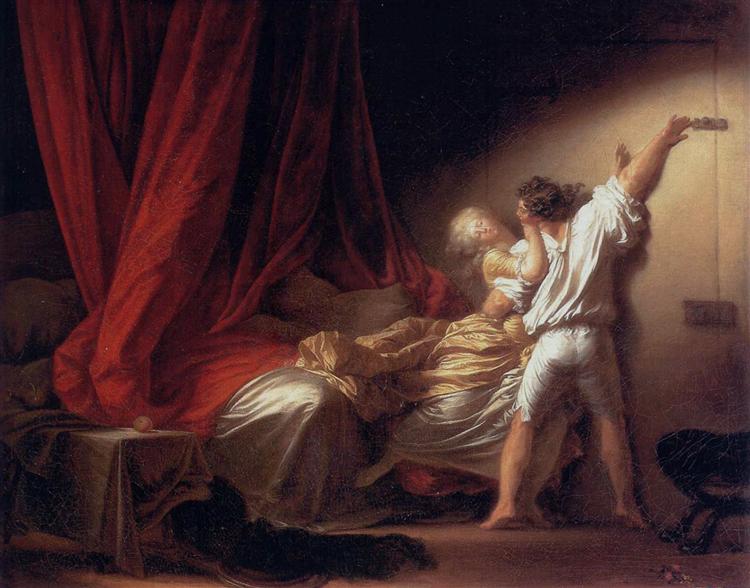
The Bolt 1778
A man pushes a bolt shut on a bedroom door with his right hand while his left arm pulls a woman towards him; she resists with her whole body, leaning back against his embrace, her expression somewhere between protest and surrender. The scene is lit by a single warm light from the left that catches the bolt, the tumbled white sheet on the bed, and the woman's pale arm. An apple lies on a small table by the bed — a coded reference to original sin. The Louvre acquired this painting in 1974 and it has been interpreted ever since as an image of erotic coercion, though the French eighteenth century read it simply as a galanterie.