Kazimir Malevich
He painted a black square and called it the face of God.
Style and technique
Malevich arrived at abstraction through an argument about the zero of form — the point at which painting removes all reference to the visible world and stands on its own, in pure sensation. He called his system Suprematism: the supremacy of pure feeling in art, over and against representation, narration, and all the accumulated cultural weight of previous art.
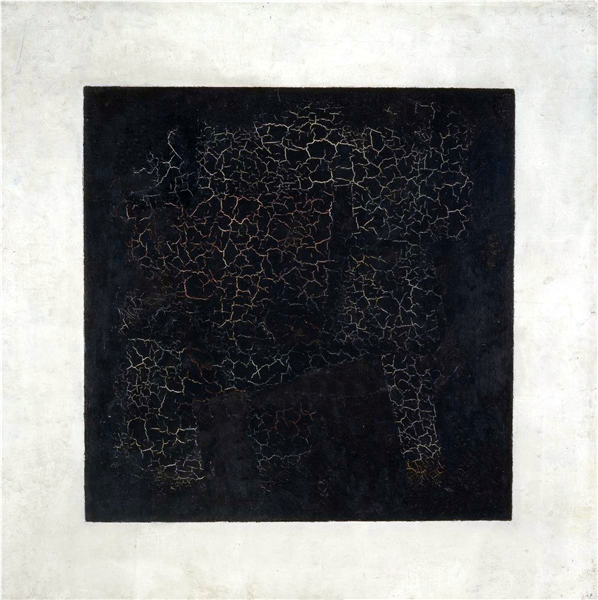
The black square on a white field, exhibited in Petrograd in December 1915 at the 'Last Futurist Exhibition 0,10', was hung in the corner of the room at ceiling level — the position traditionally reserved in Russian Orthodox homes for the icon. This was not accidental. Malevich was proposing Suprematism as a new religion, the black square as its supreme image: pure form, no reference, nothing outside itself.
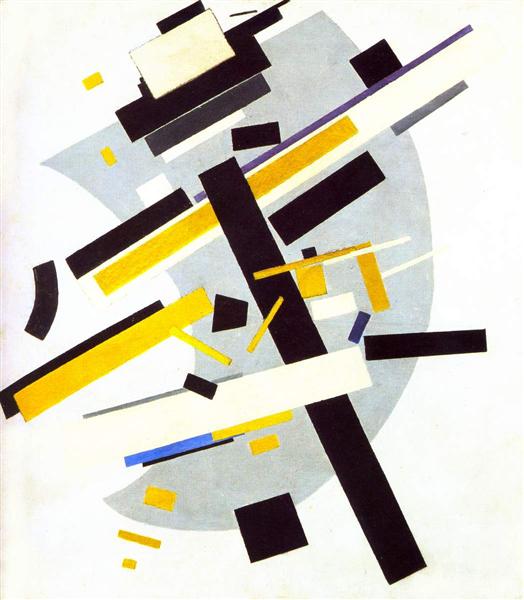
The system expanded from the black square to a vocabulary of geometric forms — squares, rectangles, crosses, circles, trapezoids — in various colours, floated across a white field that he called 'the white abyss of infinity'. The forms are not arranged compositionally in the classical sense; they are scattered, floating, freed from gravity.
Four fingerprints: pure geometric forms floating on white, no atmospheric perspective or spatial depth, a colour vocabulary ranging from primary and secondary colours through the complete achromatic scale to white-on-white, and a cosmic or spiritual ambition unusual in the twentieth-century art that tends to be ironic about its own claims.
Life and legacy
Malevich was born on 23 February 1879 in Kiev (now Kyiv), to Polish Catholic parents who had emigrated from Poland to Ukraine. His father worked in sugar manufacturing, and the family moved frequently during his childhood across Ukraine and Russia. He showed an early interest in drawing and eventually made his way to Moscow in his early twenties, where he studied at the Moscow School of Painting, Sculpture and Architecture.
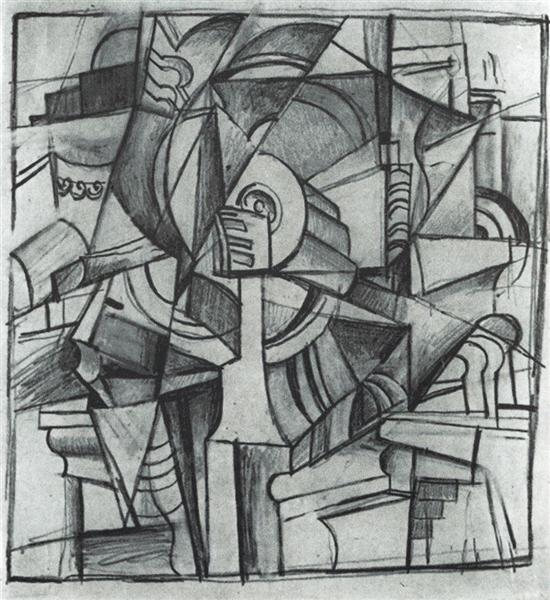
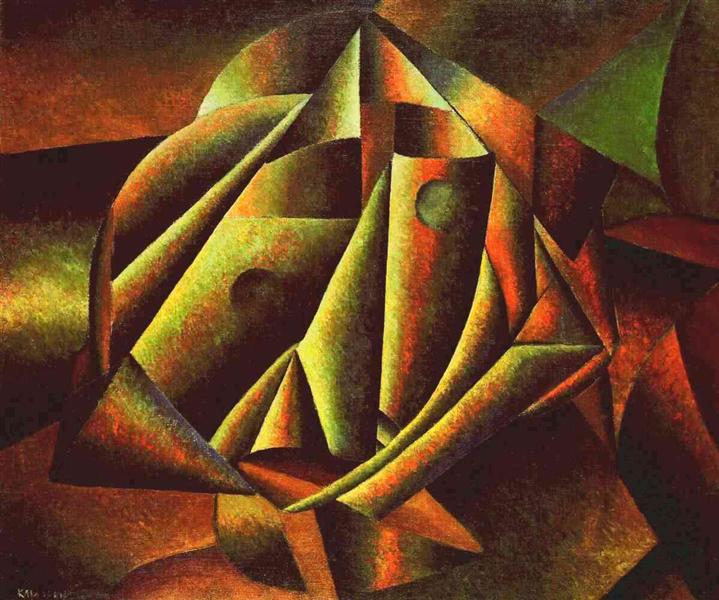
His early painting passed through several phases: Post-Impressionism in the early 1900s, then a concentrated study of Cézanne, then a Cubo-Futurist phase in which he combined the multiple viewpoints of Cubism with the dynamic energy of Italian Futurism. By 1913 he was designing the sets and costumes for the Futurist opera 'Victory over the Sun', and the geometric costume designs — particularly the square costume of the 'New Man' — were moving directly towards the abstraction he would formalise the following year.
The '0,10' exhibition of December 1915 was his declaration. Forty-nine Suprematist works were shown, dominated by the large 'Black Quadrilateral' hanging in the icon position. The other participants — Tatlin, Puni, Boguslavskaya — were overshadowed. The argument was that painting had reached its logical end point in the black square; nothing further was needed.
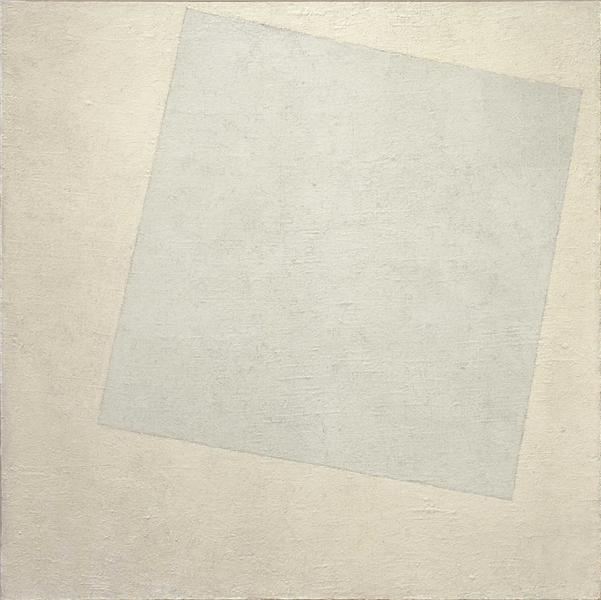
He continued developing the Suprematist vocabulary through subsequent years: the 'dynamic Suprematism' of diagonal and diagonal-dynamic compositions, the 'white period' that culminated in 'White on White' (1918), a white square tilted slightly on a white field — the near-invisibility of form as the furthest reach of the system.
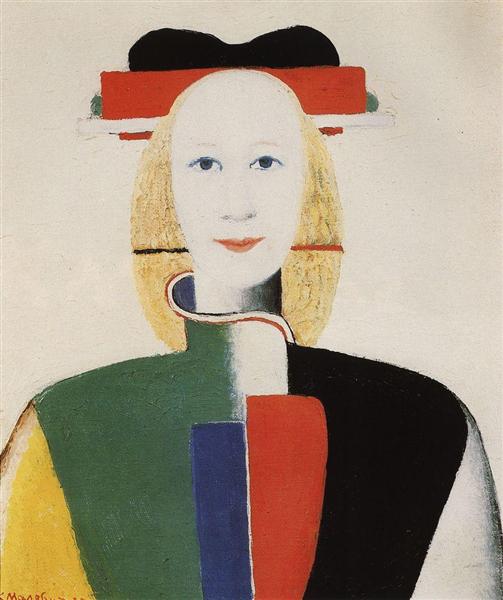
The political wind turned against abstraction in the early 1920s, as Soviet cultural policy moved towards a demand for representational art accessible to the proletariat. By the late 1920s Malevich was returning to figurative painting — but his late figurative works are haunted by Suprematist geometry: the peasant faces are blank ovals, the bodies are simplified cylinders, the colours are the primaries and blacks of his abstract work.
He was arrested briefly in 1930 on suspicion of espionage — possibly in connection with his contacts with the German Bauhaus — and interrogated for several weeks. He died on 15 May 1935 in Leningrad of cancer, aged fifty-six. Per his instructions, he was buried in a Suprematist coffin he had designed himself, surrounded by Suprematist crosses. His grave in Nemchinovka was destroyed during the Second World War.
Five famous paintings
Black Square 1915
The most radical painting of the twentieth century, or the most extreme confidence trick in art history — opinions remain divided. A black square painted on a white field, exhibited at the 'Last Futurist Exhibition 0,10' in December 1915, hung in the corner of the room where a Russian Orthodox icon would have been placed. Malevich had made a simple claim: this is the endpoint of painting, the 'zero of form', beyond which there is nothing. The black square has been repainted several times on the same canvas (visible in X-rays); the earliest version shows no preliminary drawing. The painting is in the Tretyakov Gallery in Moscow.
White on White 1918
The furthest reach of the Suprematist system: a white square painted at a slight diagonal on a white field. The two whites are very slightly different — one is cooler, one warmer — and the boundary between them is perceptible but barely so. The painting exists at the edge of visibility. Malevich described it as the sensation of weightlessness, of flight, of the dissolution of form in light. After this, he apparently felt he had reached the absolute limit. He stopped making paintings and spent several years on theoretical writing and architectural models before returning to figure painting. It is in the Museum of Modern Art in New York.
Dynamic Suprematism 1916
A typical work from the 'dynamic' phase of Suprematism, in which geometric forms of varying shapes and colours are set in diagonal, energetic relationship to suggest movement and space. Rectangles, squares, and trapezoids in red, black, yellow, and blue float across a white field, their diagonal orientations implying vectors and speeds. The influence of Futurism's obsession with speed and dynamic energy is still present, now freed from representation. The composition has no single centre; the eye moves across the surface without being resolved into a resting point. It is in the Tate in London.
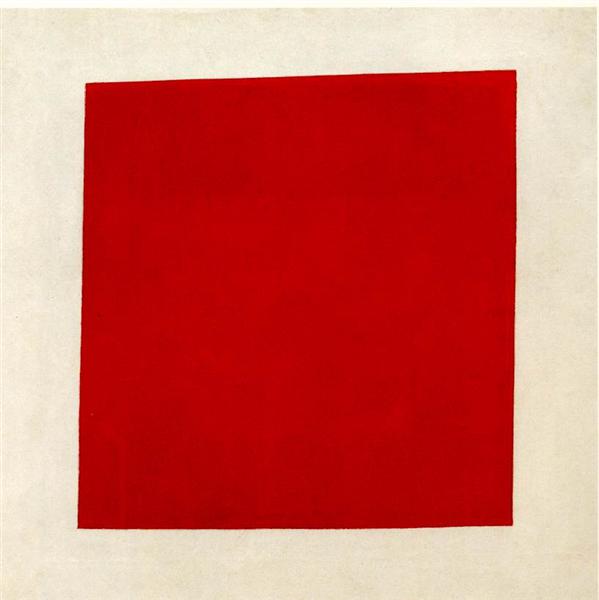
Red Square 1915
Also known as 'Painterly Realism of a Peasant Woman in Two Dimensions' — the full title was Malevich's sly argument that this geometric shape was as real as any painted peasant woman. A red square, tilted slightly off the horizontal, sits on a white field. The slight tilt introduces a dynamic quality absent from the perfectly aligned black square: this one seems to be turning, moving, almost alive. Made in the same period as the Black Square and shown at the same 'Last Futurist Exhibition 0,10', the Red Square represents the colour and dynamic dimension of a Suprematist vocabulary still being developed. It is in the Russian Museum in Saint Petersburg.
Girl with a Comb 1933
A late figurative work, made in the final years of his life when political pressure had made abstract painting effectively impossible in the Soviet Union. A woman — simplified, her face a smooth oval, her body a cylindrical column — combs her hair. The figure is not naturalistically rendered; it has the solidity and simplification of an archaic statue. The colours — ochre, black, white, a specific pale blue — are Malevich's abstract palette pressed back into figurative service. The figure looks forward from the canvas with the same blank intensity as the Black Square. The painting shows a painter who had gone beyond representation returning to it under duress, and finding a way to make it strange.