Jackson Pollock
He took the canvas off the easel, put it on the floor, and walked around it dripping paint until something happened.
Style and technique
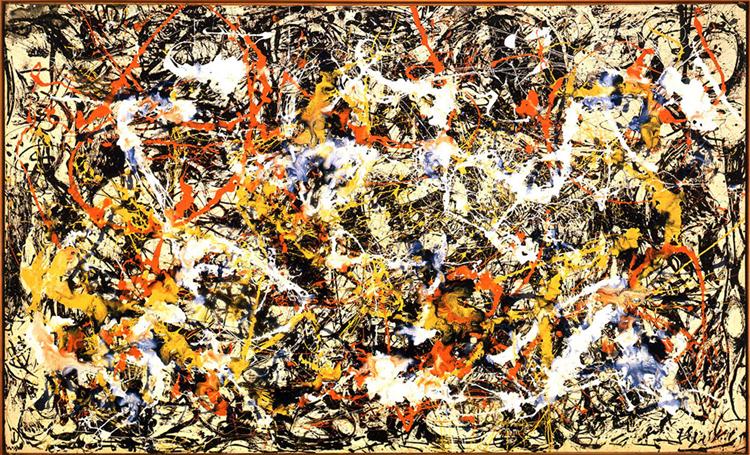
Pollock invented a new way of making a painting. He pinned an enormous unstretched canvas to the floor of his Long Island barn, walked around it on all four sides, and dripped or flicked or poured liquid enamel paint onto the canvas from sticks, hardened brushes, and old tin cans punched with holes. He never put the canvas on an easel. He never touched the surface with a brush. The painting was made by gravity, gesture and momentum.
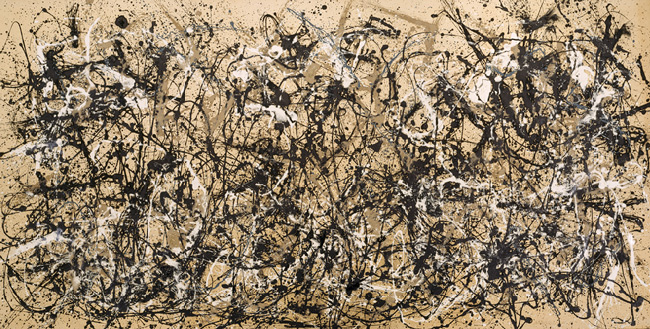
The technique sounds gimmicky if you have never stood in front of one of the results. The actual canvases are roughly two metres tall and four metres wide, and the marks on them are extraordinarily controlled. Each layer of dripped paint is laid down at a specific speed, with a specific rhythm, in a specific direction; the layers cross and re-cross in a way that produces an even, all-over lacework with no top, no bottom, and no figure to focus on. He called this 'all-over' painting — the term has stuck.
Four fingerprints make a Pollock instantly recognisable.
Drip and pour, not brush. No brushwork in the conventional sense. Lines are made by the movement of his arm above the canvas; thickness depends on the speed of the gesture and the distance from the surface.
Layered networks. Several distinct colour systems usually overlay one another. A black layer crosses a white layer crosses an aluminium-silver layer crosses a deep red layer. The eye reads each layer separately, then together, then separately again.
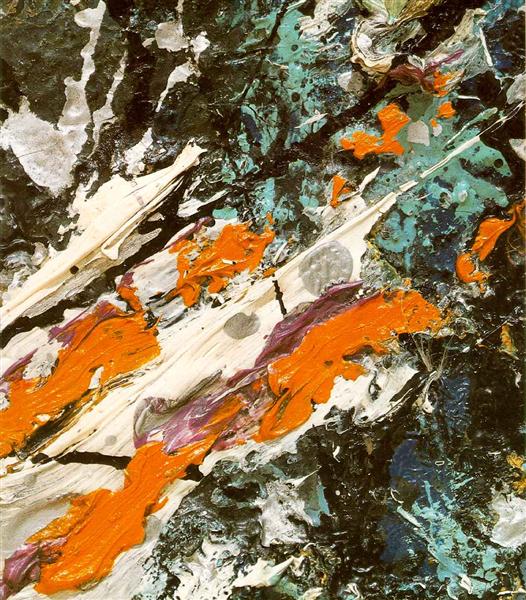
Industrial materials. He used enamel house paint (Duco, Devoe & Reynolds) rather than oil. Sometimes he added sand, glass, gravel, ash. The surface, up close, has the texture of an oil-streaked road.
Huge horizontal scale. The drip canvases are designed to fill a wall. Standing in front of one is meant to feel less like looking at a picture and more like standing inside the painting.
The drip technique only lasted, in its mature form, from 1947 to 1952 — five years. Before and after, Pollock painted in a darker, more figurative manner influenced by Mexican muralists like Siqueiros, by Native American sand-painting (which he had seen as a boy in the American Southwest) and by Carl Jung's archetypes (he was in Jungian therapy through 1939). The drip pictures are one phase of a much shorter and stranger career than the mythology suggests.
Life and legacy
Paul Jackson Pollock was born on 28 January 1912 in Cody, Wyoming, the youngest of five brothers. His father, LeRoy, was an itinerant farmer and surveyor; his mother, Stella, was a weaver and the practical centre of the family. Cody had been founded by Buffalo Bill twelve years earlier; the family did not stay there long. The Pollocks moved between farms and small towns in Arizona and California throughout Pollock's childhood, never settling for more than two or three years.
Three of his older brothers were already drawing seriously. The oldest, Charles, became a painter and brought Jackson with him to New York in 1930. Jackson was 18. He enrolled at the Art Students League and studied with Thomas Hart Benton — a regionalist American muralist who taught his students to make tight, ambitious figurative compositions. Pollock studied with Benton for two years and remained close to him for the rest of his life. The Benton influence is visible underneath the dripped surfaces of even the late paintings.
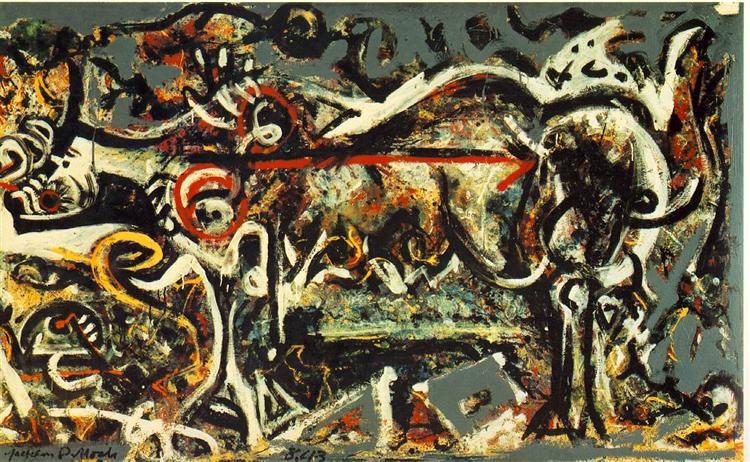
He drank heavily, was hospitalised twice in the 1930s, and entered Jungian psychotherapy in 1939 after a particularly severe breakdown. The Jungian sessions used drawings as a clinical tool: Pollock was asked to bring images that came to him spontaneously. The therapy ended after eighteen months but left a lasting effect on the dark, symbolic, totem-haunted paintings he produced in the early 1940s — works like 'The She-Wolf' (1943) and 'Guardians of the Secret' (1943).
In 1941 he met Lee Krasner, a painter slightly older than him, already trained in European modernism, with a cool, geometric Cubist style. They moved in together in 1942 and married in 1945. Krasner organised his life almost completely. She introduced him to the New York art world, smoothed over the alcoholic episodes, kept him painting. She also slowly subordinated her own career to his. Without Krasner there would have been no Pollock career; this is acknowledged now and was acknowledged at the time.
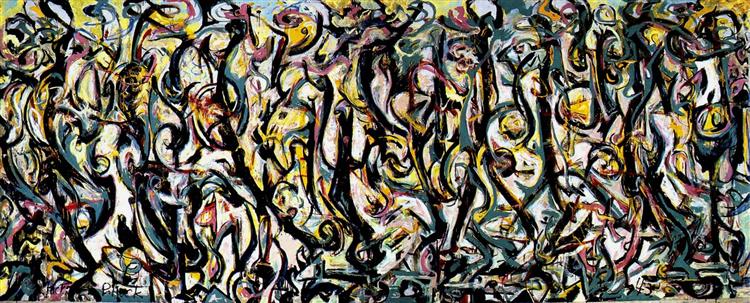
In 1943 the heiress and gallerist Peggy Guggenheim commissioned Pollock to paint a vast canvas for the entrance of her New York apartment. He was so blocked he produced nothing for six months. According to legend (Pollock's own version, retold many times), he then painted the entire canvas — 'Mural', six metres wide — in a single overnight burst at the end of 1943. Recent conservation analysis suggests this is not literally true; the painting was worked on in stages over several weeks. But the explosion was real, and 'Mural' was the breakthrough that opened up the possibility of working at huge scale.
In 1945 Pollock and Krasner used a small loan from Peggy Guggenheim to buy a wooden farmhouse in the village of Springs, on Long Island. They paid $5,000. Pollock turned the small barn behind the house into a studio. He pinned canvas to the floor and started dripping in late 1947.
'Number 1A, 1948', 'Lavender Mist (Number 1, 1950)', 'Autumn Rhythm', 'One: Number 31, 1950', 'Number 32, 1950', 'Blue Poles' — the canonical drip paintings were all made in that small Springs studio, in the years between 1947 and 1952. LIFE magazine ran a famous spread on him in August 1949 with the headline *'Is he the greatest living painter in the United States?'*. He became, almost overnight, the first internationally famous American painter, and the first abstract painter to be a celebrity in the modern sense.
The price of the celebrity was enormous. He had stopped drinking from 1948 to 1950 — almost the entire span of the great drip paintings — and the abstinence held only as long as he was painting well. From 1951 onwards he started drinking again, hard, daily, mostly bourbon. He had also become romantically involved with a young art student named Ruth Kligman. Krasner, still married to him, left for Europe in the summer of 1956 to think about whether to come back.
On the evening of 11 August 1956, Pollock was driving his Oldsmobile convertible from a bar near Springs back to his house, drunk, with Kligman and her friend Edith Metzger as passengers. The car left the road on a bend less than a mile from his house, struck a tree, and rolled. Pollock was thrown into the air and killed instantly. Kligman survived; Metzger died.
He was 44.
Krasner came back from Europe, buried him in the Springs cemetery, and spent the next twenty-eight years managing his estate. Their barn studio is now the Pollock-Krasner House, open to visitors, with the floor covered in dripped paint preserved exactly as he left it. The drip canvases are spread across the major American museums: 'Lavender Mist' at the National Gallery in Washington, 'Autumn Rhythm' at the Met, 'One: Number 31' at MoMA, 'Blue Poles' at the National Gallery of Australia.
Five famous paintings
The She-Wolf 1943
An early Pollock, painted before the drip technique. A horizontal canvas dominated by a strange wolf-like creature seen in profile, with two protruding teats and a sharp head. The figure is almost faded under thick layers of black, white and ochre paint, fragments of writing, and overlapping symbolic marks. The painting was the first thing Pollock ever sold to a museum: the Museum of Modern Art bought it the year it was painted, for $600 — a remarkable purchase given Pollock was completely unknown. It belongs to the early Jungian phase, when Pollock was using mythical animals and totemic imagery directly out of his therapy sessions. It still hangs in MoMA.
Mural 1943
Six metres wide, painted on a single piece of canvas in late 1943 and early 1944 for the entrance hall of Peggy Guggenheim's apartment on East 61st Street, New York. Pollock was famously blocked for months and, according to his own legend, painted the whole thing in a single overnight session. The truth is messier — recent conservation has shown several distinct stages — but the painting itself is unmistakably the bridge between his Bentonian figurative training and the drip work that was three years away. Coiling, dancing forms move across the canvas in a horizontal sweep, half-figures and half-abstractions, in a controlled storm of black, blue, ochre and white. It is now in the Stanley Museum of Art at the University of Iowa, which Peggy Guggenheim donated it to in 1948.
Full Fathom Five 1947
One of the very first drip paintings. The title comes from a song in Shakespeare's *The Tempest* — 'Full fathom five thy father lies' — and the canvas is dense, wet-looking, almost submerged. Pollock has poured layer after layer of black, silver and aluminium enamel onto a vertical canvas, and in this case has actually pressed nails, coins, paint-tube caps, a key and broken glass into the surface. The technique is not yet completely free; you can see careful, hard-edged shapes underneath. By the next year he would have abandoned the embedded objects. 'Full Fathom Five' is in MoMA.
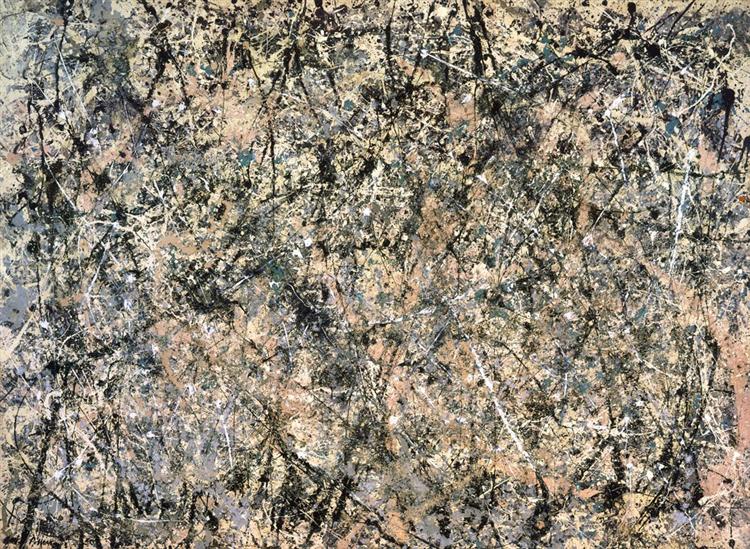
Lavender Mist (Number 1, 1950) 1950
The first of three large 1950 drip canvases that are, by most accounts, the high point of his career. Two metres tall, three metres wide, all-over dripping in soft pinks, greys, whites, blacks and a single vein of pale violet running through the lacework — there is in fact no actual lavender pigment in the painting; the pinks and greys mix optically. The bottom edge of the painting is signed and dated by hand-prints rather than by a brush. The canvas is named not by Pollock but by the critic Clement Greenberg; Pollock himself preferred the deliberately neutral 'Number 1, 1950'. It hangs in the National Gallery of Art in Washington.