Max Ernst
He found new techniques to map the territory between reason and its opposite.
Style and technique
Ernst was the most technically inventive of the Surrealists. While Dalí worked within the traditional oil-painting tradition and Magritte worked in deliberate illustration style, Ernst spent his career inventing new ways of making images: ways that bypassed the conscious decisions of the painter's hand and allowed the unconscious, or accident, or the material itself to produce images that the conscious mind could not have planned.
His major technical inventions:
Frottage (1925): pressing paper against a rough surface — floorboards, wire mesh, leaves — and rubbing a pencil across it to capture the texture. The resulting pattern is then interpreted as a landscape, a forest, a creature. The image is found, not made.
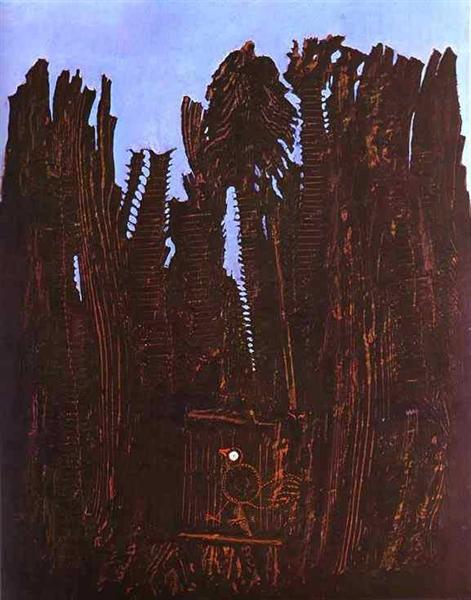
Grattage (1927): covering a canvas with paint and then scraping parts of it away with a palette knife or comb to reveal accidental textures below. Used to produce the extraordinary forest paintings of the late 1920s.
Decalcomania (1936): pressing wet paint between two surfaces and then pulling them apart. The resulting chance texture is interpreted as landscape, cave, or organic form.
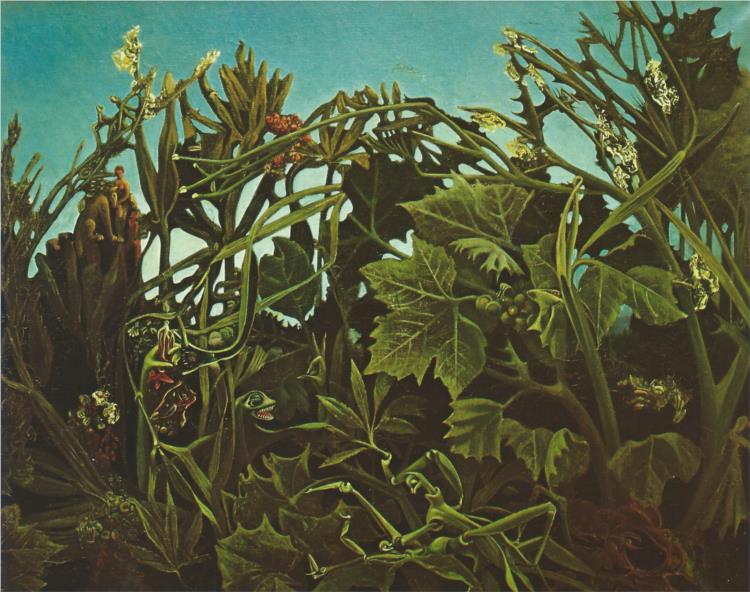
His subjects return obsessively to the forest — a dark, dense, slightly threatening space where human scale disappears — birds (the alter ego 'Loplop' appears as a birdlike figure throughout his career), and the petrified city: landscapes of stone architecture grown over by organic form.
Four fingerprints: the invented technique as primary method, the forest as claustrophobic space, hybrid figures combining human and animal or plant and stone, and a specific dark drama quite different from Dalí's sunny Mediterranean Surrealism.
Life and legacy
Ernst was born on 2 April 1891 in Brühl, a small town near Cologne. His father Philipp was an amateur painter and a school teacher for the deaf, and Ernst grew up in a household where art was taken seriously without being professional. He enrolled in philosophy at Bonn University in 1910, taught himself painting, and encountered the work of Van Gogh, Cézanne, Picasso, and the early Expressionists in the Sonderbund exhibition in Cologne in 1912.
The First World War consumed him. He served on both the Western and Eastern fronts as an artillery surveyor. 'I died on August 1, 1914,' he wrote later. 'I was resurrected on November 11, 1918.' He returned from the war profoundly changed and immediately joined the Dada movement — the absurdist, anti-rational, anti-bourgeois response to the war's catastrophic failures of reason.
He moved to Paris in 1922, where André Breton recognised his work as central to the new Surrealist movement Breton was organising. Ernst's Cologne collages — assembled from fragments of scientific illustrations, machine catalogues, and Victorian popular prints — had already produced images of extraordinary hallucinatory power.
In 1924 he published 'Une Semaine de Bonté' (A Week of Kindness), a set of collage novels using fragments of Victorian engravings assembled into new narrative sequences. The following year he invented frottage while staring at the grain of his floorboards during a fever and producing rubbings that seemed to contain forests, animals, and figures he had not consciously placed there.
He was interned as an enemy alien in France when war broke out in 1939 and spent months in a French internment camp before escaping. He eventually reached New York in 1941 with the help of Peggy Guggenheim, whom he married and then separated from. He spent the war years in New York and then in Sedona, Arizona, where the desert landscape — particularly its erosion formations — became a major visual resource.
His late work — sculptures in bronze, paintings in his developed decalcomania technique, large decorative canvases — is less studied than the Dada and early Surrealist work, but contains some of his most spatially complex images.
Five famous paintings
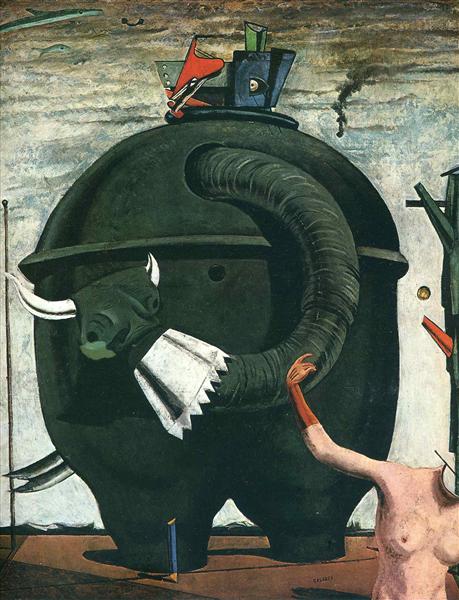
The Elephant Celebes 1921
A large, vaguely mechanical monster — based on a Sudanese grain storage vessel photographed in an anthropological journal — dominates the canvas. It has a corrugated cylindrical body, a trunk-like tube emerging from one end, and a bowl on its back. In the foreground, a headless female torso gestures. Disconnected elements — fish, bull's horns, a white glove — float in the background. The painting is a product of Ernst's systematic use of found imagery: objects from non-art contexts assembled into new relationships that have no rational explanation but a powerful visual coherence. It is one of the founding images of Surrealism. It hangs in the Tate in London.
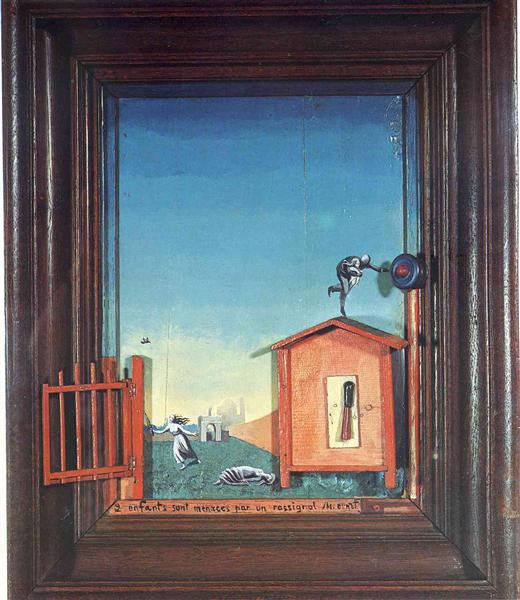
Two Children Threatened by a Nightingale 1924
A small painting with a wooden frame that extends three-dimensionally into the viewer's space: a gate opens from the painted scene, a small house sits in relief on the picture surface, a small figure runs along the top of the frame towards a button. Inside the frame: two small figures in a landscape, one running, one collapsed, threatened by a bird the size of a butterfly. The combination of painted image and three-dimensional object was a Dadaist move — destroying the frame that separates art from life. The nightingale as threat is absurd and genuine simultaneously. It is in the Museum of Modern Art in New York.
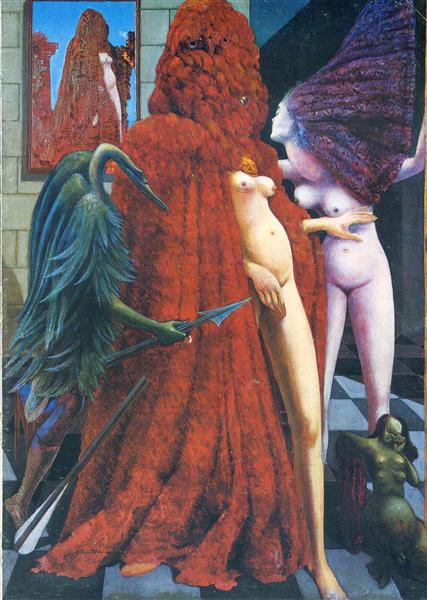
The Robing of the Bride 1940
A complex and disturbing painting from the last years before his internment and escape from France. A bride-like figure in a rich orange-red cloak — owl-headed, her body human — stands surrounded by figures who are dressing or assisting her. The scene is ceremonial and threatening. The colour — that specific orange-red — is among the most vivid in Ernst's palette and the female figure with a bird's head appears throughout his work as an ambiguous figure of desire and menace. The painting is in the Peggy Guggenheim Collection in Venice.
Forest and Dove 1927
One of the earliest and most beautiful of the grattage forest paintings. A dense, vertical forest — the paint scraped and dragged to produce a texture of layered organic forms — surrounds a small white dove in the upper centre. The forest is neither threatening nor welcoming; it is simply dense and present, a wall of vertical forms in grey-green and brown. The dove is tiny and luminous against the dark. Ernst was living in a house near Paris at the time and walked in the surrounding forest daily; the forest paintings are not invention but transformation of lived experience into a technique. It is in the Tate in London.
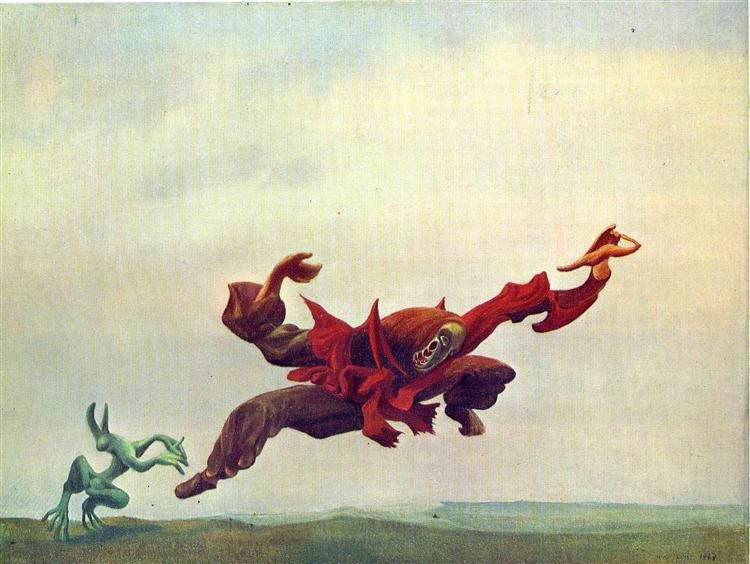
The Angel of the Hearth 1937
A figure of monstrous proportions — half-human, half-dinosaur — charges across a broken landscape. It is enormous, pink-grey, and entirely unstoppable. Ernst made this painting in 1937 in direct response to the Spanish Civil War and the rise of fascism; the original title was 'The Triumph of Surrealism' but he retitled it ironically after the fall of France. The 'angel of the hearth' is the guardian of the domestic — but here that guardian is a catastrophe. The landscape beneath its trampling feet is already destroyed. It is one of his most directly political images and one of the most physically frightening paintings of the twentieth century.