Winslow Homer
The self-taught Yankee who found America's soul in crashing surf, open skies, and the men who work beneath them.
Style and technique
Winslow Homer learned to paint the way a carpenter learns to build: by doing it, refusing short cuts, throwing out whatever did not work. He had no formal training in the European sense — no academy, no atelier, no years in Rome copying the antique. What he had was an illustrator's eye, sharpened during four years reporting the Civil War for Harper's Weekly, and a fierce, almost puritanical commitment to looking at things as they actually are.
The fingerprints of that formation are everywhere in his mature work. He builds pictures the way a good journalist builds a story: one clear subject, a strong light, no unnecessary detail. Where French painters of his generation were dissolving form into atmosphere, Homer was hardening it — tightening silhouettes, anchoring figures against sky and sea with a directness that can feel almost confrontational.
Four qualities define the Homer style.
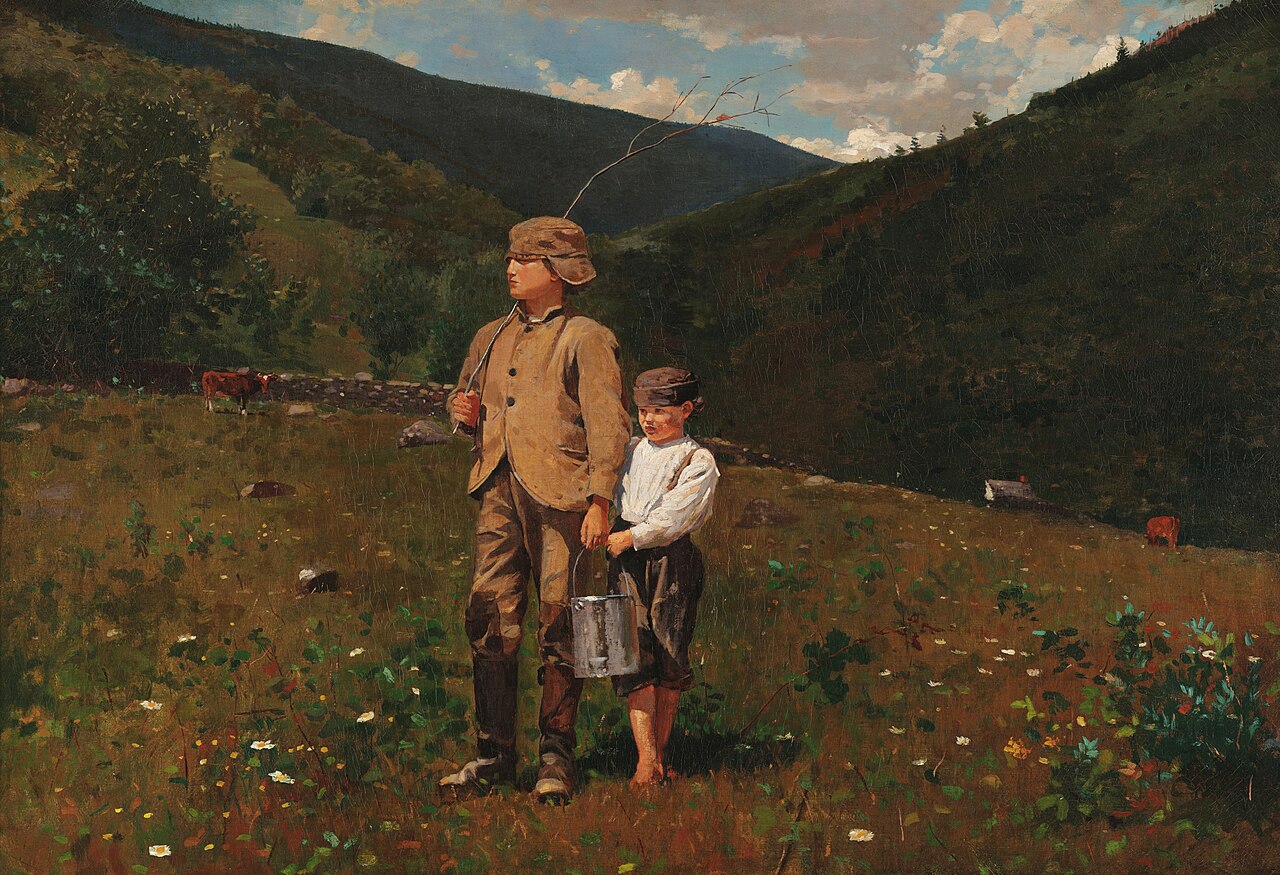
Direct light, no sentiment. He paints sunlight as a force, not a mood. In the open-air pictures of the 1860s and 70s it bleaches the top of a boy's head, burns the back of a farmhand's neck, flattens a meadow into near-abstraction. He is not interested in the golden hour. He is interested in noon.
The body at work. His figures are almost always doing something physical — pulling a net, hauling a line, launching into surf, bracing against wind. They are legible from a distance as masses of concentrated effort. He almost never paints a gentleman at leisure.
Watercolor as a primary medium. After his two years in Cullercoats on the English North Sea coast (1881–82), watercolor stopped being a sketch tool and became his dominant voice. He could suggest the transparency of deep water, the weight of wet wool, the shimmer of a Caribbean reef, in a medium that most of his peers still treated as a gentleman's pastime. His wet-on-wet washes and controlled color bleeding anticipate the abstraction of the next century.
Compositional economy. Late Homer strips the picture down to almost nothing — a horizon line, a wave, a figure or a bird — and trusts the severity to carry the emotion. Right and Left (1909), his final masterpiece, gives us two ducks struck mid-flight over a cold grey sea and barely any sky. It is one of the most structurally radical canvases in American art.
His palette changed with his subject. The Reconstruction-era pictures are warm, golden-tinted; the English coast work goes grey and heavy; the Maine seascapes open into a blue-green-white drama of foam and granite; the Caribbean watercolors arrive in pure, luminous tropical color. What never changes is the underlying structural rigour: every painting is, at its core, a problem about weight, force and light, solved with the minimum number of marks.
He was not temperamentally a joiner. He did not write criticism or give lectures. He sent his work to exhibitions and went fishing. But the work itself argued louder and longer than any manifesto, and by the time he died at Prouts Neck in 1910, he had defined what it meant to see the American landscape on its own terms.
Life and legacy
He was born in Boston, Massachusetts, on 24 February 1836, the second of three sons of Charles Savage Homer, a hardware importer, and Henrietta Benson Homer, an amateur watercolorist whose disciplined observation her son would inherit and far surpass. The family moved to Cambridge when Winslow was six, and it was there, in the open fields and the light of the Massachusetts countryside, that he developed the habit of looking at the outdoors that would anchor his entire career.
At nineteen, instead of university, he was apprenticed to J. H. Bufford's lithography shop in Boston — a commercial firm that printed sheet music covers and trade cards. He spent two years there and hated it. In 1857, the day his apprenticeship expired, he left and set himself up as a freelance illustrator, selling drawings to Boston and New York publications. Within a year he was contributing regularly to Harper's Weekly, then the most widely read illustrated journal in the United States.
He taught himself to paint in oil largely on his own, taking only a handful of lessons from the French academician Frédéric Rondel in 1861 — about as much formal instruction as he would ever accept. The real education came in the spring of 1861, when Harper's sent him to Washington and then to the Army of the Potomac as a special artist correspondent. He followed the Union Army through four years of the Civil War, from the camps of northern Virginia to the siege lines before Richmond, sending back wood-engraved illustrations that appeared in the paper every fortnight.
The war did several things to his eye. It taught him to read a scene quickly, extract the essential action, and strip away every decorative element that slowed the reading. It gave him a lasting subject in the ordinary soldier — eating, waiting, playing cards, dying — observed without heroism and without condescension. And it brought him, in 1866, his first major oil paintings: 'Prisoners from the Front', which was shown at the National Academy of Design and then at the Exposition Universelle in Paris, where it announced an American realism that owed nothing to European fashion.
He visited Paris himself in 1866–67, looked at the Impressionists with polite interest, and came home essentially unchanged. He was already moving in a different direction: out of the city and into the fields, painting farm children, women on beaches, croquet players on summer lawns, the leisure culture of Reconstruction-era America rendered in flat, outdoor light.
In 1873 he picked up watercolor seriously for the first time, working in the Adirondacks and at the beaches of the eastern seaboard. The medium suited him perfectly — fast, direct, unforgiving of hesitation. Within a few years his watercolors were as celebrated as his oils.
The decisive break came in 1881, when Homer, then forty-five and beginning to find New York suffocating, sailed for England and settled in Cullercoats, a fishing village on the Northumbrian coast just north of Tynemouth. He stayed for nineteen months. The North Sea was nothing like the mild American shore. The weather was brutal, the fishing community was genuinely poor and genuinely endangered, and the women who hauled nets and waited for boats to return had a gravity that his American genre subjects had lacked. He painted them in watercolor and oil, large-scale and without sentiment — 'The Life Line' belongs to this period's ethos — and the work he produced at Cullercoats is among the most formally powerful of his career.
He returned to America in late 1882 and made a decision that defined the rest of his life: he moved permanently to Prouts Neck, a rocky headland on the Maine coast south of Portland, where his family had a summer compound. He built himself a studio above the sea, hired a housekeeper, and largely stopped accepting dinner invitations. He became the hermit of American art — not from misanthropy, exactly, but from a complete preference for the company of the ocean over the company of critics, dealers, and literary men.
From Prouts Neck he produced the great seascapes: 'The Life Line' (1884), 'Breezing Up' (1876, acquired by the Corcoran), 'Eight Bells' (1886), 'The Blue Boat' (1892), the terrifying storm series of the 1890s. He understood the Maine coast the way a sailor understands the sea — not as scenery but as a system of forces that could kill you. He painted waves as weights, not as patterns.
Winter seasons he spent in warmer waters, making trips to Nassau, Cuba, Florida, and the Bermudas from the mid-1880s onward. These were not vacations but working expeditions, and the watercolors he brought home — turquoise shallows, bonefish, sponge boats, tropical vegetation in impossible light — are among the most purely beautiful things in American art. He showed them to almost no one until he had accumulated enough for a proper exhibition.
He was awarded major medals and honorary degrees late in life — the Pennsylvania Academy, the Metropolitan Museum acquired his work, collectors competed for his paintings — and he acknowledged the honors with characteristic brevity. His letters are famous for their terseness. When a dealer wrote to ask when a new painting would be ready, Homer wrote back: 'When it is done.'
In his final years his health declined and his output slowed, but it did not stop. 'Right and Left', painted in 1909, the year before he died, is one of the most radical pictures he ever made. He suffered a stroke in the summer of 1910 and died at Prouts Neck on 29 September 1910, aged seventy-four, alone in the studio above the sea he had painted for twenty-seven years. He is buried in Mount Auburn Cemetery in Cambridge, Massachusetts — close, in the end, to where he began.
Five famous paintings
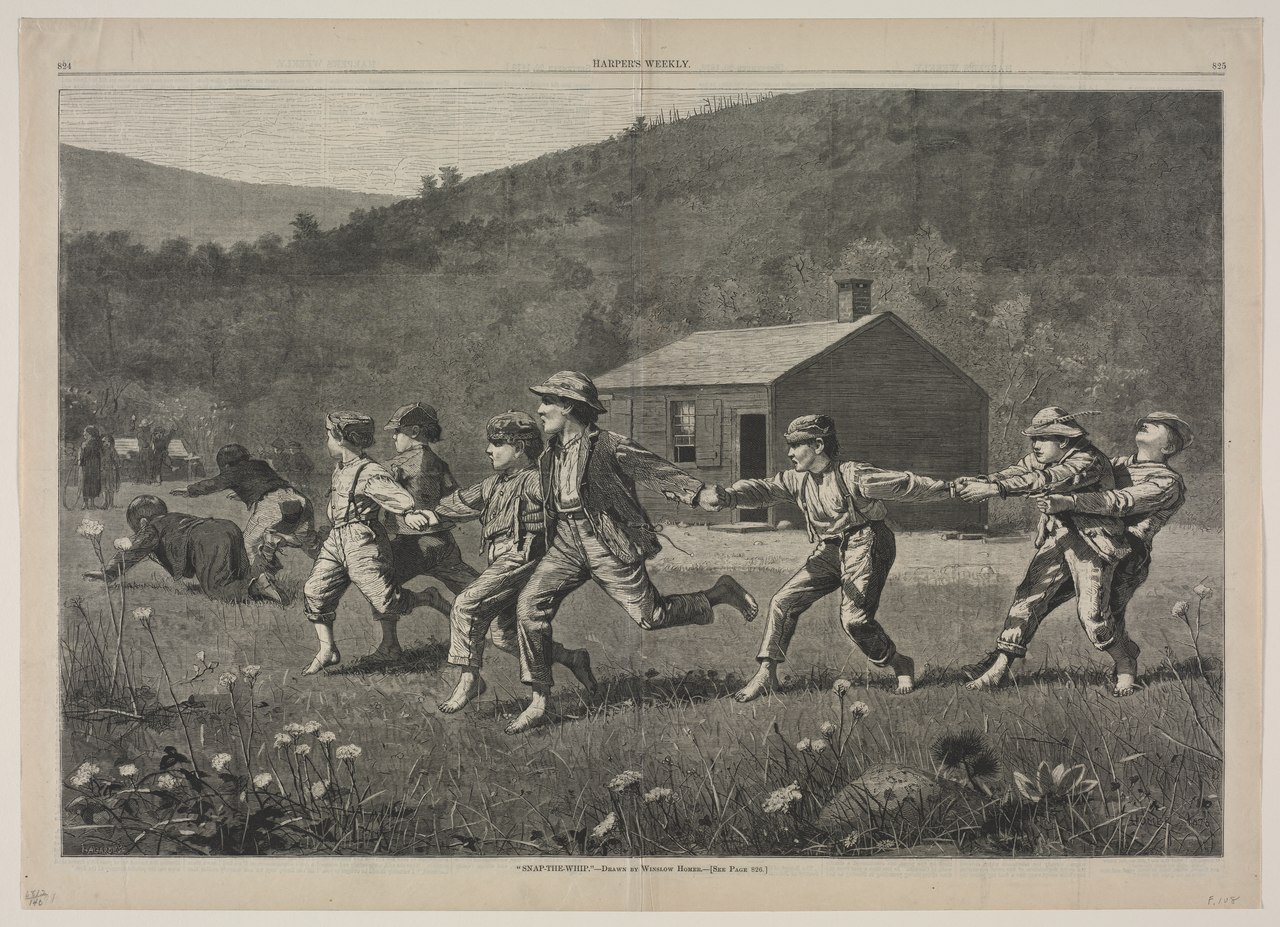
Snap-the-Whip 1873
Painted in the summer of 1872 at Hurley, New York, and exhibited at the National Academy of Design in 1873, Snap-the-Whip is the most affectionate picture Homer ever made, and one of the most precisely observed. Eight barefoot boys in a country schoolyard are caught mid-game, a human chain stretched nearly the full width of the canvas (56 × 91 cm), the two boys at the right end already losing their footing and beginning to arc outward. The ground is a sun-struck meadow; the schoolhouse sits in shade behind them; the mountains of the Hudson Valley close the distance. The light is outdoor American light — hard, frontal, flattening — and it makes every detail legible from across a room: the worn trouser knees, the rolled-up sleeves, the different degrees of grip and terror on the faces of the cracking end. It is a genre picture in the tradition of American rural life, but Homer builds it with such spatial clarity and such perfect timing — the chain caught at precisely the instant before it breaks — that it rises above nostalgia into something close to classical composition. The Metropolitan Museum owns this version; Homer made a second, slightly smaller version the same year, now at the Butler Institute. It remains one of the most reproduced images of nineteenth-century American childhood.
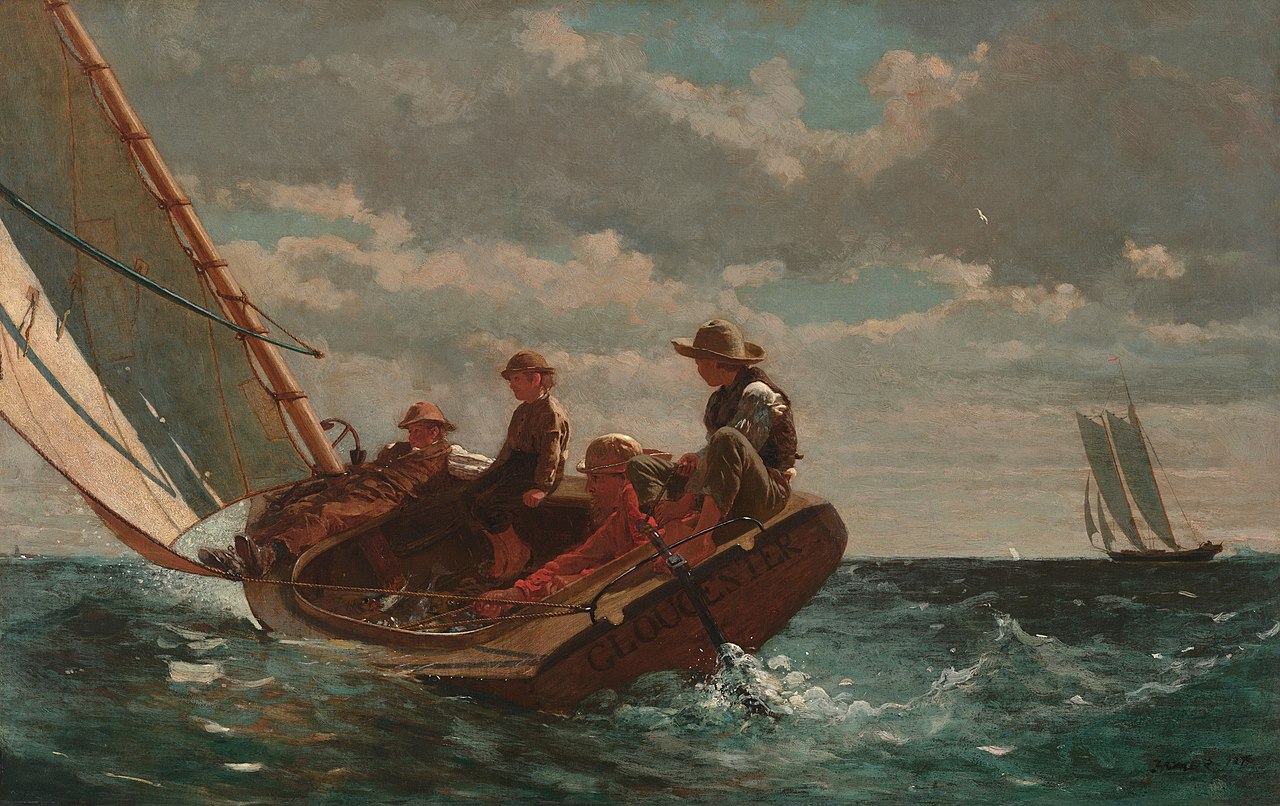
Breezing Up (A Fair Wind) 1873
Homer worked on Breezing Up between 1873 and 1876 and showed it at the National Academy of Design in 1876, where it was immediately recognised as a landmark. The canvas (61 × 97 cm, now in the National Gallery of Art, Washington) shows a catboat running before the wind on Gloucester Harbor, Massachusetts: an adult fisherman at the tiller, and three boys — one slouched against the mast, one gripping the gunwale, one balanced at the bow — the sails full, the hull heeled over, the sea running in short, grey-green chop. It sounds like a pleasant summer excursion, but the picture has more weight than that. The horizon line is low and the sky is large and building; the boat is moving fast enough that staying aboard requires attention; the boys' postures are those of people who know what water can do. Homer had been studying the fishing community at Gloucester for several summers by this point, and the boats and boys are observed, not invented. The handling of the water is extraordinary — flat, broken planes of blue-grey and green that convey both surface and depth without a single stroke of academic finish. It is the picture in which Homer first fully resolves the tension between American genre painting and something harder, more modern, and more true.
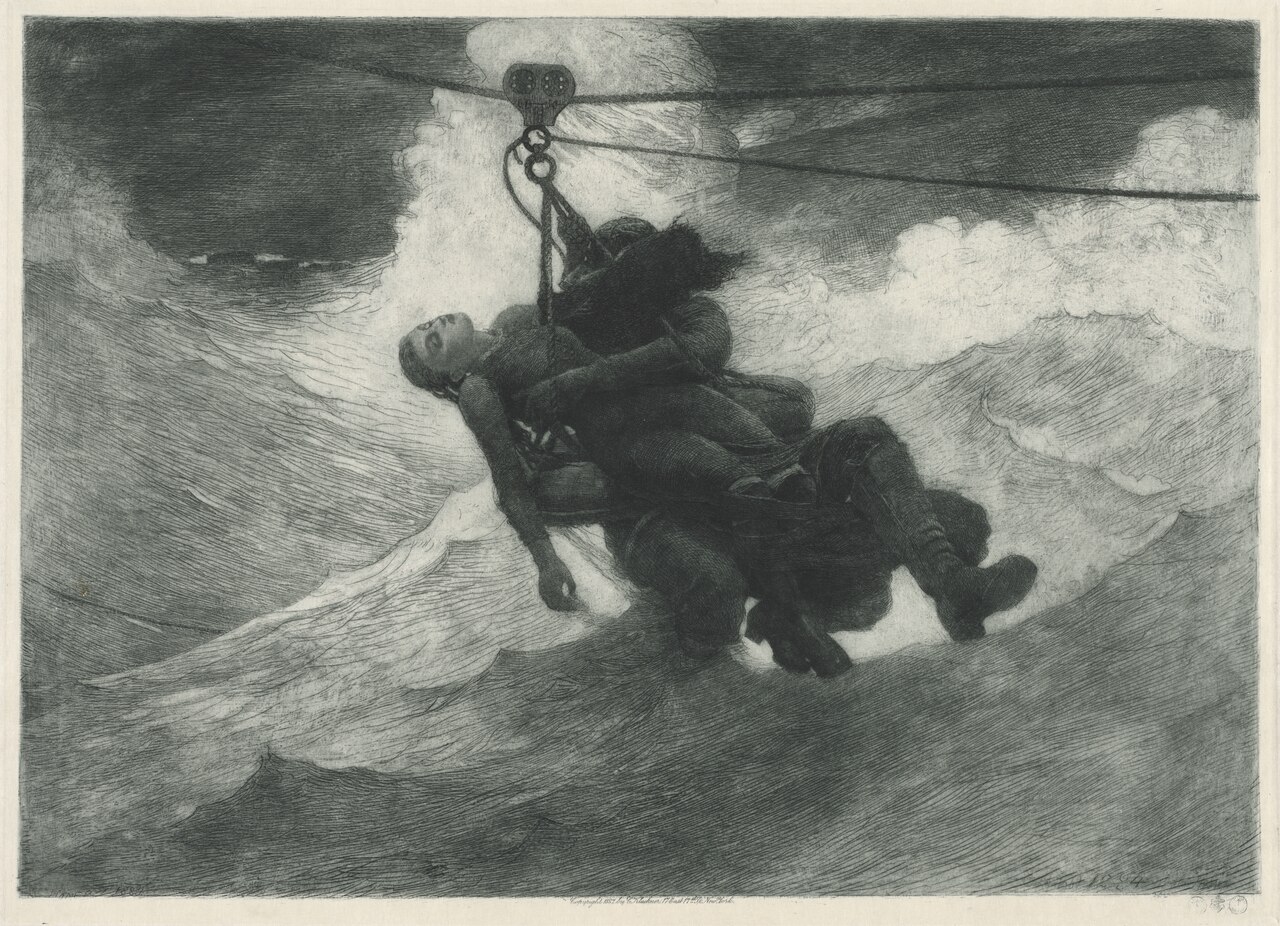
The Life Line 1884
The Life Line (145 × 177 cm, Philadelphia Museum of Art) was the sensation of the National Academy of Design exhibition of 1884 — Homer's first major public success after years of critical reservation. The subject is a breeches buoy rescue: a woman, unconscious or barely conscious, her face hidden by the rescuer's cape, is being hauled on a pulley line from a wrecked ship to shore. The rescuer holds her with one arm and grips the rigging with the other. Below them the sea is a chaos of white water and broken wave. The diagonal of the rescue line cuts the canvas from lower left to upper right with almost geometric force, and the two figures suspended against the spray are painted with a weight and urgency that is entirely convincing. Homer had been thinking about rescue and survival since his Cullercoats years; this picture is the formal resolution of everything he studied on the English coast. He suppresses the rescuer's face deliberately — the man becomes an embodiment of effort rather than a portrait — while the woman's body is rendered with complete physical specificity: wet dress, limp arms, the unconscious surrender of someone who has given up agency entirely. It was bought from the exhibition by Catharine Lorillard Wolfe for $2,500, a record price for Homer at the time.
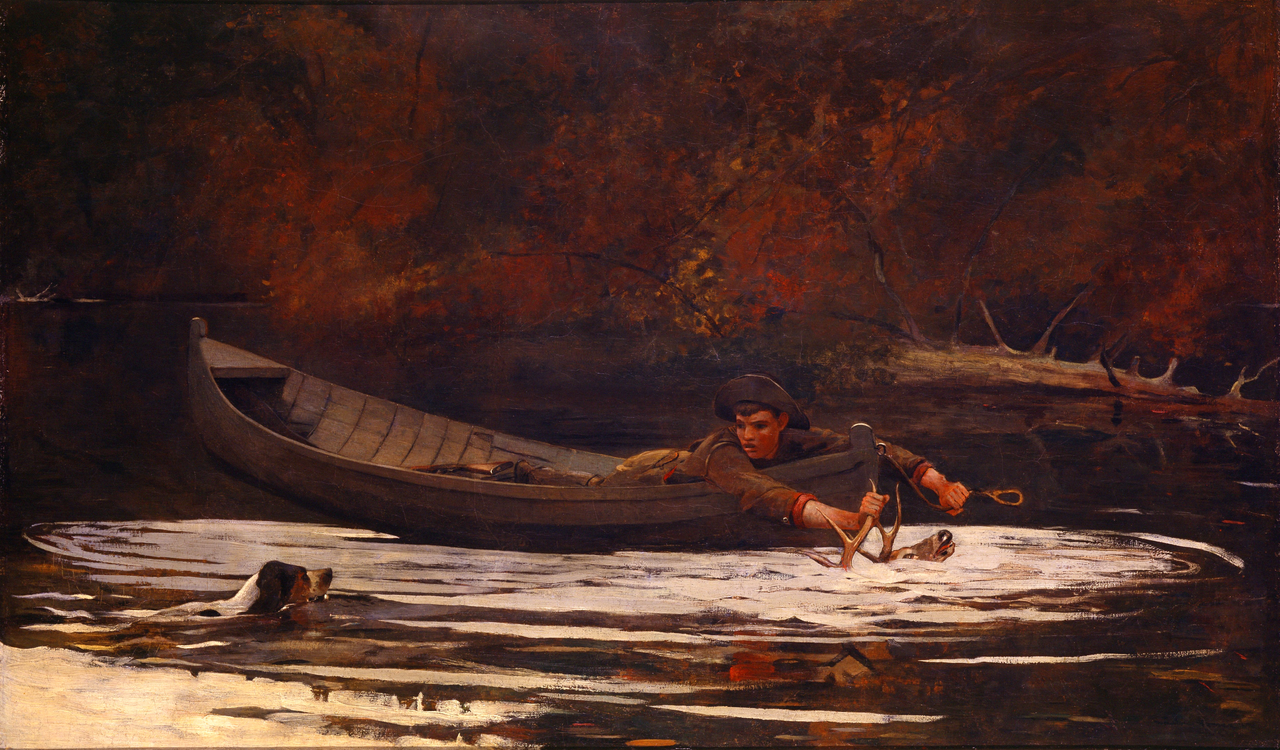
Hound and Hunter 1892
Hound and Hunter (71 × 122 cm, National Gallery of Art, Washington) is one of the most physically immediate pictures Homer ever painted, and among the most quietly disturbing. A young hunter in a green canoe is trying to hold a dead deer by the antlers while his hound clambers over the animal's body, still excited, still not entirely sure the hunt is finished. The scene takes place in the Adirondacks — dark water, dark trees, a thin strip of sky — and the light is the grey-green light of a north-woods afternoon. What makes the picture extraordinary is its complete lack of triumphalism. There is no display of the kill, no proud hunter standing over a trophy. Instead, there is labour: the boy is straining, the dog is in the way, the deer is a heavy, awkward weight. The antlers break the water's surface and leave small ripples. The handling of the water — flat, reflective, carrying the greens of the treeline as broken planes of color — is as fine as anything in Homer's oils. He painted two versions; this one, shown at the World's Columbian Exposition in Chicago in 1893, is now in Washington. John Singer Sargent, seeing it there, called it the finest picture by an American he had ever seen.