Édouard Manet
The well-bred Parisian who tore a hole in 19th-century painting and let the modern world walk through it.
Style and technique
Manet looks, at first glance, like an old master. The blacks are deep, the whites are crisp, the sitters are dressed for an afternoon at the Tuileries. Then you step closer and the whole illusion comes apart. There is no modelling. The figures are pasted onto the canvas in flat planes of colour, the shadows are barely there, the floor often refuses to recede. He paints like someone who has decided that the smooth, glazed finish of academic art is a polite lie about how the eye actually works.
He absorbed the technique on long study trips through the Netherlands, Germany, Spain and Italy in the 1850s and 60s, where he stood for hours in front of Velázquez, Goya and Frans Hals. From them he took two things the French academy had forgotten: black as a positive colour — luminous, varied, almost musical — and a way of laying paint alla prima, wet-on-wet, in confident single passes that stay visible on the surface.
Four fingerprints make a Manet unmistakable.
Flat planes, no half-tones. He skips the middle range of tones that academic painters used to model a cheek or a thigh. Light areas snap against shadow without transition, which is why his figures often look almost cut out and stuck on.
Black as a colour. Where the Impressionists would soon banish black from the palette, Manet uses it as the centre of his harmony — a black coat, a black ribbon, a black cat — and tunes everything else around it.
Frontal, blunt figures. His sitters often face the viewer dead-on and stare back. The barmaid at the Folies-Bergère, Olympia on her bed, the boy fifer on his grey ground — they refuse the demure averted gaze that the Salon expected.
Ambiguous space. Backgrounds collapse, mirrors lie, picnic clearings refuse to recede. He destabilises the perspective just enough to make the eye notice it is being lied to.
He was, by temperament, a Parisian dandy: top hat, cane, gloves, a wit at the Café Tortoni, a regular at the Café Guerbois where the future Impressionists gathered around him as around an older brother. He wanted, more than anything, the official medal of the Salon. He never got the one he wanted, and the work he made trying to get it ended up dismantling the very institution he was knocking on the door of.
Life and legacy
He was born in Paris on 23 January 1832 into a comfortable upper-middle-class family. His father, Auguste Manet, was a senior magistrate at the Ministry of Justice and expected his eldest son to follow him into law. His mother, Eugénie-Désirée Fournier, was the goddaughter of one of Napoleon's marshals and the daughter of a French diplomat. The household was cultured, conservative and well connected — the kind of Parisian family that had a piano in the drawing room and a country estate at Gennevilliers.
Édouard refused the law. He also failed, twice, the entrance examination for the French naval academy. Between the two attempts he sailed as a trainee on a transport ship to Rio de Janeiro in 1848, an experience he later credited with teaching him to look at light on water. After the second failure his father gave up and allowed him to study painting. From 1850 to 1856 he was apprenticed to Thomas Couture, the most fashionable history painter in Paris, in a studio on the rue Laval. The two of them argued constantly. Couture wanted heroic Roman subjects in smooth academic finish; Manet wanted to paint the man delivering coal.
What saved him was the Louvre and the train. Through the 1850s he travelled through the Netherlands, Germany, Austria and Italy, copying the masters he actually loved — Frans Hals in Haarlem, Velázquez and Goya at the Prado on a decisive visit in 1865, Titian in Venice. He spent more time in the Louvre than in Couture's studio, copying Spanish paintings with a brush already half-modern.
His first scandal came in 1862 with 'Music in the Tuileries' — a wide canvas of Parisian society listening to a concert in the gardens, with Baudelaire, Théophile Gautier and Manet himself among the crowd. Critics complained there was no centre, no story, no modelling — just a blur of fashionable hats and frock coats. They did not yet have a word for it. The word, eventually, would be modern life.
The year 1863 was the hinge. The official Salon rejected his 'Le Déjeuner sur l'herbe' along with thousands of other canvases, and the public outcry was loud enough that Emperor Napoleon III ordered the rejected works to be shown at a parallel exhibition — the Salon des Refusés. Visitors queued to laugh. The naked picnic became the most ridiculed painting in Paris. The same year he married Suzanne Leenhoff, the Dutch piano teacher who had been giving lessons to his younger brothers since 1849 and with whom he had probably been involved for over a decade. She brought a young son, Léon, into the marriage; the boy may well have been Manet's, or possibly his father's — the family never said.
Two years later came the real earthquake. 'Olympia', painted in 1863, was finally hung at the Salon of 1865, and a riot nearly broke out in front of it. The painting had to be moved high above a doorway and a guard posted to stop visitors attacking it with umbrellas and walking sticks. Manet, expecting recognition, was devastated. He fled to Spain to recover his nerves and stood for the first time in front of the actual Velázquez paintings he had only known from copies.
From the late 1860s a younger generation began to gather around him. Claude Monet, Edgar Degas, Pierre-Auguste Renoir and the painter Berthe Morisot — who would later marry Manet's brother Eugène — met him most evenings at the Café Guerbois on the Grande rue des Batignolles. They treated him as the senior figure, the one who had already taken the punches. When they organised the famous group exhibition of April 1874 that the press would christen 'Impressionist', they begged Manet to join them. He refused. He still wanted the Salon — its medals, its bourgeois respectability — and he believed the only fight worth having was inside the official walls. He never exhibited with the Impressionists, though he painted in their company at Argenteuil that summer of 1874 and his palette grew lighter for it.
The writer Émile Zola, then a young journalist, defended him in print in 1866 with an essay that effectively launched both their careers. Manet repaid the debt in 1868 with a famous portrait of Zola at his desk, a Japanese print and a small reproduction of Olympia visible on the wall behind him.
His last decade was a long, uneven negotiation with illness. He had probably contracted syphilis as a young naval cadet in the late 1840s; by the late 1870s the disease had moved into its tertiary stage and was attacking his nervous system and circulation. He kept painting — beer halls, café singers, the great late portraits, finally the Folies-Bergère in the winter of 1881–82, propped up because he could no longer stand for long. In April 1883 his left leg, gangrenous from locomotor ataxia, was amputated at his Paris home on the rue de Saint-Pétersbourg. He died eleven days later, on 30 April 1883, aged 51. The Salon medal he had finally been awarded the year before — second class, Légion d'honneur attached — was pinned to his coffin.
Five famous paintings
Olympia 1863
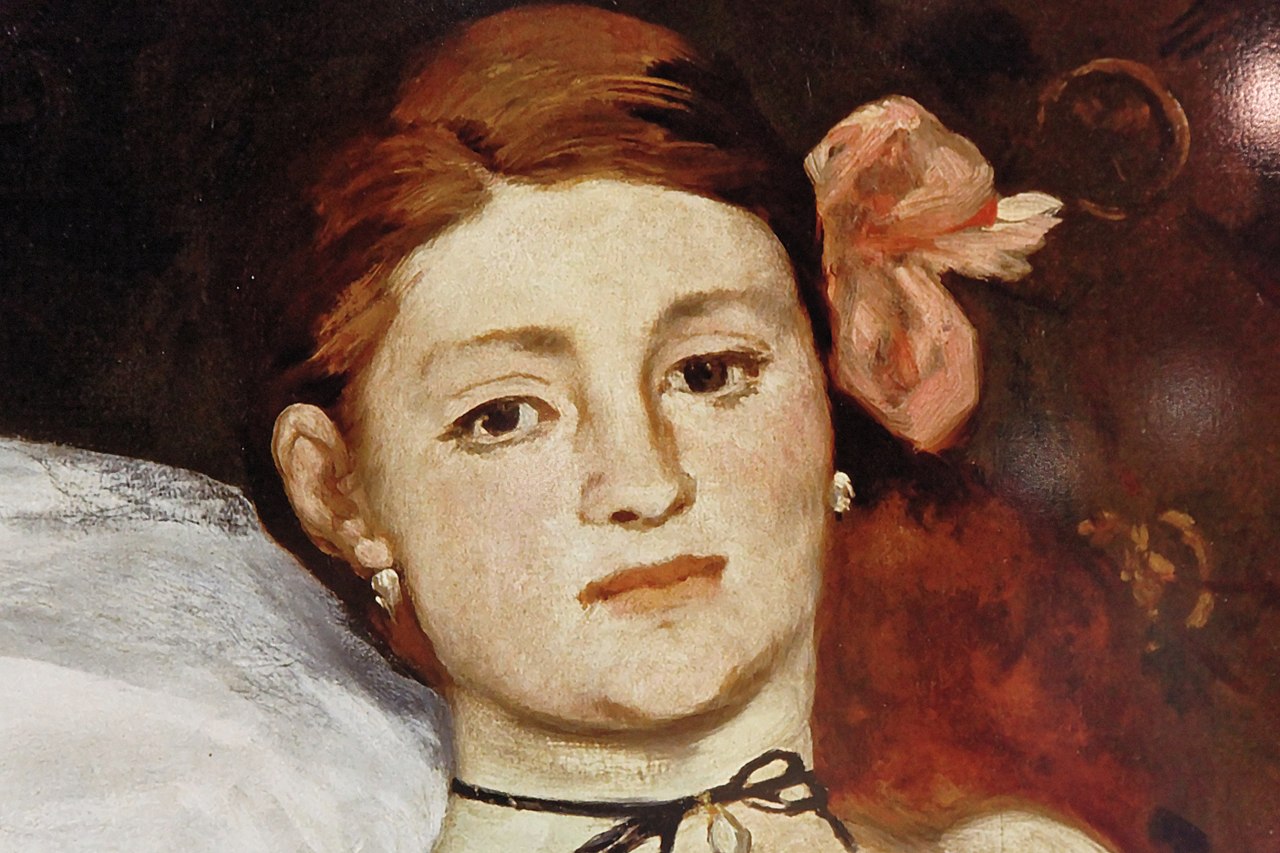
Painted in 1863 and held back from public view for two years, Olympia detonated at the Salon of 1865. The canvas (130 × 190 cm) is built directly on Titian's 'Venus of Urbino' — same pose, same propped pillows, same hand across the lap — but Manet has stripped out every mythological alibi. This is not a goddess but a Parisian sex worker, named for the most fashionable courtesan-name of the day. She wears a silk ribbon at the throat, a single orchid in her hair, a pearl bracelet, and one pink slipper. A Black maid, modelled by Laure, brings flowers from a client. Where Titian put a sleeping spaniel at the foot of the bed (a symbol of fidelity), Manet puts a black cat with its tail in the air. And, above all, Olympia stares straight back at the viewer, perfectly aware of the transaction. Critics screamed. They called the body a 'yellowish belly', 'a female gorilla', 'a cadaver'. Police were posted to protect the painting from umbrellas and canes. It is now in the Musée d'Orsay and is routinely cited as the inaugural work of modern art.
Le Déjeuner sur l'herbe 1863
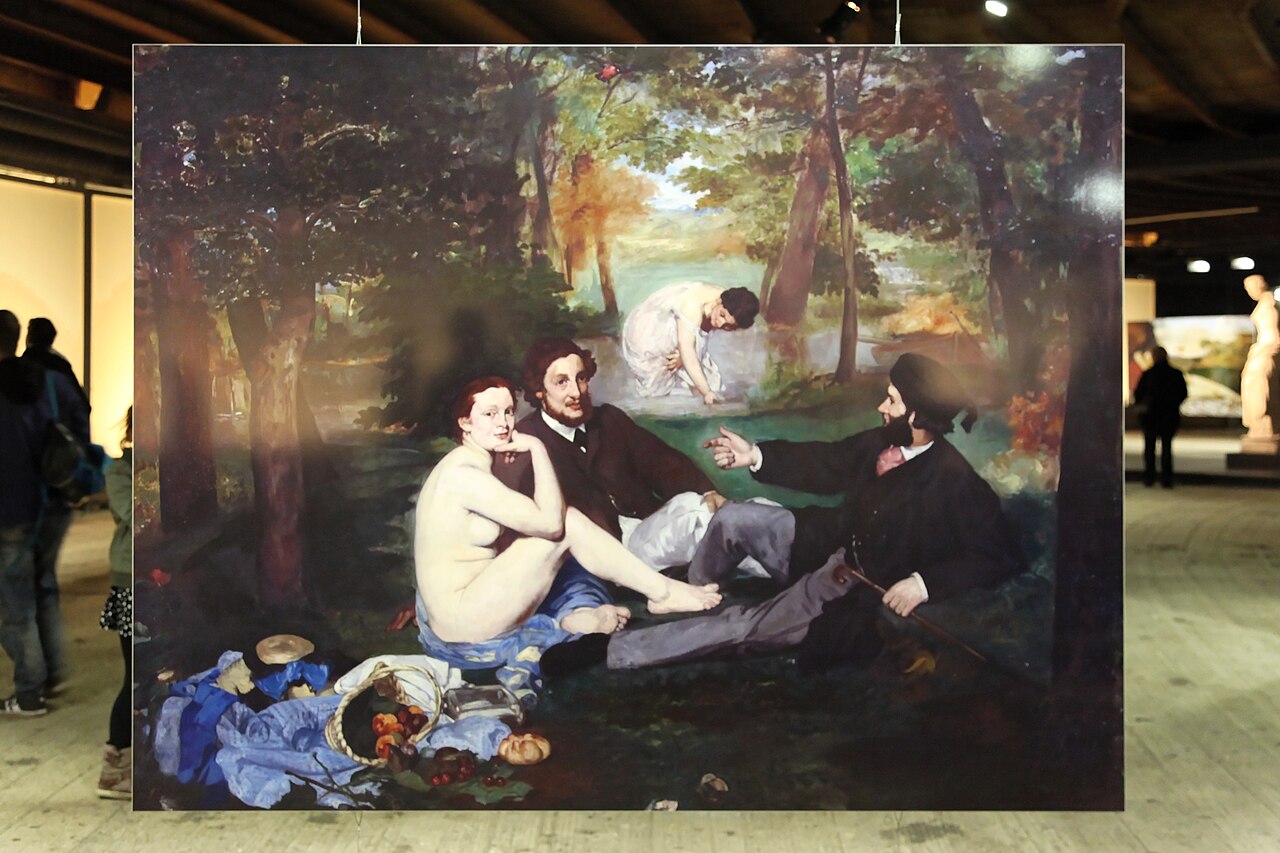
Two young men in fashionable Parisian dress — frock coat, narrow trousers, a tasselled smoking cap — picnic in a wooded clearing with a completely naked woman who looks straight out at the viewer. A second woman, half-dressed, bathes in a stream behind them. The picnic basket has tipped over; cherries and a roll have rolled onto the grass. The canvas is enormous (208 × 264 cm). The composition is lifted directly from Marcantonio Raimondi's Renaissance engraving after Raphael's 'Judgement of Paris' — Manet pulls the three river-gods out of the corner and dresses two of them in 1862 trousers. The Salon jury rejected it in 1863. When Napoleon III ordered the rejected works shown at the Salon des Refusés, visitors queued to mock it: the woman was too obviously a real woman, the men too obviously real men, the lighting impossible (her body is lit as if from the front while the wood behind her is in shade). Today it hangs in the Musée d'Orsay, two rooms away from Olympia.
A Bar at the Folies-Bergère 1882
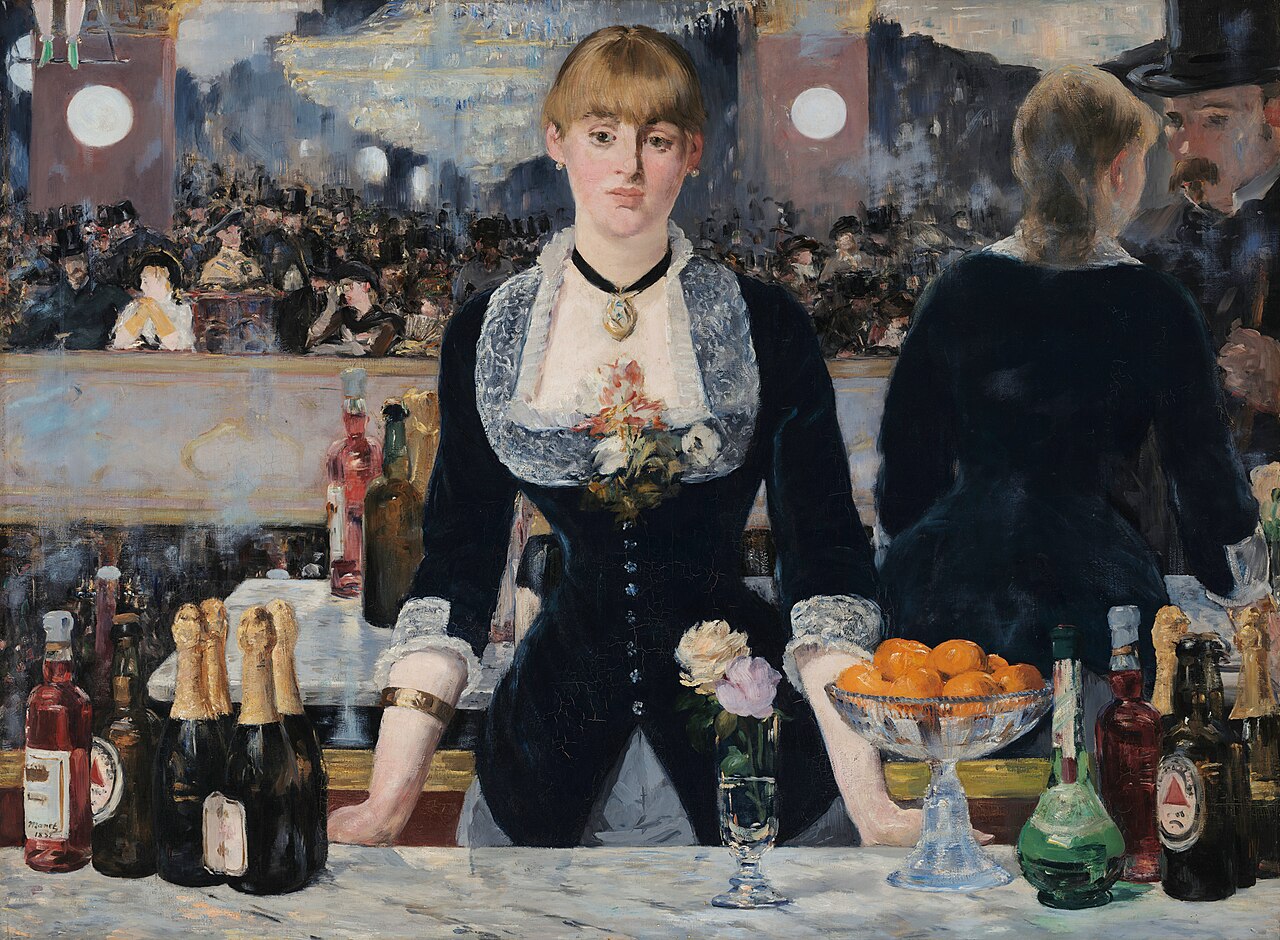
His last great painting, finished a year before his death, exhibited at the Salon of 1882 and now in the Courtauld Gallery in London (96 × 130 cm). The barmaid Suzon — a real employee of the Folies-Bergère whom Manet brought to his studio with the bottles arranged in front of her — stands behind a marble counter loaded with champagne, English ale (Bass, with its red triangle visible), crème de menthe, oranges in a glass bowl, and two roses in a tumbler. She looks at us, but not quite at us; her gaze drifts past, blank, exhausted, polite. Behind her is a vast mirror reflecting the music-hall crowd, the chandeliers, a pair of green-slippered legs of a trapeze artist in the top left corner. And there is the puzzle that has occupied historians for a century: her reflection, on the right, is offset to one side and shows her leaning forward in conversation with a top-hatted customer. Geometrically, this is impossible — if she were standing where she stands, her reflection would be directly behind her. Manet has painted not what the mirror shows but what she sees, what he sees, what the customer sees, all on the same surface. He was already dying when he painted it, and he knew it.
The Fifer 1866
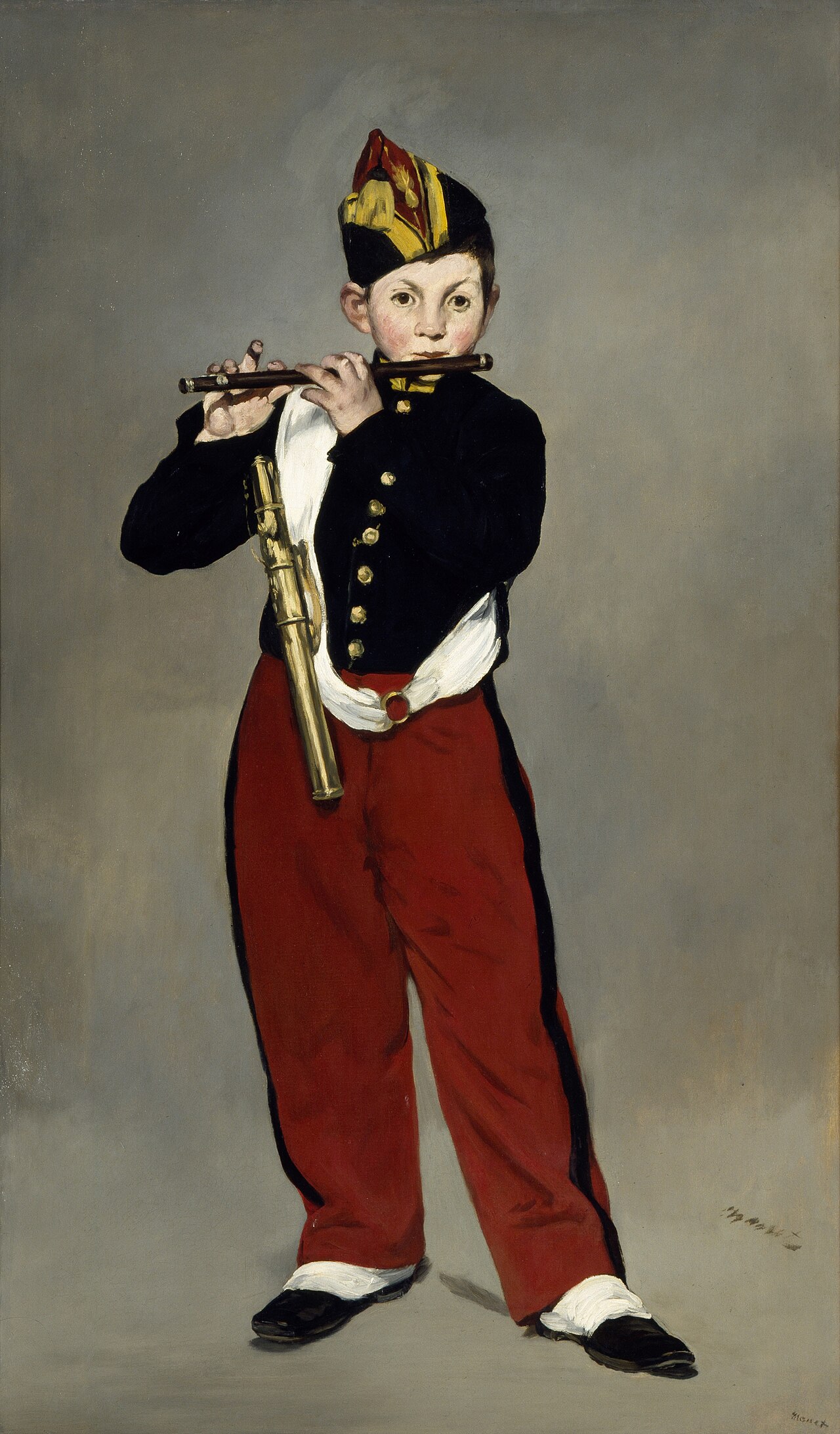
A boy soldier from the band of the Imperial Guard, in red trousers, a black tunic with white belt and gold braid, a black cap, plays a wooden fife. That is all. He stands on a flat, evenly lit grey ground that is neither floor nor wall — there is no shadow under his feet, no horizon, nothing to tell us where he is. The canvas is large (161 × 97 cm), almost life-size, and the figure is pasted onto the grey field like a paper cutout. Manet had just returned from his 1865 trip to Madrid, where he had stood in front of Velázquez's 'Pablo de Valladolid' at the Prado — a court jester on an identical empty grey ground — and the lesson is undisguised. The Salon jury of 1866 rejected the painting. The flatness was the scandal: critics complained the boy looked like a playing card. Émile Zola chose precisely this work to defend in his press campaign that summer, the article that began their friendship. It now hangs in the Musée d'Orsay.
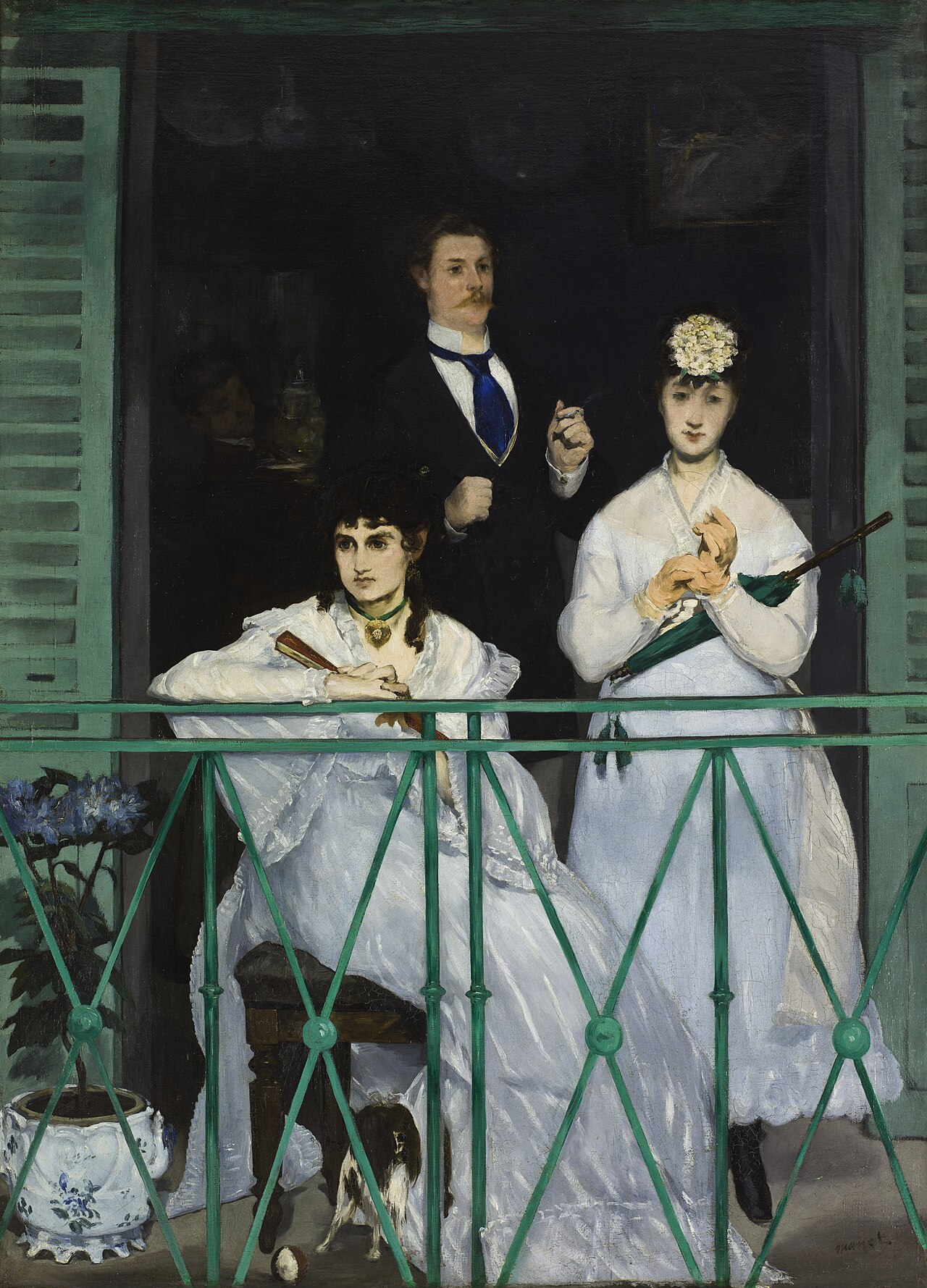
The Balcony 1869
Three figures pose on a Parisian wrought-iron balcony, behind two enormous green shutters, against a black interior. Seated at the front left is the painter Berthe Morisot — eyes large, dark, almost stricken, holding a closed fan in her gloved hand. Behind her, standing with one hand on the railing, is the violinist Fanny Claus, dressed in white, holding a parasol. To the right is the landscape painter Antoine Guillemet in a dark suit. A small boy carrying a tray (Manet's stepson Léon) is just visible in the gloom of the room behind. The composition is borrowed openly from Goya's 'Majas on a Balcony' in Madrid, which Manet had seen in 1865 — but Manet has drained the warmth out of it: his three figures do not look at each other, do not speak, are not arranged into any social moment. They simply occupy the same green-and-white architecture, alone together. Berthe Morisot wrote in a letter that posing for it was 'more amusing than tedious', and the experience drew her into Manet's circle for good. The painting (170 × 125 cm) is in the Musée d'Orsay. René Magritte parodied it in 1950 by replacing all three figures with coffins.