Rossetti, Millais, Waterhouse: how to tell three Pre-Raphaelites apart
Three painters, one label — and the label is wrong for at least one of them. A long look at what actually separates them, down to the two drowning heroines painted thirty-six years apart.
Put a Rossetti, a Millais and a Waterhouse on the same wall and most people will say "Pre-Raphaelite" and move on. The label is doing a lot of work there — more than it can carry. One of the three never belonged to the group at all, one of them quit it and became everything it was founded to oppose, and only one stayed roughly where he started. Once you know which is which, telling them apart takes about three seconds.
The Brotherhood that lasted five years
In September 1848, in a house on Gower Street in London, seven young men formed the Pre-Raphaelite Brotherhood. Three of them matter here; the rest were a sculptor, a critic and two writers. They were barely out of art school and furious at what the Royal Academy taught: a formula descended from Raphael and hardened over three centuries into brown varnish, pyramid compositions and poses borrowed from other paintings. Their answer was to look at the art made before Raphael — early Italian and Flemish painting, with its bright colour, hard edges and stubborn attention to the actual world — and to paint what was in front of them instead of what the Academy said should be there.
They signed their pictures with the initials PRB and told nobody what it meant. When it got out, the critics went for them. Charles Dickens devoted a page of his own magazine to attacking Millais's Christ in the House of His Parents, calling the boy Christ a hideous, red-headed creature in a nightgown — a carpenter's son who looked like an actual carpenter's son. That was precisely the point, and Dickens had understood it perfectly.
The Brotherhood held together for about five years. By the mid-1850s it had quietly dissolved, and the three painters in this quiz had each gone a different way.
1. Rossetti: one face, filling the frame
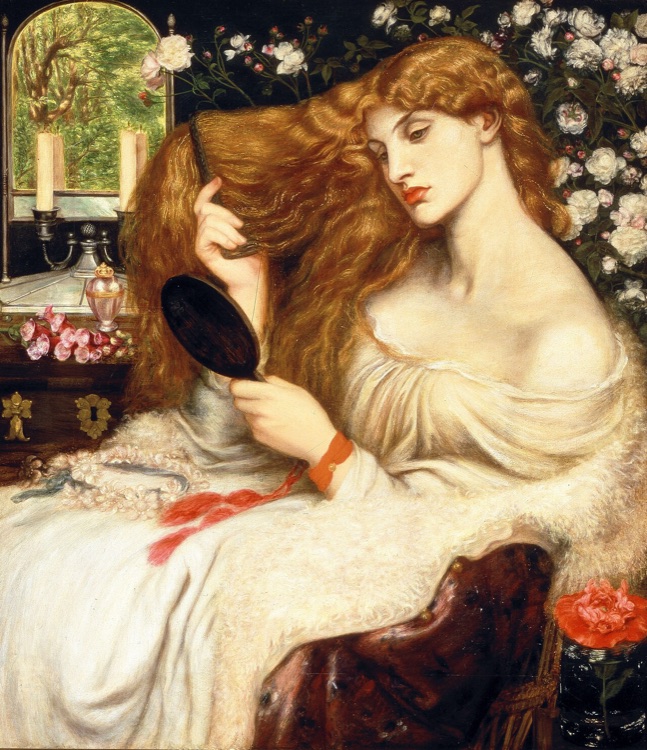
Dante Gabriel Rossetti is the easiest of the three, because after 1859 he painted essentially one picture over and over. A single woman, half-length, pressed up against the picture plane, with no room behind her and nowhere for the eye to go. There is no scene, no narrative moment, nothing happening. She looks out, or past you, or at nothing.
Three things give him away. First, the space is shallow and decorative — flowers, drapery and foliage crowd the surface rather than receding into depth. Second, the props are symbols, not furniture: a pomegranate, a mirror, a honeysuckle, each loaded with meaning for a picture that otherwise has no plot. Third, and most reliable, the same handful of faces recur across decades. Elizabeth Siddal, Fanny Cornforth, Alexa Wilding and Jane Morris are the entire population of his later work. If you have seen one Rossetti you have met his models; if a painting shows you a long neck, a heavy jaw and a mass of copper hair, you are probably looking at another.
He was not painting people. He was painting a fixation, repeatedly, from life.
2. Millais: a real place, painted out of doors
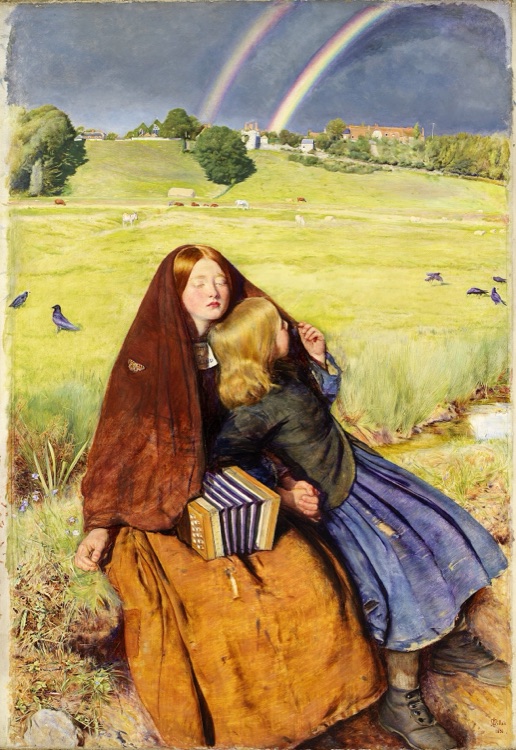
John Everett Millais is the opposite animal. His paintings are scenes with a story in them — a moment from Shakespeare, Tennyson or history, with figures who are doing something to each other and a setting rendered with almost uncomfortable precision.
The tells: a landscape that was painted outdoors, from the thing itself, with botanically identifiable plants rather than generic greenery; a bright, almost glaring ground, because the Brotherhood painted into wet white rather than onto a brown base, which is why the colour still looks electric; and hard, crisp edges everywhere, foreground and background given equal focus in a way no camera and no human eye actually manages. Everything is in focus at once. That flatness of attention is the Pre-Raphaelite signature at its purest, and Millais is the one who kept it longest.
Then he stopped. From the 1860s onward he painted portraits and sentimental subjects for a large and paying public, got rich, and in 1896 was elected President of the Royal Academy — the institution the Brotherhood had formed to rebel against. He died four months later. His late pictures of children and cherries are perfectly good paintings and have almost nothing to do with the ones that made his name, which is why he is the hardest of the three to pin with a single rule.
3. Waterhouse: the one who was never there
John William Waterhouse was born in 1849 — a year after the Brotherhood was founded, and he was a small child when it fell apart. He trained at the Royal Academy, began in a polished classical manner, and only turned to the literary and mythological subjects he is now known for in the 1880s, thirty years late. Calling him a Pre-Raphaelite is a bit like calling a 1990s band Beatles: the influence is real, the membership is not.
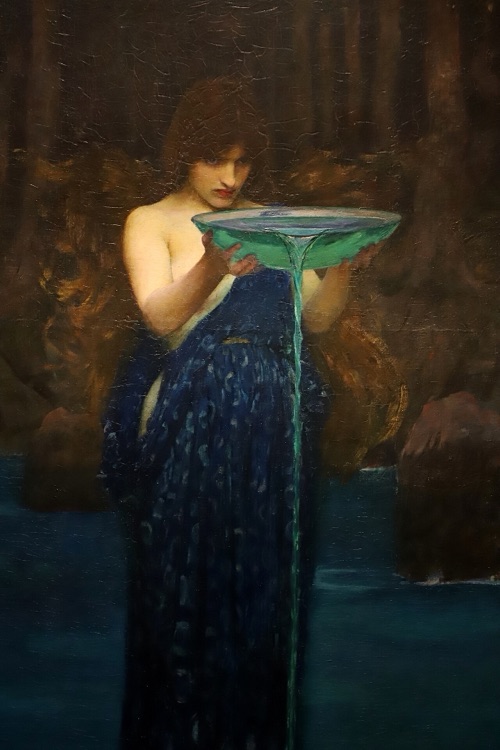
And once you look at the handling, the gap is obvious. Waterhouse's brushwork is loose. Where Millais gives you every leaf, Waterhouse gives you a suggestion of leaves, with soft edges and a smoky, unified tone that comes from thirty years of French painting the Brotherhood never saw. His colour is cooler and greyer. His subjects are consistent to the point of predictability: one young woman, usually alone, usually near water, always inside a myth — Circe, Ophelia, a mermaid, the Lady of Shalott.
If the picture is dreamy and slightly out of focus, it is Waterhouse. If you can count the petals, it is Millais.
The water test
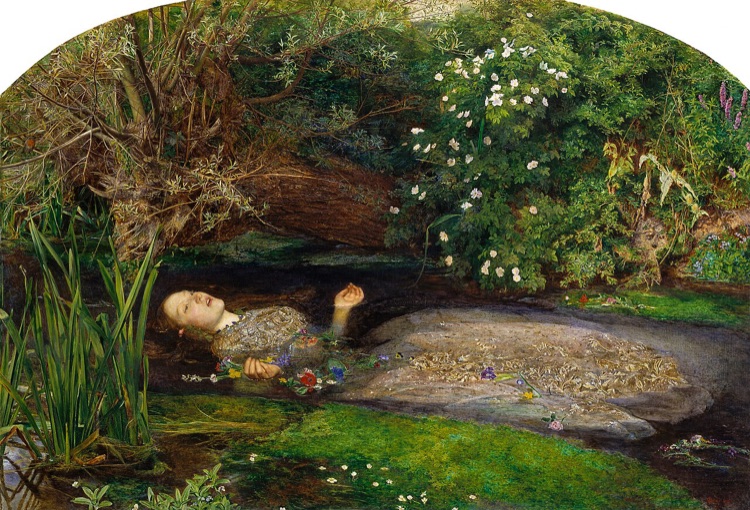
The quickest way to feel the difference: both men painted a literary heroine dying in water, thirty-six years apart, and both paintings are in this quiz. Millais gives you Shakespeare's Ophelia in the river. Waterhouse gives you Tennyson's Lady of Shalott, casting off in the boat that will carry her downstream to her death.
Millais, 1852: a real stretch of the Hogsmill River in Surrey, painted on the spot over five months, every willow and nettle and forget-me-not identifiable by species. Ophelia floats in sharp focus, mouth open, hands up, surrounded by flowers that each carry a meaning from the play. It is almost unbearably specific.
Waterhouse, 1888: the same ending, the same water, but look what happens to it. The wood behind her is a mass of dark tone with barely a leaf resolved. The reeds are strokes, not specimens. He catches the moment before — her hand on the chain, the candles still lit — rather than the body already floating. And the emotional weather is completely different: Millais shows you a death, Waterhouse shows you a girl about to go and meet one. Thirty-six years and an entire change of temperature.
One of them left the movement, one of them arrived thirty years late, and the third just kept painting the same four women.
Elizabeth Siddal posed for Millais's Ophelia lying in a full bathtub in his studio, kept warm by oil lamps underneath. The lamps went out while Millais was absorbed in painting, she stayed in the cooling water rather than interrupt him, and caught a serious chill. Her father sent the painter a doctor's bill.
Siddal later married Rossetti. When she died in 1862 he buried the only manuscript of his poems in her coffin — and seven years later had the grave opened to get them back. He published them in 1870.
Ready to test your eye?
All three are in the quiz, along with 1,389 paintings by 118 painters.
Play the quizA caveat: the two who are missing
The Brotherhood's third painter, William Holman Hunt, was the only one who stuck to the original programme for his entire career, and Edward Burne-Jones — Rossetti's student, and the bridge between the Brotherhood and Art Nouveau — is the fourth name you will meet in any gallery of this material. Neither is in this quiz yet, so you will not be asked to choose between them here. But if you meet them elsewhere: Hunt is Millais with the colour turned up and a sermon attached, and Burne-Jones is Rossetti stretched vertically, drained of blood and set in a frieze.
More from the three