Dante Gabriel Rossetti
Poet-painter of the Pre-Raphaelite dream, turning Siddal and Jane Morris into icons of longing and doom.
Style and technique
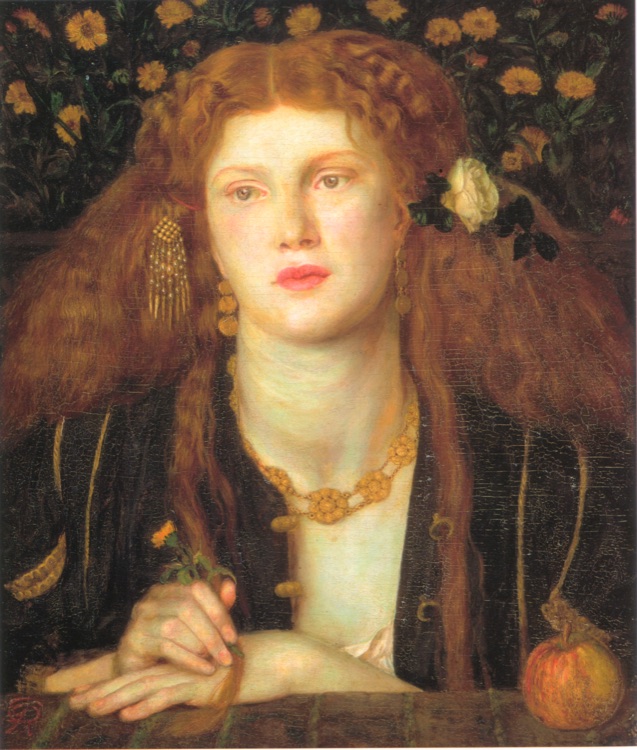
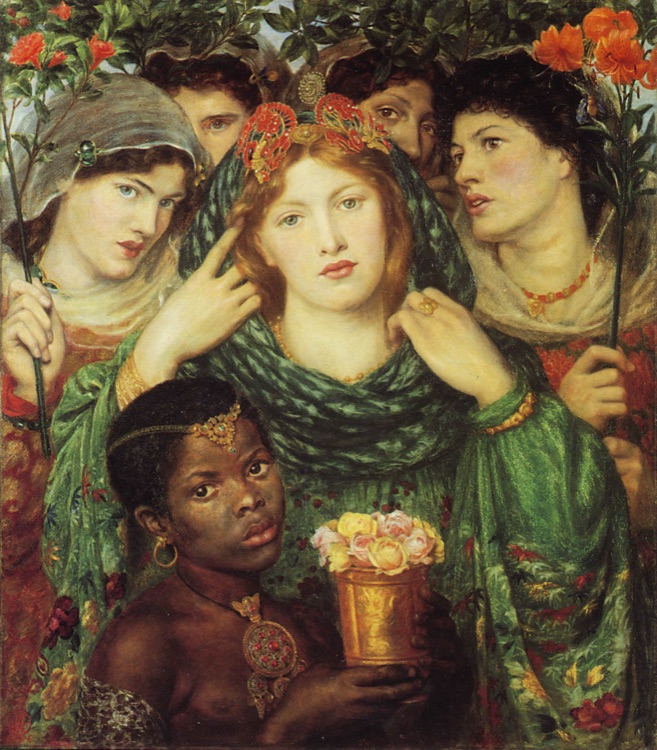
Dante Gabriel Rossetti painted as a poet writes: in symbols, refrains, and private mythologies. Trained first in the crisp, moralizing naturalism of the Pre-Raphaelite Brotherhood he co-founded in 1848, he soon abandoned its outdoor light and hard-edged detail for something more interior — a hothouse art of single female figures, three-quarter or half length, filling the canvas the way an icon fills a shrine. These are the stunners, as the Pre-Raphaelite circle called them: women with heavy-lidded eyes, tumbling copper or dark hair, and full, unsmiling mouths, each modeled on a woman who mattered to Rossetti in life — Elizabeth Siddal, Fanny Cornforth, Jane Morris, Alexa Wilding. He painted them not as portraits but as allegories, layering them with attributes borrowed from Dante, classical myth, and medieval romance: poppies for oblivion, pomegranates for the underworld, honeysuckle for entrapment, mirrors for vanity or self-knowledge. Nothing in a Rossetti canvas is merely decorative; everything is a clue.
His palette thickened over the decades into the jewel tones he is remembered for — pomegranate red, malachite green, deep aubergine, old gold — applied in dense, claustrophobic surfaces owing as much to Venetian portraiture and Titian as to the Pre-Raphaelites' early Quattrocento models. Composition narrowed accordingly: backgrounds flattened into patterned drapery or foliage, pushing the model's face and hands forward until the picture reads as an intense confrontation between viewer and subject, rather than a scene.
Underneath all of it runs Rossetti's lifelong duality as both painter and poet. He illustrated his own sonnets and inscribed verse onto frames; The Blessed Damozel began as a poem and was only later translated into paint, while other paintings generated sonnets in return, each medium completing the other. Literature supplied his subjects — Dante Alighieri above all, a household inheritance he carried in his very name, but also Arthurian legend, Goethe, and Malory — and his sitters became simultaneously Beatrice, Persephone, Lilith, and the living women who posed for them, until myth and biography were no longer separable.
Life and legacy
Dante Gabriel Rossetti was born in London in 1828 to Gabriele Rossetti, an exiled Italian poet and Dante scholar, and Frances Polidori; the household's steeping in Dante Alighieri's poetry gave the boy his defining obsession and, effectively, his name. Trained at Sass's Academy and the Royal Academy Schools, the restless young Rossetti found academic convention stifling. In 1848, alongside William Holman Hunt and John Everett Millais, he co-founded the Pre-Raphaelite Brotherhood, a secret society of artists pledged to reject the formulaic, brown-toned painting descending from Raphael in favor of the sincerity, bright color, and closely observed detail of art before 1500. Rossetti was the group's most literary and least disciplined member, more drawn to mood and symbol than to Hunt's moral earnestness or Millais's technical precision, and he drifted from the Brotherhood's original program even as he remained its charismatic center.
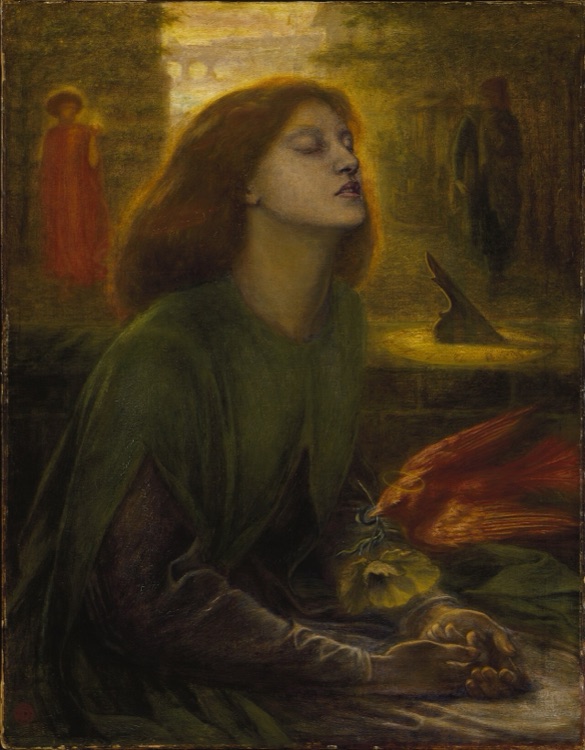
Around 1850 he met Elizabeth Siddal, a milliner's assistant who became his primary model, his pupil in painting, and eventually, in 1860, his wife. Their relationship was passionate but strained by his infidelities and her fragile health and laudanum dependence. When she died of an overdose in 1862, likely a suicide, a devastated Rossetti buried the only complete manuscript of his poems in her coffin, wound in her hair — a gesture of grief he reversed seven years later, having the grave exhumed to retrieve the poems for publication, an episode that shadowed his reputation ever after. He memorialized her repeatedly, most hauntingly in Beata Beatrix, painted in the years following her death.
Widowed and increasingly prosperous from portrait commissions, Rossetti moved into Tudor House in Chelsea, filling its grounds with peacocks, wombats, kangaroos, and armadillos, and its rooms with blue-and-white china and Regency furniture. There he entered the second, more sensuous phase of his career, dominated by images of women modeled on Fanny Cornforth, Alexa Wilding, and above all Jane Morris, wife of his close friend and collaborator William Morris. His intense, likely romantic attachment to Jane — she sat for Proserpine, Astarte Syriaca, and countless drawings across two decades, often at Kelmscott Manor, which he leased jointly with William — coincided with his physical and mental decline. Insomnia, chloral hydrate addiction taken to counter it, and a paranoid breakdown following brutal attacks on his poetry, notably Robert Buchanan's 1871 essay "The Fleshly School of Poetry," drove him into reclusion, working through the night by lamplight and rarely venturing outdoors. He died in 1882 at Birchington-on-Sea, having spent his final years obsessively repainting the handful of women who had come to define his art.
Five famous paintings
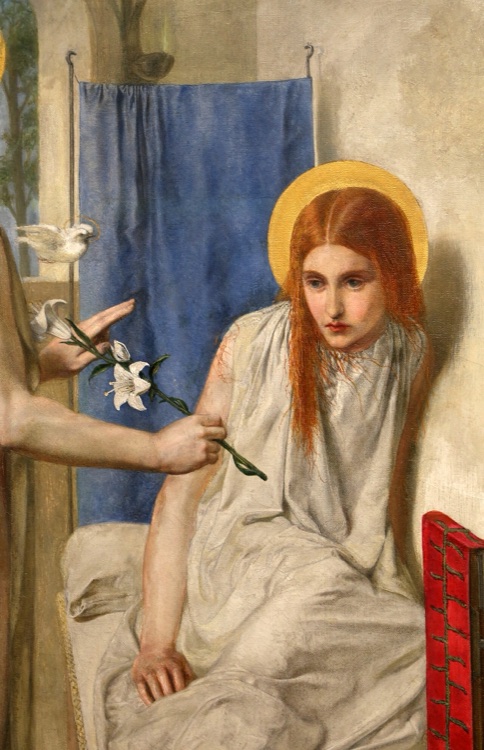
Ecce Ancilla Domini! (The Annunciation) 1850
Painted months after the Pre-Raphaelite Brotherhood's founding, this bare Annunciation drops the genre's usual golden pageantry for near-monochrome whites and a spare, closet-like bedroom. Christina Rossetti, the artist's poet sister, posed as a Virgin who visibly recoils rather than serenely accepts her fate, while brother William Michael modeled Gabriel, feet hovering on flame instead of clouds. The blue embroidery, lily, and dove carry doctrinal weight, but it was the picture's raw, clinical strangeness — flat space, stiff poses, literal symbolism — that scandalized critics and announced the Brotherhood's ambitions.
Beata Beatrix c. 1864–1870
Begun before Elizabeth Siddal's death in 1862 and completed afterward as elegy, this canvas reimagines Dante's Beatrice at the moment of mystical death described in the Vita Nuova. Modeled on Siddal from earlier studies, she sits in profile, eyes closed and lips parted, bathed in gold light as a red poppy — emblem of sleep and of the laudanum overdose that killed her — drops into her hands, delivered by a crimson dove. Behind her, blurred figures of Dante and Love cross a bridge over Florence while a sundial marks the fatal hour. Rossetti painted several versions of his most personal work, fusing grieving widower and mourning poet into one image.
Lady Lilith 1866–1868 (reworked 1872–73)
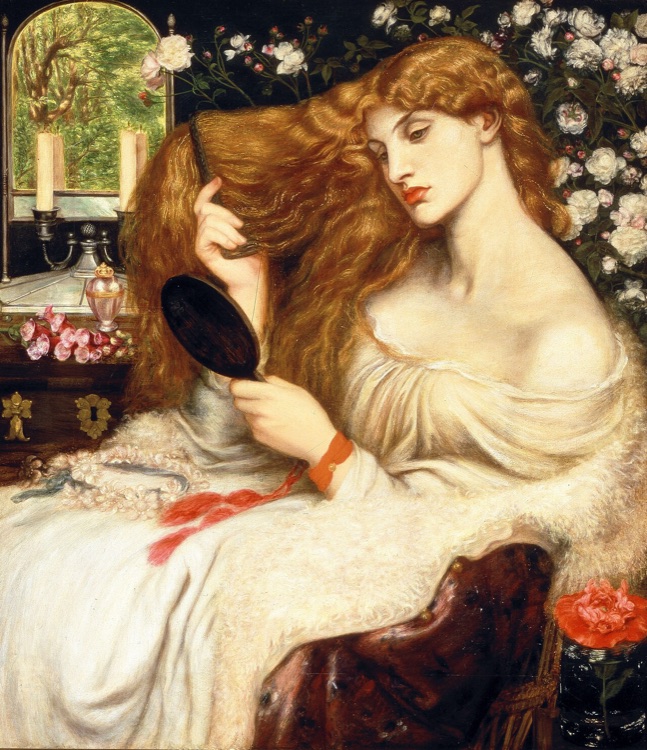
Rossetti's Lilith conjures Adam's legendary first wife, a demon of vanity in Jewish folklore, as she combs her abundant golden hair before a hand mirror, indifferent to the viewer. Modeled first on Fanny Cornforth and later repainted with Alexa Wilding's face, she sits amid white roses (pleasure) and foxgloves (poison) in a boudoir crowded with candles and mirrors, her beauty coded as a snare. Rossetti paired the canvas with a sonnet, "Body's Beauty," naming her the witch Adam loved before Eve, whose "enchanted hair was the first gold" — the definitive statement of his stunner archetype: beauty as autonomous, faintly sinister power.
Proserpine 1874
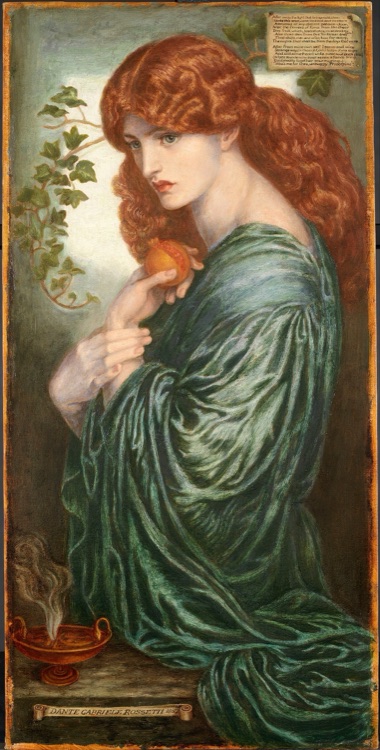
Jane Morris, wife of Rossetti's friend William Morris and by the 1870s his consuming private obsession, poses as Proserpine, queen of the underworld, condemned after tasting six pomegranate seeds. Painted in a narrow, vertical format that crowds her figure against dim greenish drapery, the canvas isolates one furtive gesture: her hand half-lifting the fruit she has already bitten, an ivy tendril coiling behind her like a chain. A single shaft of light catches only a sliver of the scene, deepening the confinement. Rossetti produced at least eight versions, obsessively returning to Jane's face and this myth of a woman bound to a fate she did not choose.
Astarte Syriaca 1877
One of Rossetti's largest and most mythic works, this canvas casts Jane Morris as the ancient Syrian goddess of love and war, a deity he conflated with Venus and Ishtar into one towering pagan icon. She stands frontal and monumental, flanked by two flame-bearing attendants, her belted girdle and crossed hands echoing altarpiece conventions repurposed for a distinctly un-Christian idol. The jewel-dark blue-green and gold palette and a sonnet calling her a mystery "betwixt the sun and moon" push the picture toward ritual rather than portraiture — his most ambitious attempt to make painting function as scripture for a religion of his own invention.