John William Waterhouse
Painter of sirens, nymphs, and doomed heroines suspended at the water's edge between desire and destruction.
Style and technique
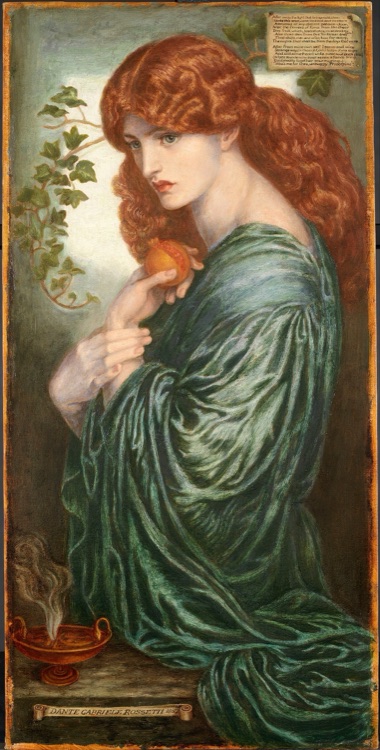
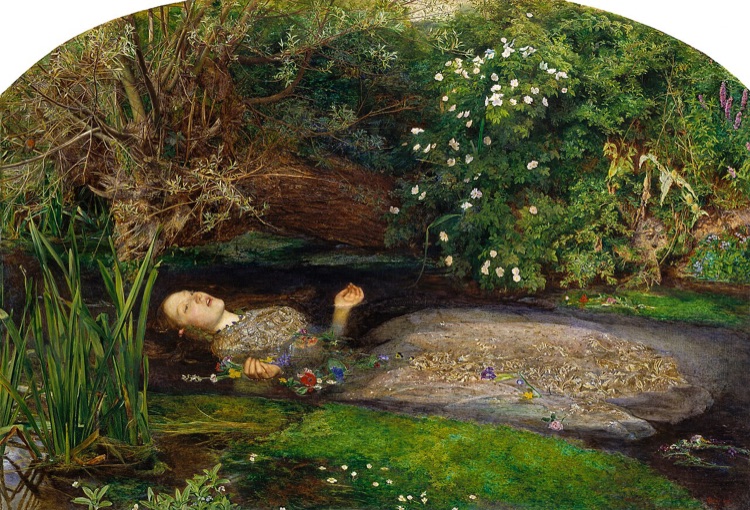
Waterhouse painted at the point where the Pre-Raphaelite Brotherhood's crisp, jewel-toned precision softened into something more atmospheric and painterly. Working a generation after Dante Gabriel Rossetti, Holman Hunt, and Millais laid down the movement's founding principles, he inherited their taste for literary and mythological subjects but rejected their meticulous, near-photographic finish. His brushwork is looser, his edges softer, his light more diffused — closer to the plein-air naturalism he absorbed as a Royal Academy student. Skies glow with an unstable, late-afternoon luminosity; water ripples in visible, confident strokes rather than being rendered hair by hair.
No motif recurs more insistently across his work than water, and the threshold it represents. Waterhouse returned obsessively to riverbanks, pools, and shorelines as liminal zones where safety gives way to enchantment or peril — the boundary between the everyday and the otherworldly, between innocence and ruin. His heroines are almost always caught mid-transition: stepping into a boat, leaning toward a pool, drifting downstream, reaching into water that will not release them.
His source material draws in equal measure from classical mythology — Ovid's nymphs and sorceresses, Homer's Circe and Sirens, the story of Narcissus and Echo — and from Victorian literature, above all Tennyson and Shakespeare, whose Lady of Shalott and Ophelia he painted repeatedly across his career. Running through nearly all of it is a fascination with women who embody desire and danger at once: sirens who lure sailors to drown, nymphs who pull mortal youths beneath the surface, heroines whose passion or grief proves fatal to themselves. These are not passive Victorian maidens but active, often otherworldly agents, painted with a sympathy that complicates any easy reading of them as simple femmes fatales — Waterhouse renders their allure and their doom with equal, melancholy tenderness.
Life and legacy
John William Waterhouse was born on April 6, 1849, in Rome, where his English parents, William and Isabella Waterhouse, were both working painters — a background reflected in the nickname 'Nino' his family used for him. The family returned to London around 1854, settling near Kensington, and the young Waterhouse grew up steeped in art: he learned first by copying works in the British Museum and sketching alongside his father before enrolling at the Royal Academy Schools in 1870. His early paintings, exhibited through the 1870s, followed the fashionable classical-genre mode of Frederic Leighton and Lawrence Alma-Tadema — scenes of ancient domestic life rendered with careful archaeological detail rather than the literary intensity that would define his mature work.
By the 1880s, Waterhouse's subject matter shifted decisively toward mythology and Victorian poetry, and his technique loosened into the atmospheric, light-filled manner for which he is now best known. Although he had no personal connection to the original Pre-Raphaelite Brotherhood, founded decades earlier in 1848 by Rossetti, Hunt, and Millais, his mature output shared so much of their thematic territory — doomed heroines, Arthurian and Shakespearean subjects, symbolic uses of nature — that he is now routinely classed among the Pre-Raphaelites' second generation, alongside painters like Edward Burne-Jones. He exhibited almost every year at the Royal Academy's summer show, building a reputation as one of late Victorian Britain's most commercially successful painters; he was elected an Associate of the Royal Academy in 1885 and a full Royal Academician in 1895. He also taught and served on Academy committees, remaining a steadily productive artist until illness slowed him in his final years; he died in London on February 10, 1917, having continued painting variations on his signature themes almost to the end.
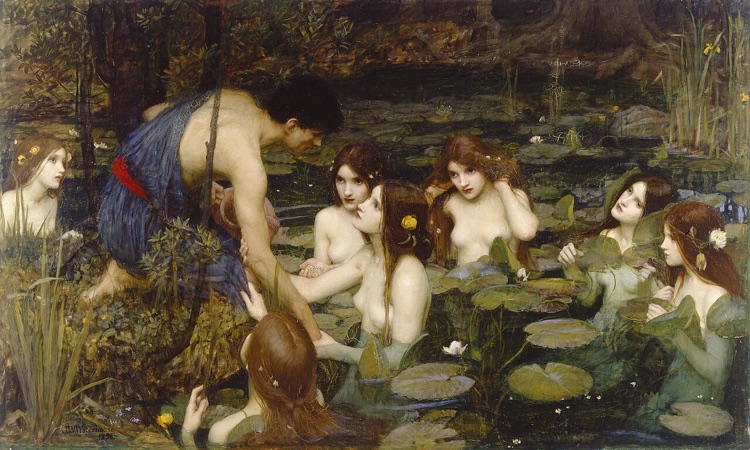
That renewed visibility collided with contemporary politics in January 2018, when Manchester Art Gallery temporarily removed Hylas and the Nymphs from its walls as part of an artist-led intervention questioning how museums display and objectify the female body, replacing the canvas with a blank space and visitor Post-it notes. Intended as a week-long conversation-starter rather than permanent censorship, the removal provoked international backlash over what many saw as censorship of a beloved public artwork; the painting was restored to the gallery within days, but the episode reignited enduring debates about gaze, gender, and the display of Waterhouse's water-nymphs in the #MeToo era.
Five famous paintings
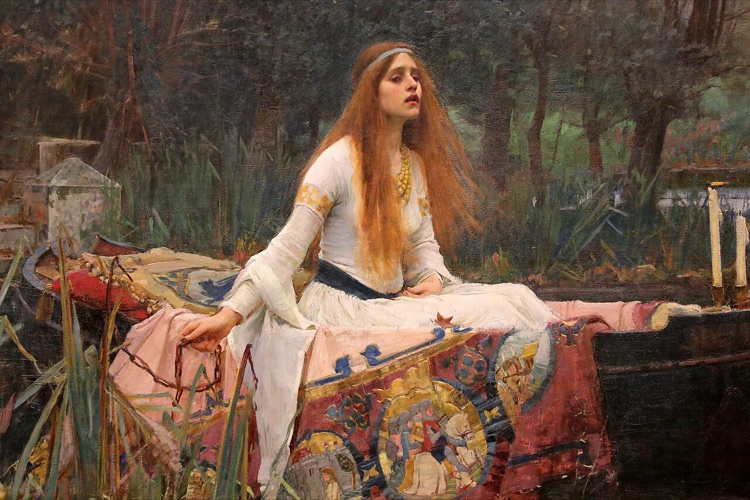
The Lady of Shalott 1888
Waterhouse's best-known painting illustrates the climactic moment of Tennyson's poem: cursed to view the world only through reflections, the Lady abandons her loom upon glimpsing Lancelot and drifts toward Camelot and death in an unmoored boat. She sits amid autumnal reeds, three candles already guttering out, a crucifix and loosened tapestry trailing in the water — every detail signaling her doom before it arrives. Waterhouse painted the subject three times; this 1888 version, his first, became one of the most reproduced images in British art and cemented his reputation as the era's foremost painter of tragic, self-destroying heroines.
Hylas and the Nymphs 1896
Seven identical, wide-eyed water nymphs rise from a moonlit pool to encircle Hylas, Hercules's young companion, drawing him under with gentle, insistent hands as he leans in, entranced and unresisting. Drawn from the Argonaut myth via a poem by William Morris, the scene turns abduction into seduction: the nymphs' faces are tender rather than menacing, the water lilies rendered with botanical precision, the light a soft glow that makes the pool feel idyllic yet inescapable. The painting became Waterhouse's most controversial when Manchester Art Gallery briefly removed it in 2018 to spark debate about historic nudes, provoking far louder outcry than the conversation intended.
Ophelia 1889
Waterhouse painted Shakespeare's drowned heroine at least three times, but this earliest version fixes her an instant before tragedy: seated on a willow branch overhanging the stream, weaving wildflowers into her hair, absorbed in madness rather than yet submerged. Her white dress and pale skin already dissolve into the surrounding foliage and water, foreshadowing the death Gertrude will later describe in Hamlet. Unlike Millais's earlier, minutely detailed Ophelia floating mid-drown, Waterhouse's looser, sun-dappled brushwork lends the scene an unstable, dreamlike hush.
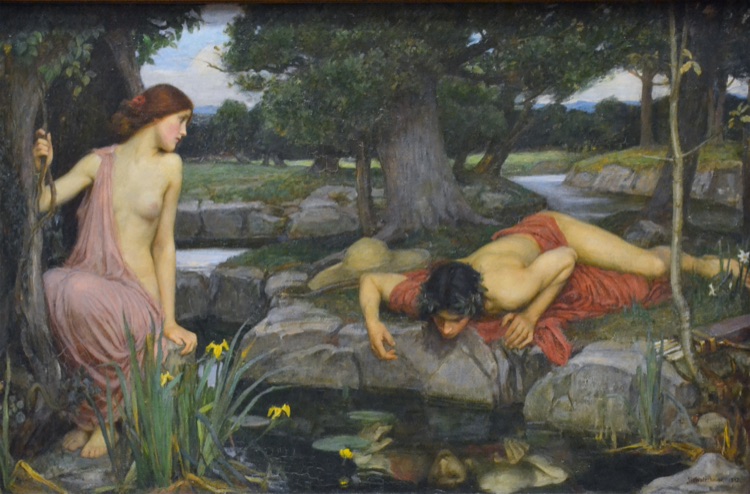
Echo and Narcissus 1903
On one bank, Narcissus leans hungrily over a still pool, transfixed by his own reflection; on the other, the nymph Echo — cursed to repeat only others' words after Hera silenced her — watches in silent, unrequited longing, her body echoing his crouched pose. Waterhouse divides the canvas cleanly along the pool's edge, using the water as both barrier and mirror, doubling the figures the way Echo can only double speech. Dense, glowing woodland and a carpet of hyacinths, into which Narcissus will be transformed, frame the scene in saturated greens — one of Waterhouse's most lushly atmospheric treatments of Ovid's Metamorphoses.
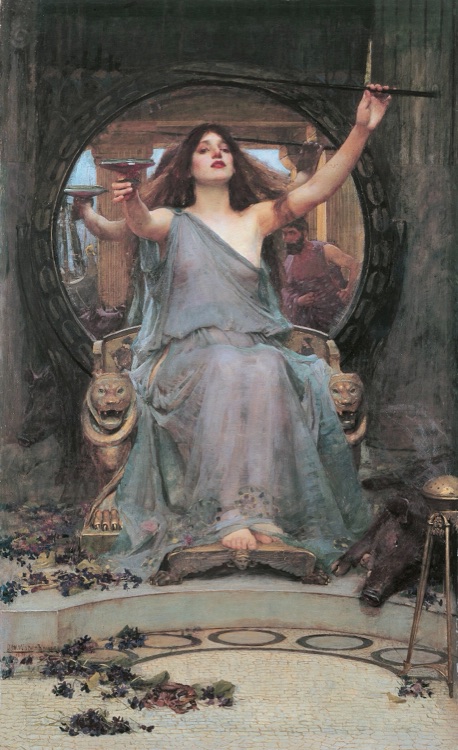
Circe Offering the Cup to Ulysses 1891
Waterhouse casts Homer's sorceress as a commanding, golden-throned figure extending a poisoned cup toward Ulysses, whose reflection looms behind her in a mirror — the only trace of him visible, and a subtle hint of the danger she poses. A drugged, half-transformed pig-man crouches at her feet, evidence of what awaits sailors who accept her hospitality, while Circe's direct gaze and bared shoulder mark her as one of Waterhouse's boldest femme-fatale figures. Exhibited at the Royal Academy in 1891, the painting shows Waterhouse at his most theatrical, staging classical myth as psychological confrontation.