
Northern Renaissance
Oil paint, obsessive detail, and the visible world recorded with almost terrifying patience.
In 1432, a polyptych altarpiece was unveiled in the Cathedral of Saint Bavo in Ghent, and the art world that came to see it found itself in front of something it could not quite explain. Jan van Eyck's *Ghent Altarpiece* depicted fabrics, grass, gemstones and human skin with a finish so fine and so precise that observers described it as closer to reality than reality itself — as if a window had been opened rather than a painting hung. Van Eyck had not invented oil paint, but he had pushed its possibilities further than anyone before him, using microscopic glazes of pigment in linseed oil to build up surfaces of extraordinary luminosity. The Northern Renaissance — spreading from Bruges and Ghent through the German cities of Nuremberg and Augsburg and eventually into the courts of England and France — was born from this same impulse: to look at the visible world with unsparing attention and render it, hair by hair and thread by thread, in a medium perfectly suited to the task. Where Italian contemporaries were studying ancient Rome, northern painters were studying the things in front of their eyes. The results were, and remain, astonishing.
Origin and history
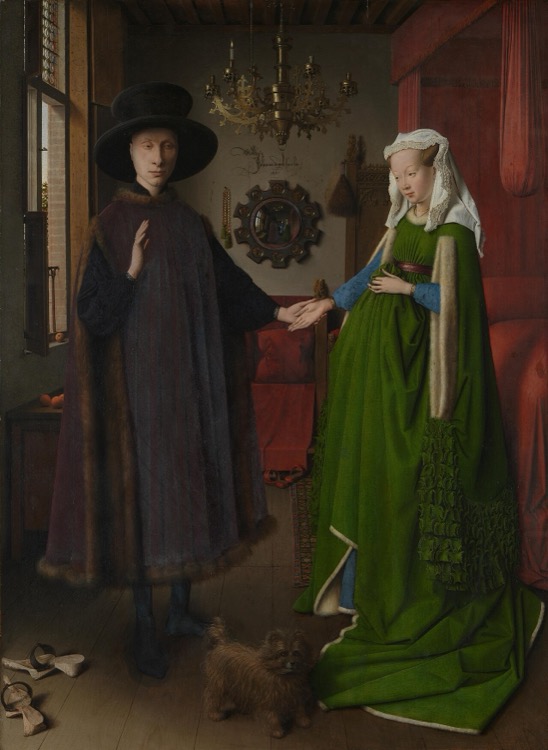
The Northern Renaissance had its first and greatest centre in the Low Countries — specifically in the prosperous wool-trading cities of Bruges and Ghent, then part of the Duchy of Burgundy. The Burgundian court was one of the wealthiest in Europe in the early fifteenth century, and its dukes competed aggressively for prestige through manuscript illumination, tapestry and panel painting. It was in this context that Jan van Eyck (c.1390–1441) developed his oil technique, working for Duke Philip the Good as both painter and diplomatic envoy. His *Arnolfini Portrait* (1434, National Gallery, London) — a double portrait of a Bruges merchant and his wife, every surface rendered with alchemical precision — established what northern painting would spend the next century perfecting: the domestic interior as a space of almost devotional attention.
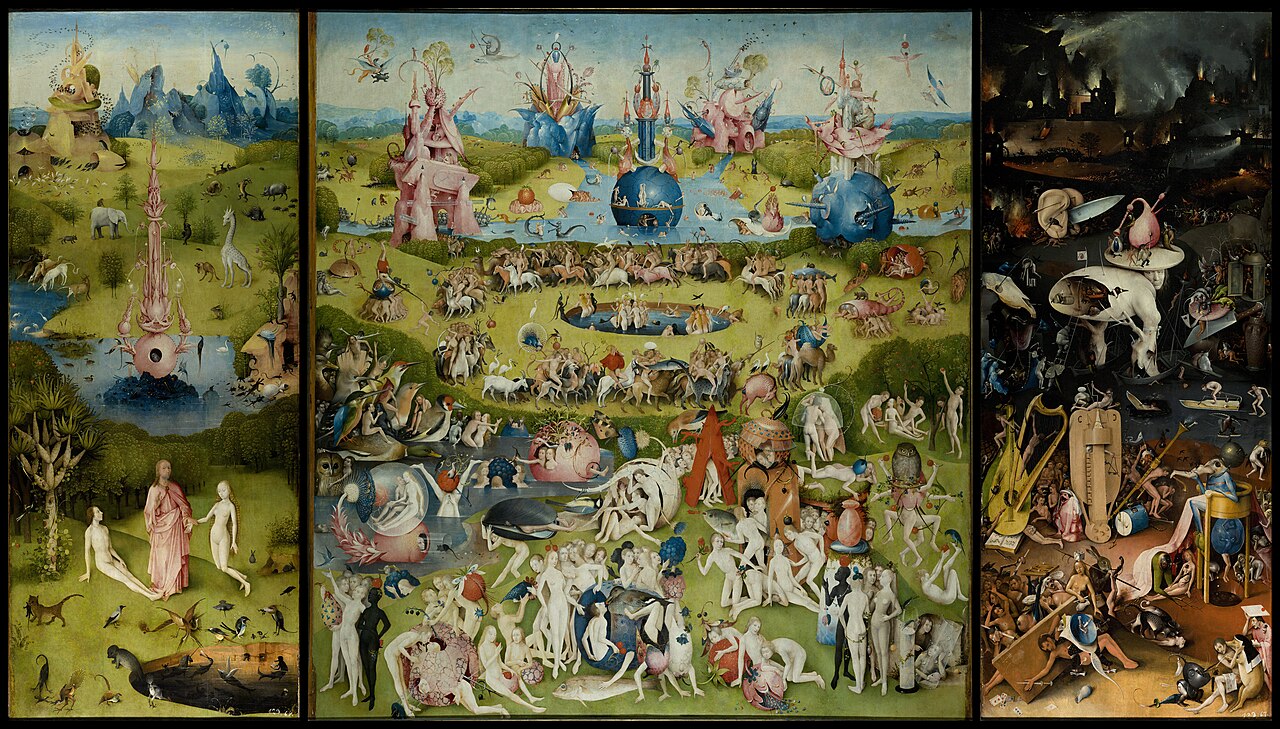
The tradition passed through Rogier van der Weyden (c.1400–1464), whose emotional intensity gave the precise northern technique a psychological depth it had sometimes lacked — his *Descent from the Cross* (c.1435, Prado) remains one of the most harrowing images of grief in Western art — and through Hans Memling in Bruges and Hugo van der Goes in Ghent. By the late fifteenth century, Hieronymus Bosch in 's-Hertogenbosch was stretching the northern tradition in an utterly different direction: his triptychs, full of hybrid monsters, miniature hellscapes and dense moral allegory, look like nothing else in Western art before or since.
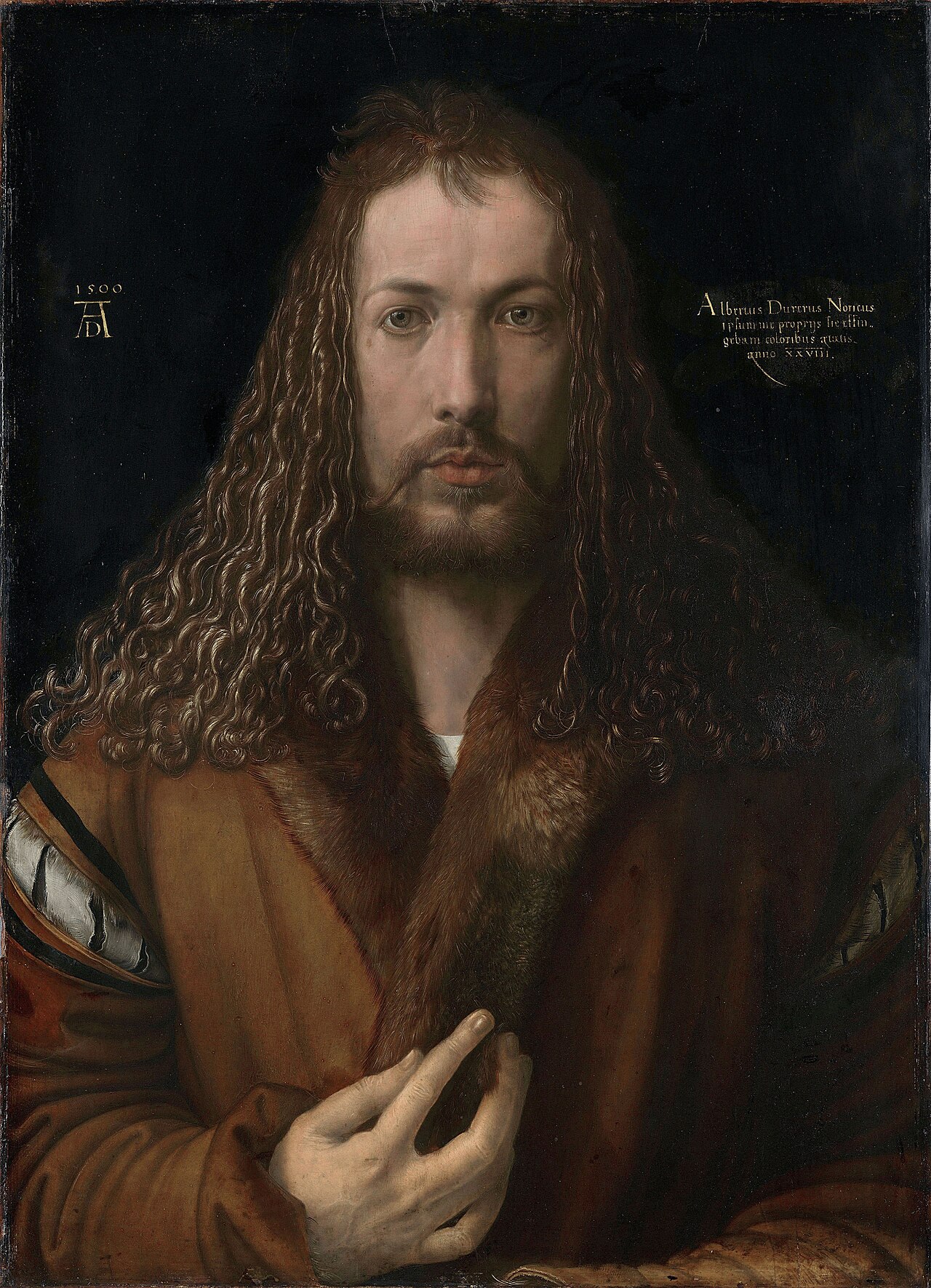
In Germany, the Northern Renaissance found its defining figure in Albrecht Dürer (1471–1528) of Nuremberg. Dürer made two trips to Venice (1494–95 and 1505–07) and came back determined to unite Italian mathematical proportion with northern precision. His self-portraits — he painted himself with almost alarming seriousness, as if the genre of self-portraiture were a philosophical project — and his prints (the *Melencolia I* engraving of 1514 is the most discussed) brought the Renaissance question of the artist's status into northern Europe for the first time. Lucas Cranach the Elder in Wittenberg painted a cooler, more decorative variant, closely associated with the Lutheran Reformation; Hans Holbein the Younger (1497–1543) took the northern tradition to its final perfection in the great portraits of Henry VIII's court, where psychological penetration and surface precision achieved a balance that has never been surpassed.
Concept and philosophy
The Northern Renaissance painters shared a set of convictions that were subtly but importantly different from those of their Italian contemporaries, even when the two traditions were in direct conversation.
First, that the visible surface of things is sacred. Where Italian painters used visible reality as a starting point and then idealised it — smoothing away wrinkles, correcting proportions, arranging figures according to classical theory — northern painters treated exact observation as an end in itself. Every thread in a carpet, every hair in a beard, every reflection in a convex mirror was worth painting with absolute fidelity. This was not mere technical exhibitionism; for Flemish painters steeped in devotional culture, the precision of God's creation demanded the precision of the artist's record.
Second, that light is the proper subject of painting — not light as an abstraction but light as it actually behaves in a specific room, at a specific time of day, falling through a specific window onto specific objects. The Flemish domestic interior, with its single light source and its rendered textures, is essentially a study in how light transforms matter. This insight — that painting is fundamentally about the behaviour of light — connects van Eyck directly, across three centuries, to the Impressionists.
Third, that the ordinary world deserves the same seriousness as the sacred one. Northern painters elevated bourgeois domestic life — merchants at their desks, women at their looms, men reading letters — to the level of high art decades before Italian painting reached the same conclusion. The *genre* painting tradition that would dominate Dutch seventeenth-century art grew directly from this Flemish premise.
Fourth, that symbols can be hidden inside the real. Northern paintings are often dense with embedded meaning — a candle in a chandelier, a dog at someone's feet, a mirror on a wall, a single orange on a windowsill — all potentially carrying devotional or moral significance. This double level of reading, where the ordinary object is also a sign, gives northern painting its characteristic quality of containing more than first appears.
How to recognise it
Six visual signatures of Northern Renaissance painting, from the Flemish masters through to Holbein's English portraits — the north has its own fingerprint, quite distinct from Italy.
- Obsessive surface texture — Velvet, fur, polished armour, wrinkled skin, brass candlesticks, oriental carpets — every material is rendered with a patience that Italian contemporaries found almost incomprehensible. Van Eyck's *Ghent Altarpiece* and *Arnolfini Portrait* are the benchmarks; oil paint's capacity for microscopic glazes made this hyper-precision possible.
- Single-source domestic light — Light typically enters from one direction — usually a window off to the left — creating strong *cast shadows* on walls and floors and catching the near side of every object with heightened clarity. The room feels observed at a specific hour of a specific day, not arranged under ideal studio conditions.
- Individualised, specific faces — Northern portraits do not idealise. Every wrinkle, every asymmetry, every flush of broken capillaries is recorded. Where Italian Renaissance faces tend toward a classical ideal of beauty, Flemish and German faces are portraits of specific people who happened to live in the fifteenth and sixteenth centuries.
- Symbolic objects in ordinary settings — Convex mirrors, guttering candles, open books, single flowers in a vase — northern paintings hide theological and moral meaning inside seemingly realistic domestic detail. The dog in the *Arnolfini Portrait*, the skull on Holbein's ambassador's table, the hourglasses in vanitas still lifes — all are signs within a scene that reads simultaneously as document and allegory.
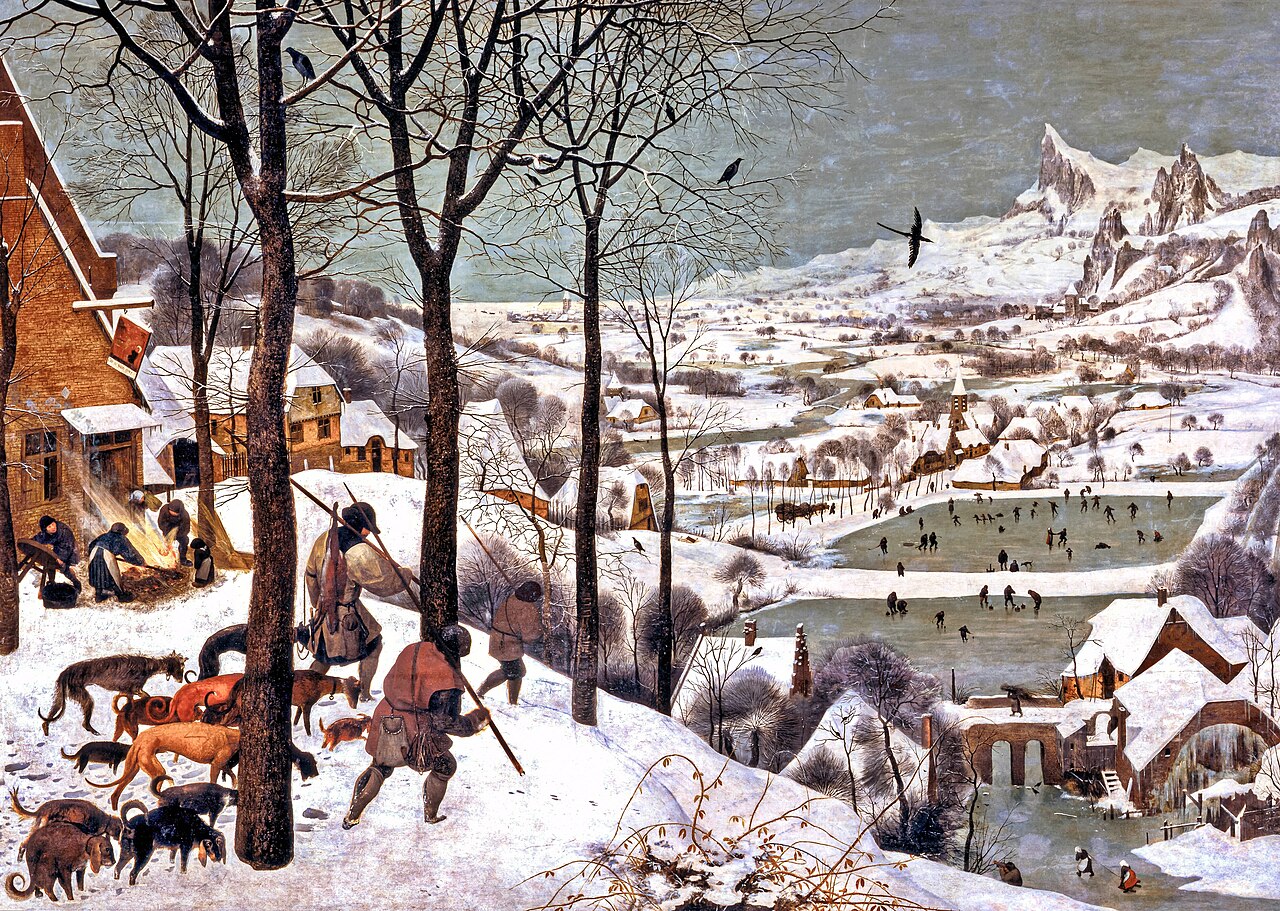
- Landscape as serious subject — Northern painting treats landscape as a full subject in its own right — not just as background. Joachim Patinir (c.1480–1524) is credited as the first painter to make landscape the primary subject of a panel; Pieter Bruegel the Elder (c.1525–1569) brought it to a peak in his panoramic Flemish seasons. Skies, weather, and the recession of hills into haze are painted with the same care given to figures.
- Precise contour lines in German work — In Dürer, Cranach, and Holbein, look for emphatic, exact outlines even in oil paint — a legacy of the northern tradition of line engraving and woodcut, where precision of contour was paramount. Dürer's prints show this most clearly; his paintings feel as if every form has been drawn before it was coloured.
Anecdotes and curiosities
Jan van Eyck signed a painting — which almost no earlier European painter had done. The *Arnolfini Portrait* (1434) carries a Latin inscription on the back wall: *Johannes de Eyck fuit hic* — "Jan van Eyck was here." The phrasing is striking: not "Jan van Eyck made this" but "was here," as if the painter were asserting his presence in the room at the moment depicted. Scholars have debated for generations whether the painting is a legal record of a betrothal, a private devotional object, or something else entirely. The convex mirror on the back wall shows two figures entering the room — one of them, it has been suggested, might be van Eyck himself.
Albrecht Dürer was outraged that Italians were copying his prints and selling them under his name. In 1506, Dürer wrote to the city council of Nuremberg that a Venetian engraver named Marcantonio Raimondi was producing copies of his *Life of the Virgin* woodcut series, reproducing even the AD monogram that was Dürer's signature. This was among the first documented cases of what we would now call copyright infringement in the visual arts. Dürer pursued the matter through the Venetian courts and eventually secured a ruling that Raimondi could not copy the monogram — but could copy everything else. The prints continued to circulate.
Hans Holbein the Younger painted a skull that can only be read from one angle. *The Ambassadors* (1533, National Gallery, London) shows two wealthy French diplomats surrounded by musical instruments, globes, and books — a vanity display of learning and worldly success. Slashed diagonally across the bottom of the painting is a smeared grey shape that looks like nothing from straight ahead. Walk to the far right of the painting and look back: the shape snaps into a perfect human skull. This *anamorphic* projection was a deliberate puzzle for viewers. The skull was presumably a memento mori — a reminder of death amid all the display of worldly achievement.
Hieronymus Bosch's biography is almost entirely unknown — which has fuelled five centuries of speculation. He was born Jeroen van Aken in 's-Hertogenbosch around 1450 and died there in 1516; he was a member of a local religious confraternity and seems to have been prosperous. Beyond that, almost nothing. His paintings — *The Garden of Earthly Delights*, *The Haywain*, *The Last Judgement* — were bought compulsively by Philip II of Spain, who filled the Escorial with them and apparently contemplated them alone for hours. Whether Bosch's hellscapes were orthodox moralising, personal neurosis, or something more playful has been argued ever since. The scholarly consensus today leans toward literate moral allegory rather than occult heresy — but the work remains irreducibly strange.
Legacy and influence
The Northern Renaissance bequeathed two gifts to subsequent Western painting that were arguably more durable than anything Italy left behind. The first was oil paint as the standard medium — the Flemish technique of building up transparent glazes spread from the Low Countries to Italy and eventually to every European studio, supplanting tempera and fresco as the default for panel and canvas painting. Every subsequent painter who worked in oil was, in a technical sense, working in van Eyck's tradition.
The second gift was the idea that ordinary life deserves serious pictorial attention. The Flemish domestic interior became the template for the Dutch Golden Age genre painting of the seventeenth century — Vermeer, de Hooch, Metsu — and from there for nineteenth-century Realism's insistence on working-class subjects, and from there for the Impressionists' conviction that a woman ironing or a café at night was as valid a subject as a mythological scene. The northern insistence on looking hard at the things in front of you, and rendering them with absolute fidelity, turned out to be one of the most consequential ideas in the history of art.
4 artists in this movement
Frequently asked questions
When did the Northern Renaissance begin and end?
The Northern Renaissance is conventionally dated from Jan van Eyck's mature work in the 1420s–1430s — particularly the completion of the *Ghent Altarpiece* in 1432 — through to roughly 1600 in the Netherlands and Germany, when the early Baroque began to absorb its legacy. In England, Holbein's departure from London in 1543 marks a rough terminus for the most concentrated phase. The transition was gradual rather than abrupt: Bruegel's work in the 1560s is simultaneously the late Northern Renaissance and the beginning of something else.
Who are the most important Northern Renaissance painters?
Jan van Eyck (c.1390–1441) is the founding figure. Rogier van der Weyden (c.1400–1464) gave it emotional depth; Hugo van der Goes and Hans Memling extended it in the Low Countries. Hieronymus Bosch (c.1450–1516) stands apart from and within the tradition simultaneously. In Germany: Albrecht Dürer (1471–1528) is the central figure, flanked by Lucas Cranach the Elder (1472–1553) and Hans Holbein the Younger (1497–1543). Pieter Bruegel the Elder (c.1525–1569) is the movement's magnificent final chapter.
What technique is most associated with the Northern Renaissance?
Oil glazing — the layering of multiple thin, transparent coats of pigment suspended in linseed or walnut oil — is the Northern Renaissance's defining technical achievement. Each layer dries before the next is applied; the cumulative result is a surface of unusual depth and luminosity, capable of rendering translucency (skin, glass, water) in ways that egg tempera or fresco cannot match. Van Eyck is credited with perfecting this approach, though the technique almost certainly developed gradually across several Flemish workshops.
How does the Northern Renaissance differ from the Italian Renaissance?
The Italian Renaissance was driven by classical antiquity, mathematical proportion, and idealised beauty — painting as a form of philosophy. The Northern Renaissance was driven by observation, materiality, and surface truth — painting as a form of witness. Italian painters idealised the body; northern painters recorded faces as they actually were. Italian compositions followed geometric rules; northern compositions often arranged figures pragmatically, the way they would actually occupy a room. The two traditions were in dialogue throughout the fifteenth century, but their priorities remained distinct.
Why is it called the 'Northern Renaissance'?
The term simply locates the phenomenon geographically: north of the Alps, as opposed to the Italian peninsula where the Renaissance began. Historians sometimes prefer the term 'Early Netherlandish' for the specifically Flemish phase (van Eyck through Bosch), reserving 'Northern Renaissance' for the broader movement that included Germany and England. The label is modern — contemporary painters would have recognised no such category, though they were certainly aware of the stylistic differences between Italian and Flemish approaches.