Agnes Martin
She spent her life reducing painting to its quietest possible statement — and found something enormous there.
Style and technique
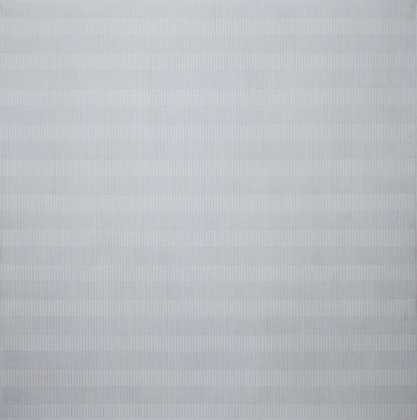
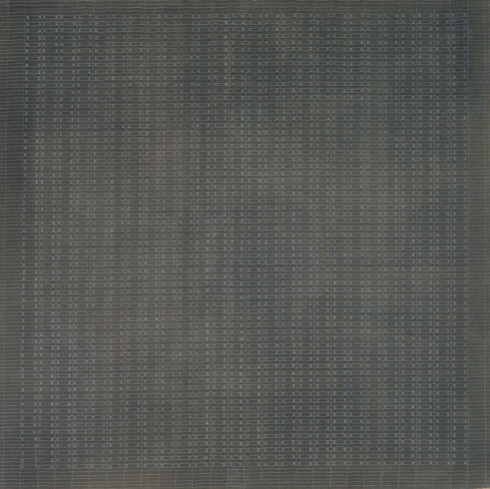
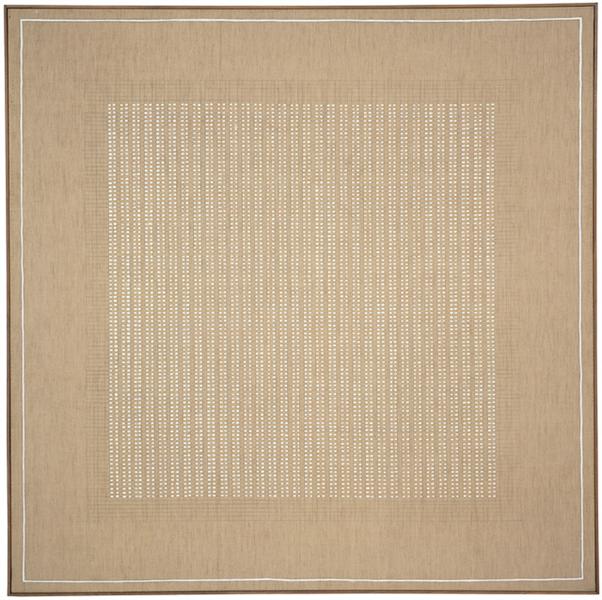
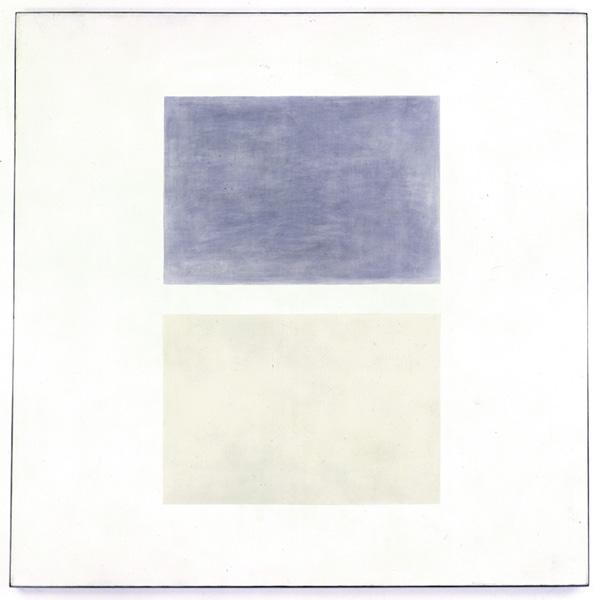
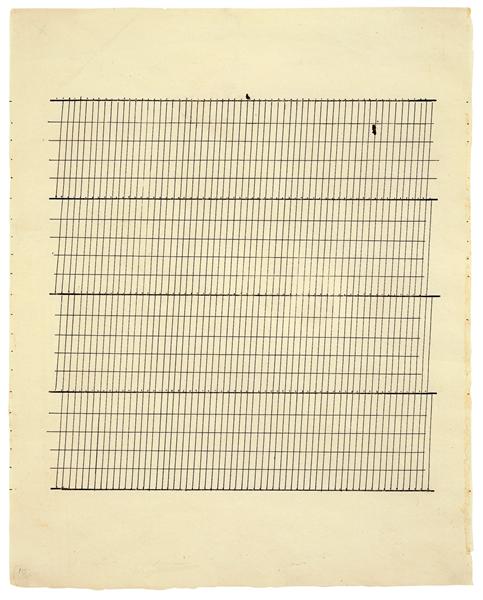
Martin's paintings are among the quietest objects in twentieth-century art. At first glance they can appear to be blank canvases — pale fields of white, cream, or grey — until you look long enough to see the faint pencil lines drawn across the surface in a regular grid or horizontal bands. The lines are hand-drawn, not ruled with mechanical precision, and this slight human imperfection is central to the work's effect: the grid that aspires to perfection and falls humanly short produces a tension that no mechanically perfect surface could achieve.
She came to her mature style through Abstract Expressionism, which she practised through the 1950s without satisfaction. By 1960 she had stripped away everything figurative and most of everything gestural, arriving at the grid as her primary compositional unit. The grid was not, for her, a geometric system; it was a response to a specific inner feeling — what she called innocence, the state of consciousness before thought imposes structure on sensation.
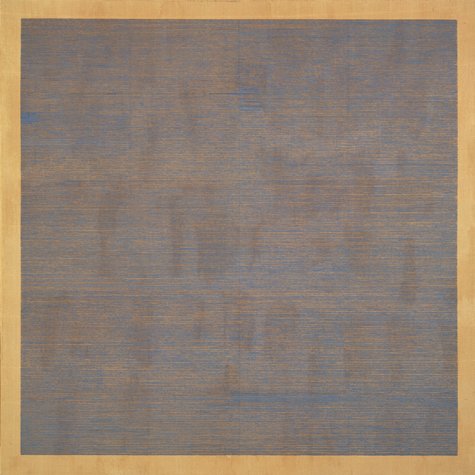
The surface of her paintings is as important as the composition. She worked on canvas or linen with graphite, oil, and acrylic in combinations that give different degrees of transparency and tooth. The light doesn't bounce off these surfaces; it seems to be absorbed and re-emitted. Standing in front of a room of her paintings, the experience is closer to meditation than to looking at art in the conventional sense.
Four fingerprints: horizontal pencil lines drawn across the full width of the canvas at regular intervals, pale fields of near-white or soft colour that recede rather than assert themselves, the large square format that became her signature shape, and a refusal of narrative or symbolic content in favour of direct perceptual and emotional experience.
Life and legacy
Martin was born on 22 March 1912 in Macklin, Saskatchewan, a small prairie town in Canada. Her childhood was shaped by the vast flat landscape of the Great Plains — the unbroken horizon, the enormous sky, the absence of incident. She later claimed this landscape as the emotional source of her horizontal paintings.
She moved to the United States as a young woman and spent years in the Pacific Northwest and New York before settling into art education. She studied at Columbia University, earning a Bachelor of Science in 1942 and then returning for further study; she also taught in various schools in New Mexico and Washington state through the 1940s.
In 1957 she arrived in New York permanently and moved into a studio in the Coenties Slip neighbourhood of lower Manhattan — a now-legendary community of artists that also included Ellsworth Kelly, Robert Indiana, and James Rosenquist. Here she made the shift from her earlier Abstract Expressionist-influenced work to the first grids, which appeared around 1959–1960.
Her reputation grew quickly in the early 1960s. The dealer Betty Parsons took her on, and her grid paintings were shown alongside the major abstract artists of the day. Critics were uncertain whether her work was Minimalist or something else — it shared the Minimalists' rejection of personal gesture but was too emotionally warm, too lyrical, too concerned with inner states to fit comfortably with the cool impersonality of Judd or Morris.
In 1967, at the height of her recognition, she abruptly left New York, drove west, and spent a year in a camper van. She eventually settled in New Mexico, near Taos, where she built an adobe house and studio and lived in deliberate isolation. She did not paint for the next six years — a silence she described as necessary.
She died on 16 December 2004 in Taos, aged ninety-two, after a career that produced some of the most distinctive and quietly powerful canvases of the century.
Five famous paintings
The Tree 1964
One of the transitional works in which the grid fully emerges as Martin's primary language. A square canvas covered with a pencil grid of fine horizontal and vertical lines — the title's reference to a tree is not illustrative but associative, pointing toward the organic and the natural as the source of the grid's feeling rather than to any geometric system. The painted surface beneath the lines is warm white, almost cream, and the pencil lines catch light unevenly, making the grid pulse slightly as you move around it. The work established the format she would maintain, with variations, for the rest of her career. It is in the Museum of Modern Art in New York.
Falling Blue 1963
A canvas of horizontal pencil lines over a pale blue wash — the lines are very close together, producing a field that vibrates between the blue and the white of the canvas beneath. The word 'falling' in the title suggests downward movement, but the painting has no directionality: the lines are strictly horizontal, equally distributed from top to bottom. The sensation is less of falling than of floating — the slight visual tremor of the line field against the cool blue creates an ambiguous depth, as if the surface might continue backward infinitely. It is one of the earliest fully mature works in which colour and line achieve the equilibrium that defines her best painting.
The Islands 1961
An early grid painting, still slightly warmer in feeling than the austerely pale works that followed. The canvas is covered with a regular pencil grid on a ground of very pale, slightly yellowish white. The title — like all her titles — is not descriptive but evocative, suggesting isolation, quiet, the self-sufficiency of things surrounded by empty space. The grid here has a slightly denser line than in later work, giving the surface more visible structure, and the overall effect is of a textile or woven material — the grid as cloth, the canvas as a made thing. The painting is in the Solomon R. Guggenheim Museum in New York.
Night Sea 1963
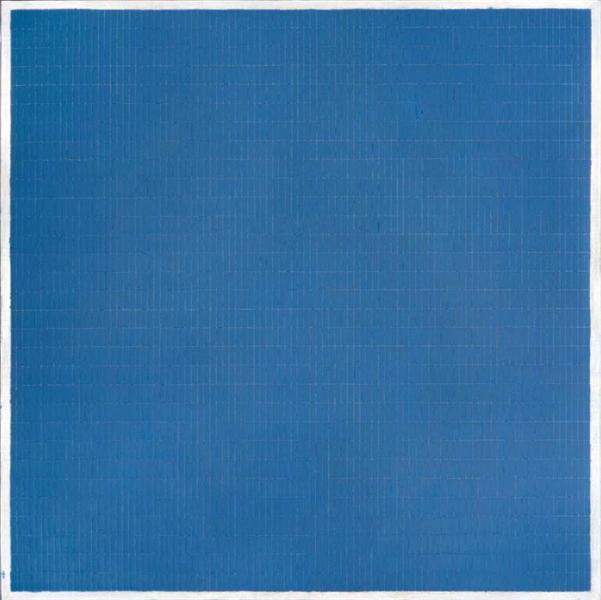
One of the most radical of the early grids — the ground is painted a deep, dark, almost navy blue, and over this the pencil grid is drawn in gold paint. The combination of blue and gold is unusual in her work, which more typically deals in pale and near-neutral tones, and the result is more visually assertive than most of her paintings. The title's reference to night sea suggests the dark and the deep, the sense of being afloat on something vast and lightless — the gold grid floating over the blue like phosphorescence. It is one of the works that complicates any simple reading of her painting as purely quiet or reductive.
Happy Holiday 1999
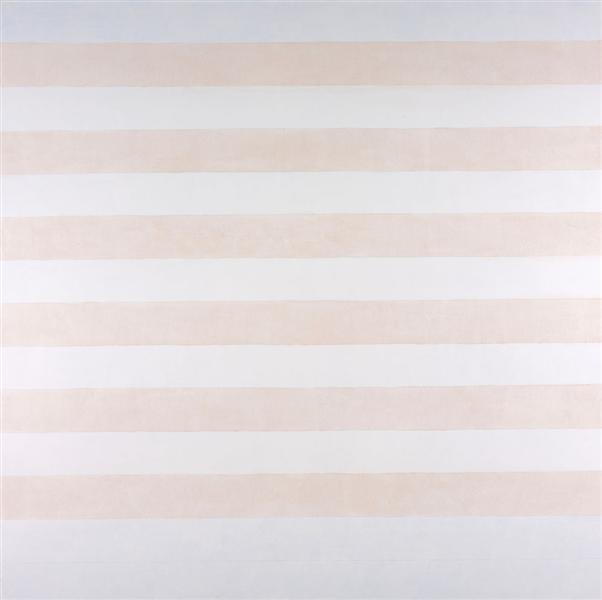
A late work from the series she produced in the final decade of her career — a large square canvas divided into horizontal bands of pale colour, alternating between near-white and a very soft yellow-green, applied in acrylic with pencil lines marking their boundaries. The title's warmth is genuine rather than ironic: in her late works she gave paintings titles like 'Happiness', 'Lovely Life', 'Innocent Love' with complete sincerity, describing emotional states she believed painting could directly convey. The colour here is at its most present, the horizontal bands broader and more assertive than in the earlier grids, the surface still and warm. It is in the Pace Gallery collection.