Anselm Kiefer
He took German history — the most catastrophically weighted history of the twentieth century — and made paintings out of its ashes.
Style and technique
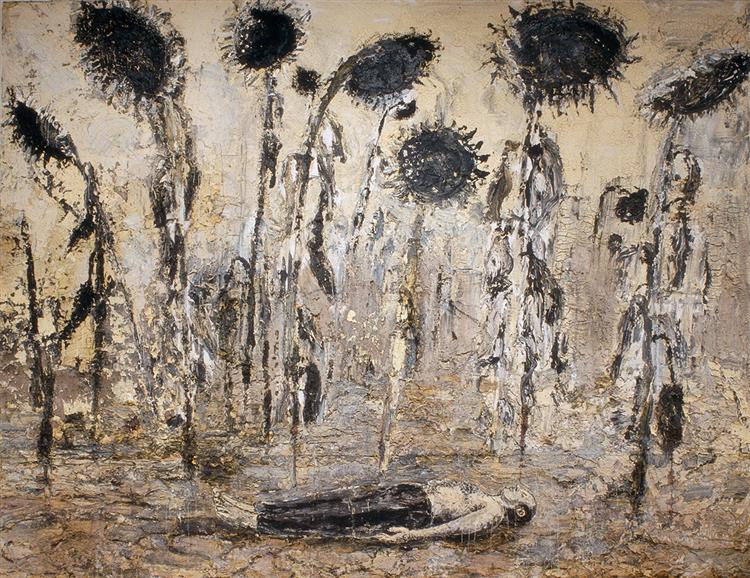
Kiefer makes paintings the way a landscape makes geology: through accumulation, pressure, and time. His canvases are typically enormous — sometimes many metres across — and their surfaces are built up with materials far beyond conventional paint: straw, lead, ash, sand, clay, broken glass, dried flowers, and sometimes lead sheeting that weighs the canvas to the floor. These surfaces are not background for an image; the surface is the subject, an environment that the image inhabits.
His imagery draws from two primary sources: German history and German mythology, which he refuses to separate from each other. The forests and heroes of Germanic legend, the architecture of the Third Reich, the words of Paul Celan and Ingeborg Bachmann, the theology of the Kabbalah — all appear in his work as elements of a single, haunted cultural landscape that cannot be approached without confronting the catastrophe at its centre.
He emerged into the German art world in the early 1970s by making work that was deliberately, provocatively uncomfortable: photographs of himself giving the Nazi salute in European landmarks, paintings of the grandiose interiors designed by Albert Speer. These early works were shocking because they treated National Socialism as a subject rather than a taboo — they looked at it rather than away from it.
Four fingerprints: enormous scale that makes the viewer feel physically inside rather than outside the painting, heavy mixed-media surfaces incorporating lead, straw, ash, and other non-traditional materials, German mythological and historical imagery — the forest, the autobahn, the architectural forms of the Third Reich — as primary visual content, and written text — names, Hebrew letters, poetic quotations — incorporated into the surface as visual and semantic elements.
Life and legacy
Kiefer was born on 8 March 1945 in Donaueschingen, Germany — exactly three months before the end of the Second World War. He grew up in the postwar Federal Republic, in the silences and evasions with which the West German state and society handled the recent catastrophe. The question of what it meant to be German after the Holocaust, to have been born into a culture that had produced Auschwitz, was for him not a political question in the first instance but a personal and artistic one.
He studied law and modern languages before turning to art, studying first in Freiburg and then with Joseph Beuys in Düsseldorf in the early 1970s. Beuys's influence — his use of heavy materials with symbolic weight, his willingness to treat historical trauma as artistic material, his sense of the artist as a kind of shaman or healer — is fundamental to understanding Kiefer's development.
The early German salute photographs, taken in 1969, were a deliberate provocation: he was performing what was illegal and taboo, not to celebrate it but to refuse the repression that kept it underground. The strategy was widely misunderstood, which was probably inevitable. The subsequent paintings were less easily misread: the blackened German landscapes, the interiors that quoted Speer's megalomaniac architecture, the titles from Nazi mythology treated not as celebrations but as wounds.
Through the 1970s and 1980s his work was received with enormous complexity in Germany — celebrated by the international art world before German institutions were comfortable showing it — and with growing international recognition. The German pavilion at the 1980 Venice Biennale, which he shared with Georg Baselitz, was a watershed: the international art world understood that German art had returned to the first rank.
In the 1980s he began incorporating lead as a primary material — lead floors, lead books, lead aircraft — and his references expanded from German history to include Kabbalah, alchemy, and the poetry of Paul Celan. The Celan connection is particularly significant: Celan, who survived the camps and wrote in German after the Holocaust, is the literary figure whose work most nearly parallels Kiefer's visual project.
He continues to work at monumental scale and remains one of the most significant painters active today.
Five famous paintings
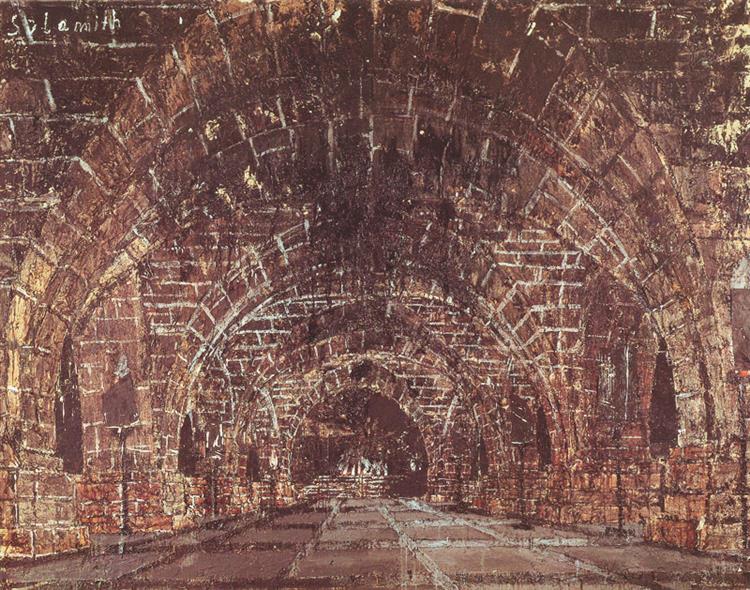
Sulamith 1983
A painting that directly addresses the Holocaust through Celan's 'Death Fugue', in which Sulamith and Margarethe are the two women — one Jewish, one German — whose intertwined fates embody the tragedy. A vast architectural interior — modelled on the Nazi Hall of Soldiers' Honour in Berlin — recedes in forced perspective toward an opening of orange fire. The space is monumental, cold, empty except for a dark smear where the fire burns at the far end. The painting confronts the architecture of the Third Reich as a physical presence, refusing to aestheticise it while making it aesthetically overwhelming. It is in the Saatchi Collection in London.
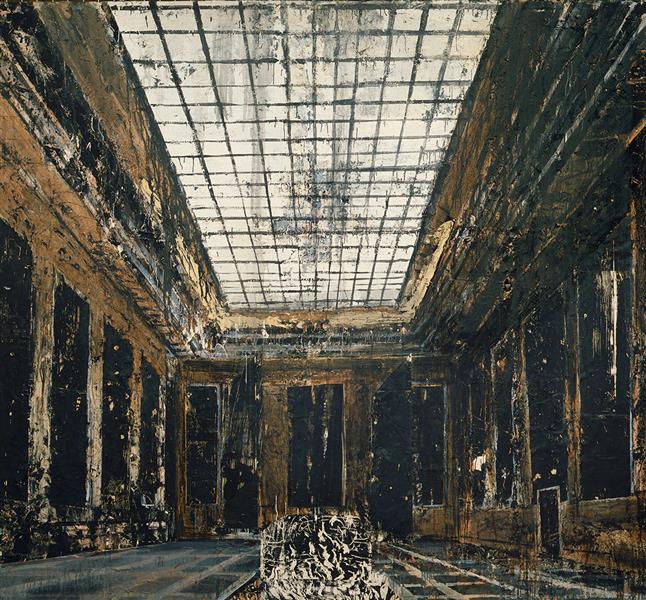
Interior 1981
An architectural interior — vast, official, marble-floored — painted in the warm browns and greys of a building photographed in black and white. The perspective is extreme; the space recedes to near-infinity. The painting is about the physical experience of the Third Reich's architecture: the Speer interiors that were designed to make the individual feel infinitely small before the state. By painting these spaces Kiefer refuses to let them be forgotten; by painting them in a way that makes them grandly empty — no people, no purpose, just echoing space — he makes them monuments to their own meaninglessness. It is in the Stedelijk Van Abbemuseum in Eindhoven.