Gerhard Richter
He has spent sixty years asking what photography did to painting — and proving the question still has no answer.
Style and technique
Richter's career defies summary because he has deliberately refused any single style, approach, or aesthetic commitment. For six decades he has moved between photorealistic paintings of photographs and pure abstraction, between colour charts and family snapshots, between blurred and precise, between warm and cold — and has insisted that each mode of working is equally valid, equally interrogative of the same questions.
The questions are: what does painting mean after photography? And: what does image-making mean after the Second World War? These are not separable questions in his practice. He was born in Germany in 1932 and grew up in the Nazi period and the East German regime; he escaped to West Germany in 1961, just before the Wall was built. His entire career is shaped by the experience of living inside two totalitarian systems that both used images — propaganda photographs, official portraits, architectural photography — as instruments of ideology.
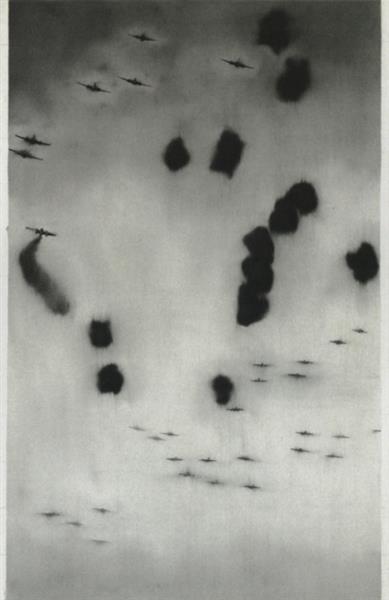
His photo-paintings, which he began in the early 1960s, are painted from black-and-white photographs with a degree of blurring that makes them seem slightly out of focus. The blur is not a failure of resolution but a formal argument: it keeps the image at a critical distance from photographic reality, insisting that the painting is a painting — a made thing, a visual object — rather than a reproduction of a document.
Four fingerprints: the photographic blur in the representational paintings — the image that is clear enough to read and unclear enough to question, the squeegee abstraction in which layers of colour are dragged and smeared into complex, luminous surfaces, a systematic irony that refuses to privilege any style or approach, and engagement with German history and memory as a recurring thematic undercurrent even in the most ostensibly formal works.
Life and legacy
Richter was born on 9 February 1932 in Dresden, in what would become East Germany. His childhood was shaped by the war — Dresden was firebombed in February 1945, when he was twelve — and by the transition from one totalitarian system to another as the Nazi period ended and Soviet occupation began.
He studied at the Kunstakademie in Dresden, where Socialist Realism was the required approach. He was a good student and a skilled painter, and he made his way within the constraints of the East German art system through the 1950s. But he was paying close attention to what was happening in the West, particularly to Informel abstraction and to Pop Art, and in 1961 — just weeks before the Berlin Wall was completed — he crossed to West Germany with his wife and did not return.
In Düsseldorf, where he enrolled at the Kunstakademie, he encountered the Fluxus movement and the work of Joseph Beuys, whose approach to art as a social and political practice was completely different from the academy he had left. He also encountered photographs — the accumulated imagery of the postwar world — in a new way, and began working directly from them.
The first photo-paintings, made in 1962–1963, were immediately distinctive. He was working from the same sources as Warhol — newspaper photographs, family snapshots — but in a completely different spirit: not celebration or appropriation but investigation, doubt, the image held at arm's length and examined for what it was actually doing.
His 'Atlas' project — a constantly expanding archive of photographs, colour samples, news images, and sketches that has grown to thousands of panels since 1962 — is both a working method and a major artwork in its own right, documenting the sources from which his paintings emerge.
The abstract squeegee paintings, which he began developing in the early 1970s, became his second major mode. Working with a large squeegee or palette knife drawn across layers of wet paint, he produced surfaces of extraordinary complexity — landscapes of colour that bear no marks of human expression in the conventional sense and yet are clearly and entirely the result of a human's decisions and physical acts.
The full retrospective of his work at the Museum of Modern Art in New York in 2002 was one of the great museum exhibitions of the last quarter century.
Five famous paintings
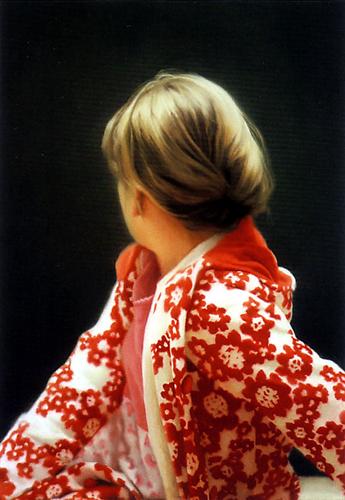
Betty 1988
Richter's daughter, seen from behind, her head turned slightly to one side. She is painted from a photograph — clearly photographic in its resolution and colour — but with the characteristic slight softening that marks all his photo-paintings. The figure turns away from the viewer; we see only the back of her head, the side of her face, the specific curl of her hair. The painting is both tender and withholding: it offers the subject while denying the frontal portrait that convention expects. The turn of the head has prompted an enormous amount of critical interpretation. It is in the Museum Ludwig in Cologne.
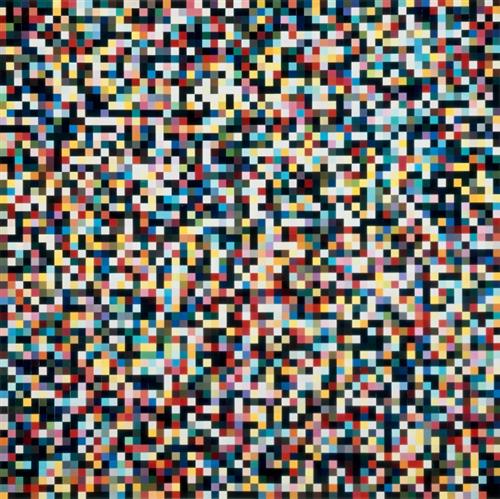
4096 Colours 1974
One of the Colour Chart paintings — a large canvas divided into a grid of coloured rectangles, each one a slightly different hue, moving through the spectrum in an arrangement that is systematic without being a simple progression. The painting is made from colour samples — the same materials a house painter or printer would use to select a colour — elevated to canvas scale and presented as painting. The work asks whether a systematic arrangement of colour samples can be a painting at all, and answers that question by existing as a painting that you cannot help responding to aesthetically. It is in the Städel Museum in Frankfurt.
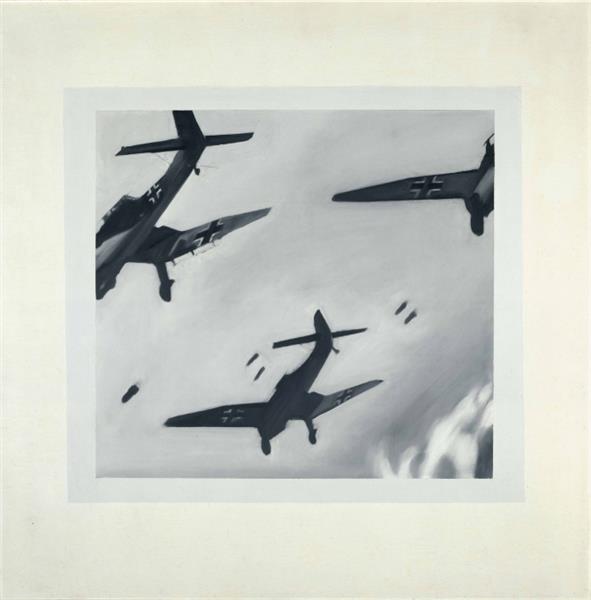
Stukas 1964
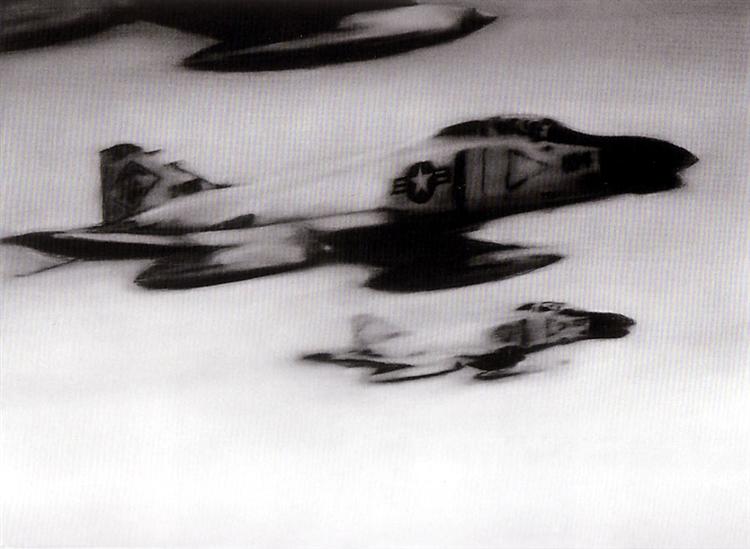
An early photo-painting showing a formation of Stuka dive-bombers — the aircraft most associated with German Blitzkrieg tactics in the Second World War — in flight. The image is taken from a wartime photograph, blurred to the characteristic degree, painted in grey and black. The subject matter is direct: this is the machinery of German aggression, represented in a style that refuses both condemnation and celebration. The blur keeps the image at a distance, prevents the easy response, insists on the act of looking rather than the comfort of an interpretation. It is one of a group of works in which he confronted the iconography of the Third Reich directly.
Mother and Daughter (B.) 1965
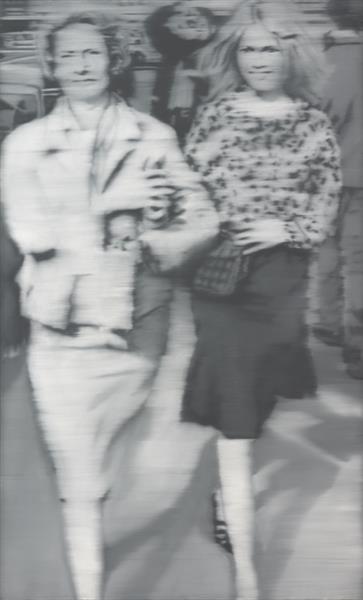
Two figures — a mother and daughter — photographed together, the image painted in his characteristic blurred grey scale. The intimacy of the subject is held at a formal distance by the photographic source and the blurring, which softens faces and figures into near-abstraction. The 'B.' in the title suggests this is one of a series of versions of the same source photograph. The work belongs to a group of domestic and family subjects that Richter treated in the early 1960s — subjects chosen for their ordinariness, their availability, their resistance to the grand historical subjects that German painting had inherited.
Women Descending the Staircase 1965
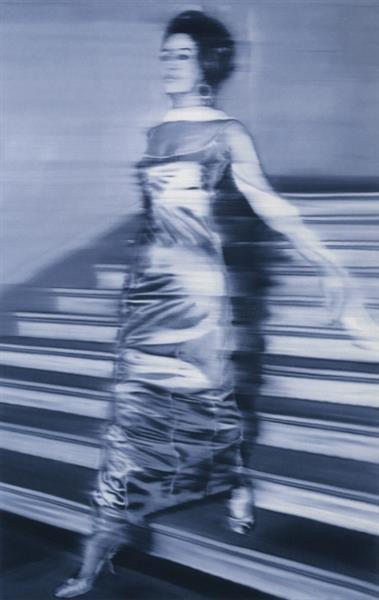
Two fashionably dressed women are photographed descending a staircase — the image has the quality of a magazine photograph, the women posed and self-aware. In Richter's painted version, the blur softens the glamour and specificity of the source, bringing the figures into the same register as his grey family photographs and wartime images. The title echoes Duchamp's 'Nude Descending a Staircase' — another painting about the impossibility of capturing motion in a still image — though the echo is probably coincidental. The painting is part of the early period in which he was testing the limits of what photographic imagery could do when moved to paint.