Banksy
He put art on walls no one was supposed to paint — and made the wall part of the argument.
Style and technique
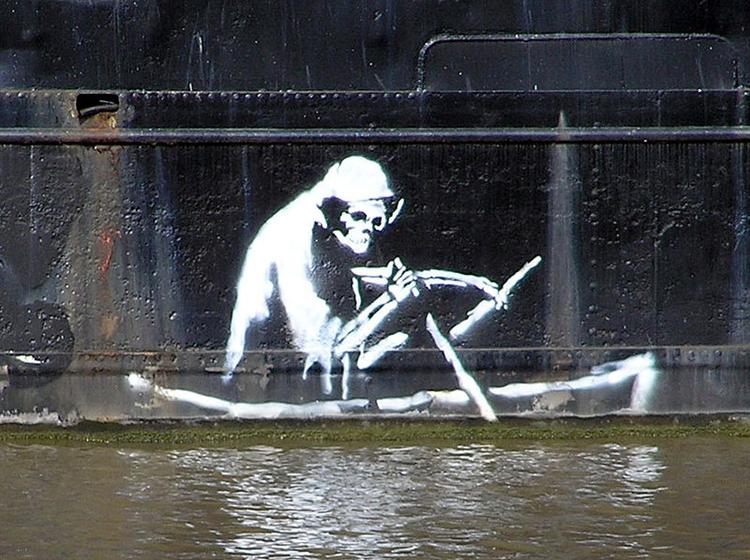
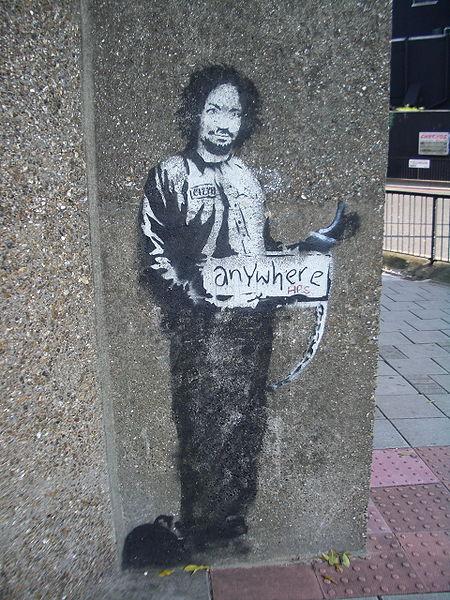
Banksy's primary medium is the stencil — a technique that allows quick application to public walls with minimal time for arrest, and that produces images with a clean graphic quality very different from the sprayed calligraphy of tag-based graffiti. The stencil enables repetition: the same image can appear in multiple cities, on multiple walls, in a way that makes the work feel both site-specific and universal.
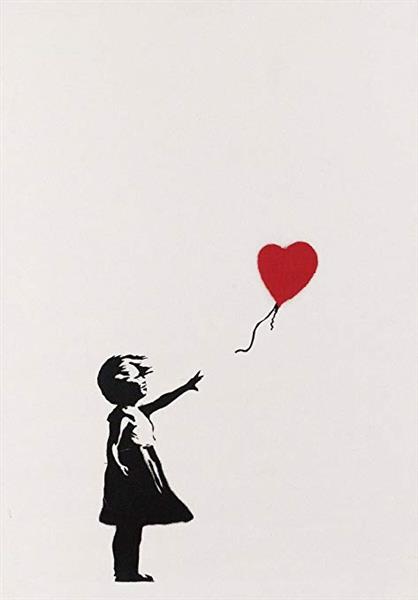
The images themselves tend to work by juxtaposition: a familiar thing placed next to or transformed into an unfamiliar context. A rat holding a paintbrush. A policeman sniffing flowers. A small girl releasing a red balloon. These combinations are not complex to read — they are immediately legible to anyone passing — but they are crafted with sufficient precision that the initial joke or irony opens onto something more uncomfortable on second look.
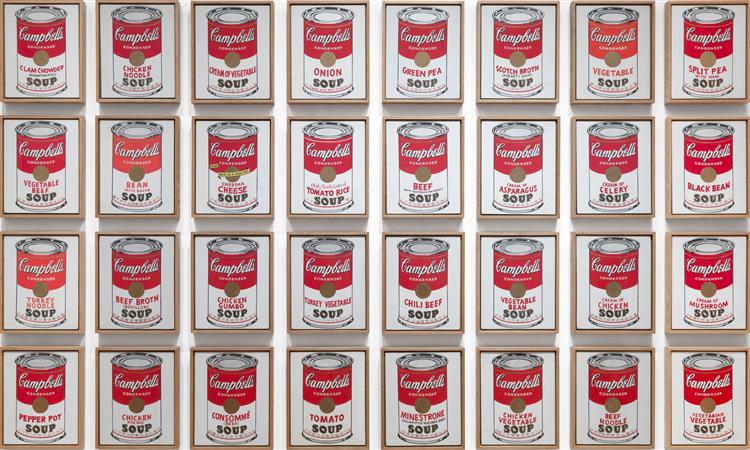
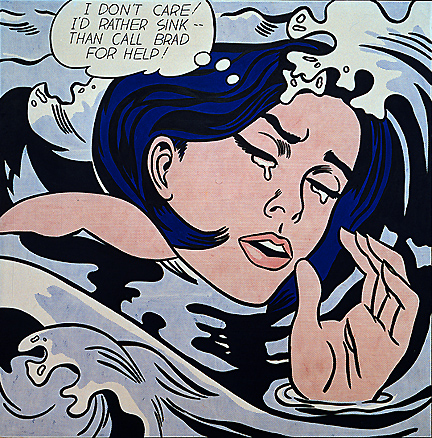
His formal influences are explicit: the street art traditions of New York and Bristol, the graphic design sensibility of political poster art, and a specific debt to Pop Art's use of popular imagery and commercial language turned against itself. He acknowledges Warhol and Duchamp as reference points. The stencil technique has its own history in Dada and Surrealist practice.
Four fingerprints: the stencil as primary technique — clean, reproducible, deployable quickly in public space, dark humour and political irony as the dominant register, site-specificity — the meaning of the image is always partly determined by where it is placed, and the tension between the street and the gallery, the public wall and the auction house, that runs through everything he makes.
Life and legacy
Banksy was born around 1974 in Bristol, England — the exact date is uncertain, as is almost everything biographical about him. His identity has never been officially confirmed, though various individuals have been named over the years by journalists and former associates. He has never confirmed or denied any of these identifications.
He grew up in Bristol and began making graffiti in the city's Easton area in the late 1980s and early 1990s, as part of the Bristol underground scene that also produced the musician Tricky, the band Massive Attack, and a broader network of street artists and musicians. The specific culture of early Bristol graffiti — informed by both American hip-hop tradition and British political protest art — shaped his initial approach.
He adopted the stencil technique around 1993–1994, reportedly after observing another artist and recognising immediately that it was faster and more effective than freehand spraying. The stencil allowed him to work on large surfaces in the time that freehand painting would require for small ones, and the clean graphic quality it produced was more legible at speed — important when the audience is people passing rather than people stopping.
He began to attract wider attention in the early 2000s as his work appeared on major walls in London, Bristol, and other British cities. The Naked Trump and the Kissing Coppers on walls in Brighton became widely photographed and shared. His first book, 'Banging Your Head Against a Brick Wall', was self-published in 2001.
His practice expanded beyond walls: he began placing altered paintings in major museum collections — hanging them on the walls of the Louvre, the British Museum, the MoMA — without permission, where they would sometimes hang for days before being removed. He built installations, made films, and organised exhibitions. 'Exit Through the Gift Shop' (2010), his documentary film about street art, was nominated for an Academy Award.
He continues to work internationally, his identity still officially unknown.
Five famous paintings
Girl with Balloon 2002
A small girl in a black silhouette reaches upward toward a red heart-shaped balloon that is drifting away from her outstretched hand. The image is simple, the stencil clean, the red balloon the only colour in the work. It first appeared on London's South Bank in 2002 and has since been reproduced endlessly — on walls, on merchandise, in charity campaigns. The image works because it is emotionally direct and optically balanced, the diagonal of the girl's arm and the upward movement of the balloon creating a visual dynamic that resolves in loss. The Sotheby's version that self-destructed in 2018 became the most famous single art event of recent years.
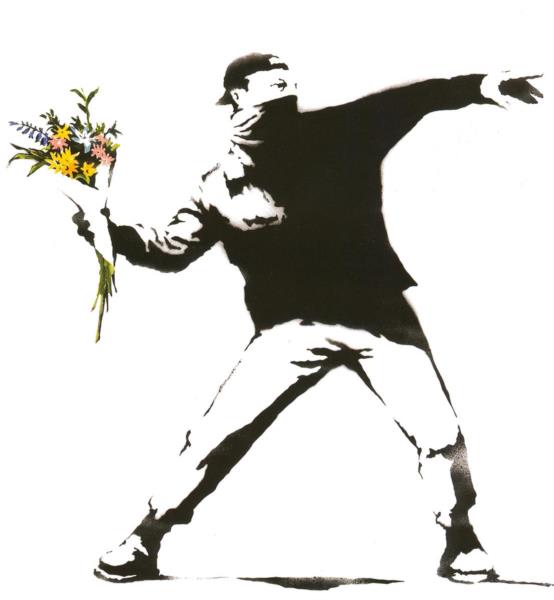
Rage, Flower Thrower 2005
A masked protestor — in the posture of someone throwing a molotov cocktail or a rock — holds instead a bouquet of flowers, about to throw it toward an unseen target. The figure is painted on a wall in Jerusalem near the Kalandia refugee camp, which becomes part of its meaning: the conflict between the flower and the thrown-gesture, the beauty of the flowers and the anger of the posture, here set against the specific landscape of the Israeli-Palestinian separation wall. It is probably Banksy's most widely reproduced image and is among the most frequently cited examples of politically effective public art.
Vandalised Phone Box 2005
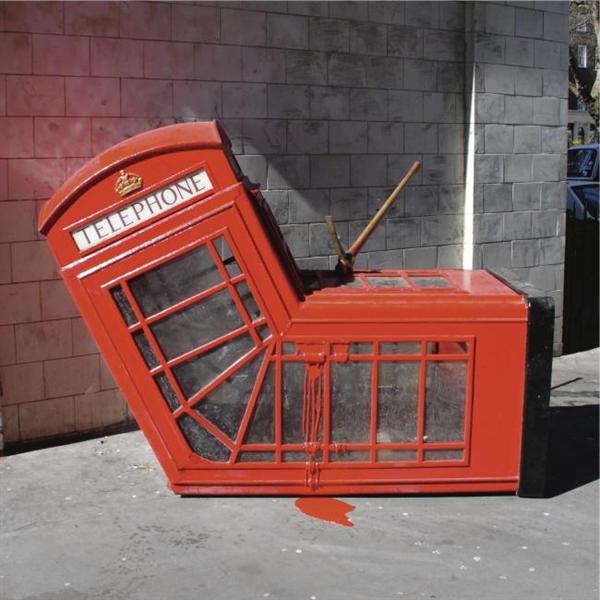
A traditional British red telephone box — a cultural icon — has been split open, bent over, and is 'bleeding' red paint onto the pavement below, a pickaxe embedded in its side as if someone has just attacked it. The sculpture was placed in Oxford Street in London without permission. The combination of the attack, the blood-like red paint, and the iconic British object created an immediate, legible visual joke about the destruction of public infrastructure and the decline of traditional British culture. It was removed by Westminster City Council after a few days.
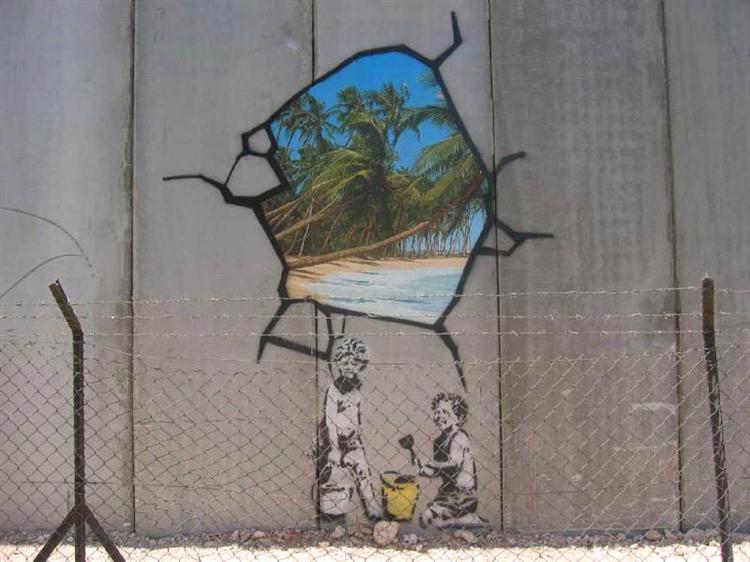
Bethlehem 2005
A painting made directly on the Israeli West Bank barrier in Bethlehem: a hole appears to have been blown in the grey concrete wall, and through it a tropical paradise is visible — white sand, palm trees, blue sky, a lounger. A soldier with a gun stands at the edge of the hole, apparently looking in. The image works because the paradise is as much a tourist cliché as a genuine vision of another world — the wall has not been blown open into Eden but into a travel poster. The irony is multilayered: the barrier is real, the violence that created it is real, and the release offered by the imagined hole is a commercial fantasy.
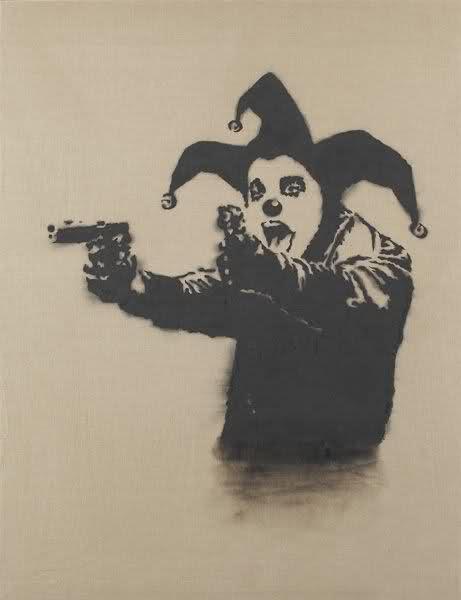
Insane Clown 2001
An early stencil work from the Bristol period, showing a clown figure in a posture of distress or madness. The clown is a recurring figure in his early work — the entertainer whose smile is a mask, the performer whose job is to make others happy regardless of his own state. The image precedes the global spread of his work and has something rougher and more personal about it than the later, more polished pieces. It is characteristic of the early Bristol aesthetic — dark humour, borrowed popular imagery, the carnival turned sinister.