Jean-Michel Basquiat
He wrote the history of Black America on canvas in the language of the street, and the art world has been trying to catch up ever since.
Style and technique
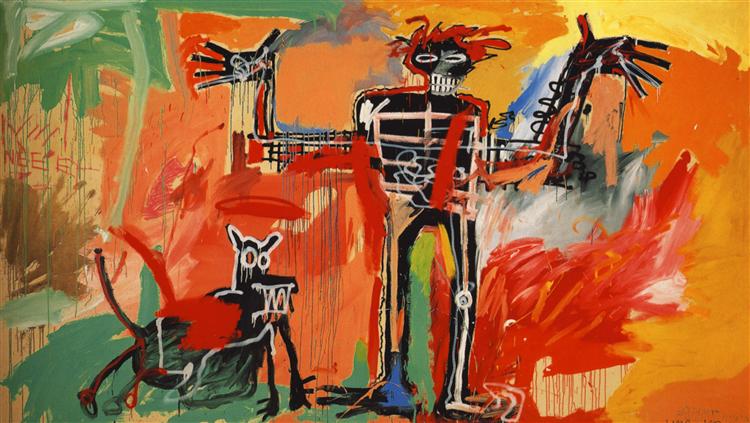
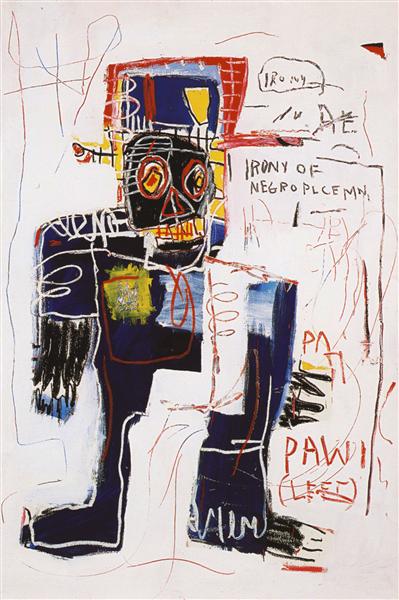
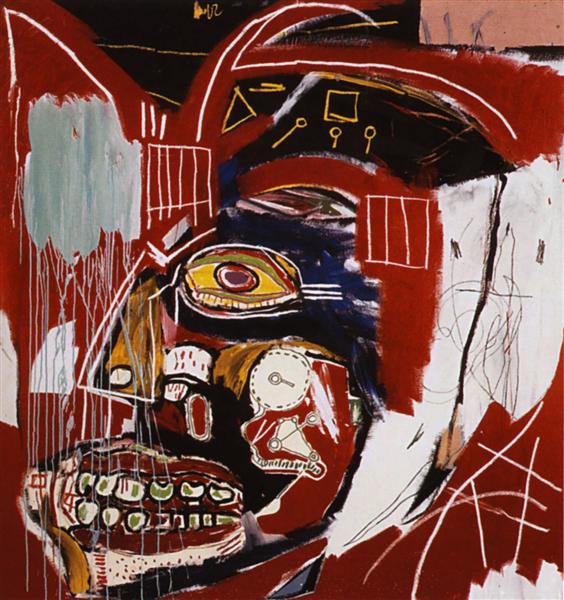
Basquiat's paintings are built from accumulation — layers of paint, drawing, text, crossing out, repainting, adding, destroying. The surface of a Basquiat canvas is a palimpsest: you can read through the uppermost layer to earlier ones, see the corrections and revisions, find the texts that have been partly obscured by paint. This stratification is not accidental but fundamental to the work's meaning; history, in his practice, is always visible beneath the present.
The sources are multiple and explicit: street graffiti, anatomical diagrams, heraldic imagery, Black music and sports history, the logos and signs of commercial America, the language of the street and the language of the museum — placed side by side without hierarchy. He put the names of jazz musicians beside the diagrams of skeletons, the copyright symbol beside historical grievances, the crowns of street royalty beside the catalogues of corporate power.
His figures — typically male, typically Black, typically crowned — have the quality of saints in an icon tradition that has never been offered to them before. The crowns are both ironic (borrowed from the street tag tradition, where a crown signals dominance) and absolutely serious: these are people who have been systematically denied acknowledgement and whom he is insisting on acknowledging.
Four fingerprints: layered, corrected surfaces with text crossed out, painted over, and rewritten, the skeleton and anatomy as recurring formal elements, proper names — athletes, musicians, historical figures — appearing as text within the composition, and the crown as a repeated symbol of self-appointment and contested authority.
Life and legacy
Basquiat was born on 22 December 1960 in Brooklyn, New York, to a Haitian father and a Puerto Rican mother. His mother introduced him to art and took him to the Brooklyn Museum and the Metropolitan from early childhood. At nine, he was in a car accident and spent a month in hospital; his mother brought him a copy of Gray's Anatomy, which would become a permanent visual reference.
He was a difficult adolescent — briefly homeless at fifteen after running away from home — and largely self-educated in art. In 1978, at seventeen, he and his friend Al Diaz began spray-painting cryptic texts and images on buildings in lower Manhattan under the tag SAMO© (Same Old Shit). The SAMO works — aphoristic texts with a distinctive visual style — were noticed by the downtown New York art world before anyone knew who was making them.
He was in the art world socially before he was professionally. He sold postcards and T-shirts on the street outside galleries in SoHo, met artists and critics at the downtown clubs and bars, and was recognised as someone whose energy and intelligence demanded attention. He began making paintings on canvas and board in 1980, and by 1981 he had appeared in a group exhibition and been photographed for the Village Voice by the critic René Ricard, whose essay 'The Radiant Child' made him nationally famous.
His rise was meteoric and without precedent for a Black American artist. By 1982, at twenty-one, he was showing in major galleries in New York, Zurich, and Los Angeles. In 1983 he met Andy Warhol, and the two became close friends and occasional collaborators, producing a series of joint canvases in 1984–1985.
The speed of the rise was also the speed of the fall. The art market absorbed him rapidly and voraciously; he produced enormous quantities of work under dealer pressure; he began using heroin heavily. His best friend Warhol died in 1987, which devastated him. He died on 12 August 1988 in his studio in SoHo, of a heroin overdose, aged twenty-seven.
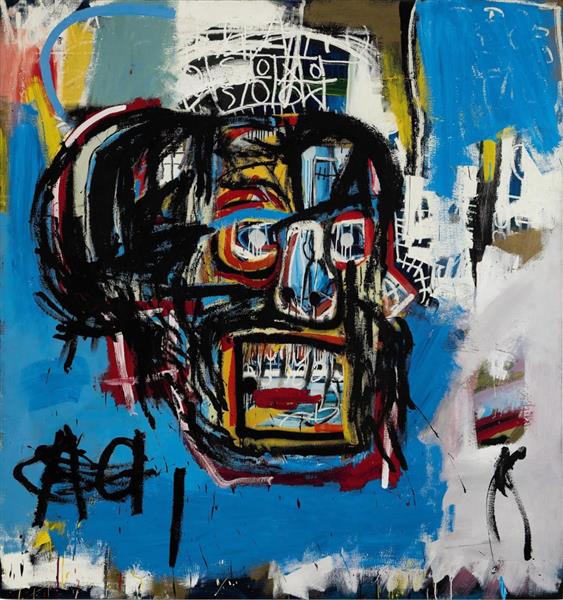
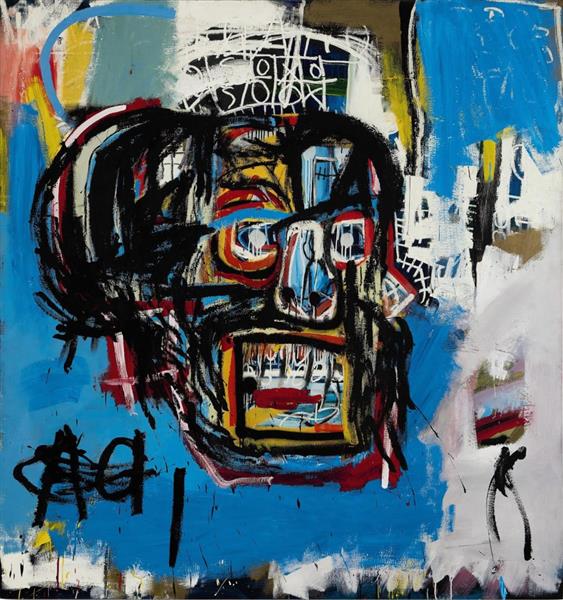
In 2017, his 'Untitled' of 1982 sold for $110.5 million at Sotheby's — the highest price ever paid for an American artist at the time.
Five famous paintings
Untitled 1982
The skull painting that sold for $110.5 million in 2017 — a raw skull rendered on a canvas of roughly 183 by 173 centimetres in thick paint, the face barely there, the skull pressing through. The painting is typically Basquiat in its accumulation: there are several layers of paint, scrawled text partially obscured, a field of deep red and black and grey that makes the skull float in an unstable space. The work was made in the year of his first major solo exhibition and represents his mature style at its most concentrated — the anatomy that interested him since childhood, the blackness that interested him always, the crown of authority placed nowhere in this painting but felt everywhere.
Dustheads 1982
Two large heads — both crowned, both intense, their mouths open — face the viewer against an orange ground. The figures are painted in black outline with interior colour: greens, reds, whites applied in loose areas. The word 'Dustheads' is both slang for someone who is high on PCP and a comment on the social position of the figures — those who live in the dust, below the sight lines of power. The crowns atop these heads are therefore doubly charged: the crowned who are also the dusted. The painting is in a private collection and is one of the most reproduced works from his 1982 body of work, which was extraordinarily productive.
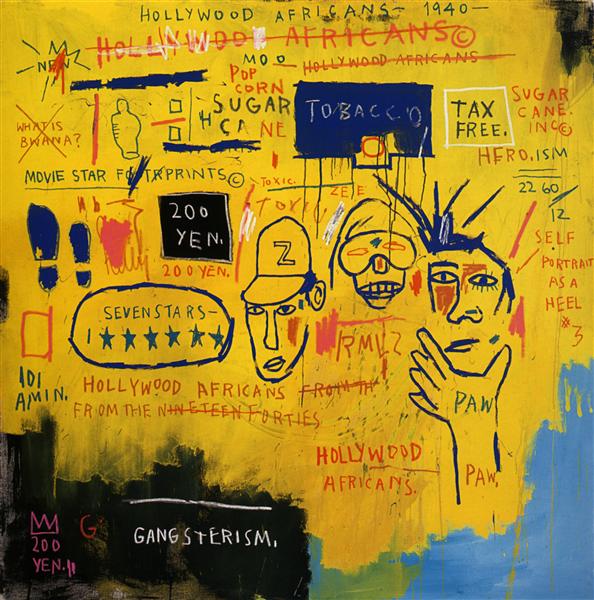
Hollywood Africans 1983
Three figures — himself, the rap artist Toxic, and the painter Rammelzee — painted after a trip to Los Angeles, where they had felt conspicuously and uncomfortably Black in a white entertainment industry. The canvas is covered with text: 'sugar cane', 'tobacco', 'HOLLY WOOD AFRICANS', '$200 A DAY', the word 'TEETH' pointing to a figure's mouth. The painting is about the commodification of Blackness in American entertainment, the way in which African American culture is consumed without acknowledgement, the price paid for being visible in a world that values you only as spectacle. It is in the Whitney Museum of American Art.
Riding with Death 1988
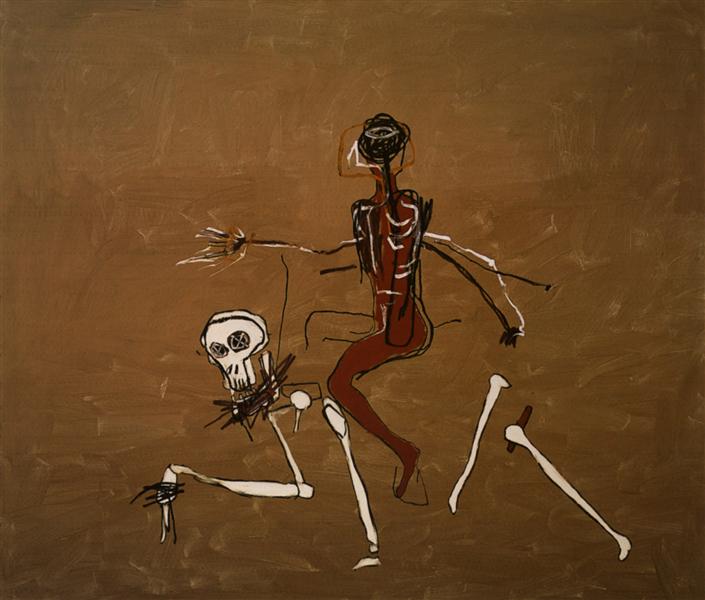
Made in the last year of his life, this painting shows a skeletal figure riding a skeletal horse — rendered in loose charcoal and paint on a canvas of unprimed surface. The execution is less dense than his earlier work, the layers fewer, the surface more open. Whether this represents a new direction, a final clarity, or the thinning of resources that precede death is impossible to know. It was completed in the year he died. The skeleton rider is one of the oldest images in Western art — the figure of Death on horseback — but in Basquiat's hands it is also specifically his own figure: the young Black artist who knew, or seemed to know, that he would not survive his youth.