
Canaletto
The camera-obscura eye that made Venice's canals, light, and crowds look almost photographic.
Style and technique
Canaletto's paintings look almost photographic, and that is no accident: he is one of the first major painters documented to have used a camera obscura, a lens-and-mirror device that projected a live image onto a surface so its outlines could be traced. The result is an uncanny precision of architectural perspective — orthogonal lines racing toward vanishing points with ruler-straight confidence, the exact rhythm of a palazzo's window bays, the precise curve of a canal's far bank. Over this scaffolding he laid a light unlike anyone else's: the cool, silvery, faintly overcast luminosity of the Venetian lagoon, where sun bounces off water onto stone and back again, softening shadows into gentle gradients and making even weathered brick look freshly washed. He built his views with meticulous underdrawing, often incising guidelines directly into the canvas, then worked from architecture outward to water, using tiny, precise flecks of white and ochre — dragged with a brush tip or palette knife — to suggest sunlight glittering on ripples, a technique so distinctive it now serves as a signature of his hand. Populating these stage-set cities are hundreds of miniature figures, each built from only a few deft strokes yet unmistakably alive: gondoliers straining at their oars, merchants haggling, aristocrats in tricornes and cloaks, dogs, washerwomen, and idlers leaning on balustrades.
Later in his career, especially after his years in England, his touch grew drier and more mechanical, with harder outlines and cooler color, but the essential recognisability never faded: exacting architecture, luminous silver-grey sky, glittering water, and crowds of tiny Venetians going about their business beneath an eternally clear and eventful sky.
Life and legacy
Giovanni Antonio Canal was born in Venice on 28 October 1697, son of Bernardo Canal, a theatrical scene painter who supplied elaborate stage sets for the city's opera houses. Giovanni Antonio — soon nicknamed Canaletto, "little Canal," to distinguish him from his father — trained in the family workshop, learning perspective, illusionistic architecture, and theatrical staging rather than easel painting. Around 1719-1720 he accompanied his father to Rome to paint sets for operas by Vivaldi and Alessandro Scarlatti. There, tradition holds, he abandoned theatre design after being struck by the raking light on Rome's ruins and by the view paintings of artists such as Giovanni Paolo Pannini. Back in Venice, he registered with the painters' guild and began painting the city itself with the same theatrical eye for staging, light, and grand perspective he had absorbed backstage, quickly finding buyers among resident foreign merchants.
His breakthrough came through Joseph Smith, an English merchant, collector, and later British consul in Venice, who became Canaletto's most important patron and effectively his agent. Smith commissioned paintings, financed a celebrated series of engravings after Canaletto's designs by Antonio Visentini, and steered a steady stream of English aristocrats on the Grand Tour toward the artist's studio. For wealthy young Englishmen rounding off their classical education with a tour of Italy, a Canaletto view of the Grand Canal or Piazza San Marco became the essential souvenir, and demand soon outstripped what one painter could supply; his nephew and pupil Bernardo Bellotto later carried the family style, and even the Canaletto name, to the courts of Dresden and Warsaw.
In 1746 he sailed for England, where he stayed roughly a decade, painting views of London, the Thames, Windsor, Warwick Castle, and English country estates in his familiar luminous style. Some patrons grumbled that his English work looked mechanical or doubted it was truly his; he answered the skeptics in 1754 by inscribing one canvas, Old Walton Bridge, with a note affirming he had painted it himself, in London, at the age of fifty-eight. He returned to Venice around 1755, was finally elected to the city's Academy of painting in 1763 after being passed over for years, and went on producing vedute and imaginative capricci until his death on 19 April 1768 — by then the golden age of the Grand Tour, and the market that had made him famous, was already fading into memory.
Five famous paintings
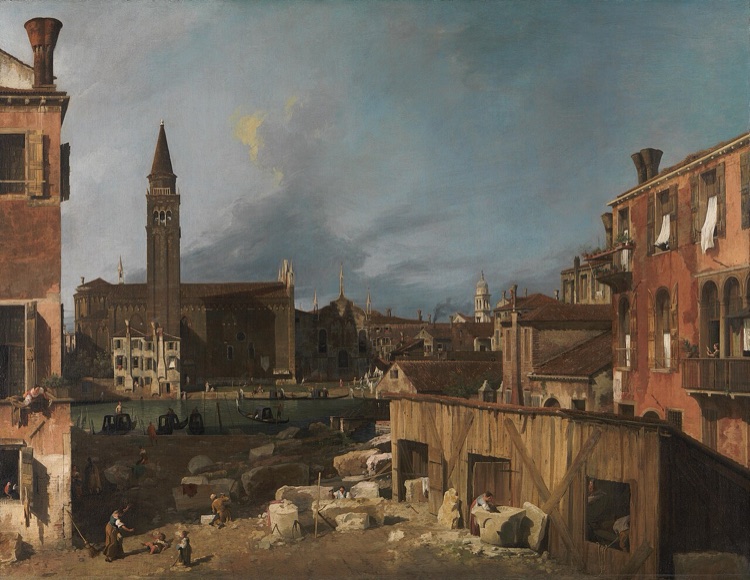
The Stonemason's Yard 1725
Far from any ceremonial pageant, this early masterpiece looks across a scruffy, sunlit campo where stonemasons cut and polish marble blocks amid scaffolding and chippings. Santa Maria della Carità rises hazily across the Grand Canal, its facade softened by humid light, while in the foreground a toddler tumbles and a woman calls from a doorway — ordinary Venice caught mid-morning. Canaletto renders worn timber, chalky stone dust, and weathered brick with the same exacting eye he gave to marble palaces, proving his camera-obscura precision worked as well on a builder's yard as on a doge's basin.
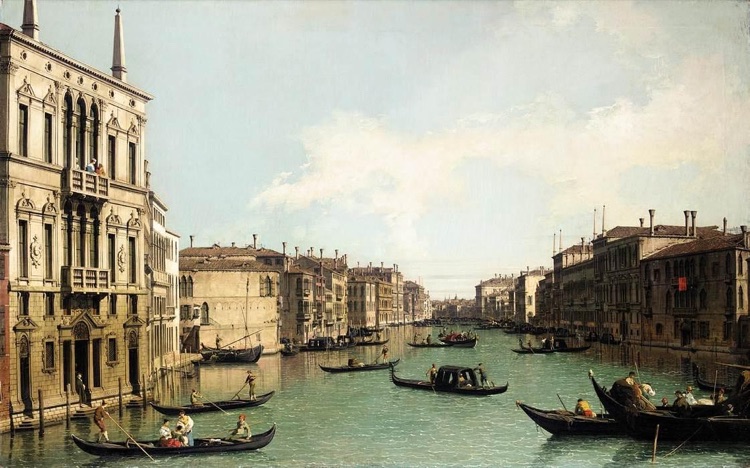
The Grand Canal from Palazzo Balbi towards the Rialto Bridge 1724
One of Canaletto's earliest dated views, this sweeping composition looks northeast up the Grand Canal from a balcony of Palazzo Balbi toward the distant hump of the Rialto Bridge, then Venice's only crossing. Gondolas and cargo barges crowd the glittering water in a diagonal rush of perspective, their oars and awnings flicked in with strokes of white and ochre, while a jumble of palazzi recedes into a silvery haze on either bank. The elevated, angled vantage point shows the young Canaletto already fusing theatrical staging with topographical exactness, a formula he would refine for decades.
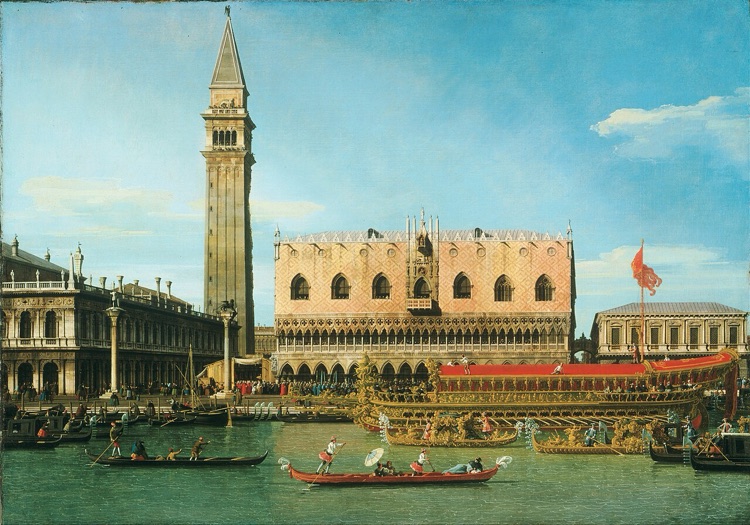
The Bucintoro at the Molo on Ascension Day 1732
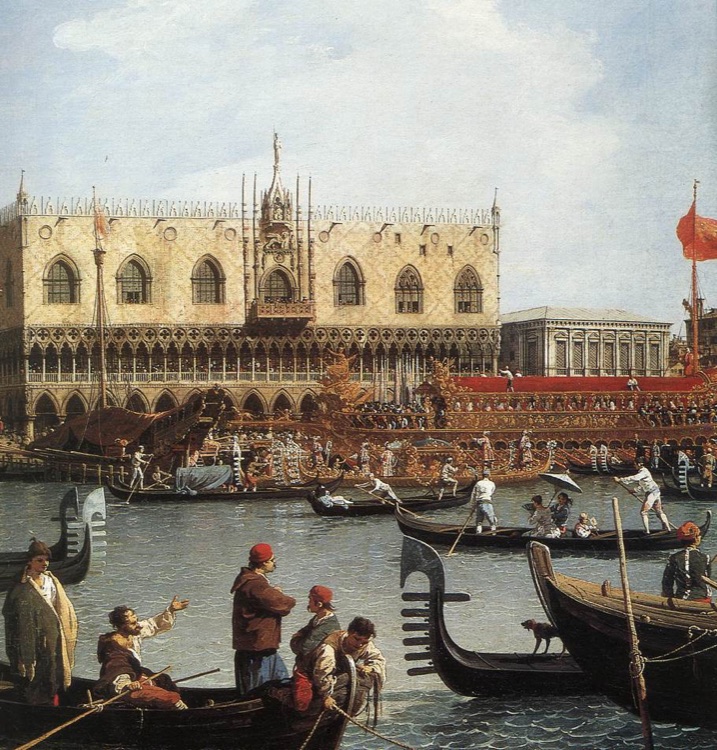
Every Ascension Day, the doge boarded the Bucintoro — a barge of carved and gilded wood rowed by scarlet-liveried oarsmen — and sailed to the Lido to cast a ring into the Adriatic, symbolically wedding Venice to the sea. Canaletto captures the vessel at the Molo, prow toward the viewer, glowing gold against grey-blue water with the Doge's Palace and Marciana Library rising behind it, while gondolas and spectator boats cram the basin and crowds line the quay. The picture doubles as civic pageantry and travel snapshot, freezing a once-a-year spectacle so a visitor who missed it could still claim to have witnessed Venice at its most magnificent.
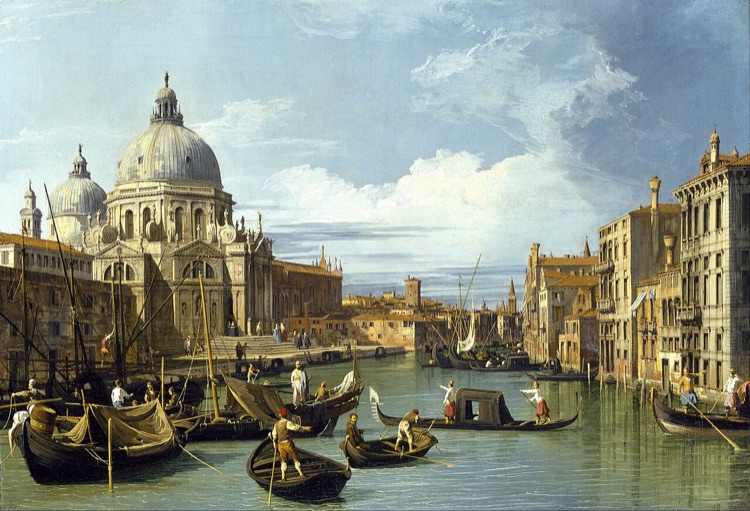
The Entrance to the Grand Canal, Venice 1730
A forest of masts and gondolas crowds the mouth of the Grand Canal at low, glassy water level, painted from Canaletto's favourite vantage in the Bacino looking toward the canal's entrance. On the left, the white dome and scrolled buttresses of Santa Maria della Salute rise against a pale sky, the Dogana di Mare's customs point juts into the water, and across the lagoon Palladio's Redentore floats in a silvery haze. Canaletto returned to this exact view again and again for eager Grand Tour patrons, refining the same composition into a repeatable, highly saleable formula. This particular version eventually crossed the Atlantic and now hangs in the Museum of Fine Arts, Houston — a testament to how far the 18th-century souvenir trade in Venetian views ultimately travelled.
Piazza San Marco 1730
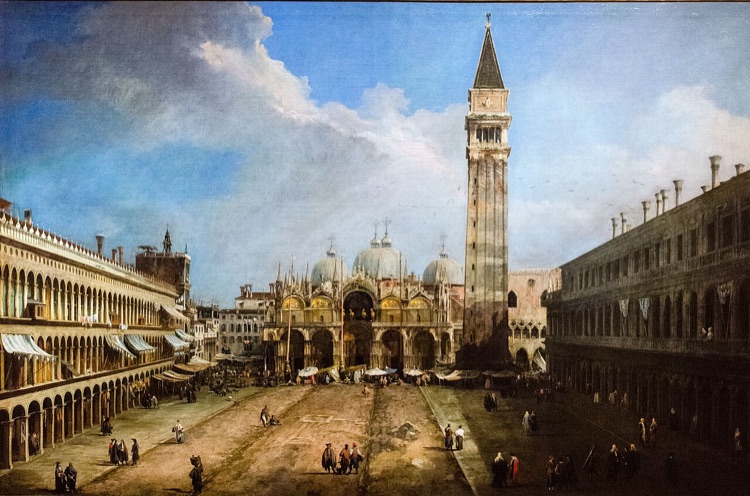
Venice's grandest room without a roof: the Piazza San Marco stretches away in flawless one-point perspective, the Basilica's domes and gilded mosaics catching the light at the far end, the Campanile rising at right, and the arcaded Procuratie running in ruler-straight lines toward the horizon. Tiny figures — strolling nobles, hawkers, clergy, dogs, and visitors in tricorn hats — cast long, precise shadows across sunlit paving stones, scaled so exactly against the architecture that the square's real dimensions could almost be measured off the canvas. It was the view every Grand Tourist wanted above all.