
Rococo
Watteau's dreamlike picnics, Fragonard's pink skies — pleasure elevated to an art form.
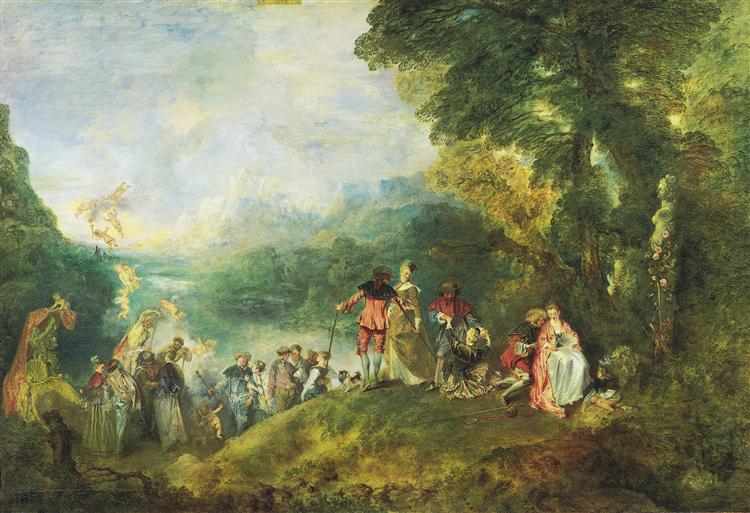
In the winter of 1717, Antoine Watteau submitted to the French Royal Academy a painting unlike anything on their walls: *The Embarkation for Cythera*, a scene of elegantly dressed lovers drifting toward the island of Venus through golden, hazy parkland. The Academy invented a category just for it — *fête galante* — and the Rococo had its manifesto. Born in Paris as a reaction against the cold grandeur of Louis XIV's court, the style spread across French salons, German princely palaces and Venetian ceilings over the following sixty years. Watteau's melancholy delicacy gave way to Boucher's rosy sensualism and Fragonard's laughing eroticism; in Bavaria, church ceilings dissolved into swirling pink and white confections by the Asam brothers and Johann Baptist Zimmermann. The Rococo was unapologetically concerned with pleasure — and produced some of the most technically brilliant, emotionally intelligent decorative art in Western history.
Origin and history
The Rococo was born from a political mood swing. When Louis XIV died at Versailles in September 1715, the French court celebrated — privately and sometimes openly. The Sun King's reign had meant fifty years of crushing tax, endless war and a suffocating ceremonial that reached into every corner of aristocratic life. His successor, the five-year-old Louis XV, handed power to the Regent Philippe d'Orléans, who promptly moved the court back to Paris. The nobility, freed from Versailles, retreated into smaller, more comfortable townhouses called *hôtels particuliers*, and the architecture of the rooms — panelled in pale wood, curved at the corners, ornamented with asymmetrical *rocailles* (shell-and-rock motifs) — gave the movement its name.
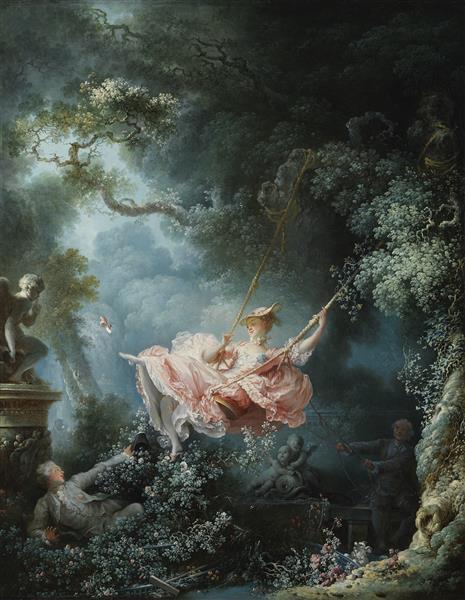
The painters who rose to meet this new domestic scale were not history painters working in the grand manner. Watteau (1684–1721) had trained as a decorator, absorbing Flemish warmth and Italian theatrical colour, and he brought both into his *fêtes galantes* — those scenes of refined society figures in parkland settings that feel simultaneously real and impossibly dreamed. After Watteau's early death, François Boucher (1703–70) became the movement's dominant voice, winning the patronage of Madame de Pompadour and painting a France of rosy flesh, silken clouds and playful gods. His pupil Jean-Honoré Fragonard (1732–1806) pushed the style to its most charming extreme: *The Swing* (1767), commissioned by a nobleman who wanted himself depicted watching his mistress fly through the air while a bishop pushed her, is Rococo distilled.
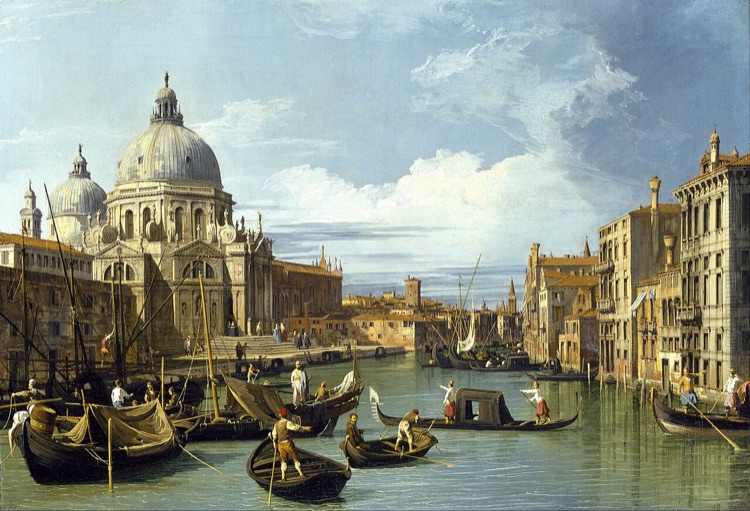
Beyond France, the style found its grandest architectural expression in Bavaria and Austria, where Catholic princes used Rococo ornament to turn pilgrimage churches into theatres of devotion. The Wieskirche in Bavaria (1745–54), frescoed by Johann Baptist Zimmermann, achieves an almost hallucinatory lightness — white and gold dissolving into painted sky. In Venice, Giovanni Battista Tiepolo (1696–1770) brought the Rococo to ceiling fresco on a scale no Parisian could match, covering the Würzburg Residenz (1750–53) with a vast allegory of the continents. The style faded around 1780 as Neoclassical severity reasserted itself, but it had defined an entire visual culture of aristocratic leisure.
Concept and philosophy
The Rococo operated on a set of convictions about what painting was for that were almost the mirror opposite of everything the seventeenth century had believed. Where the Baroque demanded that art move you to tears or devotion, Rococo painting asked only that it delight you — and that delight, its practitioners argued, was a serious ambition.
The first conviction was that intimacy was more honest than grandeur. The enormous history paintings of Lebrun at Versailles had glorified the state; Watteau's *fêtes galantes* asked what individual people feel in a garden on a summer afternoon. The domestic scale of the new Parisian interior demanded a new scale of painting: portraits that caught a glance rather than a pose, mythologies that felt like parties rather than court ceremonies, still lifes that made everyday objects glow with sensuous pleasure.
Second, that ornament was not decoration but language. The asymmetrical *rocaille* — the S-curved shell-and-rock form that gave the movement its name — was not merely applied to surfaces but generated composition, figure, landscape and frame all at once. In Boucher and Fragonard, the swirling comma-stroke that builds a cloud is the same that builds a cheek. Line itself carries pleasure.
Third, that colour should feel like light. Rococo painters rejected the dark-ground technique of the Baroque and painted on pale grounds, building up translucent glazes of pink, sky blue, pearl grey and cream. The result is paintings that seem to glow from within rather than to be lit from outside — a quality that required exceptional technical skill and was easily mistaken for mere prettiness.
Finally, that subject and execution should match in spirit. The Rococo does not depict suffering with a light touch out of callousness — it deliberately restricts its subject matter to what can be treated with wit, grace and sensuality. Watteau's occasional melancholy is the exception that proves the rule: when he paints a *Pierrot* standing alone in a garden, the lightness of technique only deepens the sadness.
How to recognise it
Six visual cues that identify Rococo painting instantly — the palette alone will often be enough.
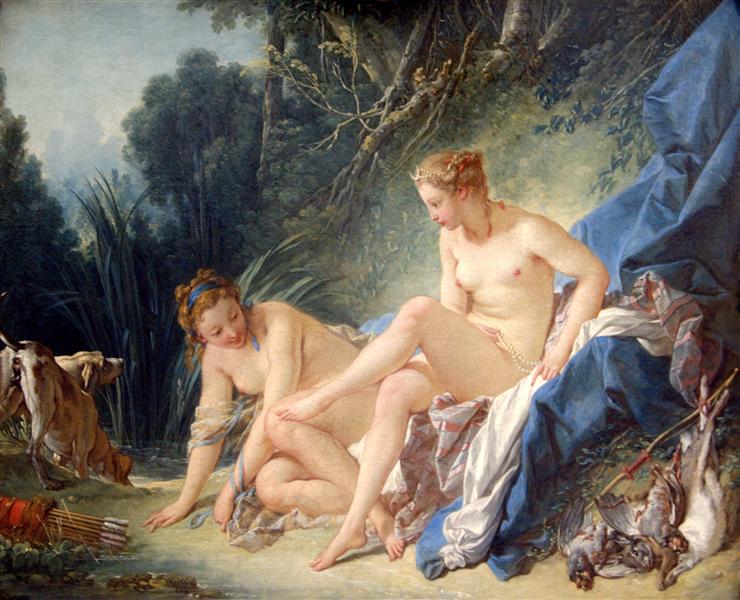
- Pale, powdery pastel palette — Rose pink, sky blue, mint green, warm cream and pearl grey — colours that look as if they have been slightly bleached by summer haze. This is the single most reliable Rococo fingerprint. Boucher's flesh tones are almost always this chalky rose; Fragonard's skies this milky turquoise. If the colour feels powdery rather than saturated, you are almost certainly looking at Rococo.
- The S-curve and asymmetry — Rococo rejects the straight line and the axis of symmetry. Compositions are organised around flowing *S*-curves and *C*-curves — in figure poses, in drapery, in the cloud-and-cherub skies, in the ornamental frames. The *rocaille* motif that gave the movement its name is itself an asymmetrical curl of shell and rock. If everything in the painting seems to undulate, you are in Rococo territory.
- Subjects of pleasure and sociability — Lovers in gardens, hunt picnics, mythological bathing scenes, powdered aristocrats at music or games — the Rococo systematically excludes serious moral and religious subjects. Even the mythologies (Venus, Cupid, Diana) are pretexts for undress and flirtation rather than allegory. If the subject seems to have been chosen because it is pleasurable rather than important, this is Rococo.
- Light, feathery brushwork — Rococo paint handling is rapid, suggestive and *bravura* — strokes left visible but not laboured, edges dissolved rather than drawn, surfaces shimmering. Fragonard in particular applies paint with a speed and freedom that anticipates Impressionism by a century. If the brushwork seems almost too quick to be true, that is a feature, not a bug.
- Slender, porcelain-like figures — Bodies in Rococo painting are elongated, refined and slightly boneless — closer to *objets d'art* than to the muscular, weighty figures of Baroque painting. Women especially are rendered with a delicacy that verges on the decorative. Hands are always beautiful; postures always graceful. If everyone in the painting looks as if they have never done physical labour and never will, this is Rococo.
- Cherubs and theatrical cloud skies — Rococo ceilings and large compositions almost always feature *putti* — chubby, winged infant figures — floating in skies of improbable cloud formations. In Tiepolo and Boucher, clouds are essentially furniture, arranged to support figures. If the sky is occupied and theatrical rather than atmospheric, the painting belongs to this period.
Anecdotes and curiosities
**Fragonard's *The Swing* (1767) began as a request the painter almost refused.** The Baron de Saint-Julien asked Fragonard to paint his mistress being pushed on a swing by a bishop while the baron himself hid in the bushes looking up her skirt. The subject was scandalous even by the standards of the French aristocracy; Fragonard reportedly replaced the bishop with a more neutral companion and turned the baron into a reclining admirer, but kept the upward gaze and the flying slipper that made the picture famous. It sold for an enormous sum and became one of the most reproduced images of the ancien régime.
Watteau died before the Rococo he had invented fully understood itself. He died in 1721 at thirty-six, probably of tuberculosis, having spent his last years in England seeking a cure. His friend and patron Jean de Jullienne spent years after his death engraving every surviving drawing and painting to preserve his legacy — the *Recueil Jullienne* (1726–28) is one of the most comprehensive posthumous catalogues in art history. Without it, much of Watteau's work would have been lost entirely.
Madame de Pompadour was arguably the most powerful patron in Rococo history. As Louis XV's official mistress from 1745, she effectively directed the royal workshops at Sèvres and Gobelins, decided the decor of every royal palace, and gave Boucher his most lucrative commissions. She appears in at least six of his paintings, almost always in a blue silk gown. When she lost the king's romantic interest in the late 1750s she retained his political friendship, continuing to shape French cultural policy until her death in 1764 — an extraordinary run of influence for anyone, let alone a woman without formal power.
The Rococo's most spectacular surviving room is not in France but in Bavaria. The Hall of Mirrors at the Amalienburg hunting lodge near Munich (1734–39), designed by François de Cuvilliés, encases an entire round room in silver-and-blue mirrored panels interwoven with stucco chinoiserie and hunting trophies. No surface is flat; every corner curves; light bounces between mirrors until the room seems to have no walls. It was built to celebrate the pleasures of the chase and is, by any measure, one of the most intoxicating interiors ever created.
Legacy and influence
The Rococo left two kinds of legacy: a set of technical achievements that proved almost impossible to supersede, and a cultural reputation that spent two centuries being alternately despised and rehabilitated. On the technical side, the movement bequeathed to painting a lightness of touch and a mastery of translucent colour that Impressionist painters — Renoir above all — consciously studied. Fragonard's rapid, feathery stroke is a direct ancestor of Renoir's dappled light; Watteau's handling of figures in atmospheric landscape anticipates Monet's garden pictures. The Rococo's insistence on painting *en plein air* light, even if the settings were artificial, pushed colour away from the dark studio tones of the Baroque.
The more surprising downstream connection is with fashion and design. The Rococo essentially invented what we now call lifestyle branding — the idea that every object in a wealthy person's environment (porcelain, fabric, furniture, wall panel, painting) should form a coherent aesthetic world. The Rococo interior was total design centuries before the concept existed. Louis Vuitton's pattern vocabulary, Wedgwood's pastoral relief motifs, the decorative tradition of French *haute couture* — all trace a line back to the *rocaille* workshops of eighteenth-century Paris.
The movement's moral reputation suffered badly under Neoclassicism and never fully recovered among serious critics. But the art public never stopped loving Fragonard and Watteau — and today the major Rococo works command extraordinary prices and command exhibition blockbusters, suggesting that the pleasure principle the movement championed has proved more durable than the moral severity that condemned it.
6 artists in this movement
Frequently asked questions
When did the Rococo period begin and end?
The Rococo runs from roughly 1715 to 1780 — from the death of Louis XIV and the Regent's return to Paris to the rise of Neoclassicism in France. In Germany and Austria it persisted somewhat longer, and in Venice Tiepolo's late work carries Rococo characteristics into the 1760s. The French Revolution (1789) ended it definitively as a living style, though its influence on decorative arts persisted well into the nineteenth century.
What is the difference between Baroque and Rococo?
The Baroque (c.1600–1715) is monumental, dramatic and morally serious — large-scale altarpieces, chiaroscuro lighting, religious and historical subjects, figures that sweat and bleed. The Rococo is intimate, delicate and deliberately unserious — small-scale domestic decoration, pale pastel palettes, subjects of pleasure and social play. The Baroque wants to overwhelm you; the Rococo wants to charm you. Both are technically brilliant, but they have entirely opposite emotional ambitions.
Who are the key Rococo painters?
Antoine Watteau (1684–1721) effectively founded the movement with his *fêtes galantes*. François Boucher (1703–70) dominated the mid-century and defined the Rococo's sensual, decorative mode. Jean-Honoré Fragonard (1732–1806) brought it to its most technically brilliant and playful extreme. In Venice, Giovanni Battista Tiepolo (1696–1770) translated the style into monumental ceiling fresco. In Germany, François de Cuvilliés and the Zimmermann brothers gave it its most spectacular architectural form.
Why is it called 'Rococo'?
The name comes from the French *rocaille* — the asymmetrical shell-and-rock ornamental motif that appeared on furniture, wall panels and frames throughout the period. Like Baroque before it, 'Rococo' began as a term of mockery, applied by Neoclassical critics who found the style frivolous and over-ornate. The first recorded use of the word as an insult dates to the 1790s. Today the word is simply a period descriptor, though its origins in mockery still colour how critics discuss the style's merits.
How does Rococo differ from Neoclassicism?
They are near-contemporaries and direct opposites. The Rococo celebrates pleasure, ornament, asymmetry and emotional delicacy; its moral framework is hedonist. Neoclassicism celebrates virtue, restraint, geometric order and civic seriousness; its moral framework is Stoic Roman republicanism. David's *Oath of the Horatii* (1784) is virtually a manifesto against everything Fragonard represented — all axes, severity and sacrifice where Fragonard had been curves, softness and seduction.