Georges Braque
He dismantled the painting and rebuilt it in a language that took a century to fully learn.
Style and technique
Braque and Picasso invented Cubism together in a period of such close collaboration — roughly 1908 to 1914 — that their individual canvases from this period are sometimes difficult to tell apart even by specialists. Yet their temperaments were opposite. Picasso was impulsive, varied, and always needed a new challenge; Braque was slow, methodical, and spent fifty years deepening a narrow set of concerns — the still life on the studio table, the guitar, the relationship between a painted surface and the physical world.
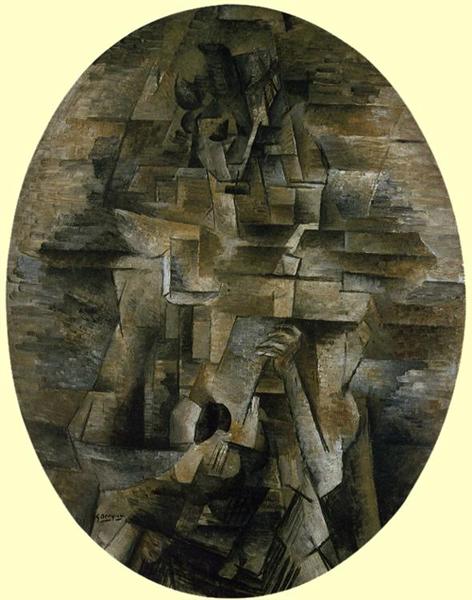
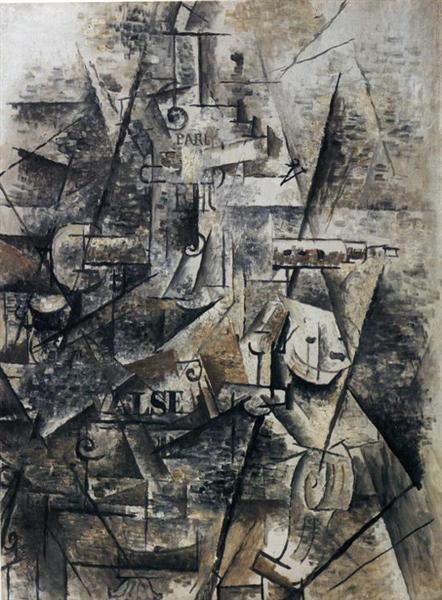
The central Cubist insight, which Braque arrived at partly independently from Cézanne and developed jointly with Picasso, was this: a painting should show what you know about an object as well as what you see from any one viewpoint. A guitar has a front, a back, sides, a neck, a sound-hole, strings — all of these simultaneously real and simultaneously unseen from any single position. Analytic Cubism fractured the object into these multiple views and reassembled them on the flat canvas surface in a new kind of pictorial logic.
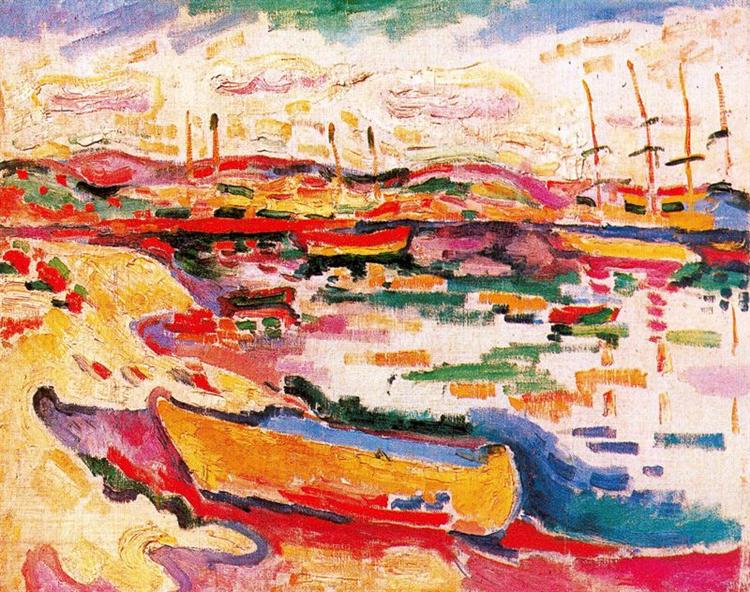
Braque came to Cubism from Fauvism — he was one of the vivid colour painters shown at the 1905 Fauve Salon — and then encountered Cézanne's late work at the memorial exhibition of 1907. The reduction of landscape to geometric solids in Cézanne showed him that the representation of space in painting was a convention, not a truth.
Four fingerprints: the limited, ochre-and-grey palette of Analytic Cubism (colour is subordinated to structural analysis), the table as the primary compositional space, stencilled letters and numbers — the newspaper date, a brand name, a price — as elements that are simultaneously image and text, and a texture consciousness that carries directly from his training as a house decorator.
Life and legacy
Braque was born on 13 May 1882 in Argenteuil, just north of Paris, and grew up in Le Havre, where his father was a house painter and decorator who ran his own business. Braque served an apprenticeship in his father's trade and passed the decorator's certificate that gave him a professional qualification in mixing paints and applying decorative surfaces — an expertise that would prove relevant throughout his career.
He came to Paris in 1900 and enrolled at the École des Beaux-Arts. He also attended classes at the Académie Humbert, where he met Marie Laurencin and Francis Picabia. His early work was thoroughly conventional until he encountered the Fauve paintings — Matisse, Derain, Vlaminck — at the 1905 Salon d'Automne and was transformed.
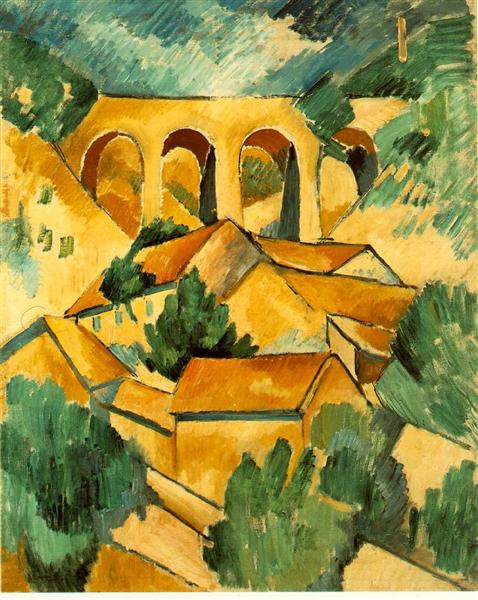
He spent 1906 in the south of France with Othon Friesz, working in the bright Fauve palette. The following summer, alone in L'Estaque, he produced the first Cubist landscapes: the houses reduced to cubes, the trees to cylinders, the hills to geometric planes, the whole scene assembled without atmospheric perspective. He submitted these to the 1908 Salon d'Automne where the selection committee — which included Matisse — rejected them. The dealer Daniel-Henry Kahnweiler mounted a show instead, and the critic Louis Vauxcelles described the paintings as 'cubes', giving the movement its name.
Picasso had been working toward similar conclusions from different starting points. The two men met in late 1907, when Braque saw 'Les Demoiselles d'Avignon' in Picasso's studio, and the collaboration that followed was the most productive artistic dialogue in modern art. They worked alongside each other daily, compared canvases, built on each other's innovations, and kept their conversations almost entirely private.
The First World War intervened brutally. Braque was called up in August 1914 and seriously wounded in the head in May 1915 — a wound that required trephination and kept him incapacitated for nearly two years. When he returned to painting in 1917, Picasso had moved on to other things. Their collaboration was over.
In the late 1940s and 1950s he produced a new cycle of major work: the 'Studio' series, eight large canvases showing the artist's studio as a complex interior space, and the 'Birds' series — great black birds in flight against blue or grey fields — that became his late signature image. He died on 31 August 1963 in Paris, aged eighty-one. His funeral at the Louvre was attended by André Malraux, the French Minister of Culture, who gave the oration.
Five famous paintings
Houses at L'Estaque 1908
The painting that launched Cubism — or at least gave it its name. Braque painted the houses of L'Estaque, the Provençal fishing village where Cézanne had also worked, as a stack of geometric solids: rooftops, walls, and windows reduced to flat planes and cubes, the whole composition compressed and viewed from multiple points simultaneously. The palette is entirely desaturated — ochre, brown, grey, green — because colour would distract from the structural analysis. The painting was rejected from the Salon d'Automne and shown by Kahnweiler, where Vauxcelles described it as 'cubes'. It is in the Kunstmuseum in Basel.
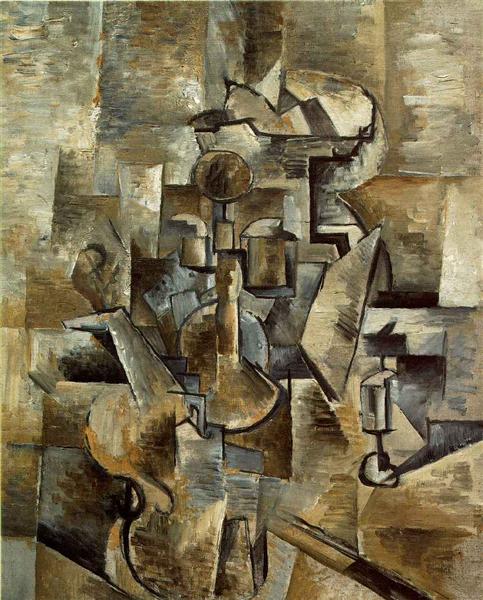
Violin and Candlestick 1910
A still life of a violin and candlestick seen from multiple simultaneous viewpoints — the Analytic Cubist method at its most rigorous. The objects are fragmented into facets, overlapping and translucent, the whole composition built in a tight geometry of grey-brown planes that barely suggest their source objects without ever completely abandoning them. The palette is so restricted that it reads initially as almost monochrome. This was a deliberate choice: Braque and Picasso both believed that colour distracted from the structural analysis they were attempting. The question the painting asks is: what is a violin, once you know it from all sides simultaneously?
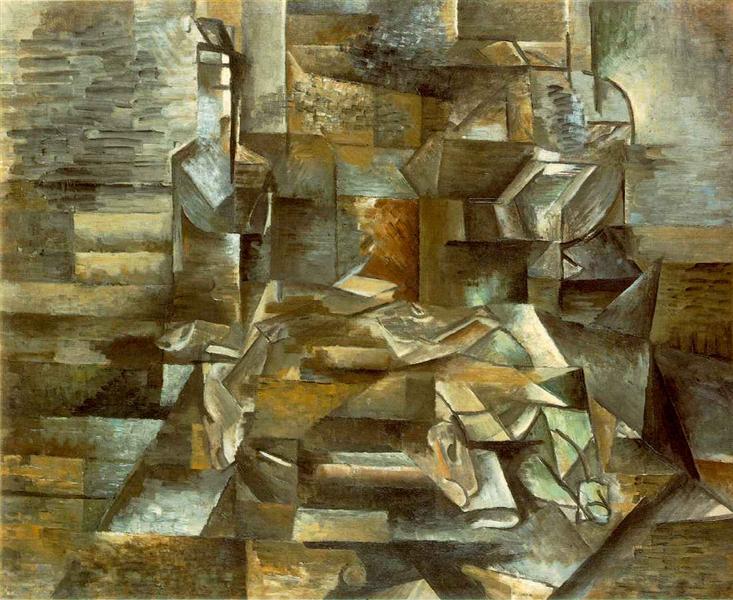
Clarinet and Bottle of Rum 1911
High Analytic Cubism: a still life of a clarinet and a bottle of rum fragmented into a complex of overlapping angular facets. This is the most dissolved of the Cubist still lifes — the objects are almost entirely dispersed into pure geometry, and the viewer must actively reconstruct the clarinet and bottle from the fragments. The stencilled letters RUM at the top right are a key Braque invention: literal text inserted into the painted surface as a reminder that the surface is paint and paper, not a window. This kind of typographic element would prove enormously influential on advertising and graphic design.
Landscape at La Ciotat 1907
A transitional work, painted in the summer of 1907 before Braque met Picasso and before the full Cubist analysis. The landscape still recognisable — a bay, trees, sky — but already stripped of atmospheric perspective, the colour simplified into flat planes of green, blue, and orange, the forms beginning to press towards the picture surface rather than receding into depth. This is the direct descendant of Cézanne's L'Estaque pictures, Braque understanding Cézanne's lesson about the flatness of painted space and beginning to draw conclusions. The painting shows the exact moment of transition from Fauvism to Cubism.