Grant Wood
He turned a stiff Iowa farmer, a pitchfork, and his own sister into America's most parodied painting.
Style and technique
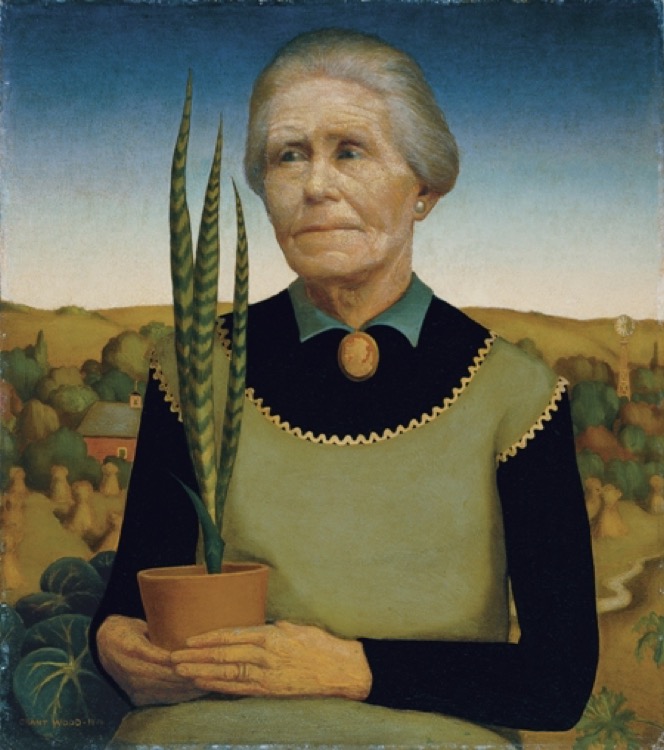
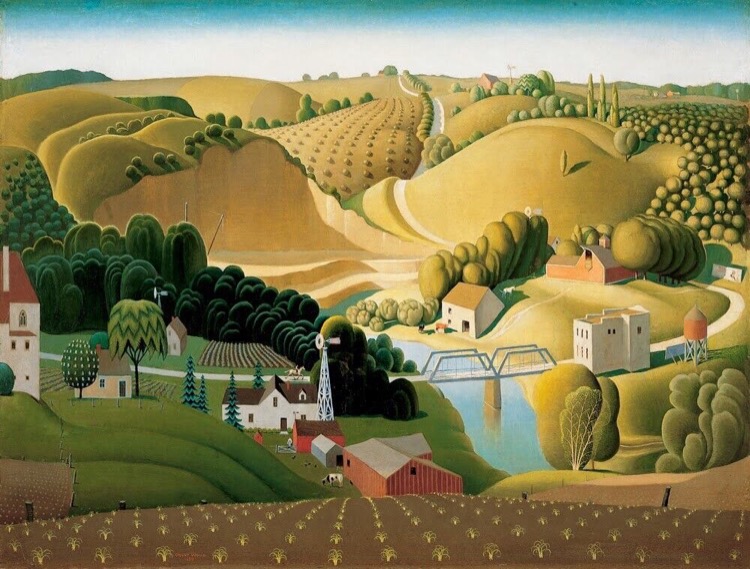
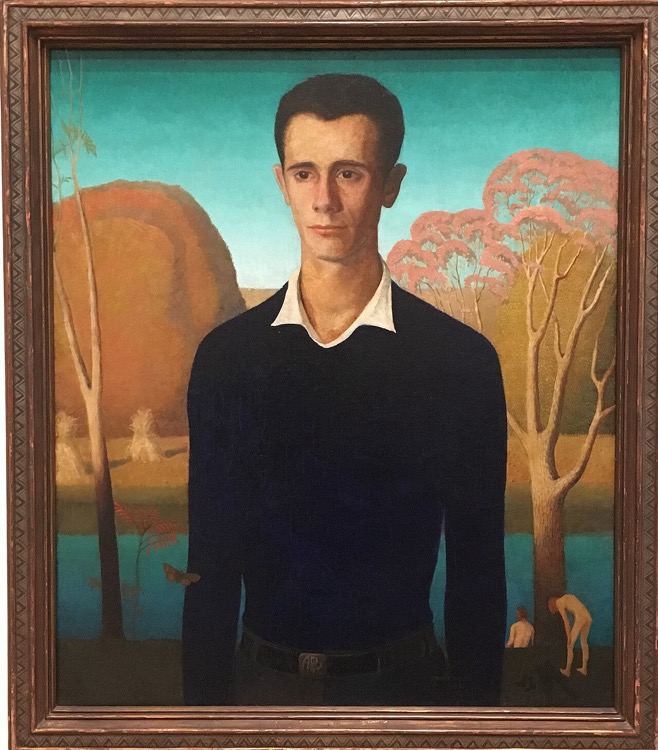
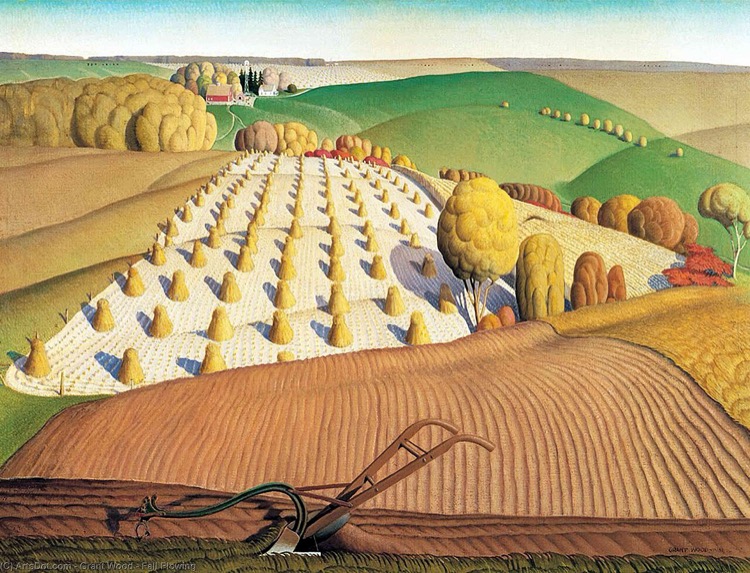
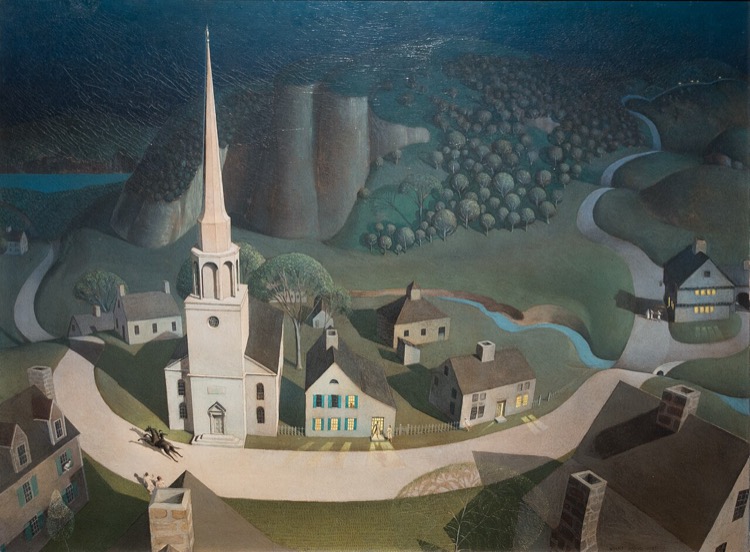
Grant Wood paints Iowa as if it had been rolled out like dough. Hills swell into smooth, rounded mounds; furrowed fields comb into perfectly parallel bands; trees cluster into neat, lollipop-shaped puffs. Nothing in a Wood landscape looks quite like unruly nature — it looks like nature redesigned by a meticulous quiltmaker, every contour softened and repeated until the countryside reads as pattern.
This is American Regionalism, the movement Wood championed alongside Thomas Hart Benton and John Steuart Curry in the 1930s: a deliberate turn away from European modernism toward proudly local, rural American subject matter, rendered in a legible style ordinary viewers could read at a glance.
Three qualities define a Wood painting.
Precise, almost naive figuration. After seeing Flemish and German primitives — Memling, van Eyck, Dürer — in Munich in 1928, Wood dropped his earlier loose Impressionist brushwork for hard-edged, enamel-smooth surfaces where every blade of grass and strand of hair carries equal, flat clarity. Figures stand stiffly upright, faces long and unsmiling, painted with a doll-like exactness that flatters no one and mocks no one outright.
Obsessive pattern and repetition. Wood repeats a single curved or geometric motif — a haystack's dome, a window's arch, a pitchfork's tines — across a whole composition until the picture feels composed rather than observed, closer to decorative design than documentary realism.
A dry, watchful satirical edge. Beneath the placid rural surface sits real social observation: the pinched propriety of small-town matrons, the stern rectitude of a farm couple, the gap between historical myth and its manufactured origins. Wood rarely tips his hand — his satire works through deadpan exaggeration rather than caricature, which is exactly why American Gothic still splits viewers between affectionate tribute and gentle mockery.
Wood also treated the Midwest as worthy subject matter at a moment when American artists were expected to look toward Paris, painting presidents' birthplaces and threshing-crew dinners with the same formal seriousness earlier painters gave religious scenes.
Life and legacy
Grant DeVolson Wood was born on a farm near Anamosa, Iowa, on 13 February 1891, son of a strict Quaker farmer. When Wood was ten, his father died suddenly, and his mother moved the family to Cedar Rapids, where he grew up in reduced circumstances, drawing constantly and working as a metalworker and jewelry craftsman — training that left him a lasting taste for precise, decorative detail.
He studied briefly at the Art Institute of Chicago, then returned to Iowa to teach art in Cedar Rapids public schools while painting in a loose, competent Impressionist manner that showed little of what was to come. Four trips to Europe between 1920 and 1928 exposed him to Impressionism firsthand, without giving him a style of his own.
The turning point came in 1928, when Wood traveled to Munich to oversee fabrication of a stained-glass window he had designed as a war memorial for Cedar Rapids. In Munich's galleries he encountered Northern Renaissance painting: Memling, van Eyck, the jewel-like realism of the early Flemish masters. It reorganized his approach entirely. He came home and traded Impressionist looseness for a hard-edged, meticulous style, applying it first to portraits of family and neighbors, then to the rolling Iowa farmland around him.
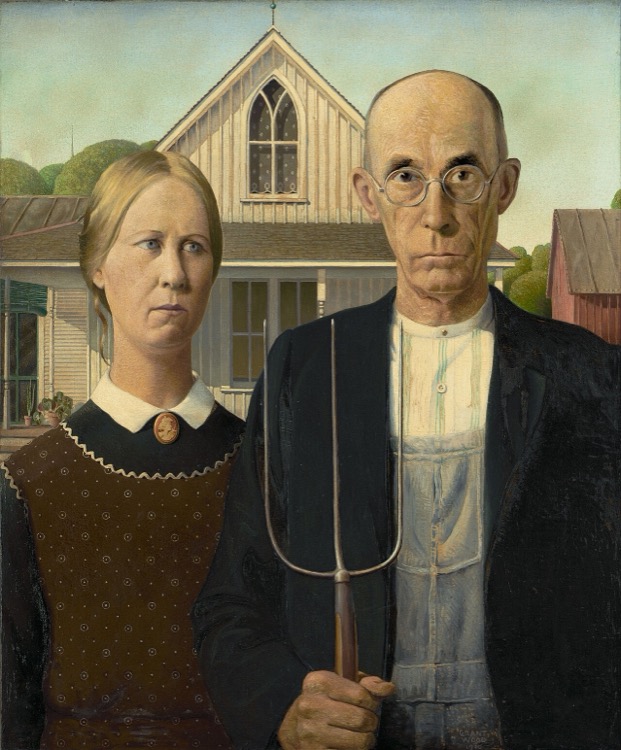
In 1930, Wood submitted a small oil of a farmer and a woman before a modest Gothic-windowed farmhouse to the Art Institute of Chicago's annual exhibition. American Gothic won a $300 bronze medal, was bought by the museum, and within weeks became a national sensation, reproduced coast to coast and endlessly parodied — a fame that startled Wood, who had painted his own sister and his dentist as models and insisted the picture was affectionate, not mocking.
The sudden celebrity made Wood figurehead of American Regionalism, a movement he championed alongside Thomas Hart Benton and John Steuart Curry as a proudly American alternative to European modernism; the three shared the cover of Time in 1934. Wood taught at the University of Iowa, ran federal art projects during the Depression, and co-founded the Stone City Art Colony, a summer school for young artists in an abandoned quarry town.
His mature career was brief but productive: farm scenes, satirical portraits, and reimagined American history — Daughters of Revolution, Parson Weems' Fable, Dinner for Threshers — followed through the 1930s, each carrying his blend of precision and dry irony. In 1941, a university colleague led a campaign against him, partly fueled by whispers about his private life, pushing him toward resigning his post.
By then Wood was already ill. Diagnosed with pancreatic cancer in late 1941, he died in Iowa City on 12 February 1942, one day before his fifty-first birthday, leaving barely a decade of work that had, almost single-handedly, made the American Midwest a subject worth painting.
Five famous paintings
American Gothic 1930
Oil on beaverboard, shown at the Art Institute of Chicago's 1930 annual exhibition, where it won a $300 bronze medal and was bought by the museum, where it still hangs. Wood spotted the real house, a carpenter-Gothic cottage in Eldon, Iowa, and sketched its pointed window before inventing a couple to live in it. His sister Nan Wood Graham and his dentist Byron McKeeby posed separately in his studio, never meeting the house or each other. Within weeks the image was reproduced nationwide, read as both tribute and satire, a debate never settled and one that made it the most parodied painting in American history.
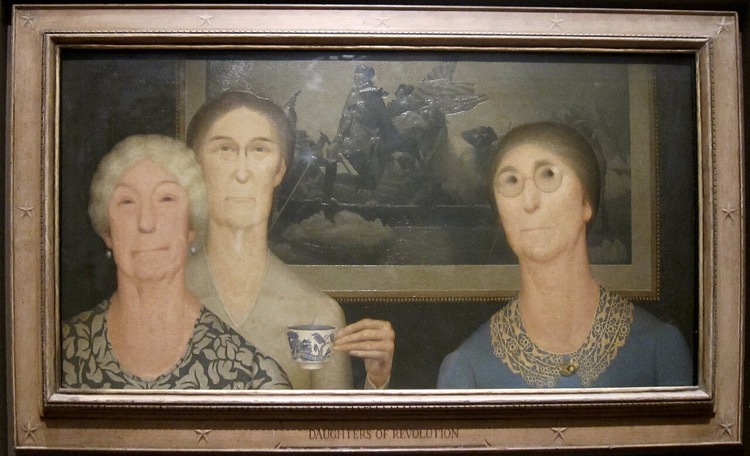
Daughters of Revolution 1932
Oil on panel, painted after the Cedar Rapids chapter of the Daughters of the American Revolution publicly criticized Wood's stained-glass Veterans Memorial window for being fabricated by craftsmen in Munich rather than by American labor. Stung, Wood retaliated by painting three prim society matrons, modeled on real Cedar Rapids women, sipping tea in pinched poses, crowded before a reproduction of Emanuel Leutze's heroic Washington Crossing the Delaware. Self-styled guardians of Revolutionary patriotism fuss over propriety while dwarfed by the real thing, cementing Wood's reputation for satire beneath placid surfaces.
Fall Plowing 1931
Oil on canvas, commissioned in connection with the Deere & Company tractor manufacturer and now held in its corporate collection in Moline, Illinois. Unlike almost everything else in Wood's mature output, the canvas contains no human figures at all, only a single old-fashioned, horse-drawn plow left standing mid-furrow as daylight fades. The rounded Iowa hills behind it are combed into smooth, parallel bands of turned earth, treated as ornamental pattern. Painted as tractors rapidly replaced horse-drawn equipment across the Depression-era Midwest, the empty plow reads as a quiet elegy for a vanishing rural way of life.
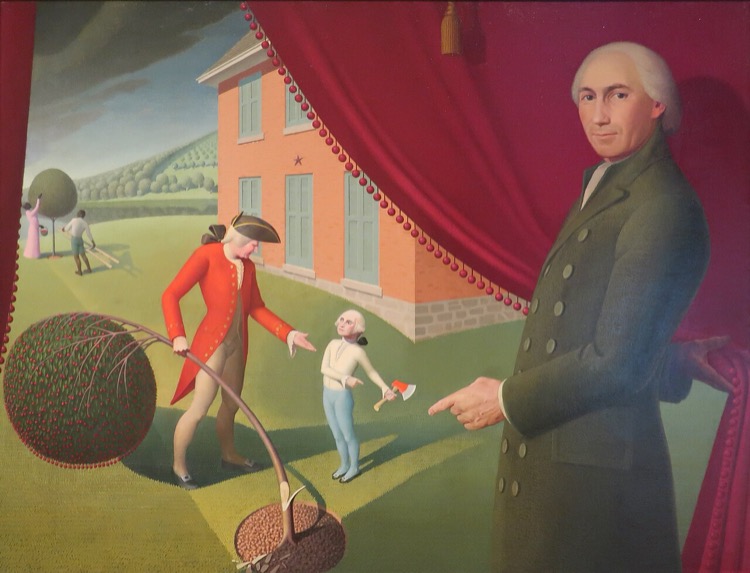
Parson Weems' Fable 1939
Oil on canvas, now in the Amon Carter Museum, Fort Worth, and among the last major paintings Wood completed before his death. It dramatizes the invented cherry-tree legend from Mason Locke 'Parson' Weems' bestselling 1800 biography of George Washington, showing Weems himself drawing back a stage curtain to present the scene, an admission that the story is theater, not history. Young Washington stands beside the felled tree wearing the unmistakable adult face lifted from Gilbert Stuart's iconic portrait, while enslaved figures picking fruit behind him quietly acknowledge what the folk legend omits from its telling.
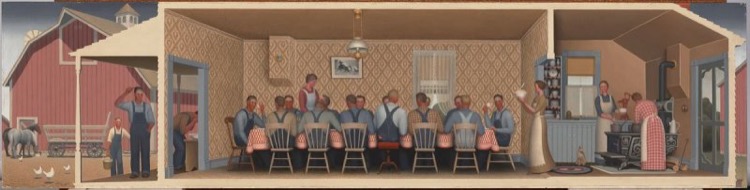
Dinner for Threshers 1934
Oil on masonite panel, now in the de Young Museum, San Francisco, and one of Wood's most ambitious multi-figure compositions. Drawing on his own boyhood memory of harvest-season meals cooked for hired threshing crews, Wood sliced the farmhouse open like a dollhouse with its roof removed, borrowing the horizontal layout of early Italian Renaissance predella panels he had studied on his European travels. Women serve food in the kitchen at left while rows of men eat in near-identical poses at a long table, the whole scene compressed into one continuous cross-section of communal Midwestern labor and hospitality.