Henri Matisse
He spent fifty years simplifying — until colour was strong enough to do the drawing on its own.
Style and technique
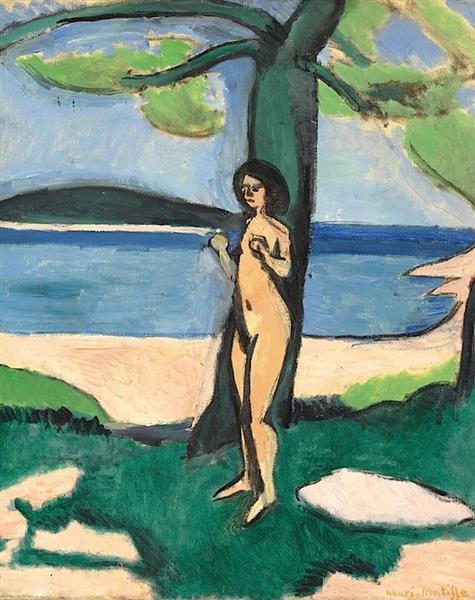
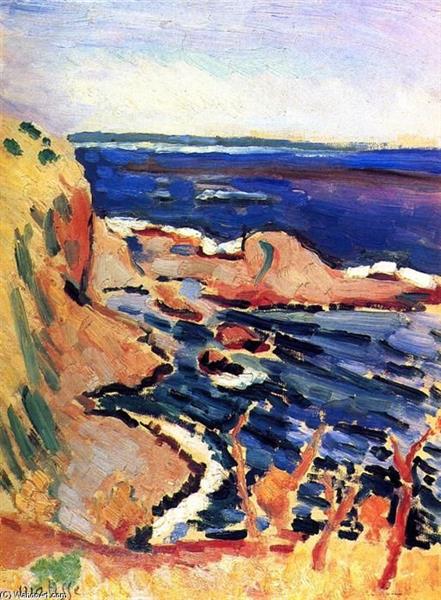
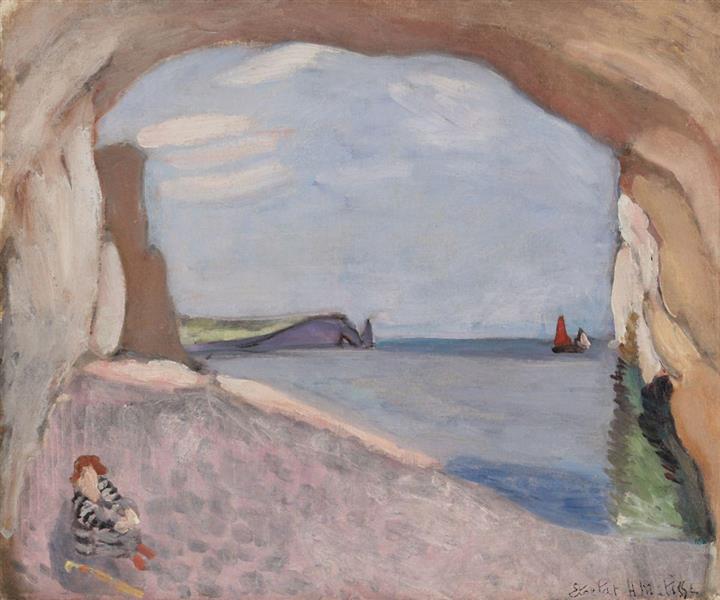
Matisse painted with colour as the primary actor. Where Cézanne had built his pictures from small geometric facets and Picasso would soon shatter form into cubist planes, Matisse simplified the world into broad flat zones of saturated colour and let the shapes carry themselves. A red room is just red. A blue dress is just blue. The drawing is reduced to the absolute minimum needed to keep the figure recognisable.
This sounds simple. It is the opposite. Stripping a scene down to two or three colours and a few lines turns out to be one of the hardest things a painter can do, because there is nowhere to hide. Every shape has to count. He spent fifty years getting it right.
Four fingerprints make a Matisse instantly recognisable.
Flat fields of bright colour. Often pure red, pure green, pure cobalt, pure orange. He used the cheapest, most saturated industrial pigments of his day — many of them only available because of late-19th-century chemical industry — and applied them straight from the tube.
Decorative patterning. Wallpapers, carpets, fabrics, vases, screens — Matisse loved interiors stuffed with patterns, and would paint them as flat tile-like surfaces that compete with the figures in the room.
Confident contour line. A single black or dark blue line traces the figure with no hesitation. He was an extraordinary draughtsman; he simply chose to draw with the absolute minimum of lines.
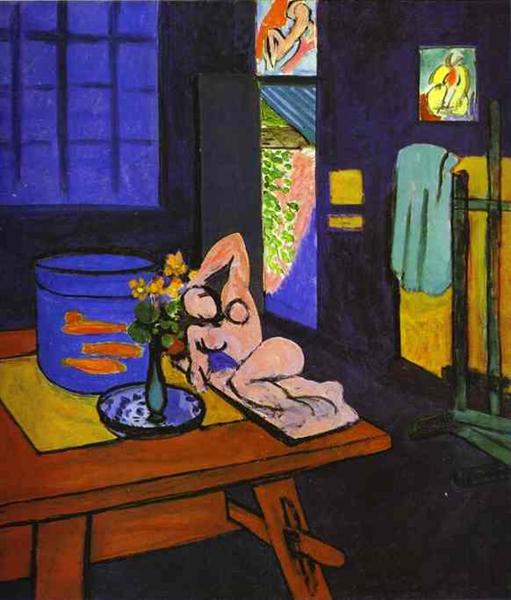
Window-and-Mediterranean compositions. Repeatedly, throughout his life, the same set-up: an interior, a table, a vase of flowers, a window opening onto the bright south. Compositions became almost a formula he refined for fifty years.
His great rival and friend was Picasso. They met in 1906, swapped paintings, watched each other obsessively, and pushed each other into invention for the next forty-eight years. Picasso famously said, on the day Matisse died, that he felt 'now everything is duller'. Matisse, in turn, had described their relationship as 'two cyclists who go down the same road but each in his own way'.
Life and legacy
Henri Émile Benoît Matisse was born on 31 December 1869 in Le Cateau-Cambrésis, a small textile town in northern France, near the Belgian border. His father ran a grain and seed shop; his mother painted porcelain and ran the local hardware store. The family expected Henri to become a lawyer.
He did. He studied law in Paris, passed his exams in 1888, and got a job as a court clerk in Saint-Quentin, the regional capital. He hated it. In 1890, when he was twenty, he had a long bout of appendicitis and was confined to bed for months. To pass the time, his mother bought him a box of oil paints. Within weeks he had decided to throw away his legal career.
His father was furious. Henri went anyway. He moved to Paris in 1891 and enrolled at the Académie Julian. By 1895 he had been admitted to the studio of Gustave Moreau at the École des Beaux-Arts — the most enlightened classical teacher in Paris, who told his students to look at museums in the morning and paint freely in the afternoon. Among his classmates were the future painters Albert Marquet and Henri Manguin, who would go on to be his Fauvist allies a decade later.
The 1890s were poor and uncertain. He married Amélie Parayre in 1898; they had a daughter, Marguerite, and two sons. The family was supported partly by Amélie's small hat shop. Matisse copied old masters at the Louvre to scrape together extra francs.
He began his real revolution slowly. Around 1900 he was painting in subdued, late-Impressionist colours; by 1903 he was visibly looking at Cézanne; by 1904, in summers spent at Collioure on the Mediterranean coast with the painter André Derain, he had broken through. The brushstroke had become loose, large, and almost violently coloured. The shadows had turned green and purple. The faces had stopped trying to be naturalistic.
In the autumn of 1905, the Salon d'Automne in Paris included a small room of paintings by Matisse, Derain, Vlaminck and a few others. The critic Louis Vauxcelles, walking through it, saw a small classical sculpture in the centre of the room and exclaimed in print: '*Donatello among the wild beasts*' — *les fauves*, in French. The label stuck. Fauvism was born by accident, named by an insulted critic, and dismissed by the Paris establishment as a hooligan style.
Within two years it was over as a movement, and Matisse had moved on. In 1906 he met the unknown twenty-five-year-old Picasso through the American collector Gertrude Stein. The two looked at each other's work and never quite stopped looking again. Matisse was recognised; Picasso was not yet. Within five years their positions had reversed and they were equals.
The 1910s and 1920s were Matisse's golden years of painting the interior. He worked for the Russian collector Sergei Shchukin, who commissioned the great panel pair 'Dance' and 'Music' for his Moscow mansion. He spent winters in Nice, painting the same hotel room with different odalisques in different patterned costumes year after year.
Then, in 1941, aged 71, he was diagnosed with abdominal cancer and given perhaps a year to live. He survived a brutal operation. He never walked unsupported again. He was bedbound or wheelchair-bound for the next thirteen years.
Unable to stand at an easel for more than a few minutes, he reinvented his art. He had his assistants paint sheets of paper in solid gouache colours, and then — propped up in bed or in a wheelchair — he cut shapes out of the painted paper with enormous tailor's scissors. Other assistants pinned the shapes onto the walls of his studio in compositions he directed verbally. He called the technique *gouache découpée* — gouache cut-outs. The results were enormous: 'The Snail', 'Blue Nudes', the four-volume artist's book *Jazz*. He worked at a scale and intensity he had not managed for thirty years.
He also designed his only architectural project: the Chapel of the Rosary in Vence, on the French Riviera, between 1948 and 1951. Stained-glass windows, ceramic tiles, vestments, candle-holders, even the door handles — every detail was his. He told his friends he considered the chapel his masterpiece.
He died of a heart attack on 3 November 1954, aged 84, in his apartment in the Hôtel Régina in Nice. He was buried in the Cimiez cemetery overlooking the city. The Hôtel Régina is still standing; his apartment is preserved as it was.
The largest single collection of his work is at the Musée Matisse in Nice, with significant holdings at MoMA in New York, the Pompidou in Paris, the Hermitage in Saint Petersburg (which inherited Shchukin's Russian collection) and the Musée Matisse in his hometown of Le Cateau-Cambrésis.
Five famous paintings
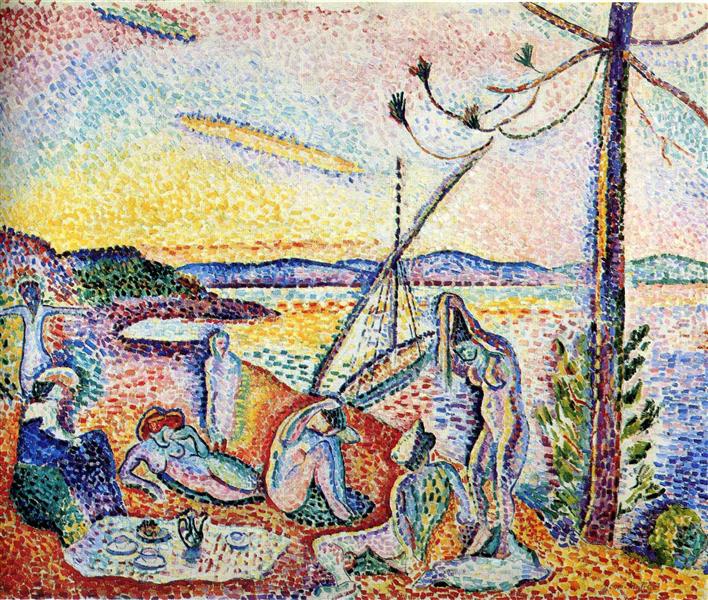
Luxe, Calme et Volupté 1904
Painted in the summer of 1904 in Saint-Tropez, where Matisse had spent the season in the company of the older painter Paul Signac. The title comes from a refrain in a Baudelaire poem ('There, all is order and beauty, luxury, calm, and pleasure'). Six nude bathers — drawn loosely, almost casually — gather around a picnic spread in a yellow and pink Mediterranean light. The brushwork is borrowed from Signac's pointillism; the colour is already Matisse's own, a year before Fauvism would name itself. The painting is now in the Musée d'Orsay, Paris.
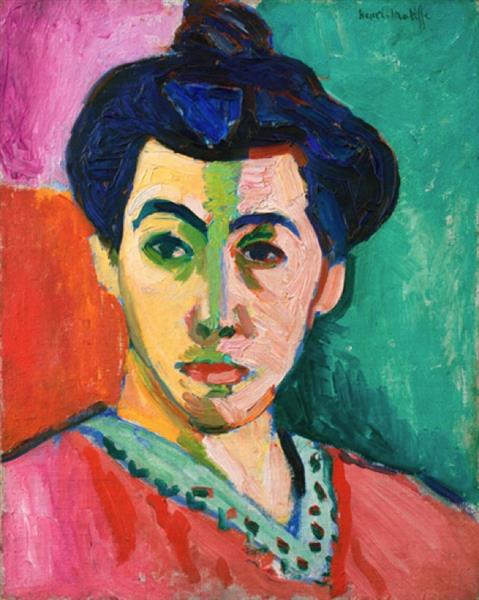
The Green Stripe (Madame Matisse) 1905
A portrait of his wife Amélie, painted in Collioure during the summer that produced the Fauve scandal. The face is divided down the middle by a single thick green stripe — the cool side of the face, lit from the left. The right side glows pink-orange under a yellow light source. The hair is purple-black, the dress is two flat zones of red and green, the background is three rectangles of green, pink and pale teal. There is no transition between any of these zones. When it was first shown, viewers thought Matisse had assaulted his own wife in paint. The portrait now hangs in the Statens Museum for Kunst in Copenhagen.
The Red Room (Harmony in Red) 1908
Originally painted in blue, then in green, finally finished in red. A serving woman places fruit on a long table covered with a heavily patterned red tablecloth. The wallpaper behind her is the same red, with the same swirling pattern. Table and wall merge into a single red field, broken only by the rectangle of a window in the upper left, through which a pale green spring landscape is visible. The painting was commissioned by the Russian collector Sergei Shchukin for his Moscow dining room and now hangs in the Hermitage in Saint Petersburg. It is one of the most important early demonstrations of what colour can do when it is allowed to flatten depth on purpose.
Dance 1910
Five naked figures, painted in deep red against a flat green ground and a flat blue sky, dance in a circle holding hands. There is nothing else in the painting — no shadow, no detail of anatomy, no facial features. The figure on the lower left has lost their grip on the next dancer; the small gap between their fingers is one of the most discussed pieces of empty space in modern painting. Three colours: red, green, blue. Five figures. One ring. Matisse painted two versions, both for Sergei Shchukin's Moscow staircase. The smaller version, in his own apartment, is now in the Hermitage; the larger Russian version is also there. Matisse considered 'Dance' the painting that had finally given him 'simplicity, joy and force at the same time'.
Interior with Aubergines 1911
An enormous decorative interior — over two metres square — painted in his studio at Collioure. A small still life of three aubergines sits on a table at the centre of the canvas. Around them, the room is built almost entirely out of clashing patterns: a flowered carpet, a striped wall, a patterned screen, a drape of dotted fabric. Through a half-open door, a Mediterranean garden glows pale green. Through a small mirror on the wall, a glimpse of his own studio is reflected. Matisse worked on the painting for months, layering pattern on pattern, and considered it one of the most ambitious things he had ever made. It hangs in the Musée de Grenoble.