El Greco
A Cretan icon-painter who learned Venetian colour, told the Pope he could improve Michelangelo, and ended his life inventing modern painting in a small Spanish town.
Style and technique
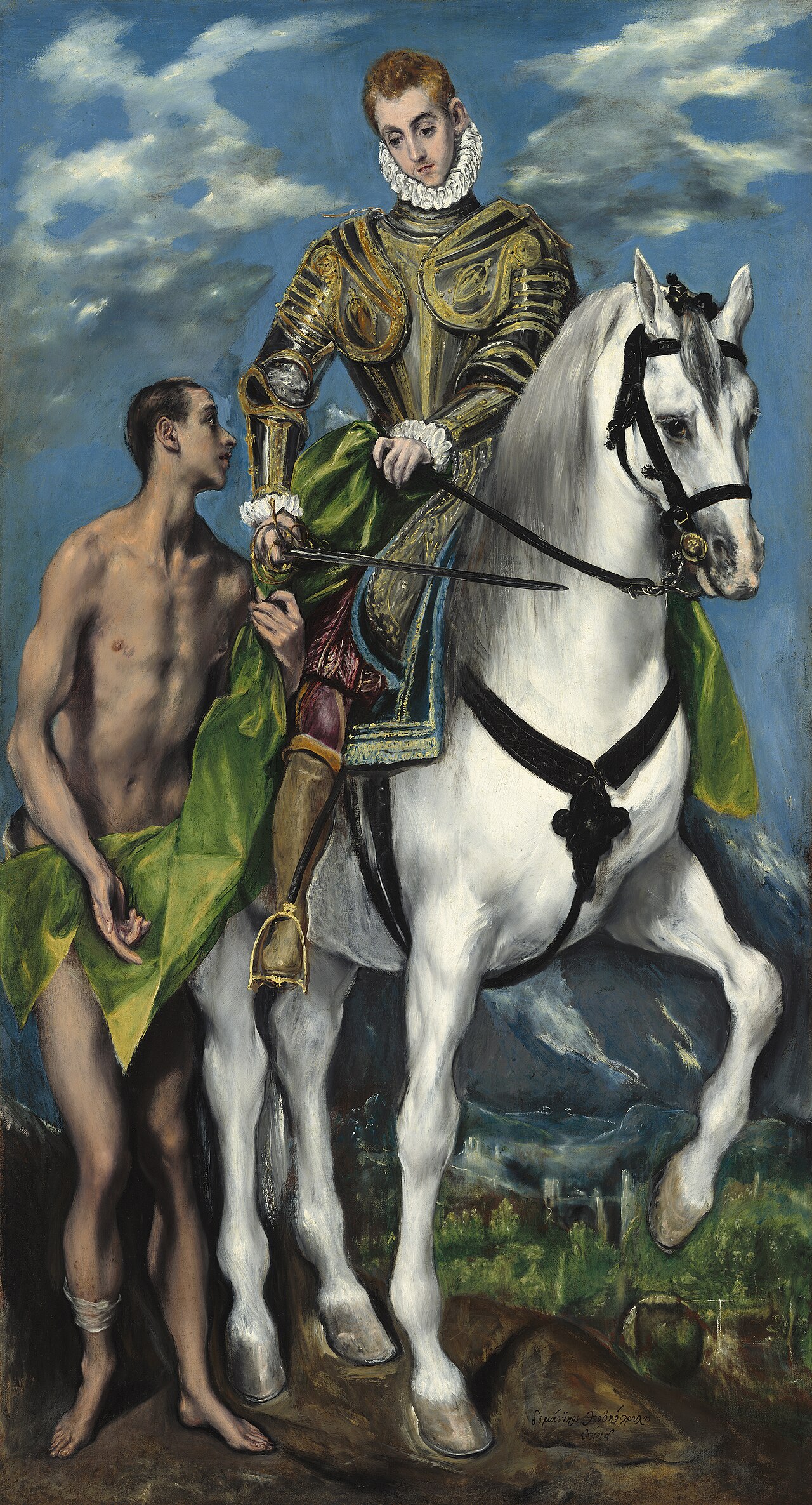
El Greco does not look like anyone else. Stand in front of one of his canvases and the first thing you notice is that the bodies are wrong — too tall, too thin, too far above the floor, sometimes with a head-to-body ratio approaching 1:11 when nature averages around 1:7. The second thing you notice is that the colours are wrong too: acid lemon yellow next to cobalt blue next to a vermilion that almost vibrates. The third thing you notice is that you cannot stop looking.
He is the great oddity of Western painting. He trained on Crete as a Byzantine icon painter, in a tradition that had barely changed since the eleventh century — flat gold backgrounds, frontal saints, inscriptions in Greek. Then, around 1567, he sailed to Venice and discovered Titian's flesh, Tintoretto's whiplash brushwork, and Michelangelo's twisting bodies. Most painters who absorb such different traditions blend them into something polite. El Greco welded them together at full voltage.
Four fingerprints make a Greco unmistakable.
Elongation. Saints and angels stretch upwards like wax candles in a draught. He was not painting badly — he was painting mystical ascent, the body straining out of itself toward heaven.
Acid colour. Lemon yellow, cobalt, rose madder, vermilion, sometimes a poison green. The palette is closer to a stained-glass window than to an oil painting of his time.
Flickering light. Highlights are not laid down with a smooth brush. They are dragged on in nervous, broken strokes that catch on the canvas weave. The whole surface seems to shiver.
Compressed space. There is rarely a clear horizon. Earthly figures are pressed into the bottom register; heavenly figures fill the top. The space behind them is not landscape but a kind of charged emptiness.
His contemporaries thought he was eccentric to the point of being unsellable. Philip II of Spain rejected one of his paintings as 'not pleasing'. For 250 years after his death he was almost forgotten — a footnote in Spanish painting between Titian and Velázquez. Then in the late 19th century Cézanne, Picasso and the German Expressionists rediscovered him. Picasso's 'Demoiselles d'Avignon' is unthinkable without the elongated figures of El Greco's late work. The 20th century recognised, four hundred years late, that he had invented something the rest of painting was only just catching up to.
Life and legacy
He was born Doménikos Theotokópoulos in 1541 on the island of Crete, almost certainly in Heraklion (then known by its Venetian name, Candia). Crete in 1541 was a Venetian colony — it had been ruled from Venice for over three hundred years — and the city was the last great workshop of the Cretan School of Byzantine icon painting. There, between sixteen and twenty-five, he trained in the tight discipline of the icon: egg tempera on wood, gold-leaf backgrounds, the figures laid down in a fixed sequence of green underpaint and ochre highlights, the inscriptions written in Greek.
A document from 1563 calls him 'master Doménigo', meaning he had already been admitted to the painters' guild at twenty-two. By 1567 he had left Crete for Venice, and the move turned his life inside out.
In Venice he absorbed the entire late Renaissance in about three years. He worked in or close to the circle of Titian, then in his late eighties, and learned the Venetian secret of building flesh through layers of warm and cool glazes. He stole the bold, slashing brushwork of Tintoretto and the muscular bodies of Michelangelo (whom he knew only through engravings). He stopped painting on wood and learned to paint on canvas. He stopped writing in Greek on the picture and started writing in Latin — though for the rest of his life, on every signed painting, he would sign his full Greek name.
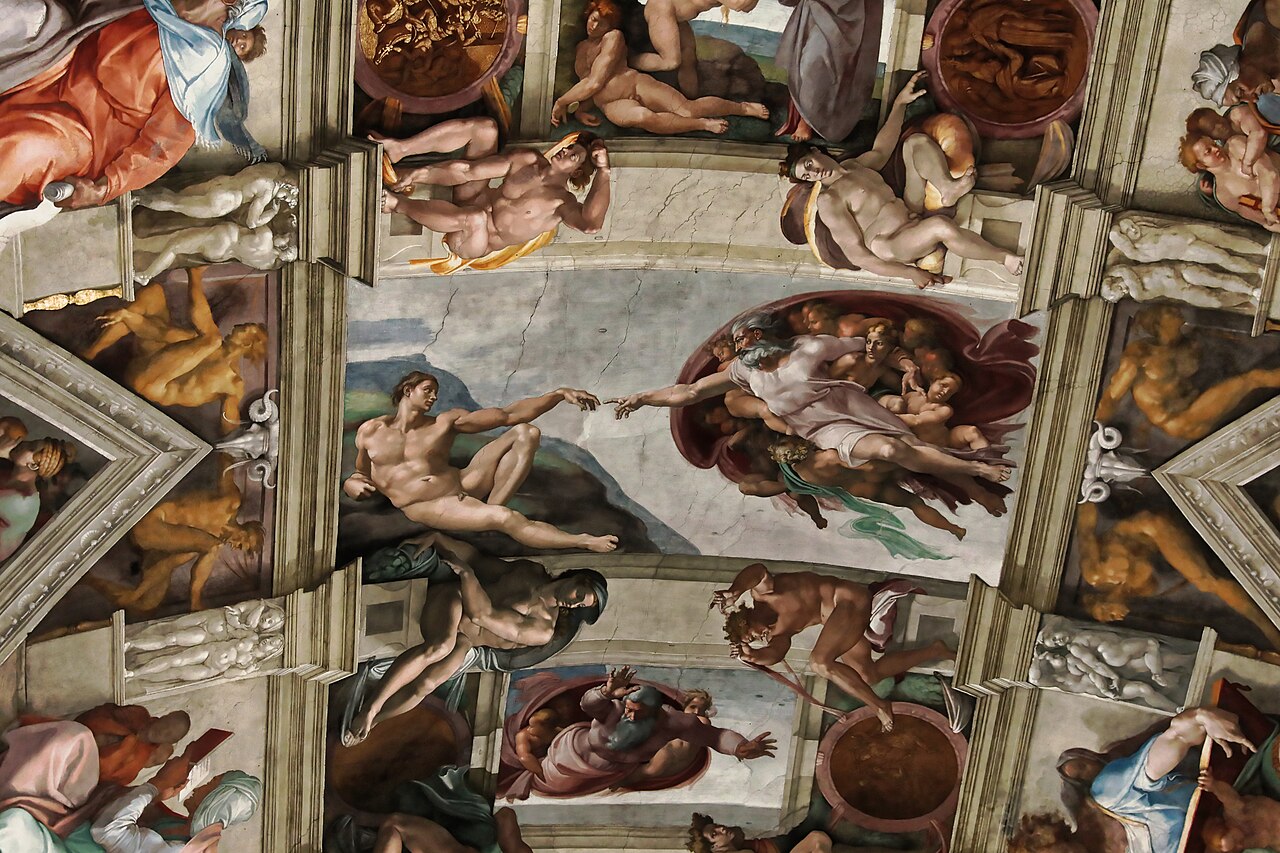
In 1570 he moved to Rome, carrying a letter of introduction from the miniaturist Giulio Clovio. Cardinal Alessandro Farnese, the most cultivated patron in the city, gave him rooms in the Palazzo Farnese. He should have flourished. He did not. The story preserved by his contemporaries is that, asked his opinion on the controversy over Michelangelo's Last Judgment — whose nudes had recently been ordered to be painted over — the young Cretan said he could pull the whole thing down and paint it again with decency and decorum. The remark went around Rome in a week. He left the city not long afterwards, his reputation as an arrogant outsider already fixed.
In 1577 he turned up in Toledo. He was thirty-six, broke, and apparently expecting only a short stop on the way to a court position with Philip II in Madrid. He never left. The cathedral chapter of Toledo immediately commissioned him to paint 'The Disrobing of Christ' for the sacristy, and the city — wealthy, intensely religious, full of Counter-Reformation fervour — recognised something in him that Rome had not. He stayed for the next thirty-seven years.
The king did try him. Around 1580 Philip II commissioned 'The Martyrdom of Saint Maurice' for the basilica of El Escorial, the vast monastery-palace then under construction. The king inspected it, declared it 'not pleasing', paid for it anyway, and quietly shelved it in a side room. Royal patronage — the great prize of any Spanish painter's career — was closed to him for ever. He turned back to Toledo and made a virtue of it.
He set up a large workshop, took a Spanish companion, Jerónima de Las Cuevas (whom he never married — possibly because he had a wife still in Crete, possibly for reasons we no longer know), and had a son, Jorge Manuel Theotokópoulos, who became his apprentice and eventually ran the workshop himself. The clergy, the religious orders and the nobility of Toledo became his clients. He charged extremely high prices and got them. He rented twenty-four rooms in a Renaissance palace once owned by the Marquis of Villena, hired musicians to play to him while he ate, and built up a personal library of over a hundred books in Greek, Italian and Latin — Plato, Plutarch, Vitruvius, Vasari — annotated in his own hand.
And yet he died poor. He was constantly suing his patrons over fees, constantly being sued himself. The cathedral of Toledo went to court against him over 'The Disrobing of Christ', claiming he had placed the three Marys in the foreground (where the Bible does not put them) and let a soldier's head rise above Christ's (which contravened decorum). He won the lawsuit on the question of decorum, lost on the price, and went on with the painting essentially as he had made it.
He died in Toledo on 7 April 1614, aged 72, deep in debt. His son inherited the workshop, his unsold paintings and his books. Within a single generation his style was considered a curiosity; within two, it was considered an embarrassment. For two and a half centuries he was a footnote.
Five famous paintings
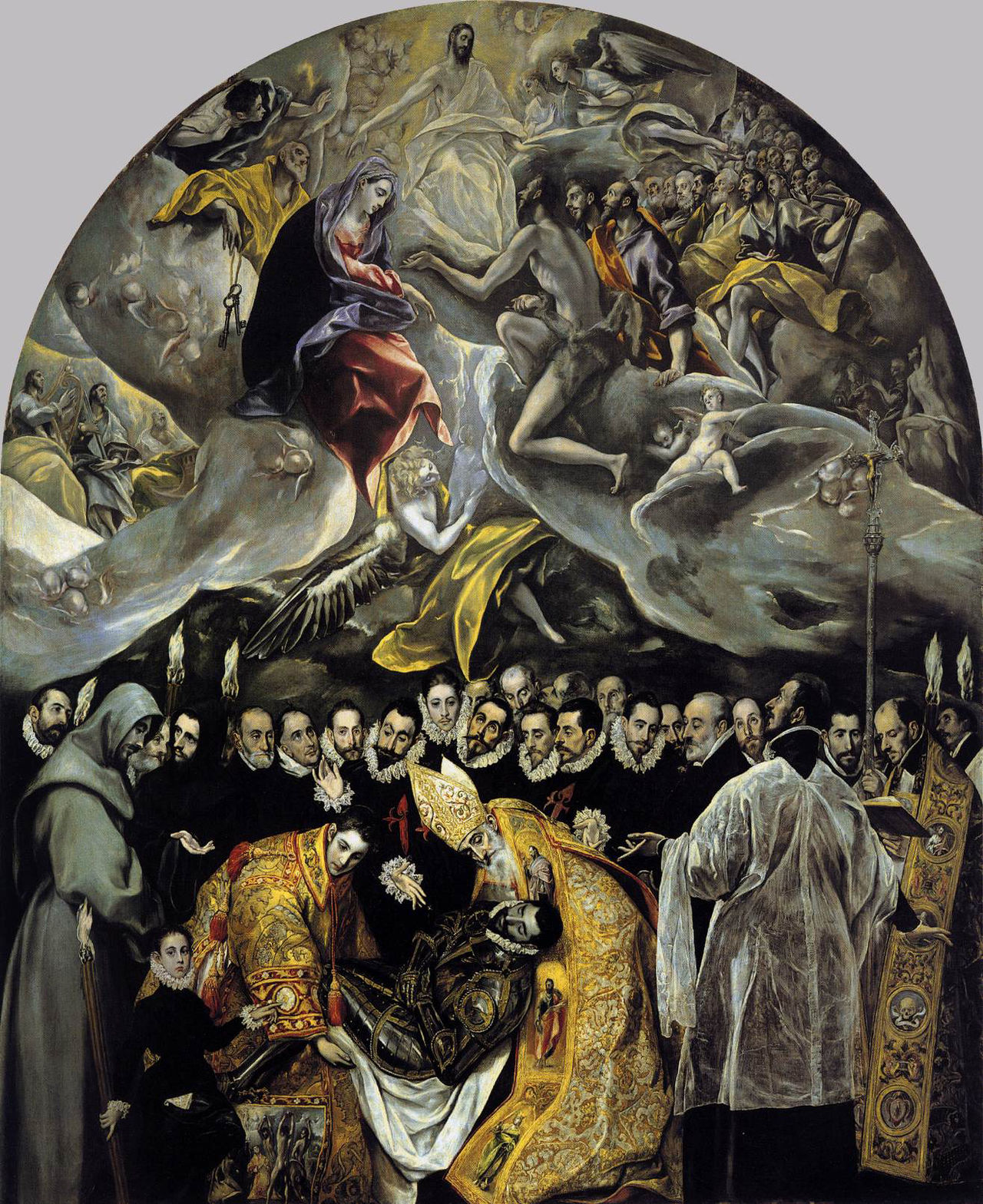
The Burial of the Count of Orgaz 1588
Painted between 1586 and 1588 for the small parish church of Santo Tomé in Toledo, where it still hangs on the same wall it was made for. The subject is a local miracle: when Don Gonzalo Ruiz de Toledo, Count of Orgaz, was buried in 1323, Saints Stephen and Augustine were said to have descended in person to lower his body into the tomb. El Greco divides the canvas into two horizontal worlds. Below, in the earthly register, the saints in heavy gold-embroidered robes hold the dead nobleman in his polished armour, surrounded by a row of black-clad Toledan gentlemen — recognisable portraits of the city's clergy and nobility. Above, in a shimmer of acid yellow and cobalt, the soul of the count rises through clouds toward Christ. Look closely at the row of mourners and one face stares straight out at the viewer, hand on chest: it is El Greco himself. The boy in the foreground holding a torch is his son Jorge Manuel, eight years old.
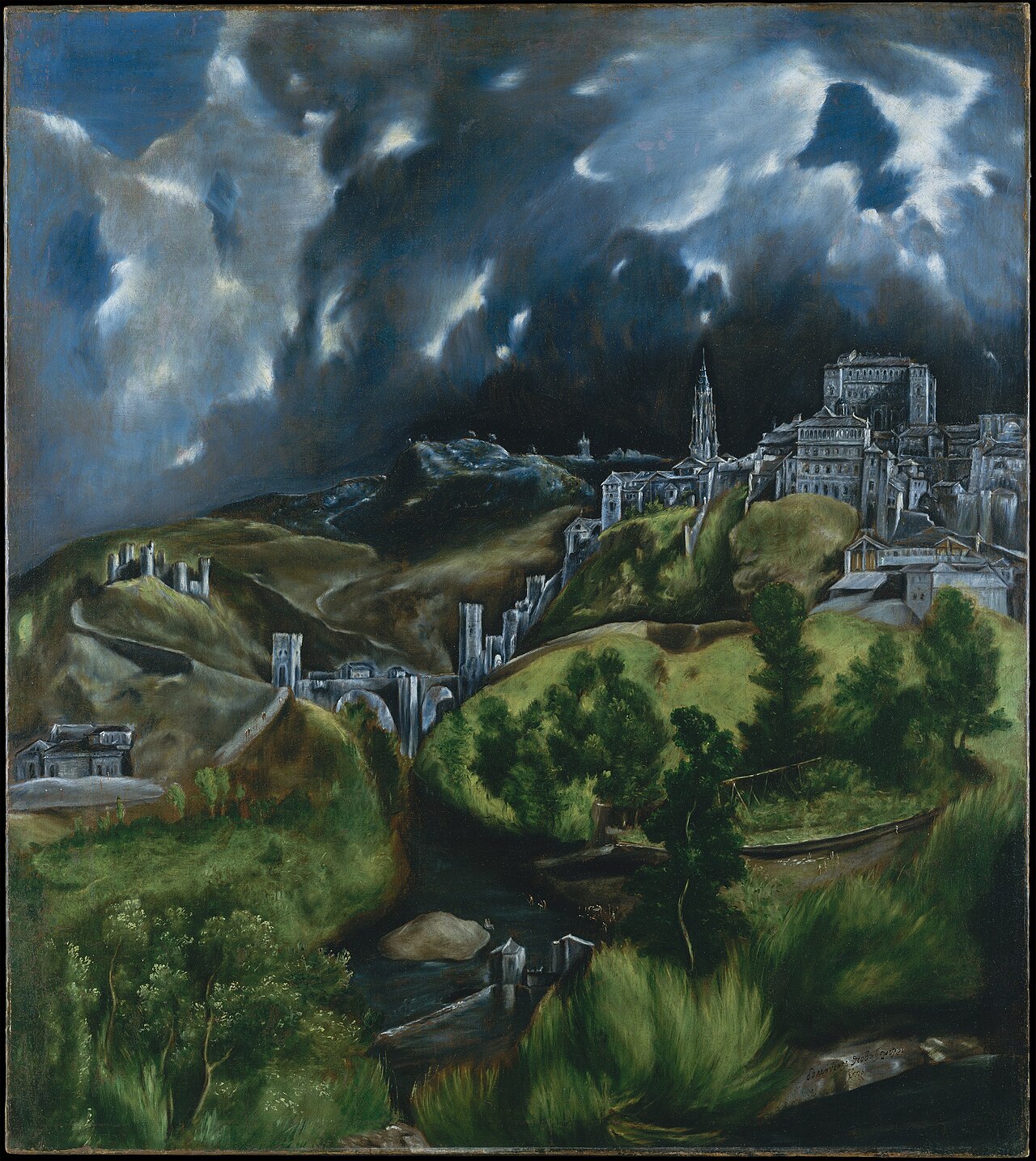
View of Toledo 1599
Painted around 1599-1600 and now in the Metropolitan Museum of Art in New York. It is one of only two surviving pure landscapes painted by El Greco, and one of the very few pure landscapes painted anywhere in Western Europe before the nineteenth century. The city of Toledo rises on its rocky bluff above the Tagus river, the cathedral spire pushed northwards from its real position to make the composition work. A storm sky boils over the rooftops in slate grey, ink black and a sudden bright green. There are no figures. There is no story. The whole city seems lit from within by an unstable, electric light. Painters had been putting cities into the backgrounds of religious scenes for two centuries; nobody had ever made the city itself the subject and let it speak for the spiritual life of its inhabitants. The painting was unknown to the public for centuries and only entered the Met in 1929.
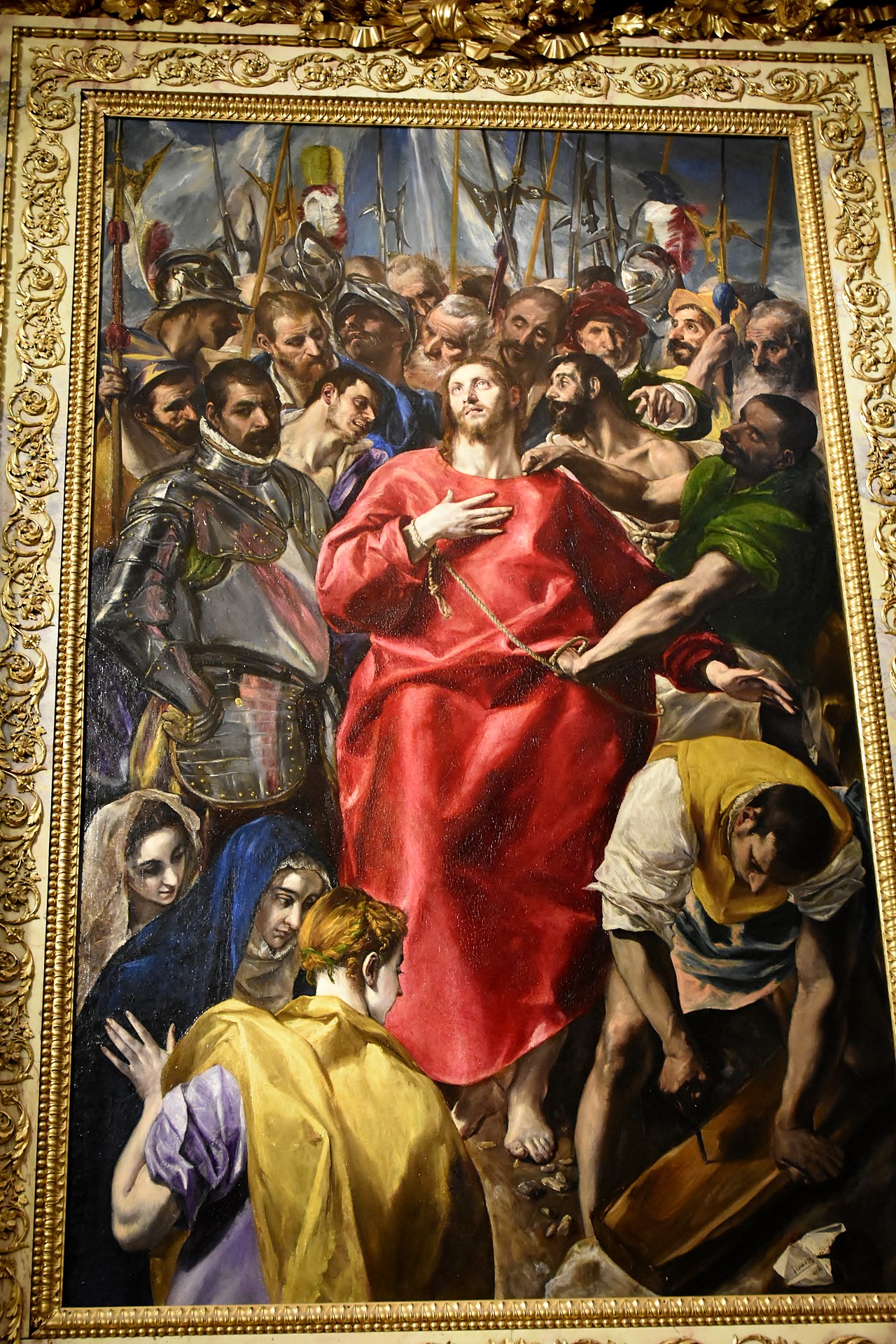
The Disrobing of Christ 1579
Known in Spanish as 'El Espolio'. It was the painting that introduced El Greco to Toledo: commissioned in 1577 for the sacristy of Toledo Cathedral, where it still hangs above the altar today. Christ stands at the centre in a vivid red robe, eyes raised to heaven, the moment before the Roman soldiers strip him for the cross. Around him, a tight knot of helmets, raised arms and shouting faces presses in from every side; there is no air, no horizon, no escape. In the lower left, three Marys watch in silence. The cathedral chapter, when they saw it, was scandalised: they sued the painter for putting the three Marys in the scene at all (the Gospels do not place them there) and for letting a soldier's head rise above the head of Christ. The lawsuit dragged on. El Greco won the argument over decorum; he lost the argument over the fee, which the chapter forced him to reduce. He delivered the painting in 1579 and refused to alter a single figure.
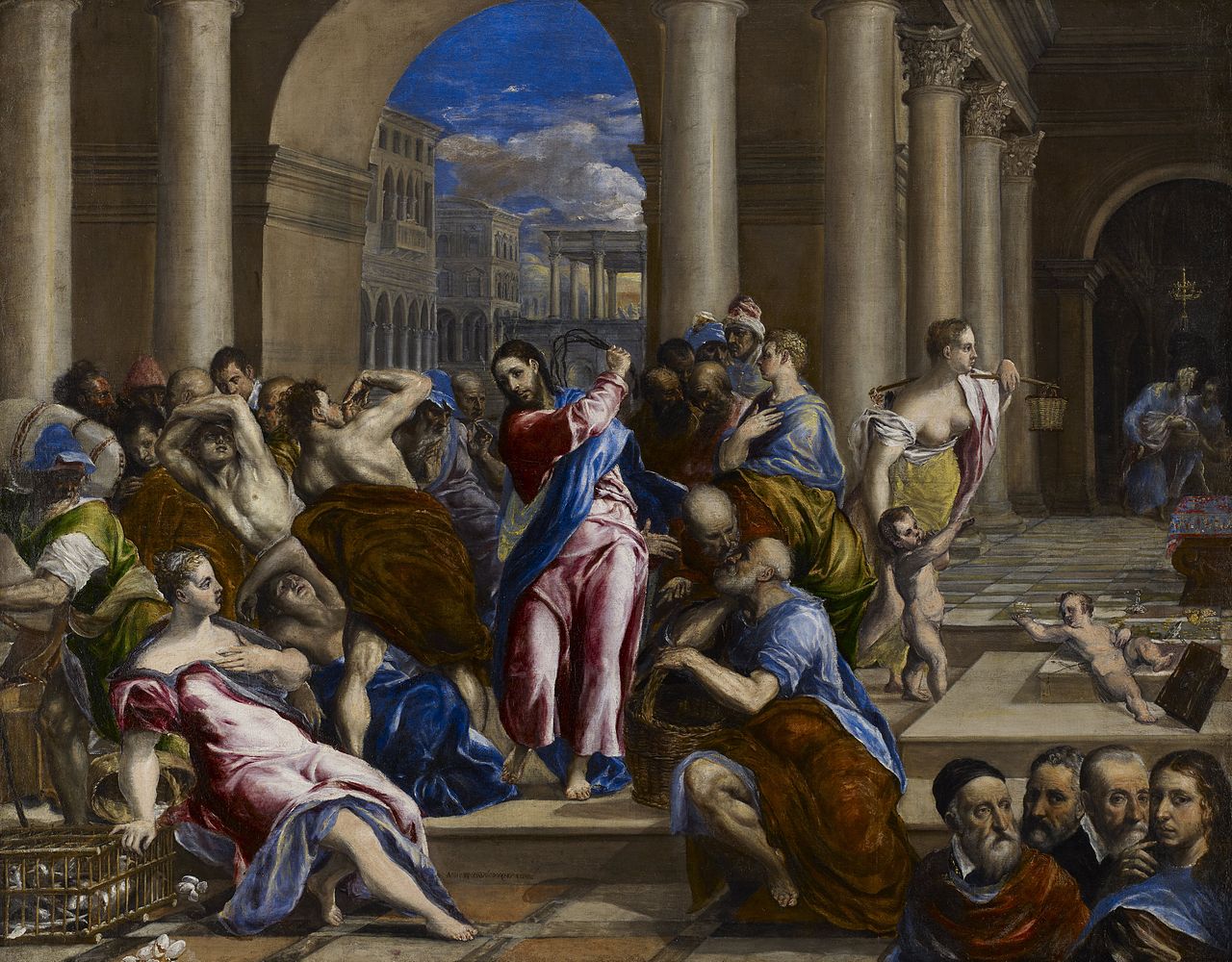
Christ Driving the Money Changers from the Temple 1571
El Greco painted this subject at least four times across his career, but the earliest version — the one in the National Gallery of Art in Washington, painted around 1570-1571 — is the most revealing. It is an Italian-period work, made during his years in Rome, and the influences are still on the surface like fresh paint. Christ swings a knotted cord at the merchants and money-changers in the Temple courtyard; the figures twist and recoil in the muscular, contrapposto poses of Michelangelo, but the loose, slashing brushwork and the deep architectural perspective come straight out of Tintoretto's Venice. Down in the lower right corner, almost as a signature, El Greco has placed four small portraits of the painters he considered his masters: Titian, Michelangelo, Giulio Clovio, and a fourth man often identified as Raphael. He is publicly stating his lineage. The elongated, weightless saints of Toledo are still ten years away.
The Opening of the Fifth Seal 1614
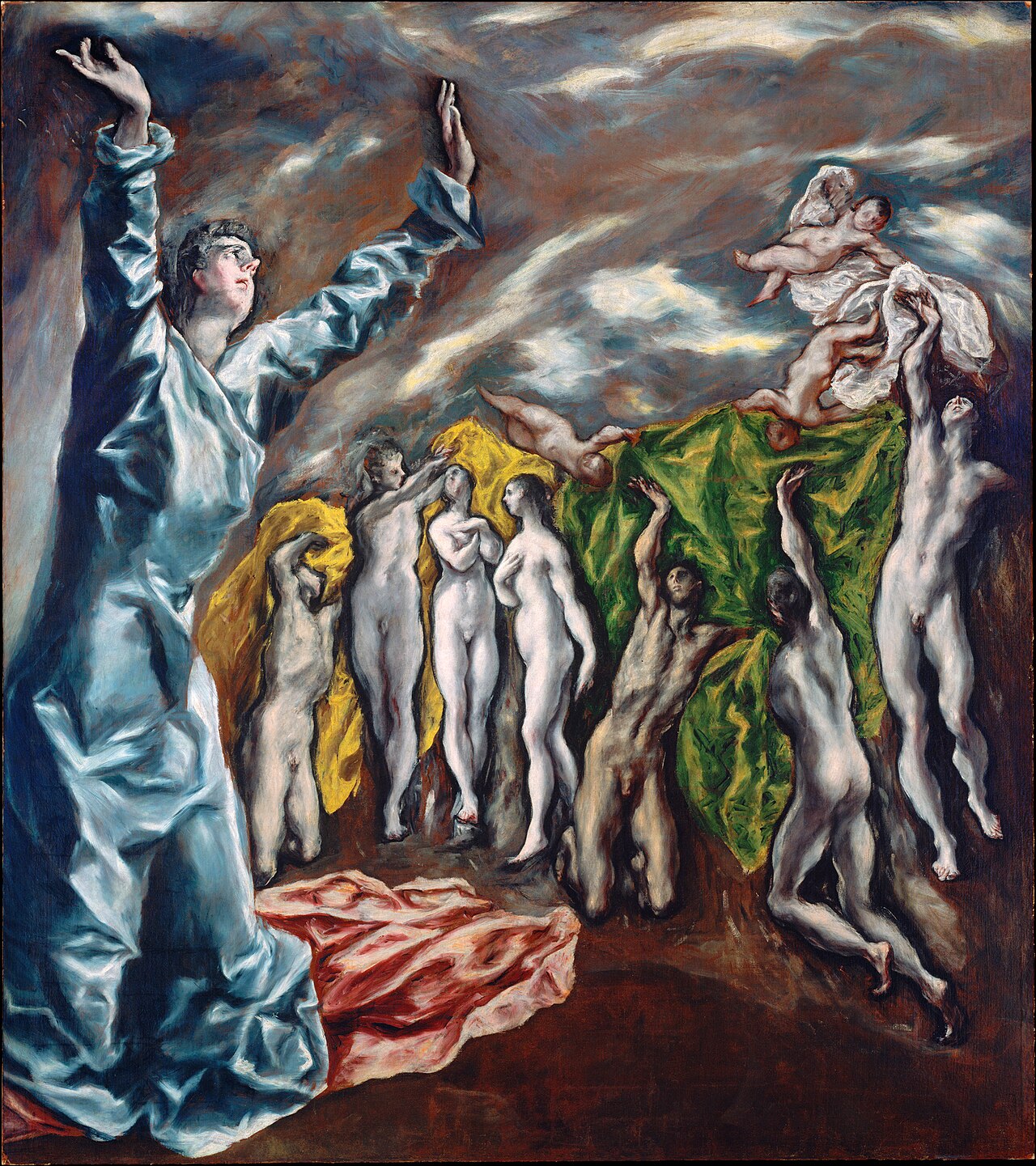
Also called 'The Vision of Saint John'. He was painting it in the last months of his life and it was almost certainly still on the easel when he died in April 1614. The subject is the moment in Revelation 6 when Saint John, kneeling on the left, sees the souls of the martyrs receiving white robes from heaven. What El Greco painted is a vision of nude bodies — pale, elongated, weightless, twisting in cobalt, yellow and rose like flames in a dark wind. The canvas in the Metropolitan Museum of Art is a fragment: about a third of the original painting was cut off and lost in the seventeenth century, probably the upper section showing Christ and the angels. What remains is one of the strangest things painted in Europe before 1900. Picasso owned a smaller related study and kept it in his studio in 1907, the year he painted 'Les Demoiselles d'Avignon'. The borrowed figures are unmistakable. Three hundred years late, El Greco had found his pupils.