Honoré Daumier
France's most prolific caricaturist also painted Paris's poor and pompous with a loose, unsparing brush.
Style and technique
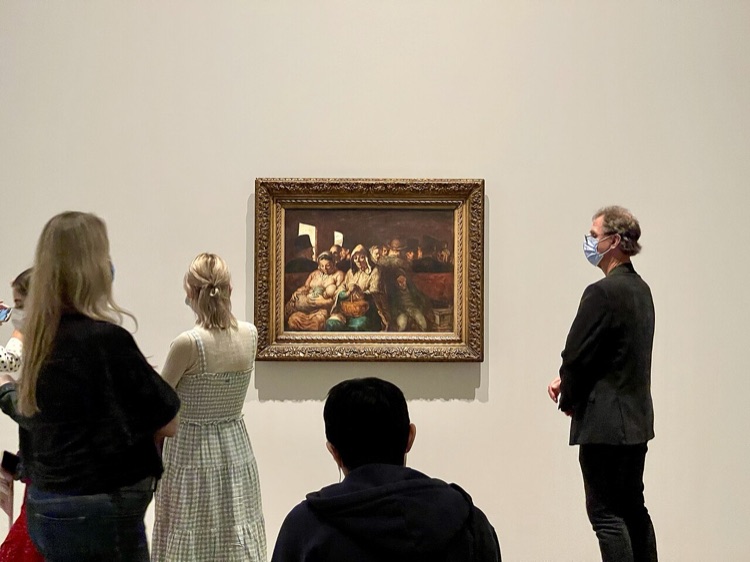
His brushwork is loose and loaded, laid on in broad slabs of tone rather than built up through careful glazes—paint pushed and dragged with a heavy brush, contours restated and left visible, so that many canvases retain the urgency of a sketch rather than the polish of a finished Salon picture. This is not negligence; it is a working method carried over from the crayon-on-stone discipline of caricature, where a figure had to read instantly, in silhouette, before a deadline. Faces are frequently summarized to a few dark accents, bodies rendered as compact masses of shadow and highlight, so that individuals dissolve into the anonymous rhythm of the crowd—travelers packed into a train carriage, a mob surging through a doorway, laundresses bent under identical burdens.
His palette stays deliberately narrow: ochres, umbers, bitumen browns, and blacks, punctuated by rare, telling notes of red or blue, producing a chiaroscuro indebted to Rembrandt and to the Spanish painting he studied in the Louvre. Light rarely falls evenly; it pools on a raised arm, a lawyer's collar, a horse's flank, letting the rest sink into shadow and heightening drama at the expense of description.
He returned obsessively to a handful of themes—third-class rail travelers, laundresses, saltimbanques, print-shop browsers, and above all Don Quixote, painted dozens of times as an emblem of threadbare idealism tilting against an indifferent world. With almost no market for his paintings in his lifetime, he worked chiefly for himself, reworking the same compositions again and again, leaving pentimenti and unresolved passages that only sharpen their raw, unmediated force.
Life and legacy
Honoré-Victorin Daumier was born on 26 February 1808 in Marseille, the son of a glazier, Jean-Baptiste Daumier, who nursed literary ambitions and moved the family to Paris around 1816 hoping to make his way as a poet. The gamble left the household poor, and the young Daumier was put to work early, as an errand boy for a court bailiff and later as a clerk in a bookshop—jobs that gave him a close, unglamorous view of the legal world he would later skewer without mercy. He also haunted the Louvre and trained briefly at the Académie Suisse, absorbing Rubens and Rembrandt even as he learned the new commercial trade of lithography.
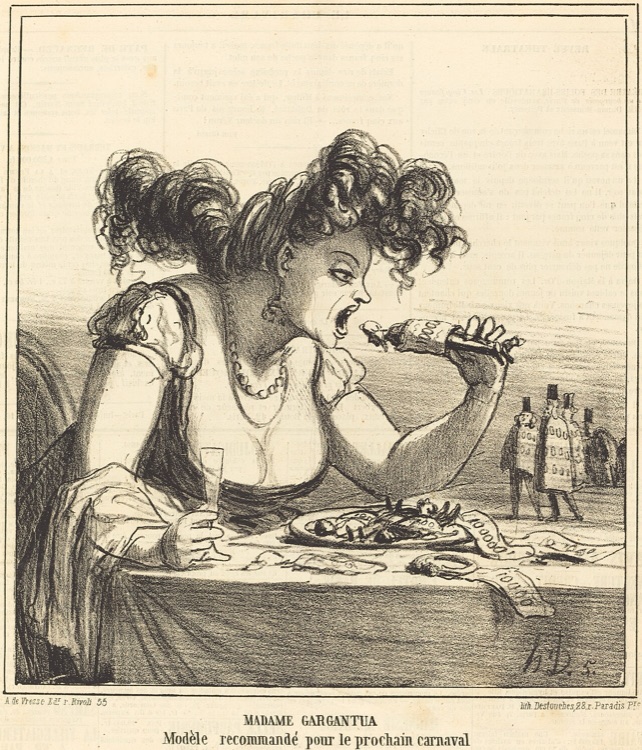
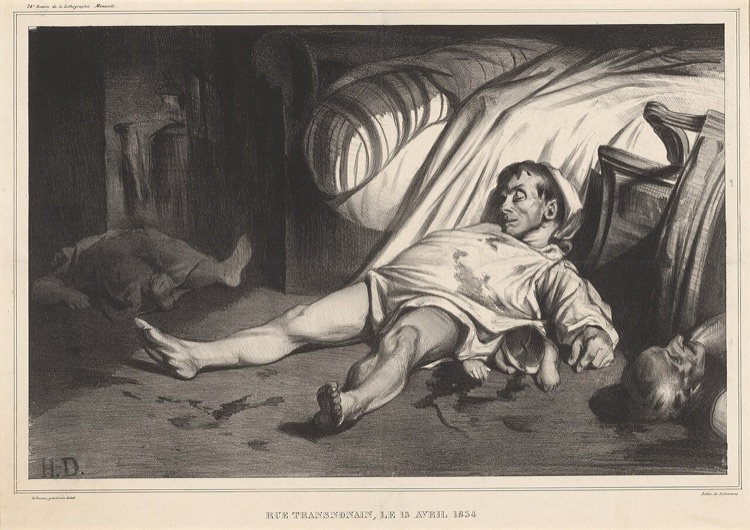
From the late 1820s he drew for the satirical press, and when Charles Philipon founded La Caricature in 1830, Daumier became one of its sharpest weapons against the July Monarchy. His most notorious lithograph, Gargantua (1831), showed King Louis-Philippe as Rabelais's giant, gorging on tribute squeezed from the poor while excreting decorations to his cronies below. The image brought a prosecution for offending the king's person, and in 1832 Daumier served six months in prison, part of it at Sainte-Pélagie. When new press laws in 1835 outlawed political caricature outright, he pivoted to social satire, turning his crayon on lawyers, doctors, landlords, and the newly moneyed bourgeoisie in series like Robert Macaire and Types parisiens. Alongside the prints he modeled small, unbaked clay caricature busts of sitting deputies, works of startling sculptural freedom that he used as reference for his lithographs and that later collectors prized as sculpture in their own right. Over roughly forty years he produced nearly four thousand lithographs for Le Charivari and other journals, becoming the most widely seen graphic satirist in France.
Painting remained, for most of his life, a private and secondary pursuit, made without patrons or a reliable market and shown only rarely at the Salon; his 1848 submission to a government competition for an allegory of the Republic won praise but he never delivered the large final canvas.
Failing eyesight and worsening poverty overtook Daumier in his final decade; his old friend Corot, learning he faced eviction from his cottage, quietly bought it for him at Valmondois, where he lived out his last years, nearly blind. A retrospective exhibition organized by friends in 1878 brought recognition but little money. He died at Valmondois on 10 February 1879, still known chiefly as a caricaturist. Only afterward did critics, and later artists from Degas to Picasso, recognize his paintings as one of Realism's most original and personal achievements.
Five famous paintings
The Third-Class Carriage c. 1862–1864
Daumier returned to this composition several times, and this version distills a crowded train carriage into a frieze of quiet endurance. In the foreground a grandmother, a nursing mother, and a sleeping boy sit pressed together, their worn hands rendered in a few dense strokes of brown and black; behind them, rows of anonymous passengers dissolve into shadow. There is no anecdote, no incident—only the patient fact of third-class travel, newly affordable to the working poor after the railway boom. Painted with a loaded, dragging brush, it turns a mundane commute into a monument to ordinary endurance, without sentimentality.
The Laundress c. 1863
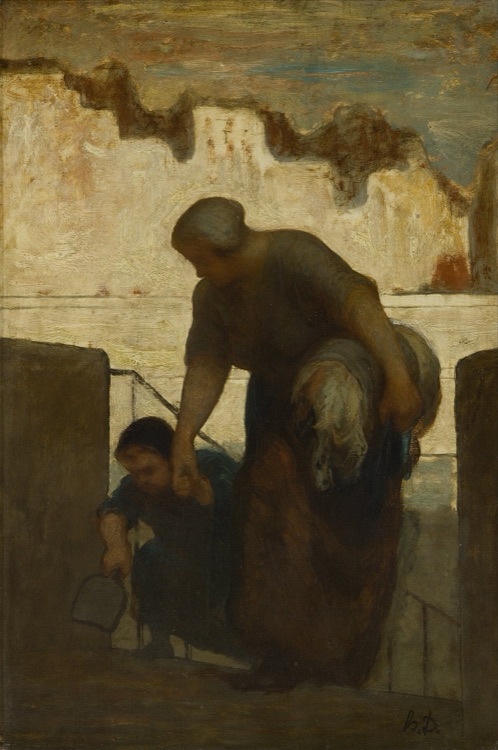
A washerwoman climbs the riverbank steps from the Seine, one arm braced against the weight of a small child, the other hauling a bundle of wet linen nearly as large as she is. Daumier silhouettes both figures darkly against a luminous, thinly brushed sky and water, so mother and child read as a single straining shape, bent under a burden that is at once literal and social. He painted several versions of this subject, drawn from laundresses he watched along the Paris quays, each stripping away picturesque detail in favor of raw physical labor—the stooped back, the taut arm, the bodily cost of keeping a household fed and clean.
Crispin and Scapin c. 1863–1865
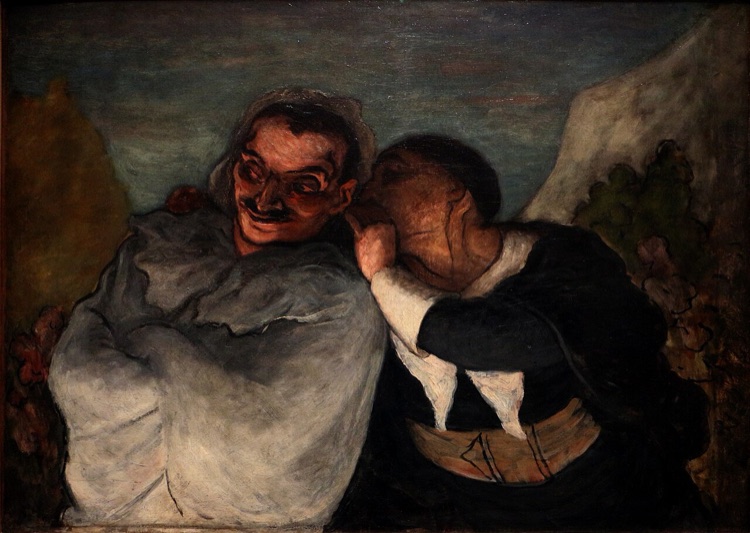
Two stock characters from French farce and the commedia dell'arte lean together conspiratorially, one whispering into the other's ear, their white costumes catching a raking light against a dark, undefined stage. Daumier, a lifelong theatergoer, distilled these scheming valets into pure gesture and mask-like expression, brushwork so loose that ruffled collars and painted faces seem to flicker rather than sit still. Beneath the comedy lurks his familiar suspicion of performance and deceit—these are tricksters plotting a scheme, and the sketch-like freedom lends the intrigue an unsettling charge.
The Uprising c. 1848–1852
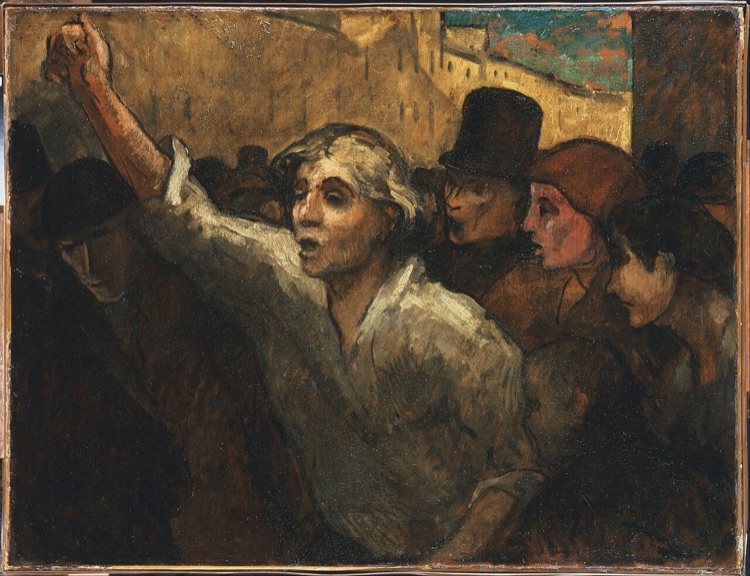
A crowd surges toward the viewer through a narrow street, a bare-chested workman with outstretched arm thrust to the front as if hurled forward by the mass behind him. Painted in the charged years around the 1848 revolution, the scene is deliberately unspecific—no barricade, no flag, no date—so it reads less as reportage than as the timeless anatomy of collective anger. Faces blur into a churning current of paint, identity subsumed into the crowd's momentum, while the workman's raised arm carries the whole force. It ranks among Daumier's most political paintings, turning the urgency of his lithographs into a brooding canvas of revolt.
Don Quixote and Sancho Panza c. 1868
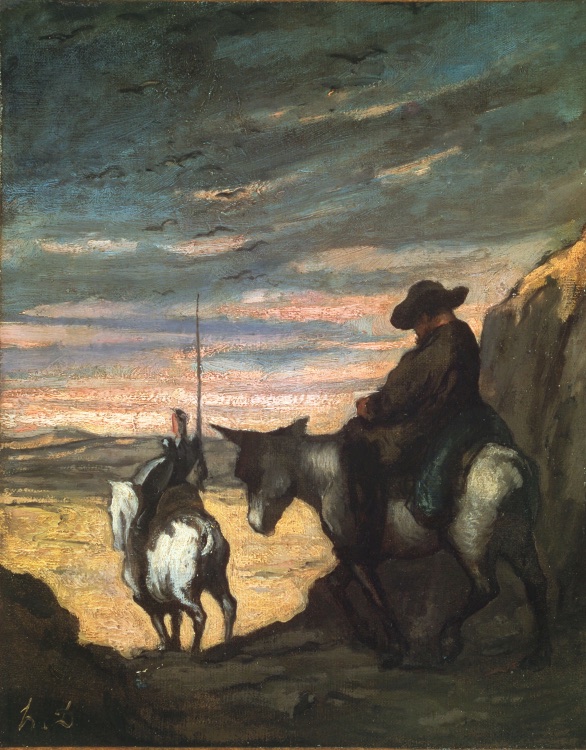
Cervantes's gaunt knight and his squat squire trudge across a bare, sunburned landscape, reduced to two dark silhouettes—one impossibly tall and thin astride Rocinante, the other short and round on his donkey—set against a blank wash of ochre earth and pale sky. Daumier painted this pairing obsessively in his later years, more than two dozen times, finding in Quixote's threadbare idealism a private emblem for his own unrewarded convictions. Stripped of incident and nearly of setting, the image works through silhouette and rhythm alone, the riders' contrasting shapes carrying all the pathos and dry comedy of the story.