Mary Cassatt
The only American invited to exhibit with the Impressionists, painting mothers and children unsentimentally.
Style and technique
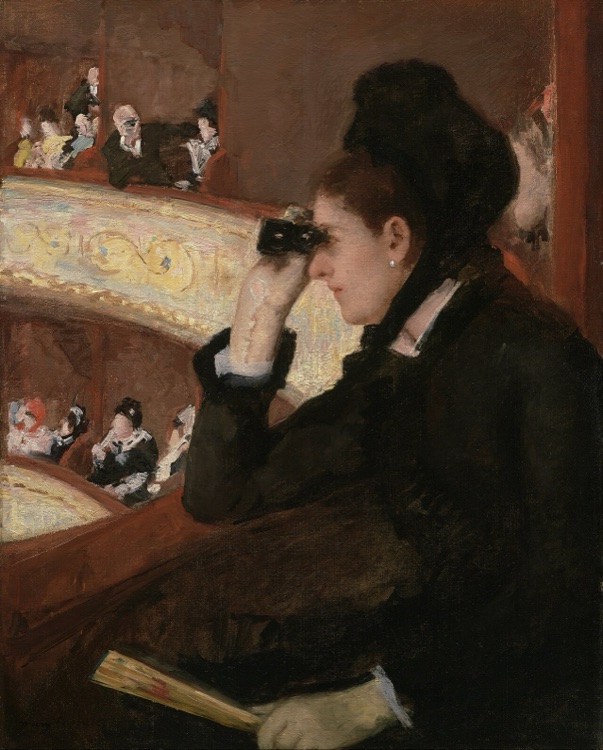
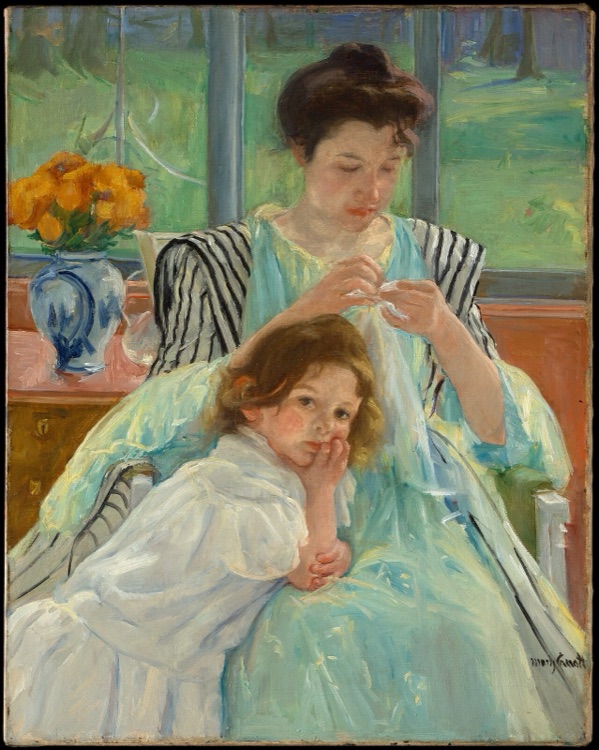
Mary Cassatt built her art around a single, radical premise: that the everyday intimacy between a mother and child was subject enough for serious painting, if only it were rendered without sentimentality. She painted bathing, nursing, dressing, and reading as she observed them, unposed and unglamorized, often caught mid-gesture, refusing the saccharine gloss that Salon painting typically applied to domestic scenes. A child's small foot cradled in soapy water, a mother's cheek pressed absently against her infant's — these are tender images, but Cassatt's brush keeps them clear-eyed, almost clinical in its attention to weight, posture, and the mechanics of touch.
After seeing a great exhibition of ukiyo-e woodblock prints in Paris in 1890, Cassatt was electrified, and the encounter reshaped her compositions permanently. She adopted the flattened picture plane, the confident black contour line, and the asymmetrical cropping and plunging bird's-eye viewpoints favored by artists like Utamaro. Figures are frequently sliced by the frame's edge, tipped into steep, floor-tilting perspectives, or silhouetted against patterned fields of color rather than modeled illusionistic space. Her series of drypoint-and-aquatint color prints, made in direct emulation of that Japanese technique, pushed the flattening further still, reducing figures to elegant planes of unmodulated color bound by fluid outline.
Her brushwork is decisive rather than atmospheric — she cared less for dissolving light than for describing solid form quickly and surely, favoring pattern, silhouette, and interlocking shapes of costume and furniture over softened edges. Color she deployed with unusual boldness: acid greens against dusty rose, black used as a full chromatic value rather than an absence of color, a habit shared with Manet and Degas but pushed toward her own quietly graphic ends. The result feels both formally daring and timelessly observant in its subject: women absorbed in the unremarkable, unrepeatable business of caring for a child.
Life and legacy
Mary Stevenson Cassatt was born in 1844 in Allegheny City, Pennsylvania, into a wealthy and cultivated family; her father was a successful stockbroker and land speculator, and the household's comfortable means gave Cassatt an early taste of Europe, where the family lived for several years during her childhood, and later gave her the financial independence to pursue an unconventional career. She studied at the Pennsylvania Academy of the Fine Arts in Philadelphia but chafed at the institution's slow pace and its condescension toward women students, and in 1866 she left for Paris, determined to study the Old Masters firsthand and to train with private tutors since the École des Beaux-Arts remained closed to women.
Cassatt settled permanently in France, submitting work to the official Salon under her own name through the 1870s while growing increasingly frustrated with its conservative juries. Everything changed in 1877, when Edgar Degas, whose pastels she had admired in a dealer's window, invited her to join the circle of independent artists exhibiting outside the Salon system.
She exhibited with the Impressionists in four of their group shows and remained the only American ever formally invited into their ranks. Her friendship with Degas became one of the defining relationships of her career, an exchange of technical advice, sharp critique, and mutual respect that shaped her draftsmanship, her experiments in pastel, and her later ventures into color printmaking, even as the two artists' notoriously prickly temperaments occasionally strained the friendship to its limit.
Cassatt never married, a choice she regarded as necessary rather than regrettable: a husband and children of her own, she believed, would have made the demanding, unglamorous work of a professional painter impossible. She poured that independence into her art and into an increasingly influential second career advising wealthy American collectors, most notably her friends Louisine and H. O. Havemeyer, steering their purchases toward Manet, Degas, Courbet, and the old Spanish masters. Through this quiet advocacy she did as much as any dealer to introduce Impressionism to American museums, since many Havemeyer acquisitions eventually entered the Metropolitan Museum of Art. In her later years, failing eyesight curtailed her painting, and she channeled her considerable energy into the campaign for women's suffrage, lending her name, her money, and her conviction that women deserved full civic standing to the cause.
Five famous paintings
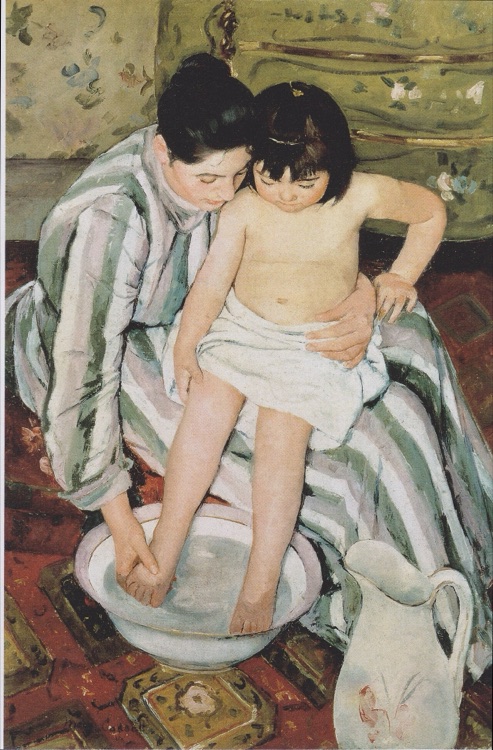
The Child's Bath 1893
Cassatt collapses the distance between viewer and subject: we look almost straight down into a striped basin where a mother steadies her naked child's foot in the water, the two heads bent together in profile. The bird's-eye angle, the cropped washstand, and the bold striped pattern of the mother's dress all derive directly from Japanese woodblock prints, which Cassatt had studied intensely a few years earlier. Yet the composition never feels borrowed; the tender, slightly awkward clasp of hands around a wriggling foot reads as observed truth, the kind of unposed domestic choreography only a patient, unsentimental eye could catch.
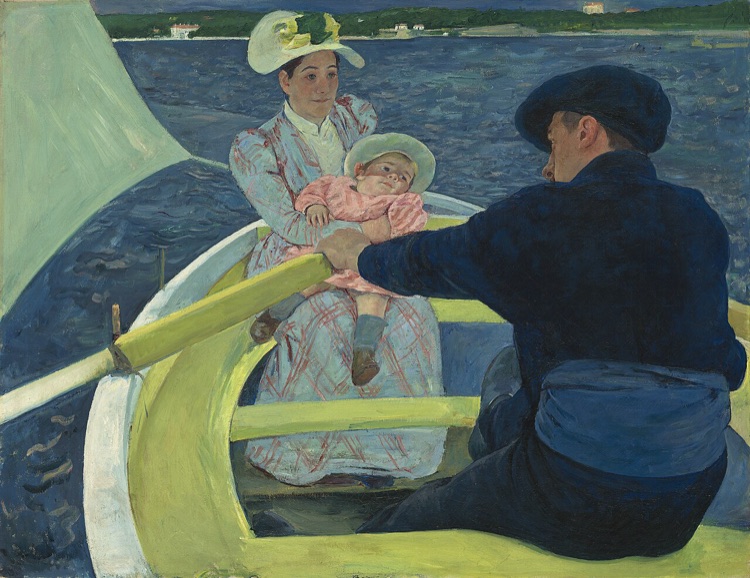
The Boating Party 1893-94
Painted after a winter in the south of France, The Boating Party is Cassatt's boldest experiment in flattened, Japanese-inflected design: a wall of unmodulated navy blue fills nearly a third of the canvas as the oarsman's broad back, while a mother and child in sunlit yellow and white occupy the boat's far end. The steep diagonal of the gunwale and the radically cropped oar owe an obvious debt to ukiyo-e prints. Unlike her more intimate interiors, this outdoor scene feels almost unnervingly graphic and modern, its quiet tension between the faceless oarsman and the watchful mother left deliberately unresolved.
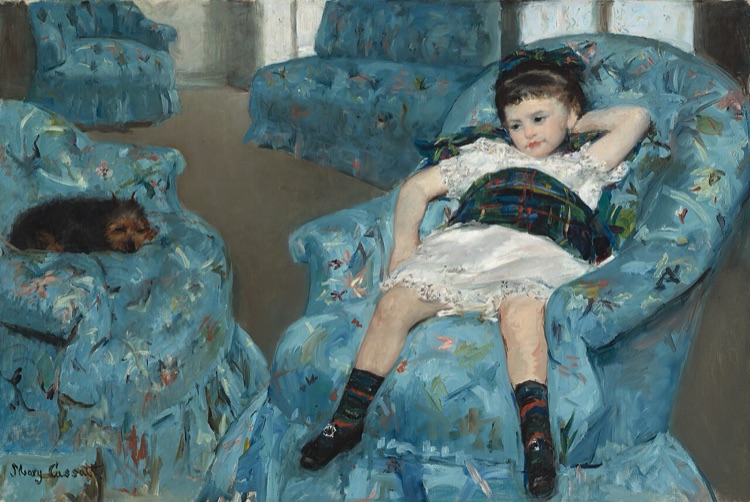
Little Girl in a Blue Armchair 1878
A restless little girl sprawls sideways across a blue damask armchair, one arm flung over its back, legs splayed with the unselfconscious abandon of a child too bored to sit still for the artist. Cassatt tipped the floor upward and let the armchairs, rendered in loose, vigorous brushwork, crowd the frame in a distinctly Degas-inflected composition; Degas himself reportedly reworked the background. The picture scandalized the jury that rejected it from an official showing, precisely because it dispensed with the era's cloying conventions for painting childhood, presenting instead a specific, fidgety, believable child at an unglamorous moment.
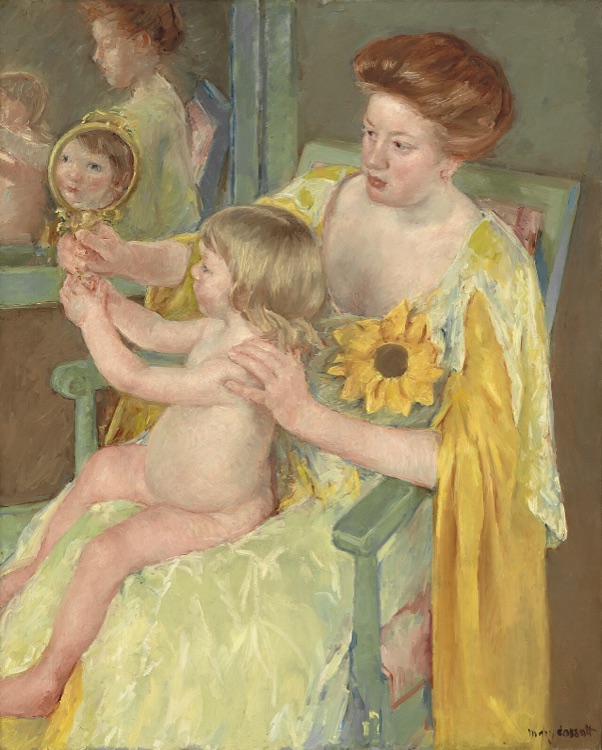
Mother and Child (The Oval Mirror) 1899
A mother lifts her round-cheeked child before an oval mirror, their two faces echoed and doubled in reflection, so the canvas becomes a meditation on likeness passed from parent to child. Cassatt arranges the pair in a tight pyramidal embrace, the child's bare arm reaching to touch the glass, while broad, confident strokes of pink, white, and gold describe flesh and drapery with none of the softening haze typical of academic sentiment. The mirror motif, a favorite of Cassatt's maturity, deepens an otherwise simple domestic moment into a quiet essay on resemblance and the bond of gazes between generations.
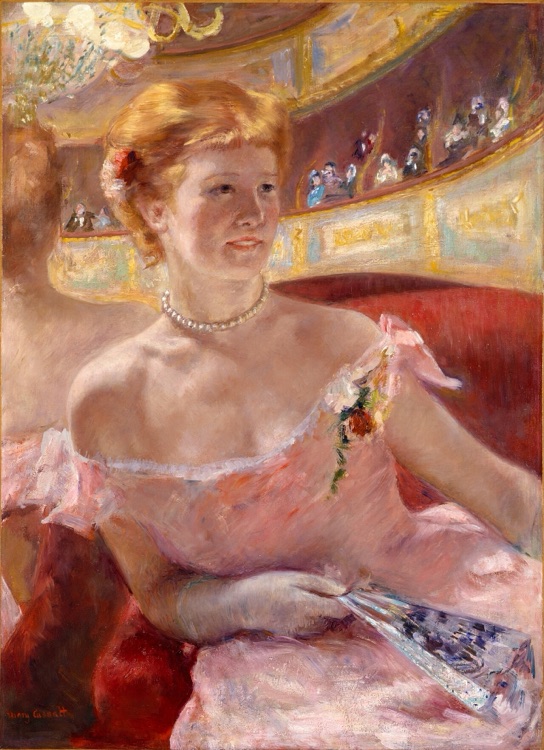
Woman with a Pearl Necklace in a Loge 1879
Shown at the fourth Impressionist exhibition, this portrait places a fashionable young woman in a theater box, her gloved hand raised to her chin, a strand of pearls glowing against her bare shoulders and a fan resting at the ready. Cassatt renders the loge's red upholstery and gilt trim in quick, textured strokes that dissolve into abstraction at close range, while the sitter's cool, appraising gaze turns the usual dynamic of theater-going, women watched as much as watching, back on the viewer. It ranks among Cassatt's most confident society portraits, matching Renoir's opera-box scenes while keeping her own drier, more alert touch.