Ilya Repin
Russia's great Realist, painting Volga barge haulers, a terrified tsar, and Tolstoy's bare feet.
Style and technique
Repin's style fuses the documentary precision of Russian Realism with a theatrical instinct for narrative drama, producing canvases that read as social reportage and staged human theater at once. Trained at the Imperial Academy but shaped by his allegiance to the Peredvizhniki, or Wanderers, he rejected mythological and biblical subjects in favor of Russia's actual streets, fields, and drawing rooms, insisting that contemporary life—its labor, its injustices, its private griefs—was subject enough for serious art. His brushwork shifts to suit the occasion: broad, encrusted strokes for weathered peasant skin and sun-bleached rags in Barge Haulers on the Volga, tightened to near-photographic precision for the writers, composers, and statesmen he portrayed.
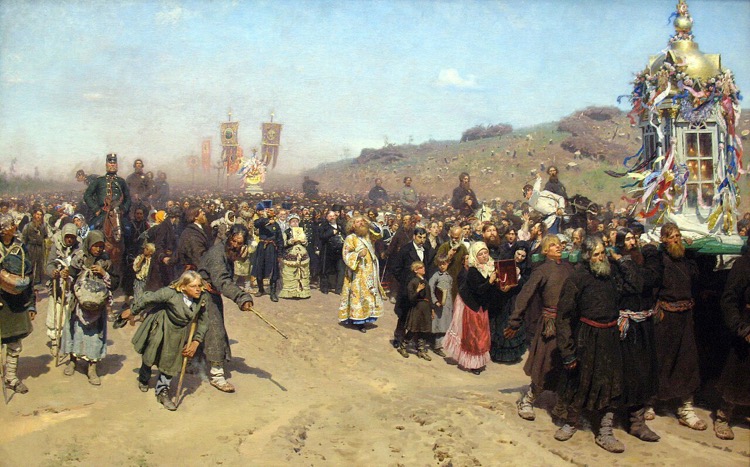
Central to his method is an almost forensic attention to individual physiognomy within a crowd. Rather than painting generic social "types," Repin studied real models—burlaki met on the Volga, Cossacks tracked down in Ukrainian villages, clerks and dignitaries glimpsed in St. Petersburg—and gave each figure in a large composition its own face, posture, and inner weather. This is what makes Religious Procession in Kursk Governorate and Reply of the Zaporozhian Cossacks read as living ensembles rather than backdrops: dozens of individuals, each independently alive, fused into one sweeping gesture of motion or laughter.
His psychological portraiture is equally exacting. Sitters from Mussorgsky to Tolstoy are captured not in flattering repose but at moments that reveal character—a composer's physical dissolution, a novelist's ascetic defiance—through unguarded expression rather than allegorical props. Color tends toward a somber, earthbound palette of browns, grays, and muted ochres, punctuated by isolated accents of red or white that draw the eye to a face, a wound, a flag. Compositions run diagonal and crowded to the frame's edge, suggesting movement spilling beyond the canvas, while lighting stays naturalistic, so meaning emerges from gesture rather than chiaroscuro.
Life and legacy
Ilya Yefimovich Repin was born on 5 August 1844 in Chuhuiv, a garrison town in the Kharkiv region of what is now Ukraine, then part of the Russian Empire's Sloboda frontier settled generations earlier by Cossack military colonists. His father traded horses for the army; the family was poor but not serf-bound, and the boy's earliest artistic training came from local icon painters, copying saints for village churches before he had ever seen a real gallery. That regional inheritance—Cossack lore, Orthodox icon craft, the plain textures of provincial life—stayed with him for life and resurfaced decades later in his epic canvases of Ukrainian history.
In 1863 Repin left for St. Petersburg, working odd jobs while studying at the Drawing School of the Society for the Encouragement of Arts, and in 1864 he entered the Imperial Academy of Arts itself. There he fell under the influence of Ivan Kramskoi, leader of the "Revolt of the Fourteen"—students who had walked out of the Academy's 1863 gold-medal competition rather than paint a prescribed mythological subject, and who went on to found the Peredvizhniki, or Wanderers, a cooperative devoted to depicting Russian life directly and touring exhibitions to audiences the Academy never reached. Repin nonetheless completed his training, winning the Grand Gold Medal in 1871 and a state-funded pensioner's trip abroad. Before he left, he had already begun the work that would make his name: years spent painting Barge Haulers on the Volga, a monumental study of laborers hauling a ship upstream that turned an unglamorous subject into a national sensation on its unveiling in 1873.
Repin spent 1873–1876 in France and Italy, absorbing the Impressionists without adopting their method, and formally joined the Peredvizhniki on his return to Russia in 1878. The following decade in Moscow was his most productive: crowd scenes exposing clerical hypocrisy and social hierarchy, a cycle on the Populist revolutionary underground, and the psychologically devastating Ivan the Terrible and His Son Ivan, briefly banned by the tsarist censor. He became the era's foremost portraitist, painting Tolstoy, Mussorgsky, and the collector Pavel Tretyakov, whose gallery would inherit much of his finest work.
From 1894 Repin taught at the Academy itself, shaping painters that included Boris Kustodiev and Isaac Brodsky. Around 1900 he settled at Penaty, his estate in Kuokkala, Finland, with the writer Natalia Nordman. When Finland gained independence in 1917, the border shifted and Penaty became foreign territory without Repin ever having moved; he declined Soviet entreaties to return home and died there on 29 September 1930.
Five famous paintings
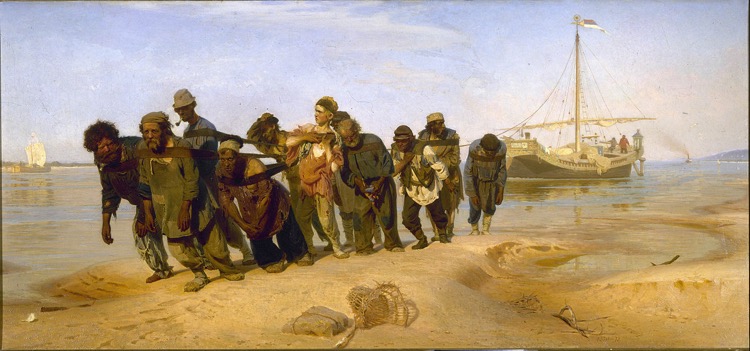
Barge Haulers on the Volga 1873
Eleven burlaki, harnessed like draft animals, drag a barge upstream along the Volga's blinding shore, each man distinguished by age, posture, and inner state rather than a uniform type. Repin sketched real haulers during a voyage in the early 1870s, refusing to romanticize their labor into folkloric color. Shown to acclaim in 1873, the canvas made the twenty-nine-year-old an overnight sensation and an emblem of Russian Realism's arrival. Contemporaries read it as a veiled comment on serfdom's afterlife, though Repin maintained he simply painted what his eyes had seen: exhaustion, endurance, and stubborn dignity under an indifferent sun.
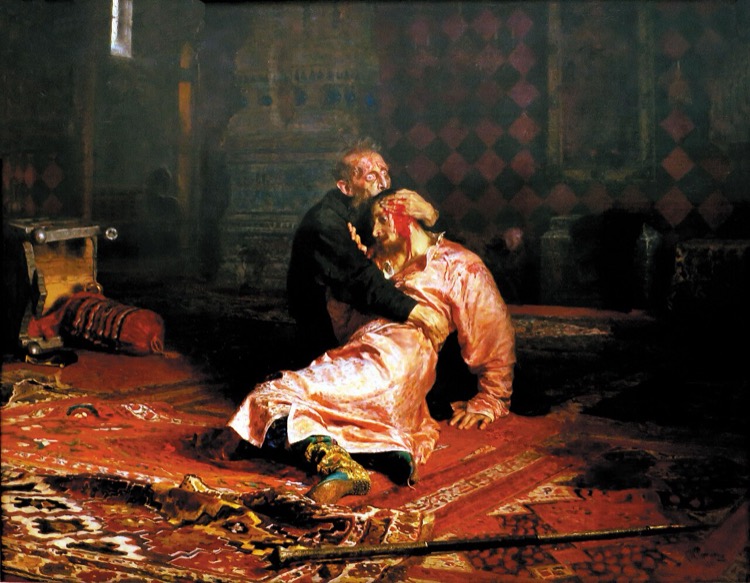
Ivan the Terrible and His Son Ivan on 16 November 1581 1885
In a dim palace chamber, Tsar Ivan IV clutches his dying son moments after striking him with a pointed staff in an ungovernable fit of rage. Blood stains the tsarevich's temple and his father's hands; Ivan's bulging, horrified eyes register the weight of what he has just done. Repin based the scene on a semi-legendary 1581 episode, and its raw psychological violence proved too much for the state: the tsarist censor banned the painting from public view for several months in 1885. It has since been physically attacked twice, slashed by a knife-wielding visitor in 1913 and struck again in 2018, each time requiring painstaking restoration.
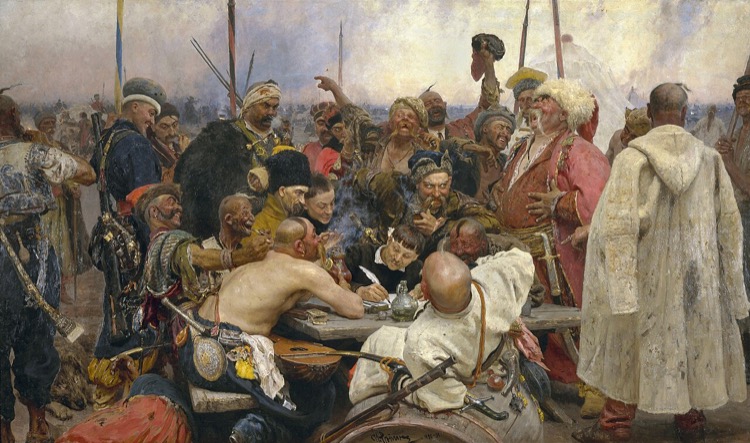
Reply of the Zaporozhian Cossacks to Sultan Mehmed IV 1891
A boisterous band of Zaporozhian Cossacks crowds around a rough wooden table, doubled over with laughter as a scribe drafts their gleefully obscene reply to the Ottoman Sultan's demand for surrender. Repin spent over a decade on the canvas, traveling through Ukraine to study Cossack descendants, weapons, and dress so each of the dozens of figures reads as a distinct individual rather than a generic type. Tsar Alexander III purchased the finished work for a record sum, and it remains one of the largest, most exuberant group portraits in Russian painting, prized for the infectious camaraderie radiating from every laughing face.
Religious Procession in Kursk Governorate 1883
A vast crowd escorts an icon down a dusty rural road in this panoramic frieze of Russian society, arranged so portly clergy and landowners on horseback command the privileged center while barefoot peasants are pushed toward the margins. A mounted overseer raises his whip against a hunchbacked boy at the edge of the crowd, making the social critique unmistakable beneath its festival surface. Repin worked on the composition for roughly three years, populating it with types sketched from real processions in Kursk province. The result functions less as devotional scene than as a sweeping inventory of imperial Russia's rigid social hierarchy.
Leo Tolstoy Barefoot 1901
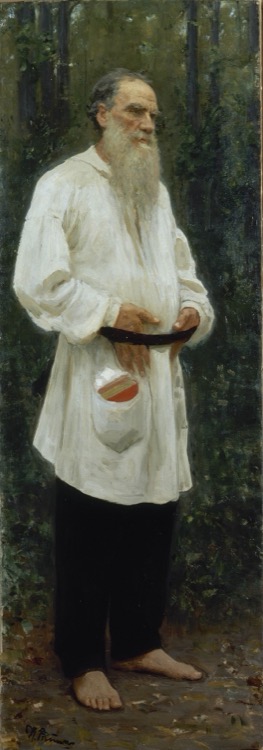
Leo Tolstoy stands outdoors on his Yasnaya Polyana estate in a plain peasant blouse cinched with rope, his bare feet planted on the earth, his weathered face and beard rendered with the same searching attention Repin gave his portraits of composers and revolutionaries. The two men were close friends for decades, and Repin visited the estate repeatedly, producing dozens of portraits of the novelist at work and at rest. This image distills Tolstoy's late-life philosophy most directly: the bare feet and coarse dress announce his rejection of his own aristocratic birth in favor of the ascetic simplicity he preached in his final decades.