Robert Delaunay
He found a way to make colour itself move, spin, and pulse without depicting anything.
Style and technique
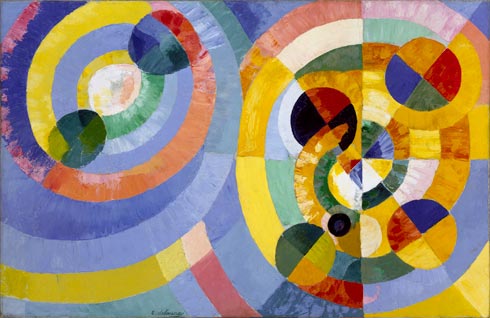
Delaunay took a single idea from Chevreul's colour theory and built an entire movement on it. Chevreul had shown that colours placed adjacent to each other affect each other — simultaneous contrast: a grey looks different against orange than against blue; pure colours placed side by side seem to pulsate. Delaunay used this optical phenomenon as the primary material of his painting.
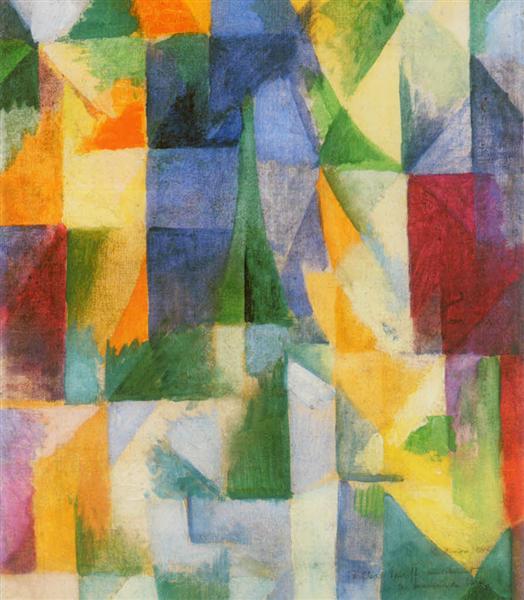
By 1912 he had arrived at the 'Windows' series: paintings of pure colour relationships with barely any representational content. The light from a window, the sky and city beyond it — these become pretexts for exploring what happens when discs and planes of complementary colour are placed against each other. The paintings shimmer and pulse; the eye cannot rest on them the way it can on a stable representation.
Apollonaire called his work Orphism — after Orpheus, the singer whose music moved the physical world — because it used colour and form to produce a directly physical, quasi-musical sensation. The term stuck, though Delaunay himself preferred Simultaneism, after the simultaneous colour contrasts that were his technical foundation.
Four fingerprints: concentric circles or arcs of pure colour as the dominant compositional element, the disc form as a unit of simultaneous contrast, a specific palette of warm and cool primaries chosen for maximum optical interaction, and the Eiffel Tower as a recurring motif — the modern structure seen through the dissolving Cubist lens of Delaunay's colour analysis.
Life and legacy
Delaunay was born on 12 April 1885 in Paris. His parents separated when he was young, and he was raised largely by his aunt and uncle. He left school early and apprenticed as a theatrical set designer in Belleville, which gave him an early sense of colour and scale on a large format.
He began painting seriously around 1904 and moved through the usual sequence: Post-Impressionism, Fauvism, Cézanne. He encountered Cubism around 1909–1910 and recognised that the Cubist fragmentation of form could be applied to colour relationships as well as to spatial analysis.
His Eiffel Tower series (1910–1912) is his first major contribution: the tower fragmented through a Cubist prism, its structure dissolving into planes and diagonals that carry the dynamism of the modern city. He described these paintings as showing the tower 'attacking' the sky — the aggressive energy of the new age of steel and engineering.
The 'Windows' series of 1912 was the decisive step into near-abstraction. The window becomes a frame within which colour relationships are explored; the representation of the city beyond is reduced to a shimmer of green and gold. The paintings move very close to pure colour abstraction without quite crossing the line.
In 1913 he met Blaise Cendrars and designed the 'Prose of the Trans-Siberian Railway' — a two-metre long illustrated poem that was one of the first artist's books. He was deeply involved in the literary and musical circles of pre-war Paris: Apollinaire was a close friend, as was Fernand Léger.
The First World War sent him to Portugal and Spain. He returned to Paris in 1921 and continued the development of his colour abstraction through the 1920s and 1930s, though never quite recapturing the radical energy of 1912–1913.
His influence was extensive: Klee and Macke visited his studio in Paris in 1912 and carried his colour ideas back to Germany, where they transformed the Blaue Reiter. The Op Art movement of the 1960s, and specifically Bridget Riley's early work, is directly descended from his optical colour research.
Five famous paintings
Circular Forms, Sun and Moon 1913
Delaunay's most complete statement of pure colour abstraction — a large canvas of concentric arcs and circular segments in orange, blue, green, and yellow arranged around a central form that is simultaneously the sun and a colour disc. There is no representational content: the painting is entirely about what happens optically when warm and cool, light and dark colours are placed in circular relationships. The forms appear to rotate; the colours pulse. Apollinaire described the effect as like looking at music. It is in the Kunsthaus Zürich.
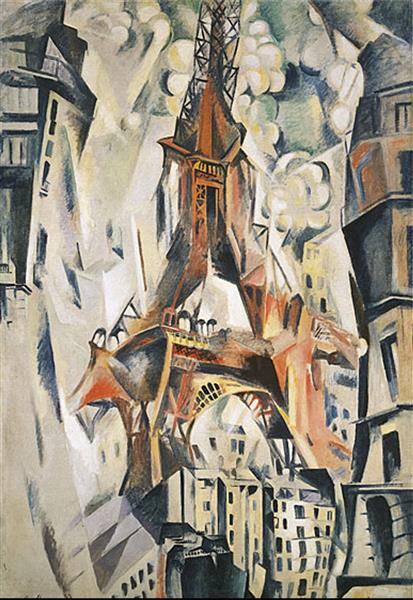
Eiffel Tower 1911
One of the Eiffel Tower series that established his mature Cubist-Futurist vocabulary. The tower is shown fragmenting — its structure dissolving into planes that reorganise themselves around the diagonal thrust of the girders. The sky and the buildings surrounding the tower press into each other; the tower's height is rendered as a compositional force rather than a measurable quantity. Delaunay was using the most modern structure in Paris as a subject for a painting that was itself trying to be modern — to find a visual language adequate to the energy of the contemporary city.
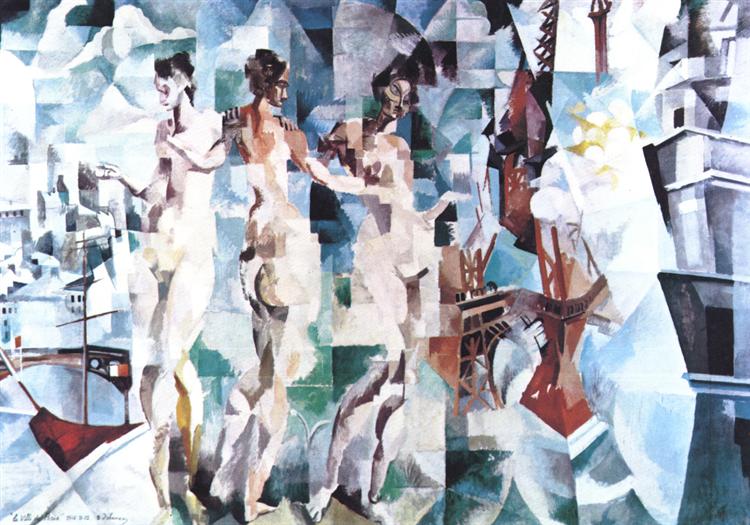
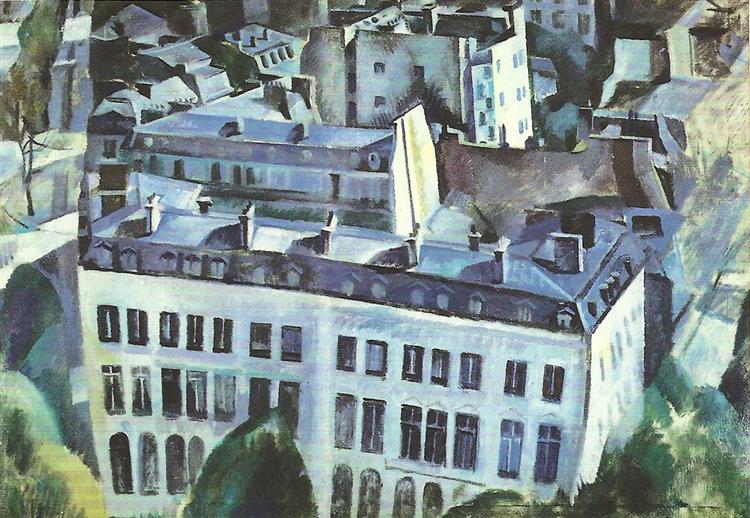
The City of Paris 1912
A large canvas — 267 by 406 centimetres — that combines the Eiffel Tower approach with figurative elements: three graces from classical painting appear at the left, the city behind them fragmented into Cubist planes of grey, blue, and ochre. The painting was Delaunay's major submission to the Salon des Indépendants of 1912 and was intended as a summation of his Paris subject matter — the ancient and the modern, classical figure painting and the new city, combined in the Cubist-Simultaneist vocabulary he had been developing. It is in the Musée National d'Art Moderne at the Centre Pompidou.
Window on the City No. 3 1911
A transitional work from the 'Windows' series, painted the year before he moved into pure abstraction. The window's curtain, the glass, and the city beyond are all compressed into overlapping planes of green, grey, and gold. A tower — possibly the Eiffel Tower — is dimly visible in the upper right. The representational content is barely present; what remains is the sensation of light filtered through glass, colour on colour, the shimmer of Paris seen from a height on a clear day. The forms are still nominally architectural but the painting is already about colour relationships as much as buildings.
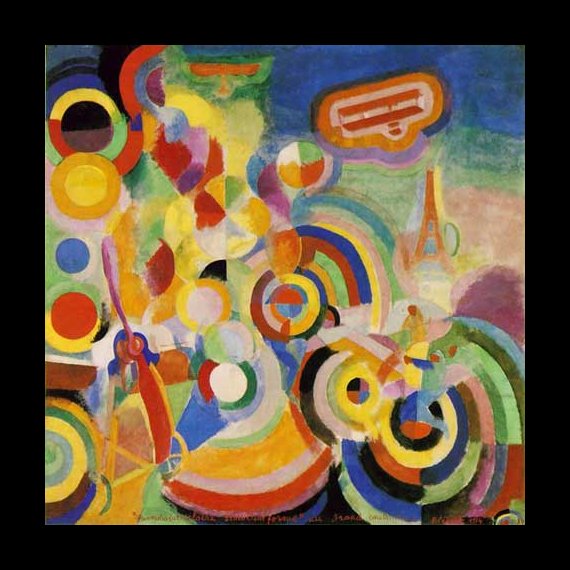
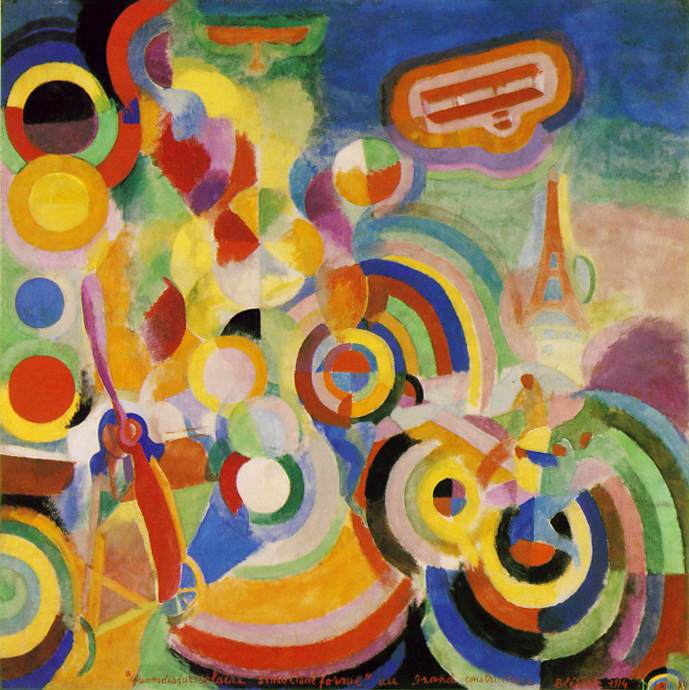
Homage to Blériot 1914
A tribute to Louis Blériot, who made the first crossing of the English Channel by aeroplane in 1909. Delaunay shows the sun — a great disc of concentric warm and cool colour — at the upper centre, with the propellers and abstract forms of an aeroplane in flight. The Eiffel Tower appears below, this time as an element in a composition about technological triumph. The colour is his most exuberant: warm orange and gold against cool blue and green, the simultaneous contrasts at full vibration. The painting captures the Futurist enthusiasm for aviation that characterised the years immediately before the war, rendered in a French rather than an Italian visual language.