Umberto Boccioni
He painted speed, force, and the sensation of modernity before it had a name.
Style and technique
Boccioni was the most gifted painter of the Italian Futurist movement and its most rigorous theorist. Where the other Futurists — Marinetti, Severini, Russolo — were essentially propagandists or decorators, Boccioni was trying to solve a genuine formal problem: how to paint force, duration, and motion in a medium that can only show a single moment.
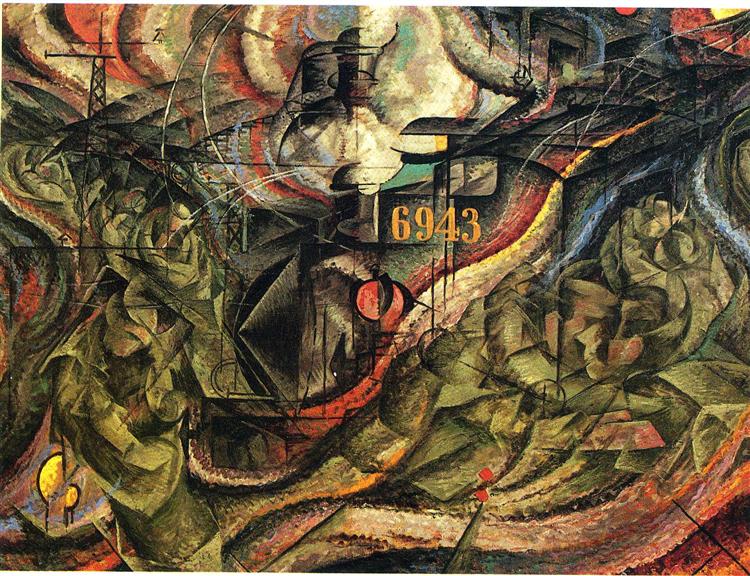
His solution was to borrow from Cubism's multiple viewpoints and combine it with the Divisionist colour theory of his Italian training. In the 'States of Mind' triptych (1911–1912), he showed the interior states of the figures — those leaving a train, those staying, those who remain — as visual fields of emotional force: diagonals of motion, wavy lines of anxiety, dense overlapping planes of sensation. The paintings are not images of motion but images of the feeling of motion and separation.
The Futurist vocabulary he helped develop included several distinctive formal strategies: lines of force (arrows and diagonals indicating the direction and energy of movement), simultaneity (the representation of consecutive moments in a single image), and interpenetration of forms (solid objects bleeding into their surroundings in the way a moving object trails afterimages).
Four fingerprints: diagonal lines of force cutting across the canvas, the interpenetration of figure and background so that the boundaries of objects dissolve into their surroundings, warm, saturated colour used as emotional indicator rather than descriptor, and a specific subject matter — industrial cities, crowds, horses, the physical energy of modern urban life.
Life and legacy
Boccioni was born on 19 October 1882 in Reggio Calabria, in the southern tip of Italy, and spent his childhood moving between various southern Italian cities as his father, a minor civil servant, was transferred between postings. He arrived in Rome at seventeen and began studying art informally, then enrolled in the Scuola Libera del Nudo and joined the studio of Giacomo Balla — an established painter who introduced him to Divisionism and the colour theories of Chevreul.
He traveled to Paris in 1906 and encountered Cubism and the international avant-garde directly. He moved to Milan in 1907, the city that would define his mature subject matter: industrial, noisy, fast, the most modern city in Italy. The riots and workers' protests that periodically convulsed the city became his visual material.
In 1909 he met Filippo Tommaso Marinetti, who had just published the Futurist Manifesto in Le Figaro. Boccioni was immediately recruited, and within a year he had become the most important visual artist of the movement, co-signing the 'Technical Manifesto of Futurist Painting' in 1910 and leading the practical development of a Futurist painting style.
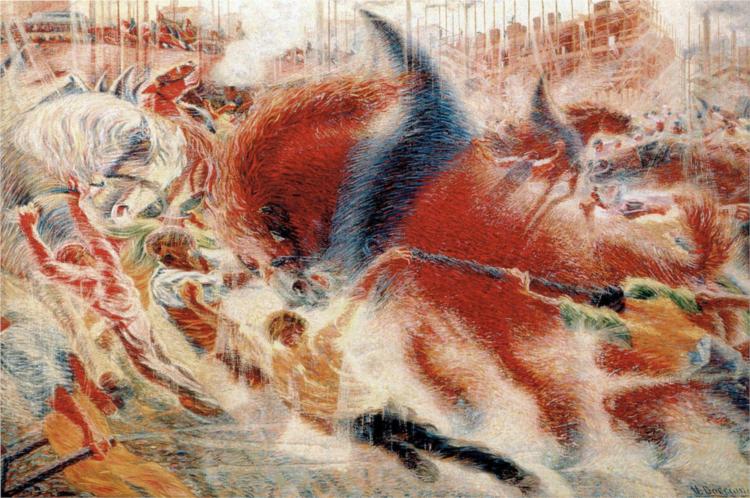
The problem was that the first Futurist paintings — the 'States of Mind' series of 1911, the 'City Rises', the street scenes — were not yet technically adequate to their stated ambitions. Boccioni traveled to Paris in 1911 and encountered Cubism directly for the first time. He returned to Milan and repainted the 'States of Mind' series from scratch, now with the Cubist vocabulary of multiple simultaneous viewpoints properly absorbed.
The second versions of the 'States of Mind' triptych are among the key works of the European avant-garde between 1911 and the outbreak of war: Cubist analysis combined with Futurist emotional intensity, the multiple viewpoints used not to describe an object from different angles but to represent the subjective experience of departure, waiting, and return.
He enlisted enthusiastically when Italy entered the First World War in 1915 — Futurism had always celebrated violence and national energy — and was posted to an artillery unit. He fell from a horse during a training exercise near Verona and died of his injuries on 17 August 1916, aged thirty-three. The loss cut the development of Futurism at its most productive point.
Five famous paintings
The City Rises 1910
Boccioni's first major Futurist canvas — 199 by 301 centimetres — and the work that announced his ambition. A great red and orange horse surges forward, surrounded by workers who grab its bridle and harness. Behind them, the construction of a modern industrial city rises in diagonals of scaffolding and smoke. The figures and the horse merge into each other; the background penetrates the foreground. The scale and energy of the painting are deliberately overwhelming — Boccioni wanted the viewer to feel physically swept up in it. It is in the Museum of Modern Art in New York.
States of Mind I: Those Who Go 1911
The central panel of the 'States of Mind' triptych, the second version repainted after Boccioni encountered Cubism in Paris. A crowd of figures at a train station is rendered as a sweeping diagonal of overlapping forms — faces, hats, hands, the bars of a railway carriage — moving from right to left. The dominant colour is grey-green; the forms interpenetrate and blur. The painting is about the sensation of departure, the specific psychic state of leaving — not the fact of the train or the station but the feeling of moving away from what is known into what is not. All three panels are in the Museum of Modern Art in New York.
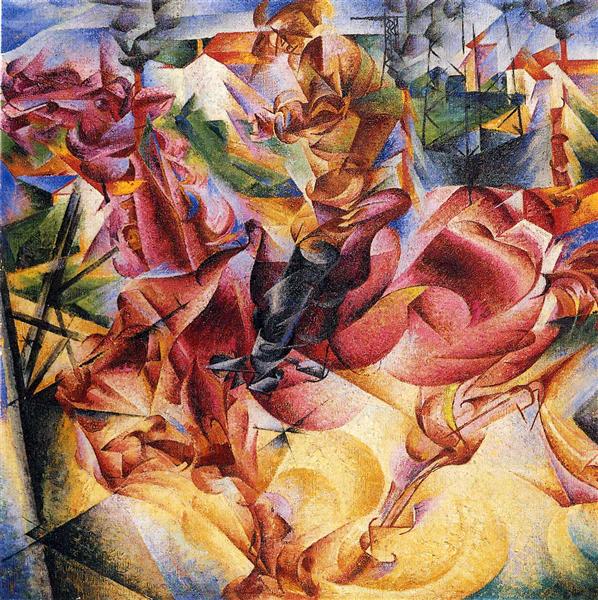
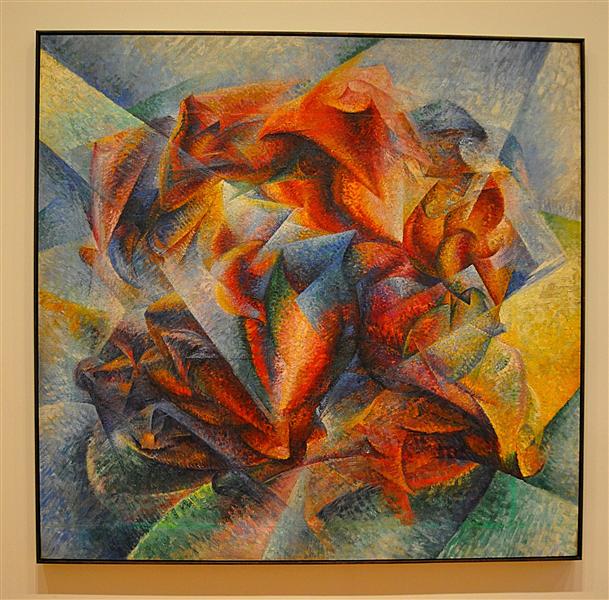
Elasticity 1912
A horse and rider in movement, the motion rendered through overlapping planes and diagonal lines of force. The horse's legs multiply into the series of positions they pass through; the rider's form echoes and repeats. The Cubist analysis is applied not to describe the horse from multiple viewpoints simultaneously but to represent the duration of its movement — all the positions the animal occupies in a brief span of time, compressed into a single image. The palette — warm ochre, green, brown, deep blue — is more restrained than the 'City Rises', the spatial organisation more complex. It is in the Pinacoteca di Brera in Milan.
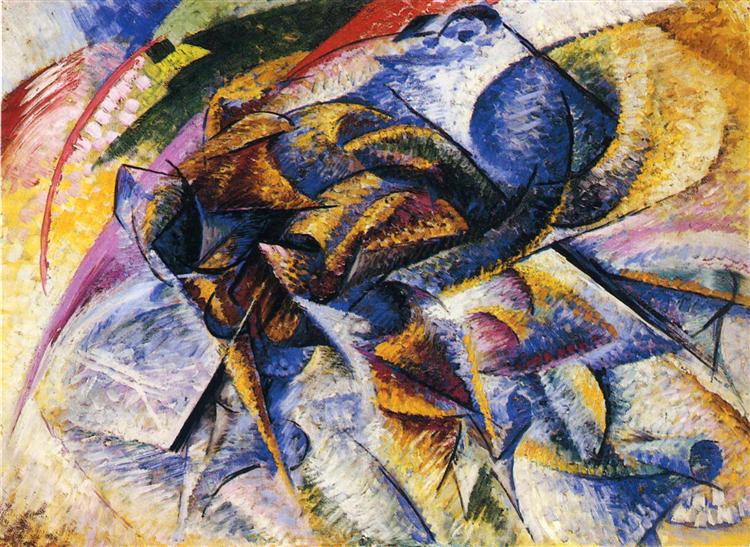
Dynamism of a Cyclist 1913
A late canvas from the height of his mature style. A cyclist — barely visible as a figure; resolved into a pattern of overlapping planes and force-lines — moves across the canvas in a rapid diagonal. The wheel, the legs, the body, the road surface all interpenetrate. The composition is organised around an absence: the most dynamic element of the image is the empty space ahead of the cyclist's movement. Boccioni is painting not the cyclist but the motion, and the motion is in the space in front of the moving body as much as in the body itself. It is in the Peggy Guggenheim Collection in Venice.
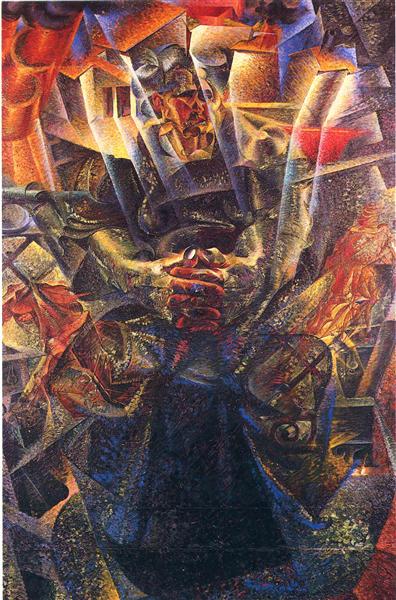
The Street Enters the House 1911
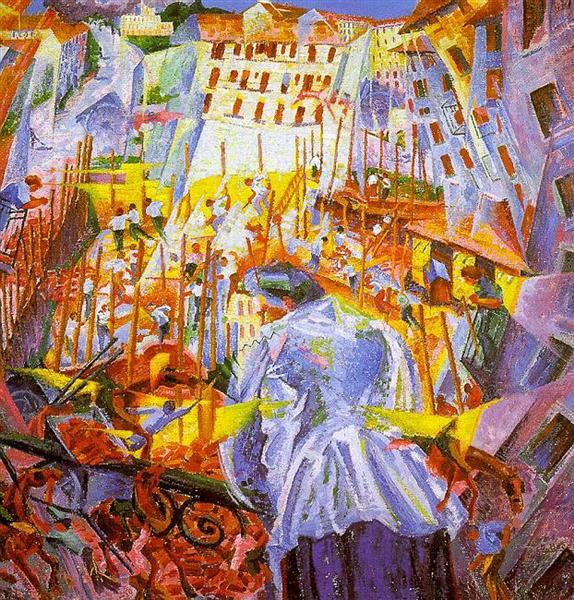
A woman in red leans on a balcony railing; below and around her, the street and buildings of a modern city press in. The title describes the painting's formal strategy: the separation between inside (the domestic) and outside (the urban) has been dissolved — the noise, colour, motion, and energy of the street pour through the balcony railing and fill the picture. Workers, a horse, scaffolding, other buildings all press forward with equal urgency. This was Boccioni's specific argument about modern urban life: the categories of public and private, inside and outside, no longer held. It is in the Kunstmuseum Hannover.