Tiziano (Titian)
The Venetian master whose molten colour and loose late brushwork invented the language modern painting still speaks.
Style and technique
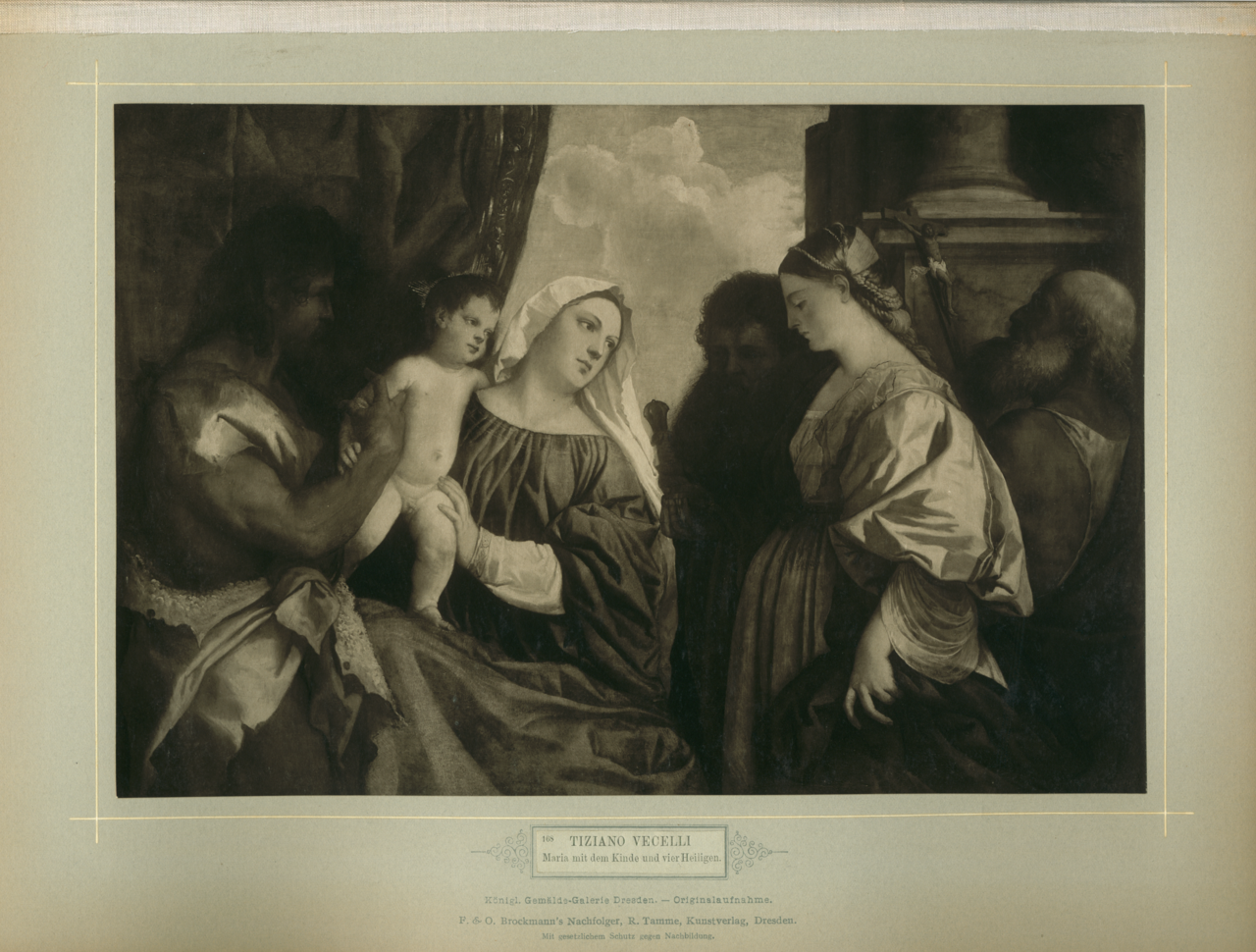
To stand in front of a Titian is to understand why colour became the central argument of Western painting. Where Florentine painters from Michelangelo to Leonardo started with line — contour, disegno, the drawn skeleton of form — Titian built his pictures the way Venice built its palaces: upward from water, sensation first, architecture second. He called his method colorito, and it would echo through Rubens, Velázquez, Rembrandt, and straight into the loose, sensation-driven painting of the nineteenth and twentieth centuries.
The remark is a perfect diagnosis. Titian's drawing, when it survives, is swift, searching, built from hatched energy rather than clean outline. But this apparent weakness was, in practice, the source of his power. Because he did not start with a firm contour, he could revise endlessly in paint — shifting the position of a limb, deepening a shadow, adjusting the temperature of flesh — without the picture falling apart. His surfaces breathe.
His technique evolved continuously across a working life that stretched, by most accounts, to nearly seventy years. In the early decades — the glowing mythologies and altarpieces of the 1510s and 1520s — the underdrawing is more present, the forms more smoothly finished, the compositions more obviously architecture-influenced. Works like the Assumption of the Virgin (1518, Santa Maria Gloriosa dei Frari, Venice), with its ascending diagonal and its turbulent crowd of apostles, show a young master who has absorbed the lessons of Raphael and Michelangelo without sacrificing the Venetian luxury of colour.
By the middle decades — the great mythological series painted for Alfonso I d'Este's camerino, the portraits of the 1530s and 40s, the poesie commissioned by Philip II of Spain — his handling has loosened into something warmer and more layered. He applies paint in multiple translucent glazes over a toned ground, building depth the way a musician builds harmony: each layer modifying the one below it, the final surface luminous from within rather than painted opaque.
Four characteristics mark Titian at his height.
Venetian colour as architecture. His palette — the deep crimsons, the sulfurous yellows, the grays that seem lit from inside, the warm umbers of shadow — is not decoration but structure. Colour is how he separates form from form, near from far, body from space.
Flesh above all else. Contemporaries noticed it immediately. His nudes, from the early Venus of Urbino onward, possess a tactile warmth that no rival of his century matched. He glazes warm orange-reds over cool underpaint, a technique that creates the subcutaneous glow of real skin caught in afternoon light.
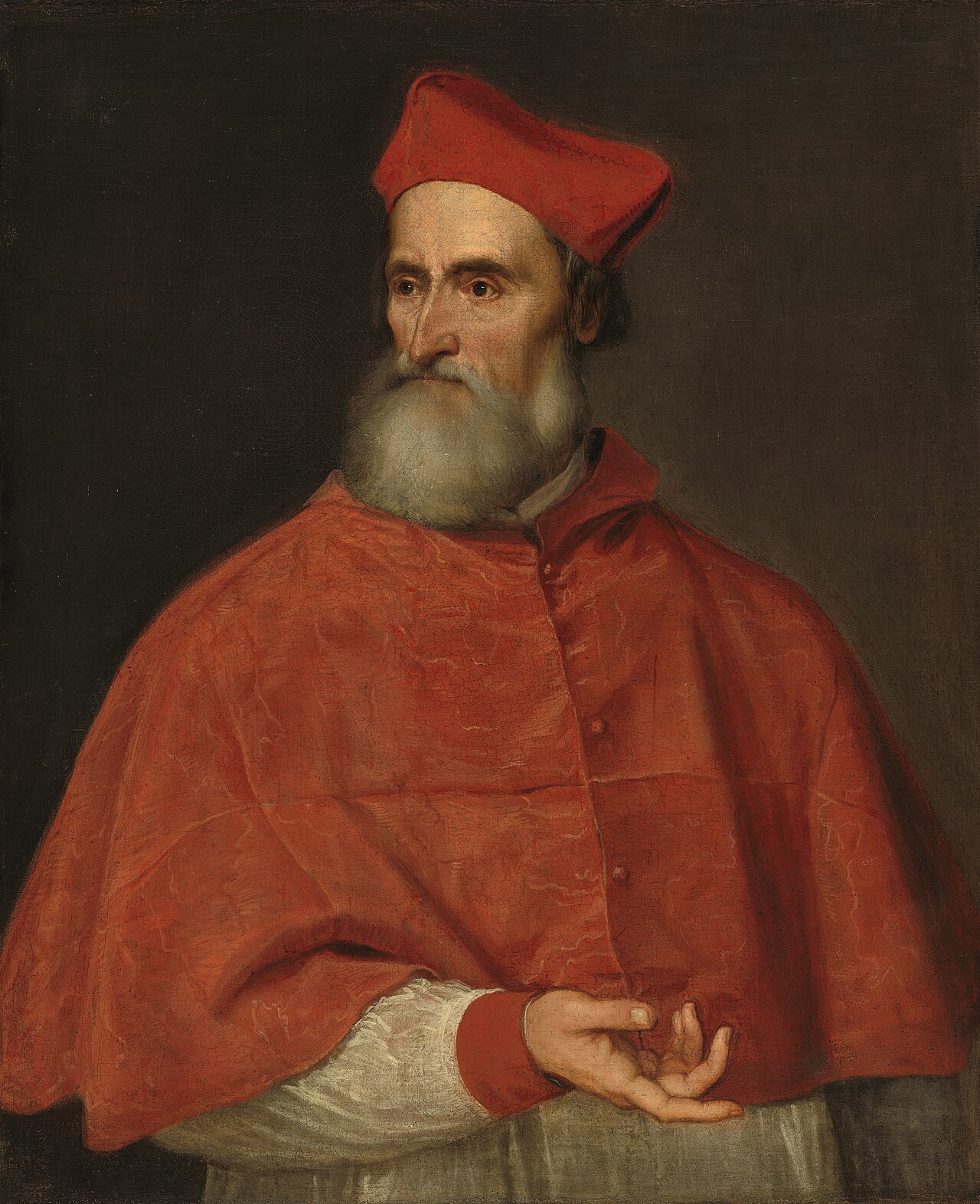
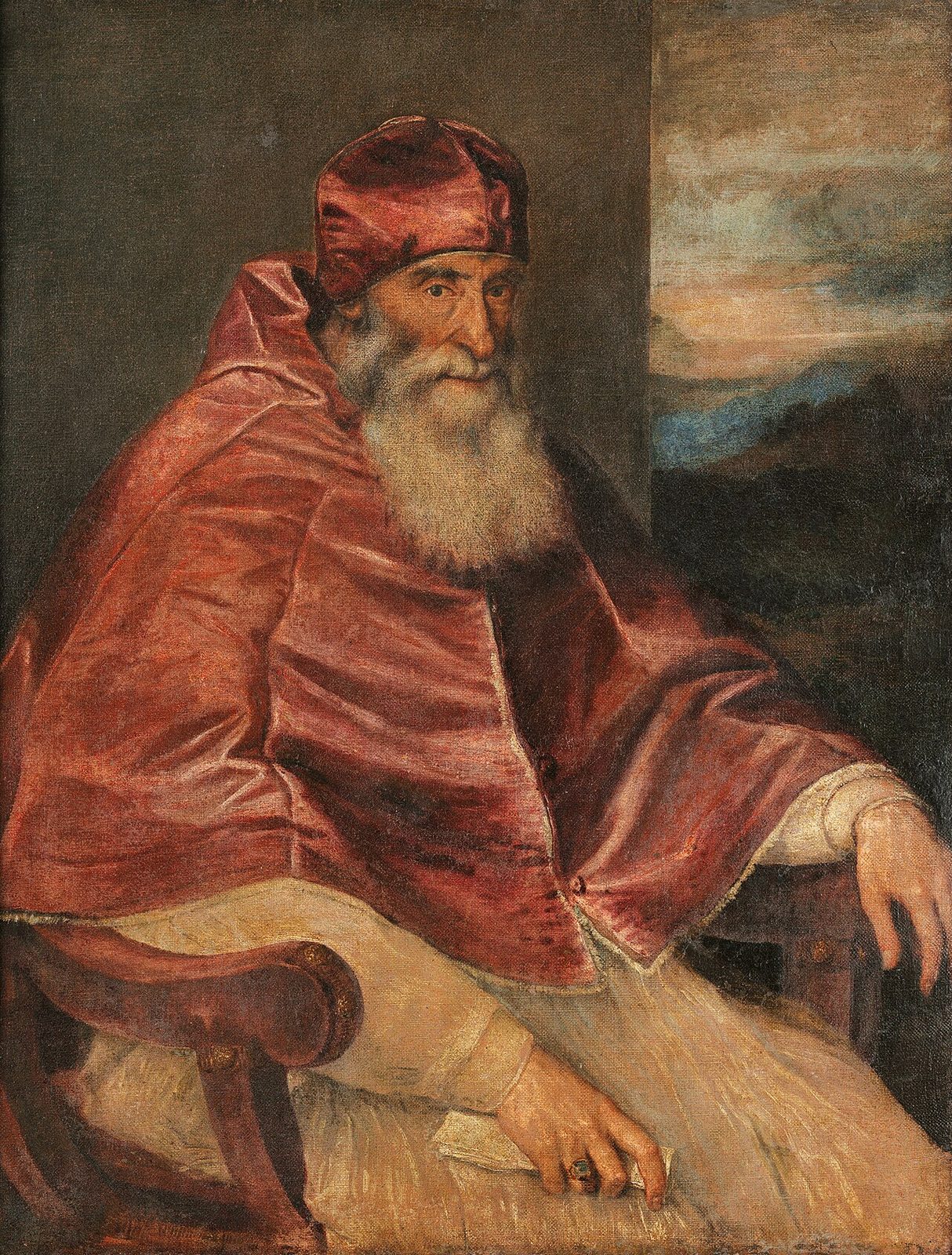
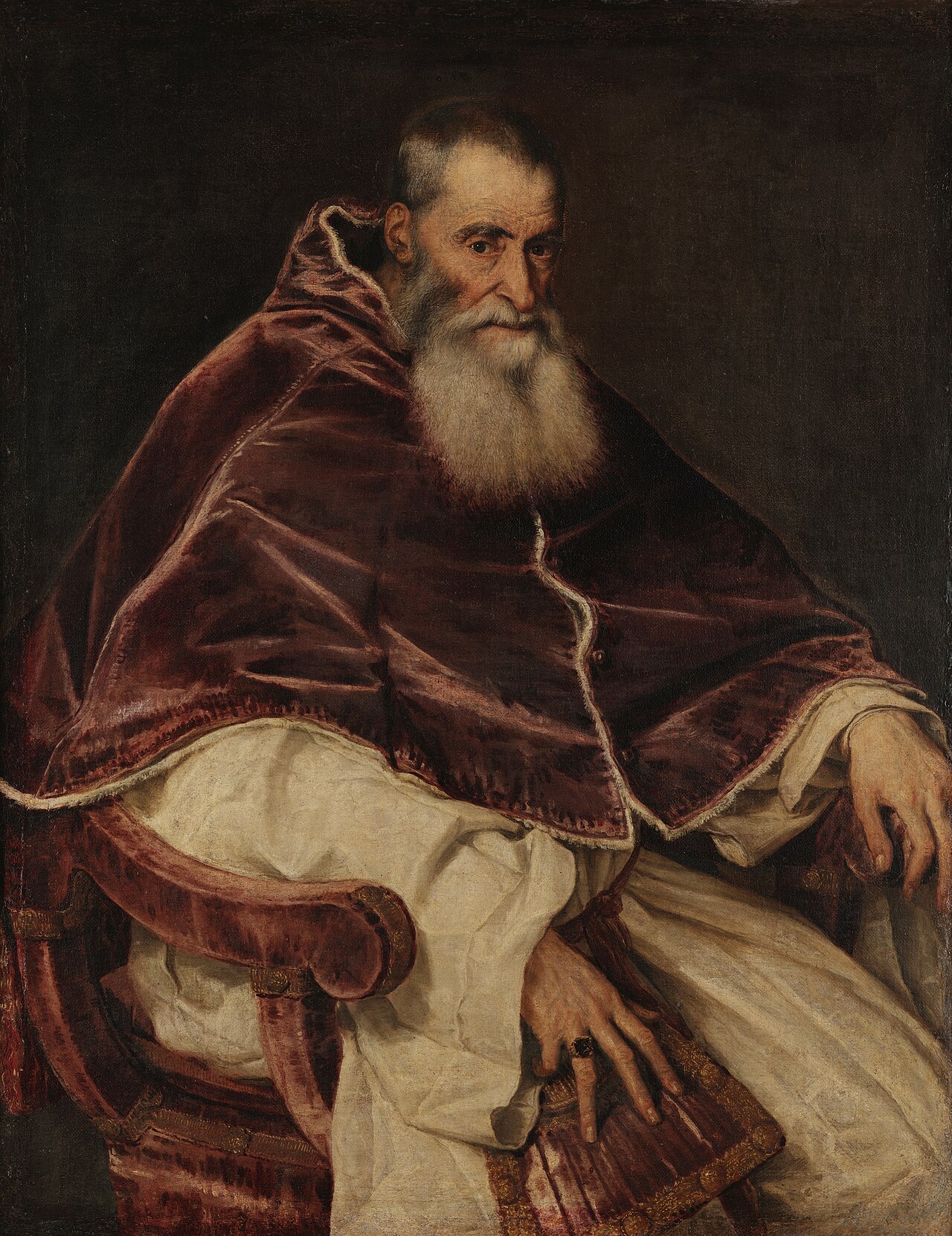
Portraiture as psychology. In his long career as the foremost portraitist in Europe, he discovered that the most revealing moment in a sitting is not when the sitter performs dignity but when they momentarily lapse out of it. His portraits carry an unease — the old pope who cannot quite forgive his grandsons, the doge who seems to be deciding whether to have you arrested — that no other Renaissance portraitist approached.
The late style: painting unmade. From roughly the 1560s onward, the surface of his canvases dissolves into something that baffled contemporaries and electrified later painters. Vasari, visiting his studio in 1566, watched him working paint directly with his fingers, smearing and dragging with his thumb. Forms are suggested rather than stated. Contours melt. The brushstrokes are visible, long, and directional, and the paint thins at the edges of figures, letting the warm ground show through. It is not dissolution but a different kind of precision: the precision of the impression, the thing seen through old eyes that have stopped lying to themselves about what seeing actually is.
Life and legacy
He was born Tiziano Vecellio in Pieve di Cadore, a small town in the Dolomite foothills north of Venice, probably around 1488, though the date is disputed — Titian himself, in old age, claimed to have been born as early as 1477, perhaps to enhance his authority as the grand old man of Venetian painting. His family were local notables; his father, Gregorio Vecellio, was a soldier and municipal official. At some point in the mid-1490s — he was perhaps eight or nine — he was sent to Venice to train as a painter, first under the mosaicist Sebastiano Zuccato, then under the ageing Gentile Bellini, and finally, most importantly, under Giovanni Bellini, the supreme master of Venetian colour.
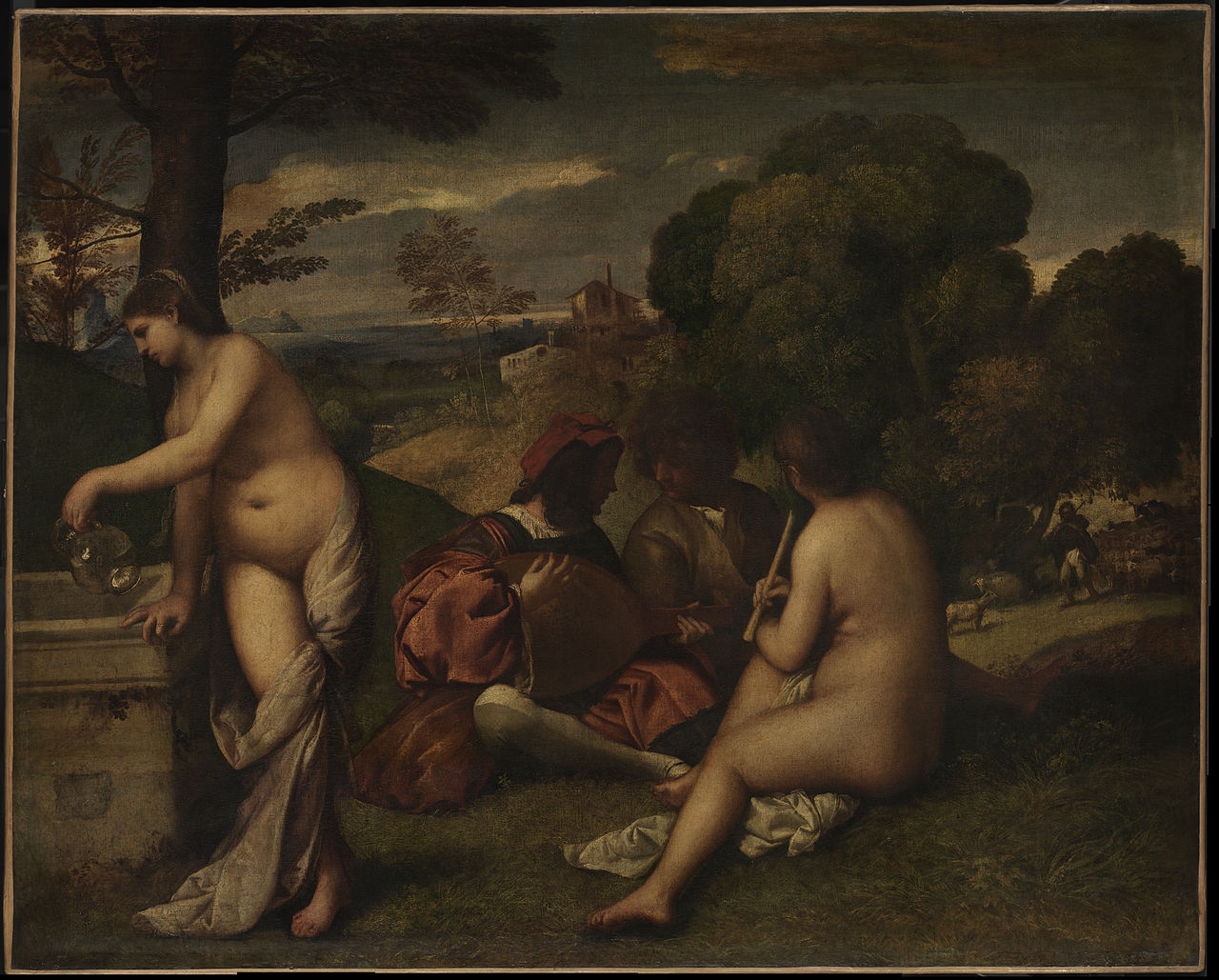
Around 1507 he joined the workshop of Giorgione, the short-lived genius who was in the process of transforming Venetian painting from a decorative craft into something lyrical, mysterious, and radically new. The two young painters worked together on frescoes for the Fondaco dei Tedeschi on the Rialto — virtually nothing survives — and the collaboration was so close that scholars still dispute the attribution of several works, including the pastoral idyll now known as Le Concert champêtre (c. 1509, Louvre), which the nineteenth century gave to Giorgione and the twentieth century has gradually returned to Titian, or to a collaboration between the two.
Giorgione died of plague in 1510. Giovanni Bellini died in 1516, and Titian stepped immediately into his role as the dominant painter in Venice, confirmed in the official appointment as painter to the Serenissima. The following decade was one of the most productive in his life. The enormous Assumption of the Virgin (1516–18), commissioned for the high altar of the Frari, announced a new ambition: he was no longer content with the jewelled, still surfaces of the Bellini generation. His figures move, shout, rise. The composition reaches upward with a physical force that no Venetian painter had previously attempted.
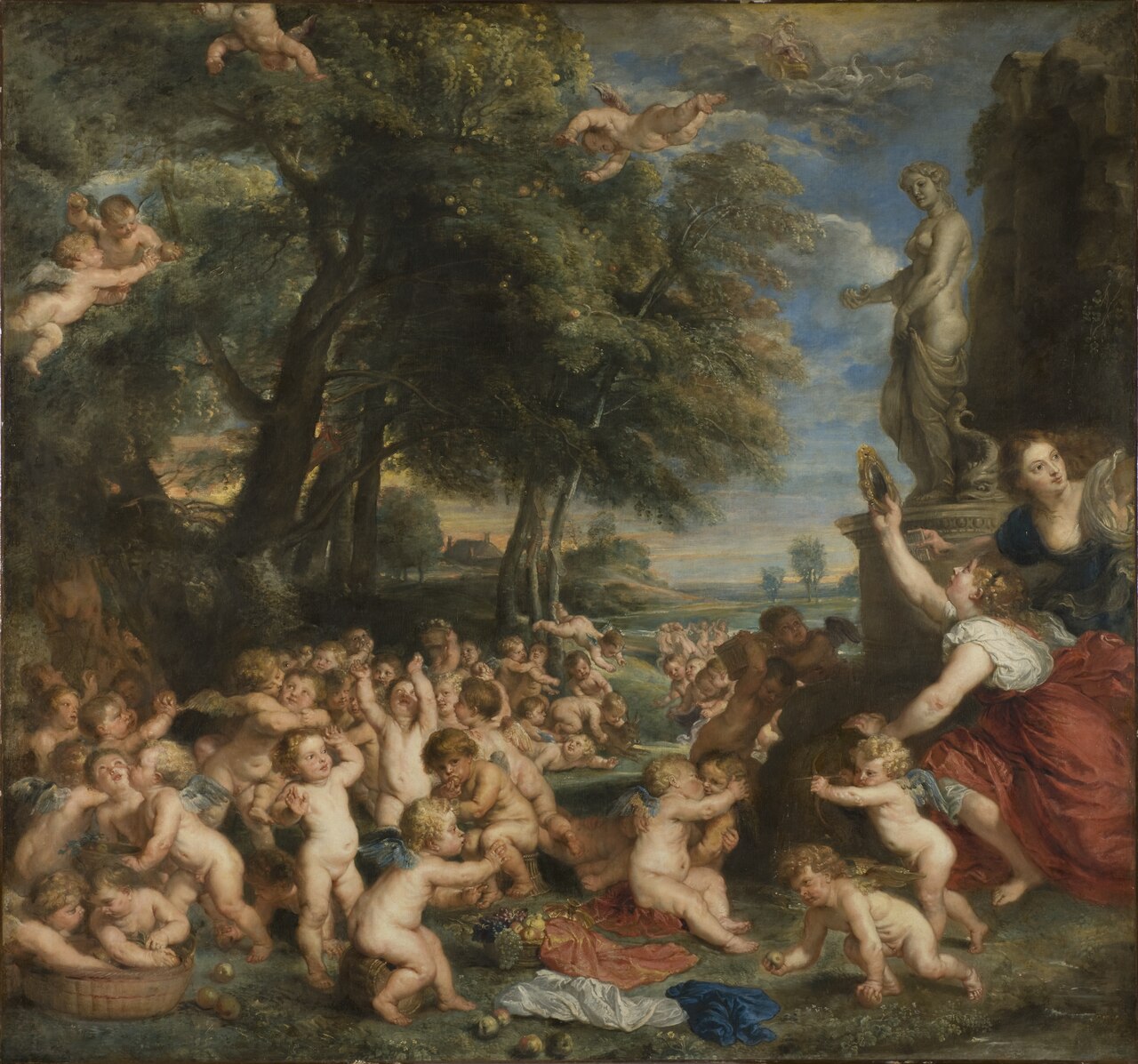
Through the 1520s he developed his relationship with the Este court in Ferrara, producing the Bacchanals — the Worship of Venus (1518–19, Prado), Bacchus and Ariadne (1520–23, National Gallery, London), the Andrians (1523–26, Prado) — works of such sensuous intelligence that they effectively defined what mythological painting could be. He also painted the first of the great portraits: the Man with a Glove (c. 1523, Louvre), the Portrait of Federico II Gonzaga (1529, Prado).
The hinge of his career came in 1530 when he met the Holy Roman Emperor Charles V in Bologna, where Charles had come to be crowned by the Pope. A portrait followed: Charles V with a Dog (1533, Prado), a work of such dignified authority that Charles made Titian his official court painter and, eventually, elevated him to the nobility, making him a Count Palatine and Knight of the Golden Spur. The relationship transformed Titian's status across Europe. He was no longer merely the greatest painter in Venice; he was the portraitist of empire.
His time in Rome in 1545–46 — his only extended visit — was important less for what he produced than for what he saw and who he met. He was received by Pope Paul III, whom he painted with devastating psychological accuracy. He studied the antique sculptures in the Belvedere Courtyard. He met Michelangelo. The encounter did not change his technique — he was nearly sixty and too fully formed — but it confirmed his conviction that Venetian colour, not Florentine line, was the deeper truth.
From the mid-1550s he began his most ambitious mythological series: the poesie painted for Philip II of Spain, Charles's son and successor. Over roughly fifteen years he delivered Diana and Actaeon (1556–59, shared between the National Gallery, London, and the National Galleries of Scotland), Diana and Callisto (1556–59, same institutions), The Rape of Europa (1560–62, Isabella Stewart Gardner Museum, Boston), Perseus and Andromeda (c. 1554–56, Wallace Collection, London), and others. These are among the grandest erotic-mythological paintings in existence: large, warm, psychologically charged, technically extraordinary.
In his final years — the so-called late style — his technique loosened dramatically. He kept his studio in the Biri Grande district of Venice, employing assistants who helped with less demanding commissions while he worked on the paintings that most interested him. He suffered from plague in 1576, an irony of the darkest kind: he had survived the disease that killed Giorgione, and now, at the very end, it took him. He died in Venice on 27 August 1576, and was given the rare honour of burial inside the Frari, the church for which he had painted the Assumption six decades earlier. He was the only victim of that year's plague permitted burial inside a church; the authorities suspended their own ordinance for him.
He left behind a body of work — altarpieces, mythologies, portraits, devotional images — that amounts to one of the most sustained and influential artistic achievements in European history. Rubens copied him obsessively in the early seventeenth century. Velázquez studied him in the Spanish royal collection. Rembrandt absorbed his late style's willingness to let paint be paint. Manet copied his Venus of Urbino and called it Olympia. The argument Titian began — that colour and sensation are the primary facts of painting — has never really ended.
Five famous paintings
Diana and Actaeon 1556
Painted between 1556 and 1559 as part of the great series of poesie commissioned by Philip II of Spain, Diana and Actaeon is now jointly owned by the National Gallery in London and the National Galleries of Scotland, a purchase made in 2009 for £50 million to keep the work in public hands. The canvas measures 184.5 × 202.2 cm. The subject is drawn from Ovid's Metamorphoses: the hunter Actaeon stumbles by accident into the grotto where the goddess Diana and her nymphs are bathing after the hunt. In the instant before she punishes him — transforming him into a stag to be torn apart by his own hounds — Titian freezes the scene in a moment of mutual shock. The composition unfolds across a warm golden light broken by the cool shadow of the grotto arch; the figures tumble in a loose spiral from left to right, each nude a study in a different kind of alarm. Diana, caught mid-gesture, raises her arm — not yet the full punishment, still the reflex of surprise. The stag skull hanging from the arch above Actaeon's head announces his fate. The paint surface, in the later stages of Titian's handling, is warm and fluid, flesh built from layered glazes that give the nudes their subcutaneous glow. It is widely considered one of the supreme achievements of European mythological painting.
Portrait of Pope Paul III with his Grandsons 1545
Painted in Rome in 1545–46 during Titian's only sustained visit to the papal city, this large canvas (210 × 176 cm, Museo di Capodimonte, Naples) was apparently left unfinished — a fact that has fascinated historians ever since, because the painting as it stands may be the most penetrating group portrait of the Renaissance. Pope Paul III — Alessandro Farnese, then aged 78 — sits in a high-backed chair, his white skull-cap and red mozzetta against a deep red ground. To his right, leaning with ingratiating deference, is his grandson Ottavio Farnese, bowing low in a posture that reads as simultaneously obsequious and scheming. To the left stands Alessandro Farnese the Younger, the cardinal grandson, holding a letter. The old pope turns his head toward Ottavio with an expression of barely contained suspicion — the whole composition is a diagram of dynastic anxiety, of a family patriarch who knows exactly what his heirs are after. Titian captures not ceremony but the atmosphere in the room between people who love and distrust each other. Whether it was left unfinished by accident or design — whether the Farnese family saw too much of themselves in it — remains an open question.
Portrait of Doge Andrea Gritti 1546
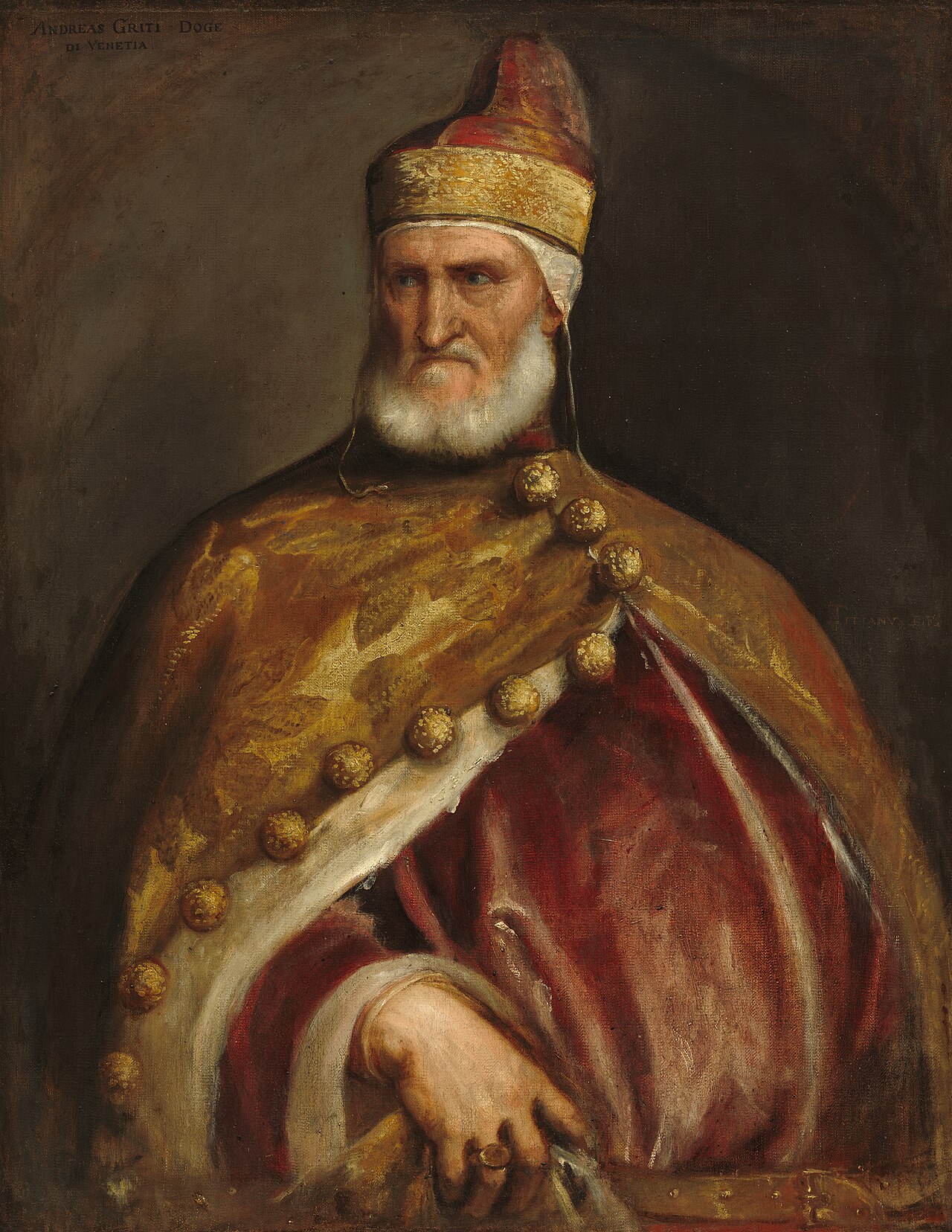
Andrea Gritti served as Doge of Venice from 1523 until his death in 1538, and was one of the dominant political figures of the early sixteenth century — soldier, diplomat, and aggressive patron of the architectural renewal of Venice under Jacopo Sansovino. Titian's portrait of him (133.6 × 103.2 cm, National Gallery of Art, Washington, D.C.) was probably painted from a death mask or earlier likeness, revised over several years, and achieves one of the most physically forceful images in Renaissance portraiture. Gritti is shown at three-quarter length, the massive bulk of his crimson ducal robe filling the lower canvas; above it, the head looms forward with an energy that seems to push out of the picture plane. The face is all concentration — heavy brows, a mouth set in judgement, eyes that are not inviting dialogue. The brushwork in the robe is among Titian's boldest: the crimson built from thick impasto over a dark underpaint, the gold brocade touched in with direct, confident strokes. It is a portrait of institutional power painted as raw physical presence.
Allegory of Time Governed by Prudence 1550
This small and enigmatic painting (75.5 × 68.4 cm, National Gallery, London) is the most explicitly philosophical work Titian produced, and the most personal. Three human heads in profile — a young man on the left, a mature man in the centre, an old man on the right — are superimposed above three animal heads: a wolf, a lion, and a dog, corresponding to the ages of past, present, and future. An inscription across the top reads, in Latin: EX PRAETERITO / PRAESENS PRUDENTER AGIT / NI FUTURAM ACTIONEM DETURPET — roughly, 'from the experience of the past, the present acts prudently, lest it spoil future action.' The three human faces have been identified, with reasonable confidence, as Titian himself (the old man, shown in profile on the right), his son Orazio (the mature man at centre), and his young nephew or kinsman Marco Vecellio (the youth at left). If this reading is correct — and most scholars accept it — the painting is Titian's meditation on the transmission of artistic tradition across generations, painted when he was already in his sixties and acutely aware of the problem of succession. It is among the most intimate images he ever made.