Raphael
He died on his thirty-seventh birthday — and left behind the most balanced, gracious paintings of the High Renaissance.
Style and technique
Raphael painted grace. Where Leonardo dissolved his figures in mystery and Michelangelo carved them out in muscle, Raphael's people stand in calm, harmonious groups, their bodies poised in perfect balance, their faces serene to the point of dreaming. He took everything Leonardo and Michelangelo had invented, distilled it, and made it sweeter, lighter, and more public — paintings that other painters could actually look at and learn from. For three centuries after his death, every art academy in Europe trained its students by copying Raphael.
Four fingerprints make a Raphael recognisable on sight.
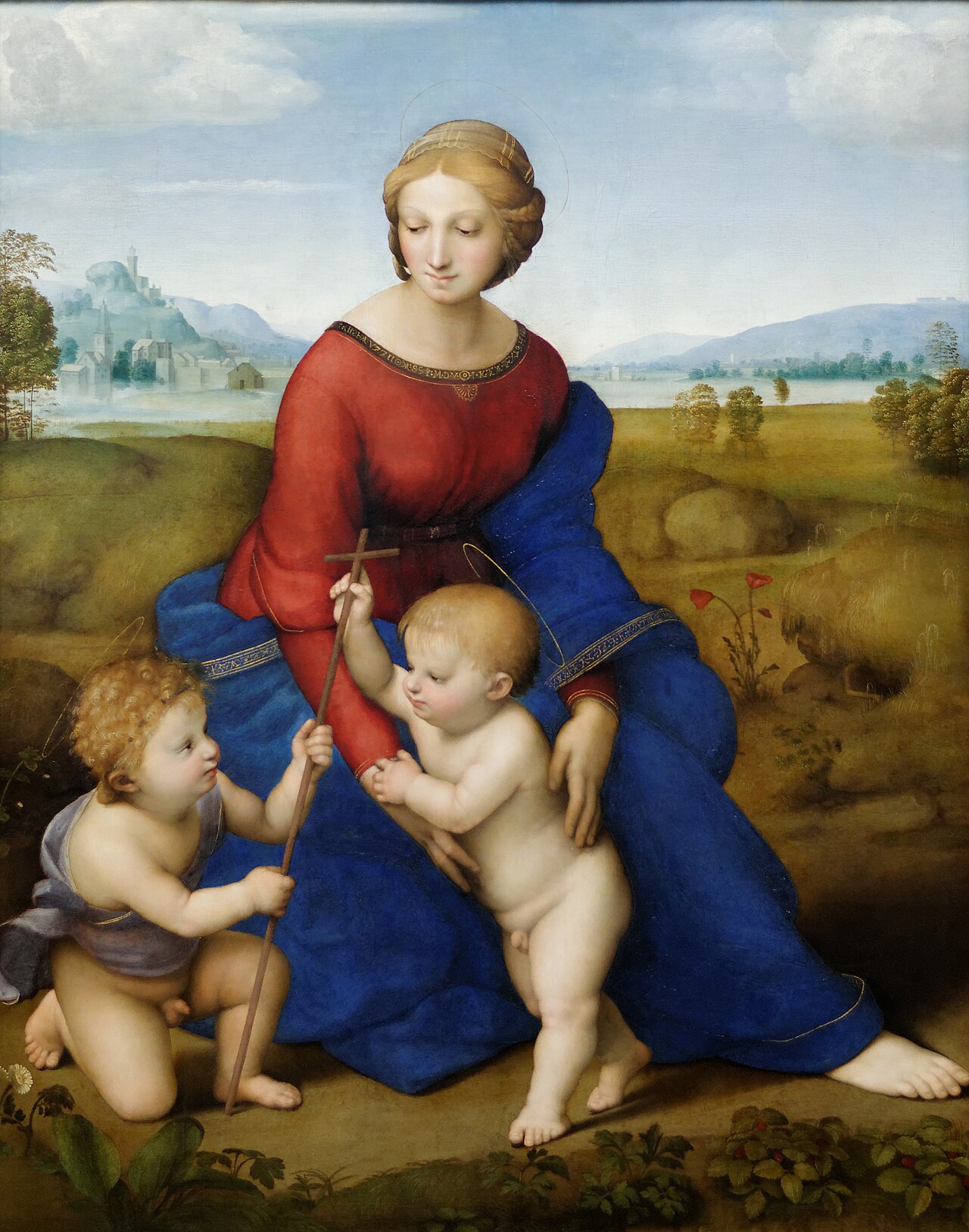
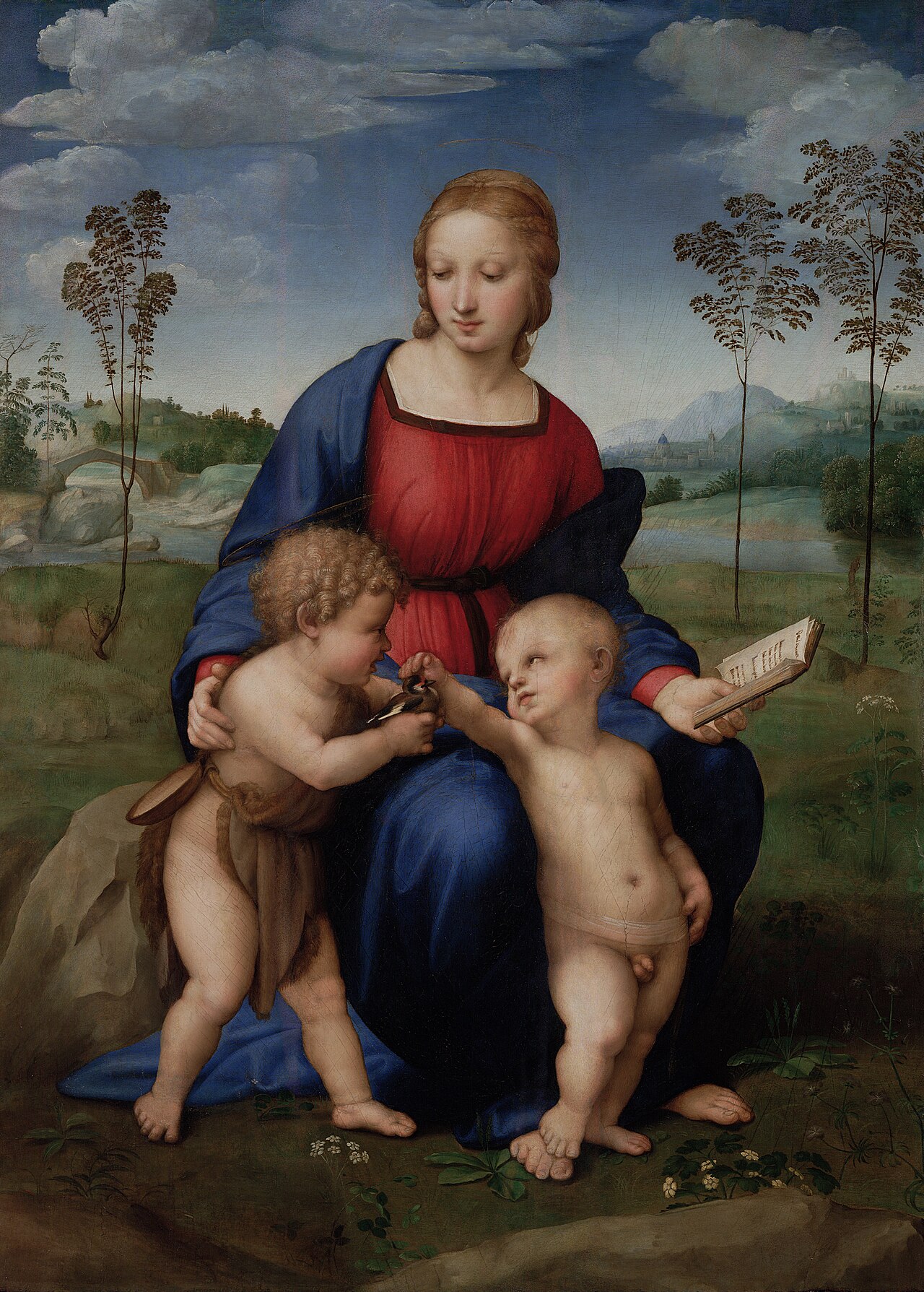
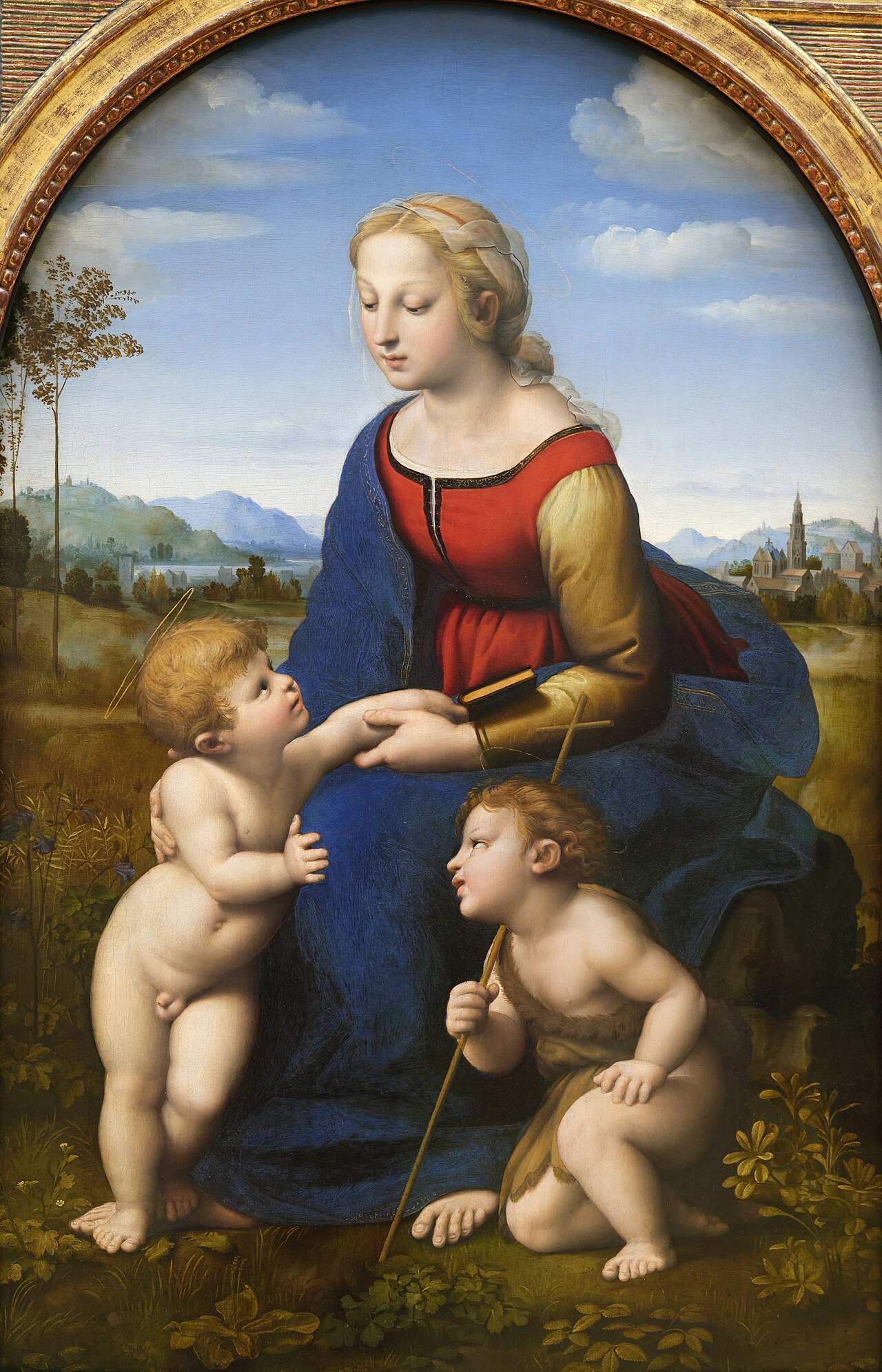
Pyramidal compositions. His Madonnas almost always sit at the apex of an invisible triangle that contains the Christ child and the infant John the Baptist below. The geometry is so stable it feels architectural. Borrowed from Leonardo, refined into a formula.
Rounded, idealised faces. Mary, the Christ child, the Madonnas of his late twenties — all share a soft, oval, unmistakably Raphaelesque face. Eyes slightly downcast. No hard contour. A small smile that is calm rather than enigmatic.
Architectural backgrounds. The school he ran in Rome with Bramante, the Pope's architect, gave him an obsession with classical buildings. Many of his major works are set inside great vaulted halls, lit by an even diffuse light that has no clear source.
Movement frozen mid-gesture. Even his calmest scenes contain a person caught in a pose — a head turned, a hand raised, a robe billowing. The movement gives the paintings life without disturbing the harmony.
He was, by all accounts, the most charming person in the Roman art world of his time. He ran an enormous workshop with fifty assistants. Patrons fought to commission him. Pope Leo X loved him. He had time, somehow, to design palaces, lay out the Vatican gardens, study ancient Roman architecture, fall in love (often), and paint at a furious rate. He died at thirty-seven, and the entire Vatican stopped for the funeral.
Life and legacy
Raffaello Sanzio was born in Urbino, a small ducal city in the Marche region of central Italy, on Good Friday, 6 April 1483. His father, Giovanni Santi, was a court painter to the Duke of Urbino and a competent if not brilliant artist. The court at Urbino was, in those years, one of the most cultivated in Europe — Castiglione would set his famous *Book of the Courtier* there a few years later.
Raphael's mother died when he was eight. His father died when he was eleven. He inherited his father's workshop, technically apprenticed himself to Pietro Perugino in nearby Perugia (the leading Umbrian painter of the day), and started taking commissions in his own right when he was barely fifteen.
By 1504, when he was 21, he had moved to Florence, where Leonardo and Michelangelo were both at work — Leonardo painting the Mona Lisa in his studio, Michelangelo sculpting the David. Raphael copied them, studied them, befriended their patrons, and absorbed everything they were doing. He stayed in Florence for four years and emerged a different painter: more sophisticated, more architectural, more confident with composition.
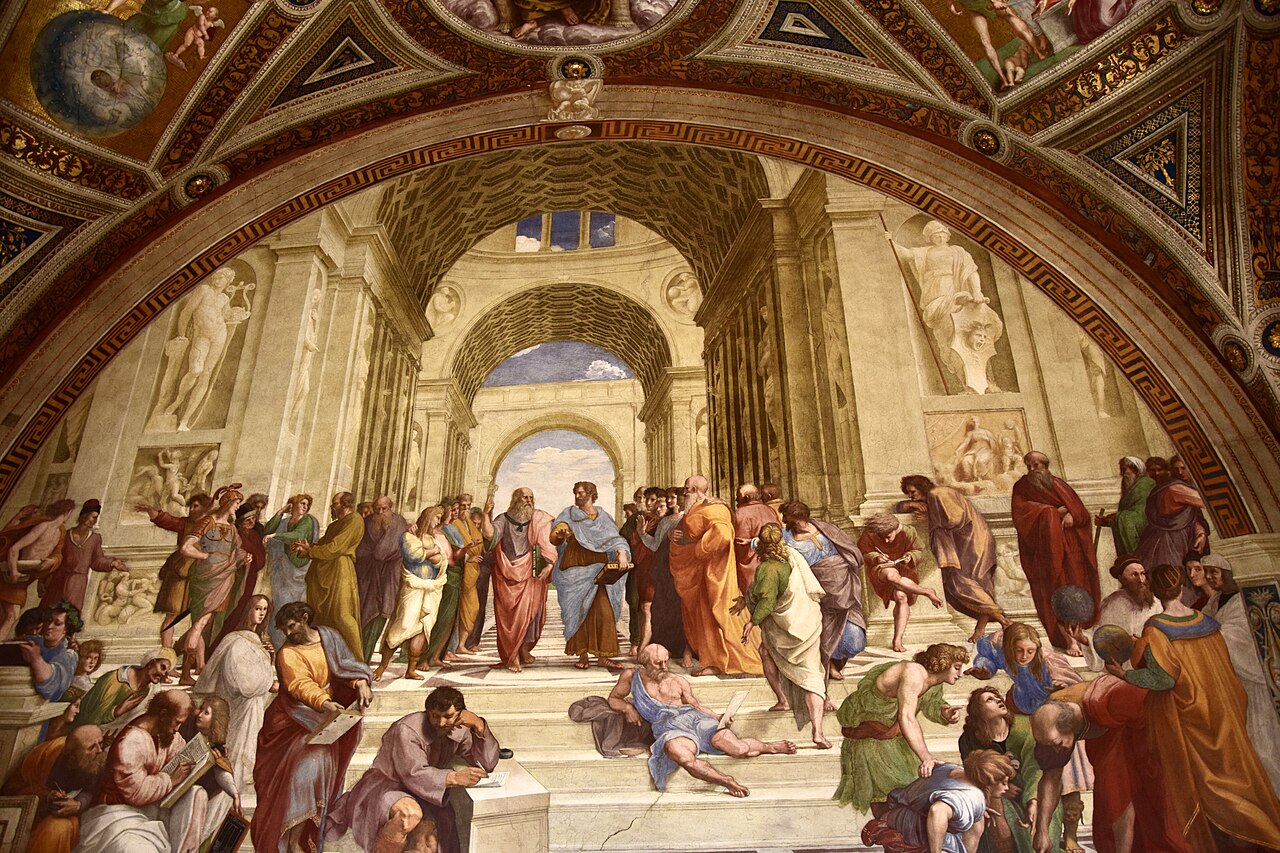
In 1508 Pope Julius II summoned him to Rome to redecorate the papal apartments in the Vatican. Raphael was given an entire suite of rooms — the Stanze di Raffaello — and four years to fill them with frescoes about philosophy, theology, justice and poetry. He painted 'The School of Athens' in the second room (the Stanza della Segnatura) between 1509 and 1511, while Michelangelo was painting the Sistine Chapel ceiling next door. The two men disliked each other. Raphael walked through the chapel one morning while Michelangelo was off scaffolding and incorporated a small portrait of him, sulking on the steps in 'The School of Athens', as the philosopher Heraclitus.
The Vatican commissions kept coming. After Julius died in 1513, the new Pope Leo X doubled down — Raphael was given the project of designing tapestries for the Sistine Chapel, then the rebuilding of St Peter's Basilica after Bramante's death in 1514. By the time he was 30, Raphael was effectively the chief artist of the Roman Catholic Church: painter, architect, antiquarian, designer of medals, supervisor of all classical excavations in Rome. He ran his workshop from a palace near the Vatican and lived more like a prince than a painter.
He never married. He was engaged for years to Maria Bibbiena, a cardinal's niece, but kept postponing the wedding. He had a long, public, devoted relationship with a Roman baker's daughter, Margherita Luti ('La Fornarina'), whom he painted several times and probably loved. Vasari, his first biographer, claims discreetly that this relationship contributed to Raphael's early death.
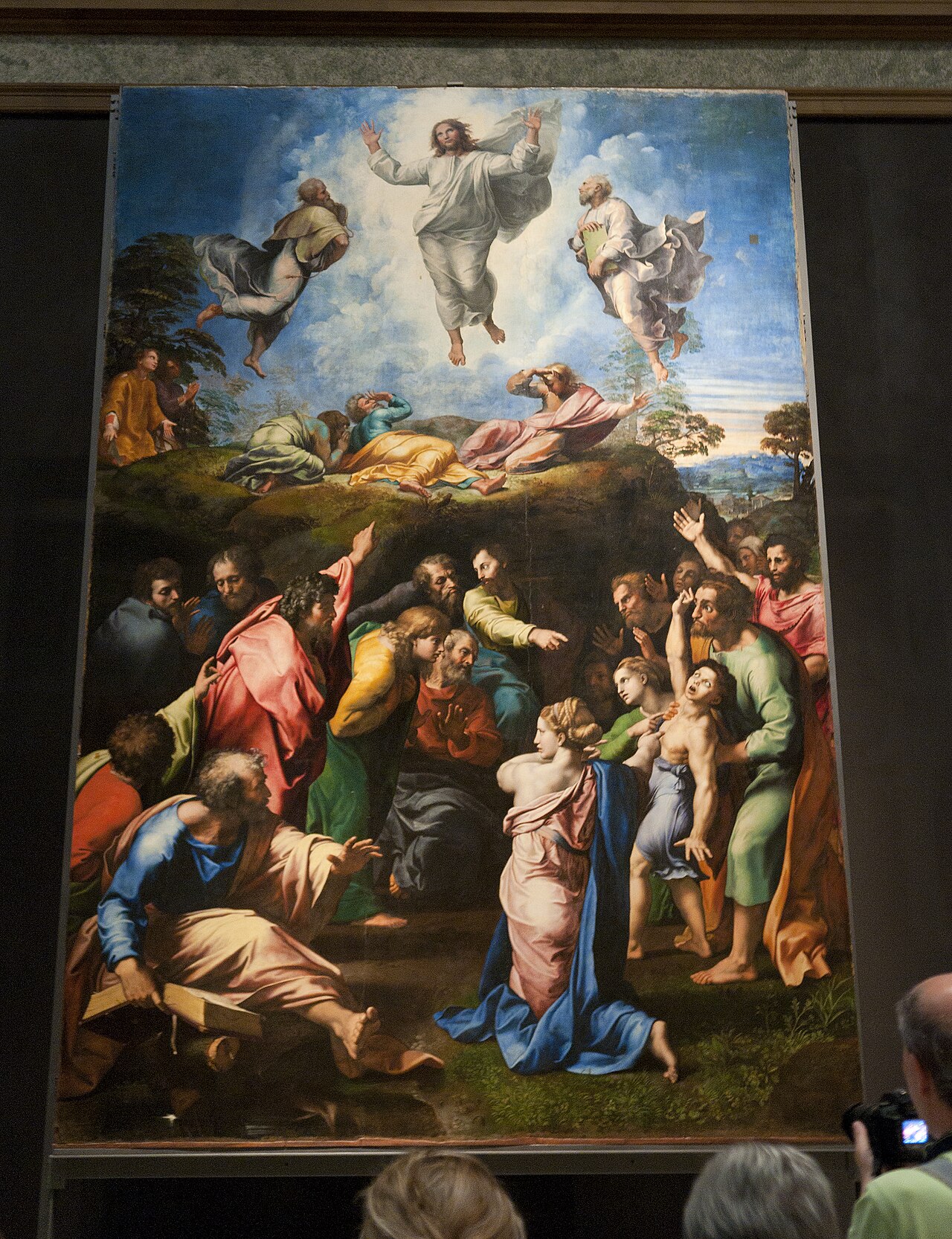
In early April 1520, after a long night out, Raphael came down with a high fever. Vasari again — gossipy but plausible — says the doctors mistakenly bled him, weakening him further. He died on 6 April 1520, his thirty-seventh birthday. The funeral was held in the Pantheon in Rome, by his own request, and he is buried there to this day. Pope Leo X is said to have wept openly. The whole of Rome mourned. His unfinished masterpiece 'The Transfiguration' was placed at the head of his coffin during the funeral.
His workshop, led by his pupil Giulio Romano, kept producing 'Raphaels' for years afterwards — many of the late 'Raphaels' that hang in museums today are workshop productions completed after his death. Disentangling them from his autograph work has been one of the great projects of Renaissance scholarship for the last three centuries.
Five famous paintings
The School of Athens 1511
Painted between 1509 and 1511 on the wall of the Stanza della Segnatura in the Vatican — the small papal library of Pope Julius II. The fresco depicts roughly fifty philosophers, mathematicians, and scientists of classical antiquity gathered under an enormous coffered Roman vault that recalls the Basilica of Maxentius and the planned dome of the new Saint Peter's. Plato and Aristotle stand at the centre, Plato pointing to the heavens (his idealist philosophy) and Aristotle holding his palm down (the empirical world). Raphael packs the scene with portrait references: Leonardo da Vinci is Plato; Michelangelo is the brooding Heraclitus on the steps (added late, after Raphael had seen the Sistine ceiling); Euclid is the architect Bramante; Raphael himself peeks out at the right edge wearing a black hat. The fresco is roughly 5 by 7.7 metres.
The Sistine Madonna 1512
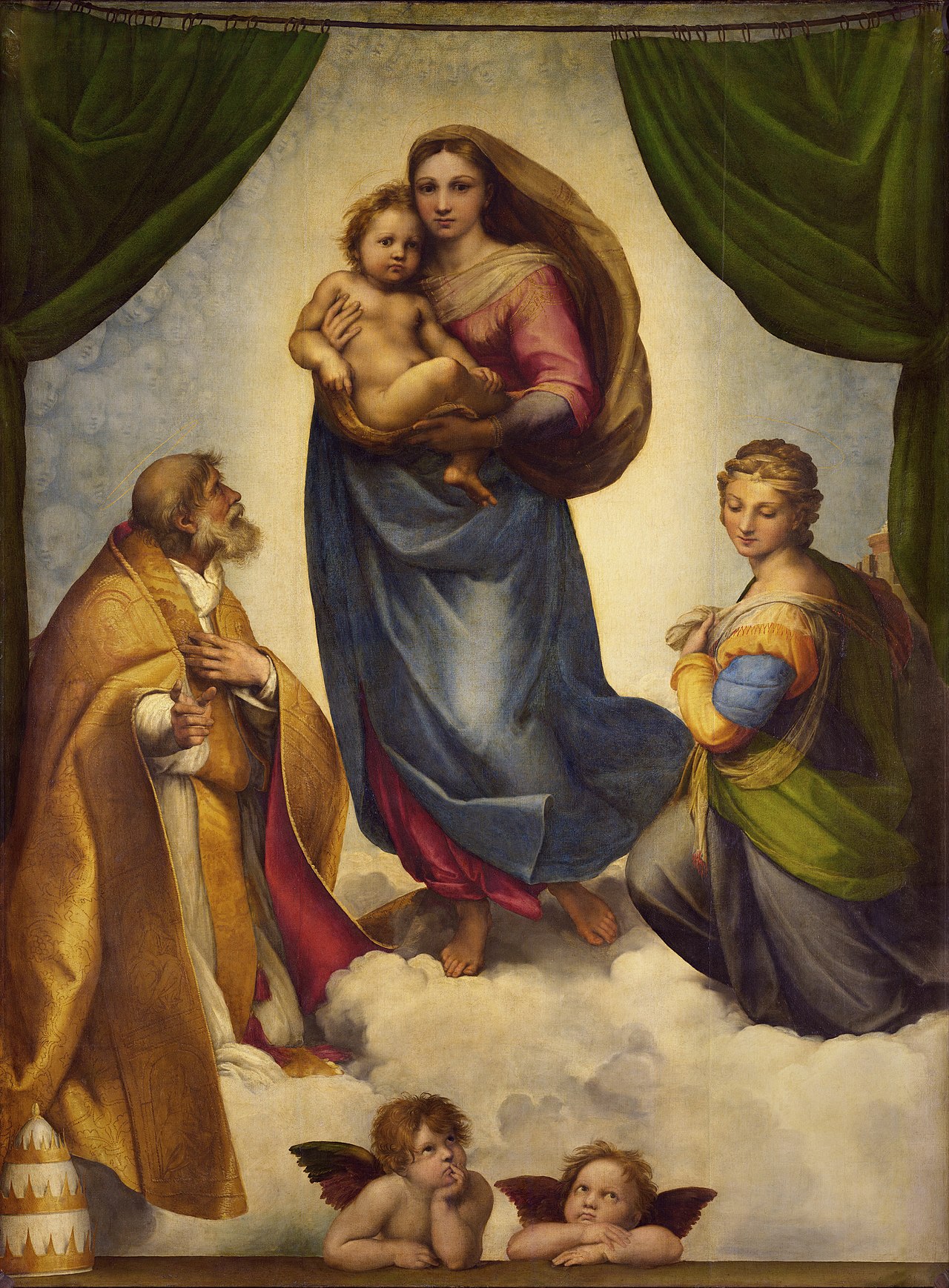
Painted in 1512 for the church of San Sisto in Piacenza, where it remained until the Saxon king Augustus III bought it in 1754 for one of the highest sums ever paid for a painting at that point. The Virgin Mary stands on clouds, holding the Christ child; Saint Sixtus and Saint Barbara kneel on either side of her. At the very bottom of the canvas, two small cherubs — perhaps the most reproduced detail in any Western painting — lean their elbows on the picture frame and look upwards. They were probably an afterthought to fill empty space. They have been printed on every conceivable surface since. The painting is now in the Gemäldegalerie Alte Meister in Dresden, where it survived the Allied bombing of the city in 1945.
The Transfiguration 1520
Raphael's last painting, left almost finished at his death and completed by his pupil Giulio Romano. The composition is split horizontally: the upper half shows Christ floating in golden light above Mount Tabor, witnessed by the prophets Moses and Elijah and by Peter, James and John fallen on the ground; the lower half shows the apostles back at the foot of the mountain, failing to cure a possessed boy whose father has brought him to them. The contrast between the calm, levitating Christ and the chaotic gesturing crowd below is a deliberate compositional argument: divinity above, human suffering below. The painting was placed at the head of Raphael's coffin during his funeral in Rome and is now in the Vatican Pinacoteca.
Madonna of the Goldfinch 1506
Painted in Florence around 1506 as a wedding gift for Raphael's friend Lorenzo Nasi. The Virgin Mary sits on a low rock; the infant John the Baptist offers a small goldfinch — a bird with a red face that, according to Christian legend, became red by pulling the thorns from Christ's crown of thorns — to the Christ child, who reaches out gently to stroke its head. The composition is pure Raphaelesque pyramid, the landscape is Tuscan, the colour palette is the soft warm chalky pinks and blues of the Florentine years. The painting was almost destroyed when the Nasi house collapsed in an earthquake in 1547; it was reconstructed from seventeen fragments. Today it hangs in the Uffizi in Florence.
Portrait of Baldassare Castiglione 1515
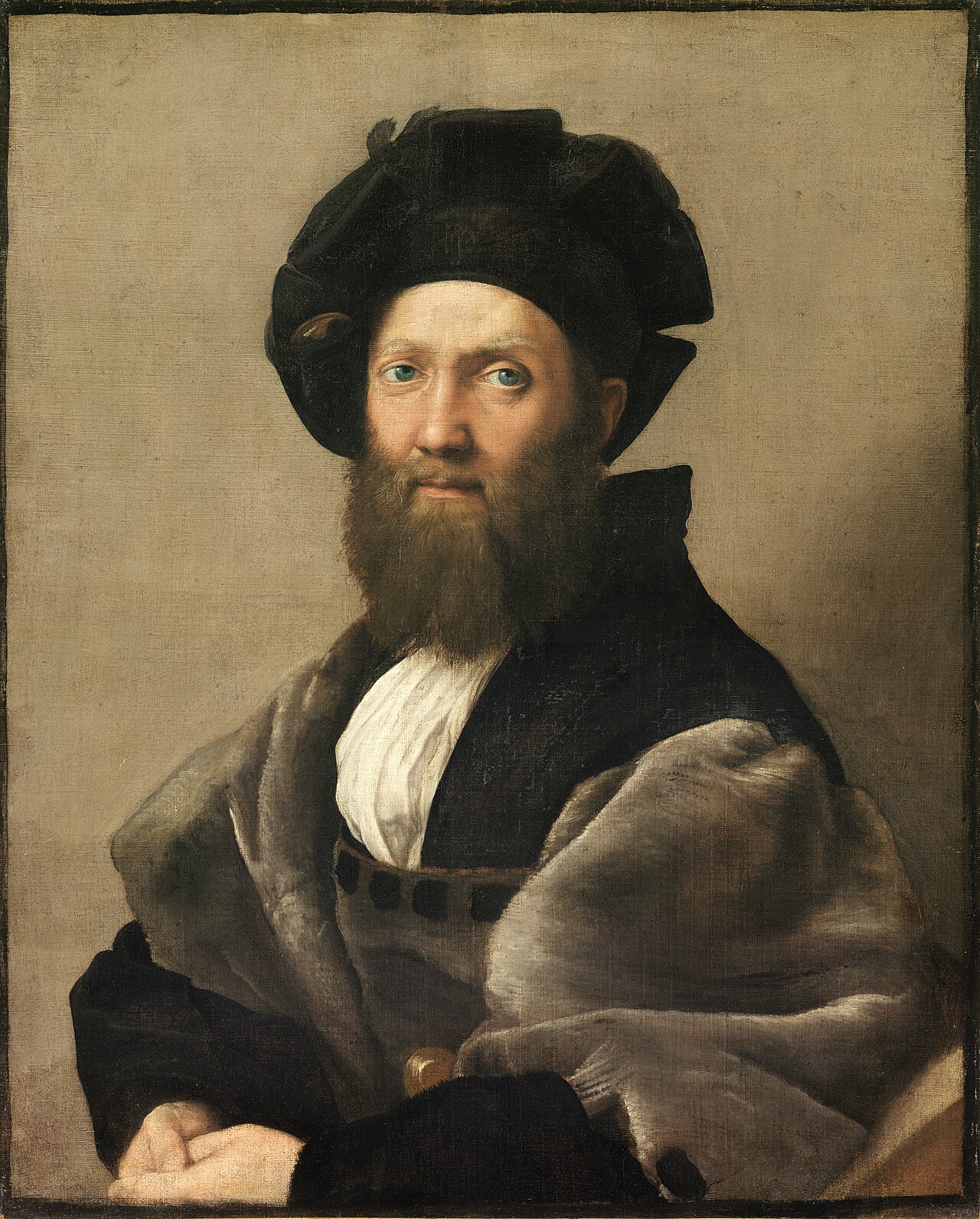
Raphael's portrait of his close friend Baldassare Castiglione, the Italian diplomat and writer of the most famous Renaissance courtly handbook, *Il Cortegiano* ('The Book of the Courtier'). Castiglione is shown half-length, in a heavy black velvet jacket and dark fur collar, against a plain background, with his blue eyes focused calmly on the viewer. The pose is borrowed directly from the Mona Lisa, but where Leonardo's smile is enigmatic, Raphael's friend is frank, open, almost present in the room. Castiglione thanked Raphael in an extraordinary Latin poem in which he says the portrait teaches his absent wife, 'every day in our home', what her husband looks like. The painting is in the Louvre.