Michelangelo
He considered himself a sculptor first — and yet painted the most famous ceiling in the world.
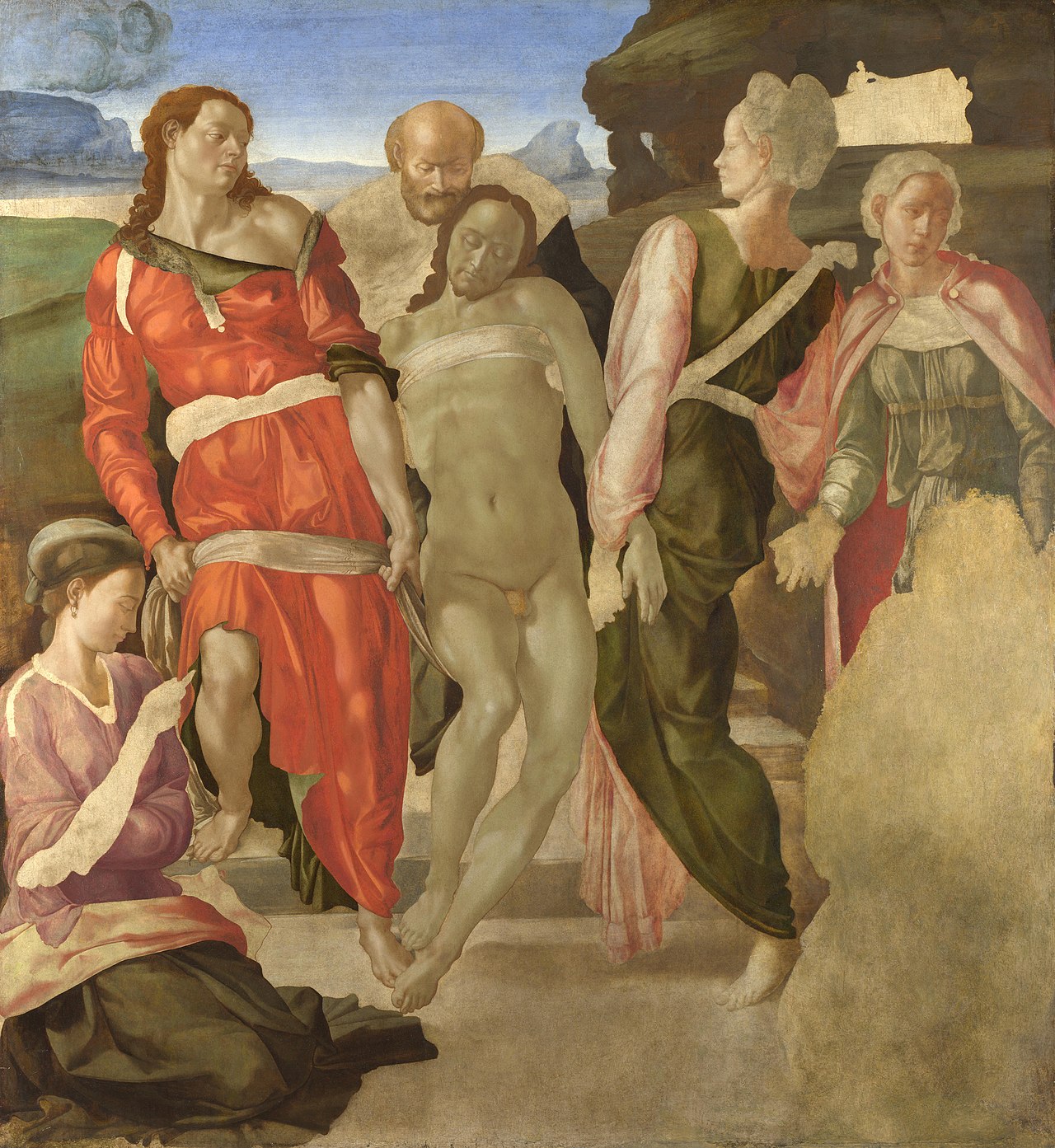
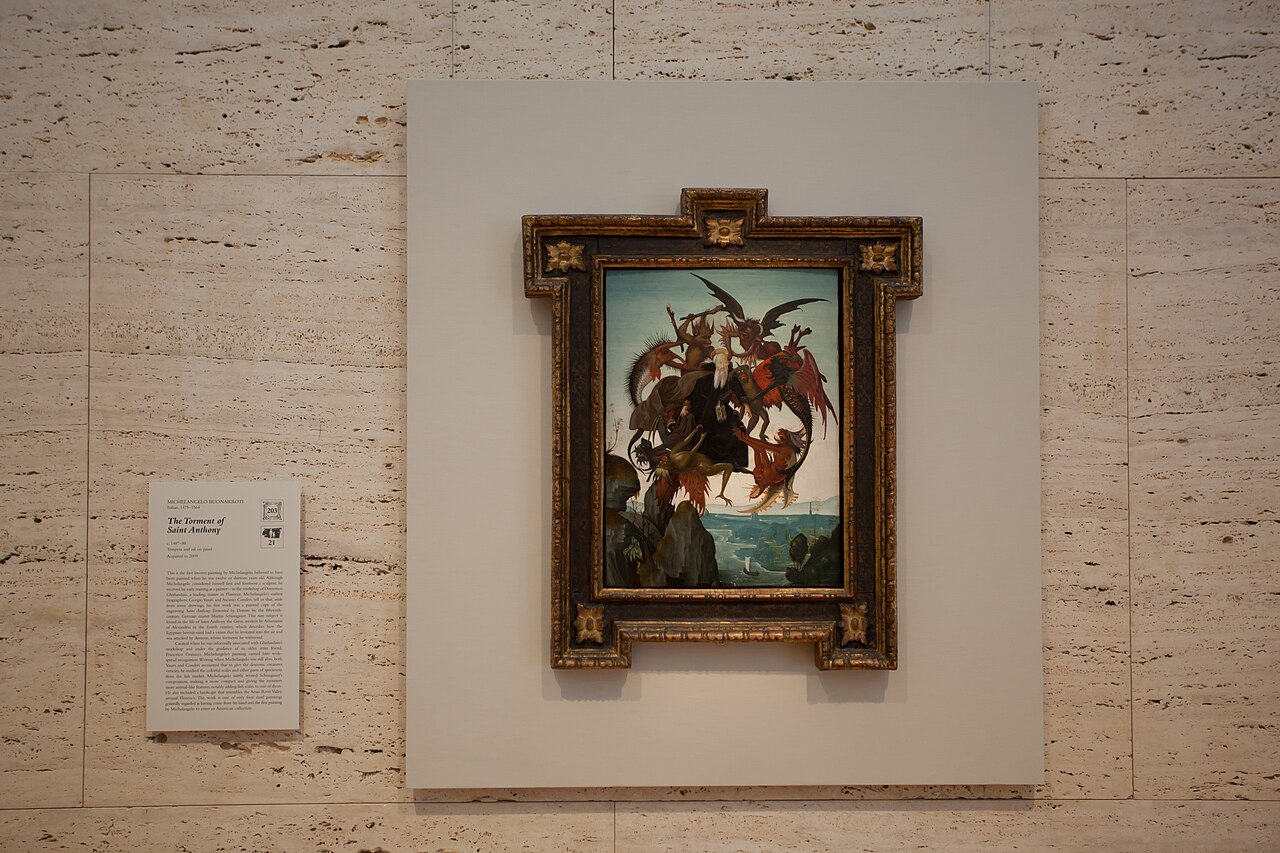
Style and technique
Michelangelo did not really think of himself as a painter. Throughout his ninety-year life he insisted he was a sculptor, and the painting commissions he accepted — the Sistine Chapel ceiling, the Last Judgement, the small panel paintings — he often took on reluctantly, after long arguments with patrons. The reason matters. When Michelangelo paints a body, he paints it as if he were carving it. The figures are massive, three-dimensional, twisted into postures that no Renaissance painter before him had attempted, lit from a single direction so that the muscles cast hard sculptural shadows.
He called this principle *terribilità* — the quality of inspiring awe through sheer, slightly frightening physical power. Every figure he paints feels capable of standing up and walking out of the picture.
Four fingerprints make a Michelangelo unmistakable.
Hyper-muscular figures. Even his women are built like wrestlers. The famous Sistine sibyls have visible biceps and pectoral muscles. He had spent years dissecting cadavers in a Florentine convent, and the anatomy is forensically correct.
Twisted poses. The figura serpentinata — a body spiralled in three directions at once — is essentially his invention. The Christ in 'The Last Judgement' is a hairpin twist. Adam reaches across the Sistine ceiling at an impossible angle.
Almost no landscape. Michelangelo paints almost no background. Floors, sky, distant buildings are flat zones of colour. The body is the entire subject.
Single-source light, sculptural shadow. Where Leonardo dissolves edges in sfumato, Michelangelo chiselled them. Each muscle has a hard highlight and a hard shadow, as if illuminated by raking light coming in from one window.
He is the bridge between High Renaissance balance and the unsettled Mannerism that came after him. Painters who saw the Sistine ceiling in 1512 — including Raphael, who happened to be working in the next room — never painted the same way again. By the time Michelangelo finished the 'Last Judgement' in 1541, the bodies had become so distorted, so twisted, so anguished, that he had effectively invented the next century of European painting.
Life and legacy
He was born Michelangelo di Lodovico Buonarroti Simoni on 6 March 1475 in Caprese, a hill village in Tuscany where his father was serving a six-month term as the local administrator. The family moved back to Florence soon after. His father, an impoverished member of a fading minor noble line, opposed his son becoming an artist — it was beneath the family's social position. Michelangelo apprenticed anyway, against his father's will, at thirteen, with the painter Domenico Ghirlandaio.
Within a year a more important door opened. Lorenzo de' Medici, ruler of Florence, was running an informal academy in his palace garden where he gave young artists free access to his collection of antique sculptures. Michelangelo, fourteen, was admitted. He lived in the Medici palace for the next four years, eating at the same table as Lorenzo, his sons, and the leading philosophers of Florence. Two of those Medici sons would later become Popes, which would matter enormously for Michelangelo's career.
He carved the Pietà in Rome at twenty-three (1499) — the only sculpture he ever signed, and one of the most technically perfect marble works ever made. He carved the seventeen-foot David in Florence between 1501 and 1504. The David, a single block of marble that another sculptor had abandoned as ruined, made him a celebrity at thirty.
In 1505 Pope Julius II summoned him to Rome to design the Pope's tomb — an enormous project of forty marble statues that Michelangelo would labour at, on and off, for the next forty years. The tomb was eventually finished in catastrophically reduced form (only seven statues, one wall instead of a freestanding monument). Michelangelo called it *'la tragedia della sepoltura'*, 'the tragedy of the tomb', for the rest of his life.
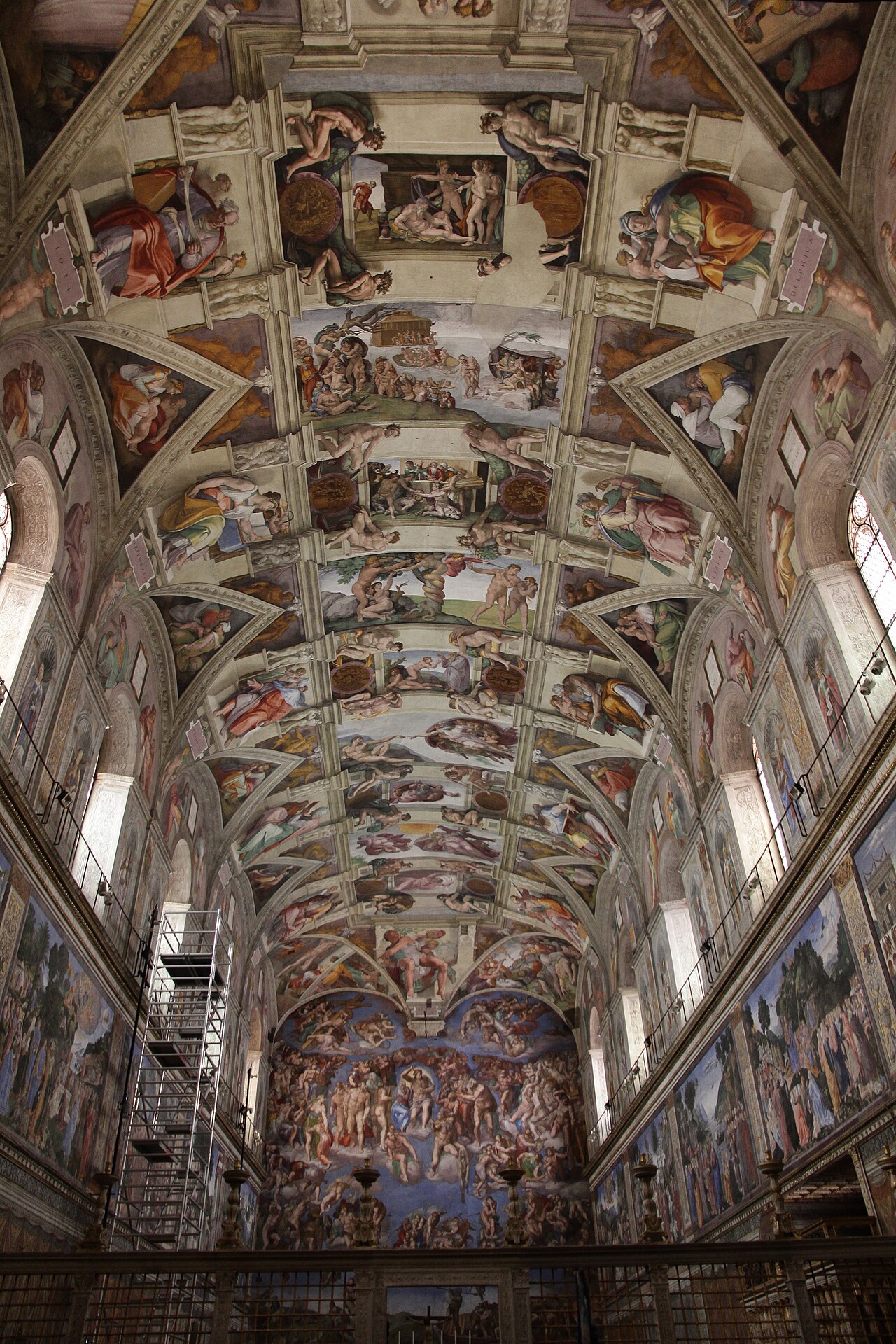
In 1508 the same Pope ordered him to paint the ceiling of the Sistine Chapel. Michelangelo argued for months — he was a sculptor, the ceiling was 18 metres above the floor, the existing decoration was perfectly adequate. Julius insisted. Michelangelo built his own scaffolding, designed his own pigments, and worked almost alone for four years and four months, lying on his back on a wooden platform with paint dripping into his eyes. He wrote a sonnet about the experience that includes the wonderful complaint that his beard was pointing at the sky and his back had bent like a Syrian bow.
The ceiling was unveiled on 31 October 1512. Raphael, working on the Pope's apartments next door, abandoned the elegant style he had been developing and started painting figures in a more muscular, Michelangelesque manner within weeks.
The rest of Michelangelo's life is the slow grand opera of an artist working into his late eighties. He returned to Florence, designed the Medici Chapel, came back to Rome in 1534, painted the Last Judgement (1536-1541) on the Sistine Chapel altar wall — a 14 × 12 metre apocalyptic composition with three hundred figures, all but one of them originally nude. (Daniele da Volterra was hired in the 1560s to paint loincloths over them; he is still known to this day as 'Il Braghettone', 'the breeches-maker'.)
His last decades belonged to architecture. He designed the dome of St Peter's Basilica in Rome, replacing earlier plans by Bramante and refining them year by year. He never saw it finished — the dome was completed in 1590, twenty-six years after his death — but the silhouette over Rome is essentially his.
He never married. He had a long, intense, probably platonic relationship in old age with a young Roman nobleman named Tommaso de' Cavalieri, to whom he wrote some of the most admired sonnets in Italian. He died at his home in Rome on 18 February 1564, just three weeks short of his 89th birthday. His body was secretly moved by his nephew from Rome back to Florence and is buried in Santa Croce, where he had wanted to be buried, in a tomb designed by Vasari with three personifications of Painting, Sculpture and Architecture weeping at his feet.
Five famous paintings
The Sistine Chapel Ceiling — The Creation of Adam 1512
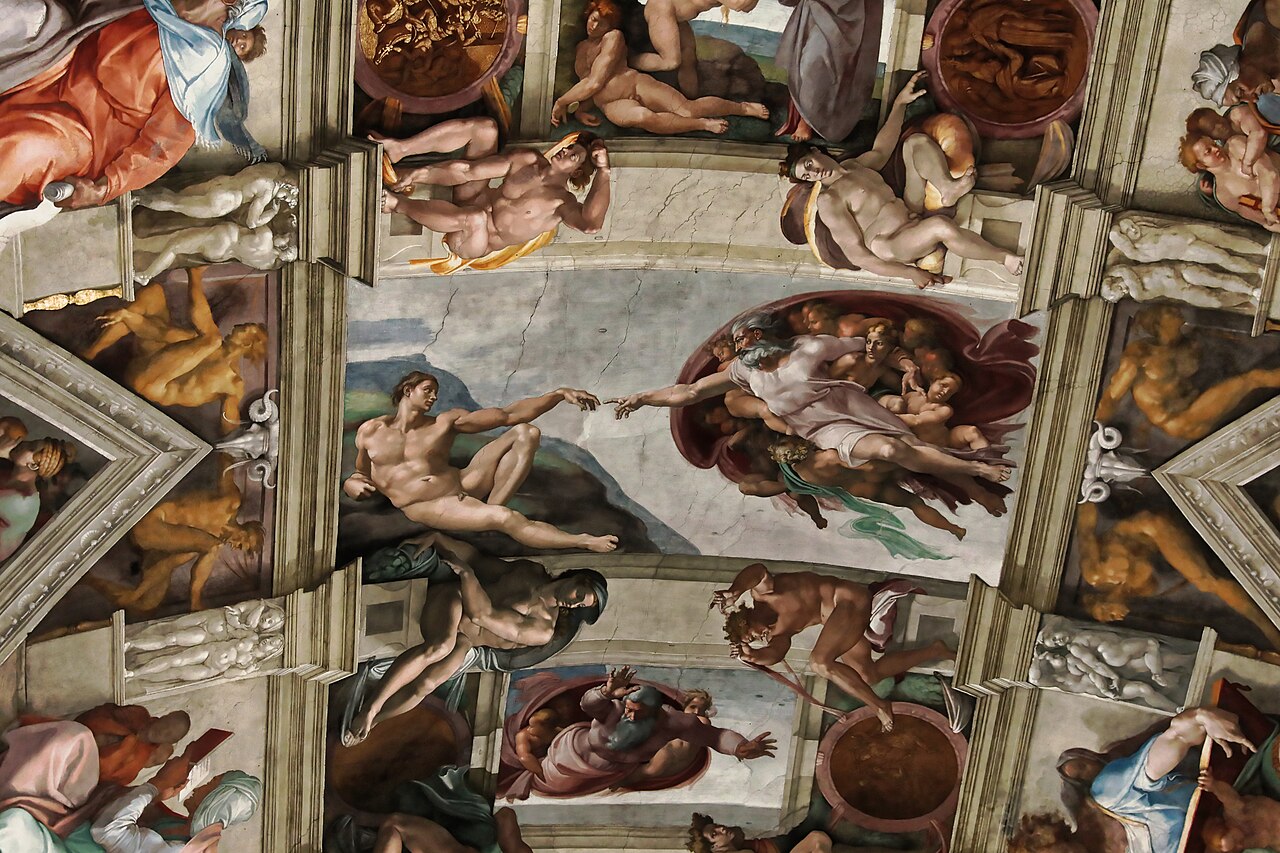
The most famous detail of the Sistine Chapel ceiling, painted between 1508 and 1512. God, propelled forward by a swirl of figures inside a billowing red cloak, reaches out his right index finger toward Adam, who is reclining naked on the earth and reaching back almost lazily. Their fingers do not quite touch. This small gap is one of the most reproduced visual ideas in Western art. Recent scholarship has suggested that the swirling red cloak around God is shaped like a cross-section of the human brain — Michelangelo had dissected hundreds of cadavers and clearly knew the anatomy. The image is a small panel in a much larger ceiling that contains nine scenes from Genesis and forty surrounding figures of prophets, sibyls, and ancestors of Christ. The whole ceiling is approximately 12 by 39 metres.
The Last Judgement 1541
Painted on the altar wall of the Sistine Chapel between 1536 and 1541, when Michelangelo was already in his sixties. Christ stands at the centre, raised arm, judging — and the whole composition spirals around him: the saved drift up on the left, the damned tumble down on the right toward a Charon ferrying souls into hell, the dead climb out of their graves at the bottom. The painting is enormous (13.7 by 12 metres) and contains roughly three hundred and ninety figures, almost all originally naked. Michelangelo painted his own face onto the flayed skin of Saint Bartholomew, who hangs from one of Christ's hands — a painter's joke about how it had felt to make the work. The loincloths were painted over many of the nudes after his death by Daniele da Volterra, on Counter-Reformation orders. Several have been removed in modern restoration; many remain.
The Doni Tondo 1507
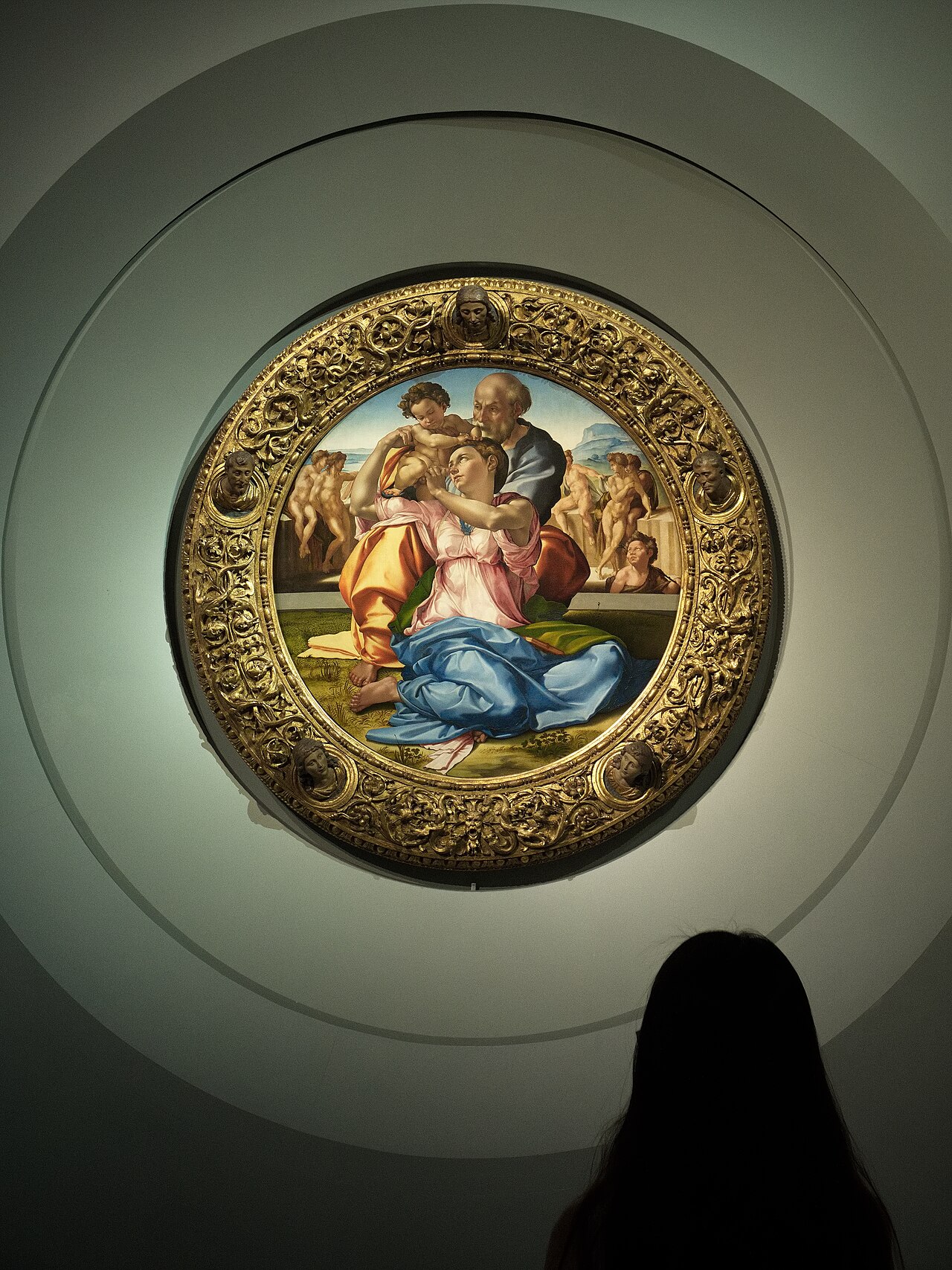
Michelangelo's only finished panel painting. Painted around 1507 for the Florentine merchant Agnolo Doni and his wife Maddalena Strozzi, on the occasion of their wedding or the birth of their first child. The Holy Family is arranged in the same spiralling triangular pose Michelangelo would soon push to extremes on the Sistine ceiling: the Virgin Mary kneels and twists to receive the infant Christ from Joseph behind her. The infant John the Baptist watches from the right. In the background — naked male figures lounging — are five of the so-called *ignudi*, partly clothed pagan-looking figures whose meaning has been argued about for five centuries. The frame, also designed by Michelangelo, is original. The painting hangs in the Uffizi in Florence.
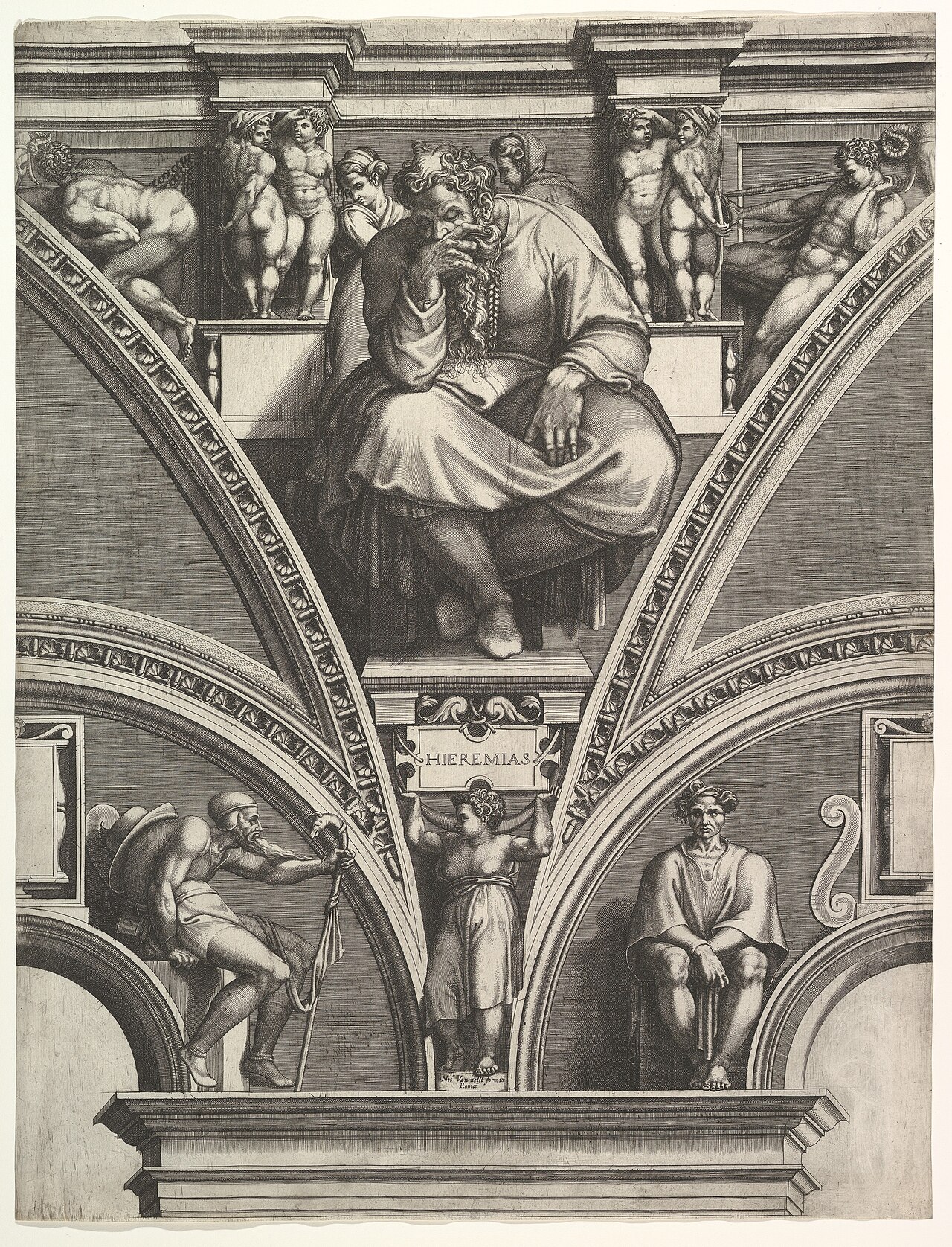
The Sistine Chapel — The Prophet Jeremiah 1511
One of seven enormous prophet figures Michelangelo painted around the ceiling of the Sistine Chapel. Jeremiah sits at the corner above the altar wall, head bowed onto his right hand in an attitude of mourning, his left hand resting on his knee. Many scholars consider the figure a self-portrait of Michelangelo himself in middle age — the body language reads as exhausted, doubting, full of dread. He is roughly 3 metres tall when seen from the floor, with the foreshortening adjusted to read correctly from below. Michelangelo lit each prophet from a single light source matching the windows of the chapel, so the figures appear naturally illuminated as you walk past them.
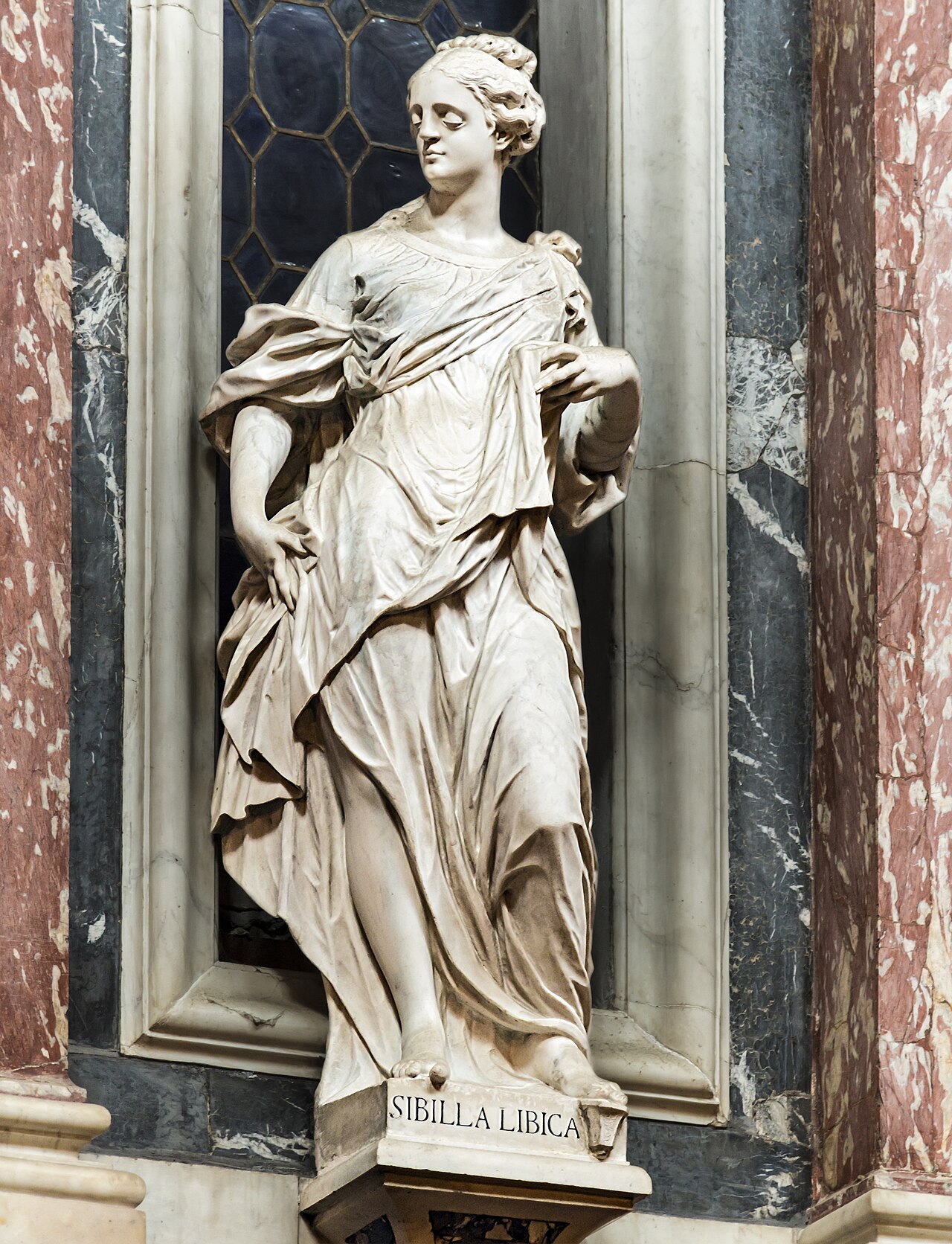
The Sistine Chapel — The Libyan Sibyl 1511
Among the most extraordinary single figures on the Sistine ceiling. The Libyan Sibyl, one of five non-Jewish female prophetesses Michelangelo paired with the Hebrew prophets, is shown twisting her body sharply to her right while reaching back to lift a heavy book of prophecy. Her bare back is one of the great anatomical bravura passages in Western painting — Michelangelo's surviving red-chalk preparatory drawing for it (now in the Met in New York) shows the same back drawn from a male model in the studio, with the female face added later. The Sibyl is about 3.5 metres high on the ceiling and reads from the floor as if she is just preparing to stand. Of all the ceiling figures, she is the one most often cited as the perfect example of *terribilità*: the body is so muscular, the pose so contained, that the figure seems impossible and effortless at once.