Jan van Eyck
Burgundian court painter whose oil glazes rendered light, jewels, and fur with uncanny precision.
Style and technique
Van Eyck worked in oil at a moment when most Netherlandish painters still relied chiefly on tempera, and he exploited the medium's slow drying time and translucency more fully than any predecessor. Building up thin, transparent glazes over a pale ground, he layered color upon color to produce depth, luminosity, and an extraordinary range of textures within a single square inch of panel: the cold glint of polished armor, the soft nap of wool, the facets of a cut gem, the fractured light inside a convex mirror.
That story is false -- oil-based media had been used by painters for generations -- but it captures something real: Van Eyck refined the technique, especially the use of oil glazes over tempera underpainting, to a level of control that made it look like a fresh invention.
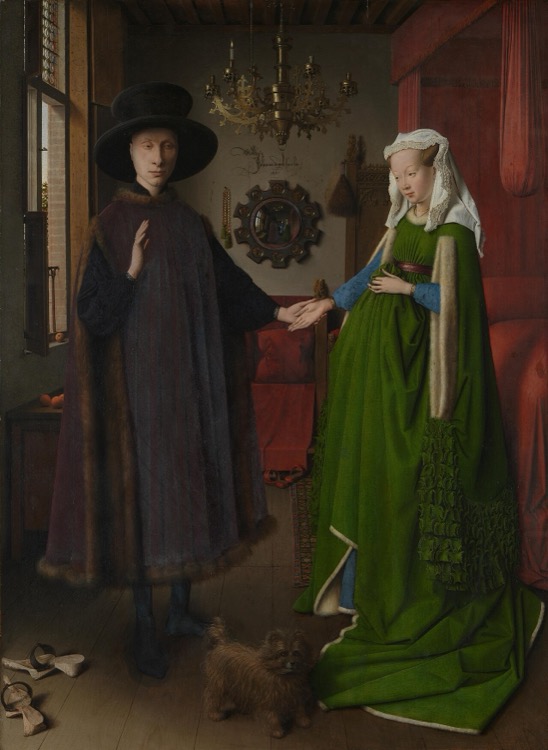
His surfaces reward close looking because they were built for it: individual hairs, threads, wrinkles, and reflections were rendered with a magnifying exactness rarely equaled before actual magnifying lenses existed. Interiors are staged like carefully arranged theaters in which everyday objects -- a dog, a pair of clogs, an orange, a convex mirror, a chandelier -- often carry disguised religious or moral meaning, encoding piety, marriage, or fidelity within apparently domestic clutter. Inscriptions, coats of arms, and Latin or invented Greek mottoes worked into frames and backgrounds add further layers of meaning meant for learned viewers to decode.
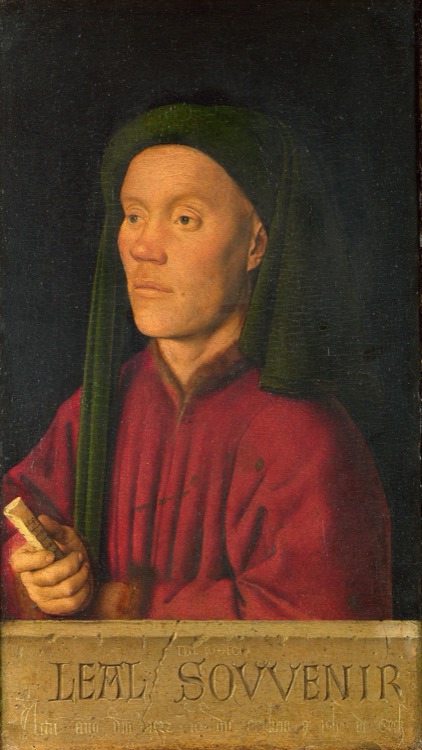
Van Eyck also brought an unprecedented naturalism to portraiture, favoring a three-quarter pose against a plain dark background that let him concentrate entirely on the sitter's face and the fall of light across it, a formula that shaped European portrait painting for generations. Whether depicting a duke's courtier, a merchant, or himself, he pursued the same unflinching, almost forensic attention to individual likeness, treating each sitter's face with the same devotion he gave to velvet, fur, or gold thread.
Life and legacy
Jan van Eyck's early life is largely obscure. He was likely born around 1390 in Maaseik, in the Prince-Bishopric of Liège, and nothing certain is known of his training. He first appears in surviving records in 1422, working for John of Bavaria, Count of Holland, at the court in The Hague. By 1425 he had entered the service of Philip the Good, Duke of Burgundy, one of the wealthiest rulers in Europe, who named him court painter and valet de chambre -- a title that placed him among the duke's trusted household rather than a mere hired craftsman. Philip valued him enormously: he paid Van Eyck a generous fixed salary, stood as godfather to one of his children, and once personally intervened when the ducal treasury was slow to pay the artist, declaring he would find no one to match him.
The duke also entrusted Van Eyck with confidential diplomatic missions between 1426 and 1429, including a journey, possibly to Portugal, to help negotiate Philip's marriage to Isabella of Portugal and paint her portrait for his approval -- a rare instance of a painter serving simultaneously as a trusted court envoy. Van Eyck settled afterward in Bruges, then the commercial hub of northern Europe, where Italian bankers, merchants, and clergy became patrons alongside the duke.
His largest and most celebrated undertaking was the Ghent Altarpiece, the enormous polyptych made for the church of Saint Bavo in Ghent and completed in 1432. An inscription on its frame credits the design to his elder brother Hubert van Eyck, "greater than whom no one was found," with Jan finishing the work -- a puzzle that has occupied scholars ever since, since almost nothing else is documented about Hubert.
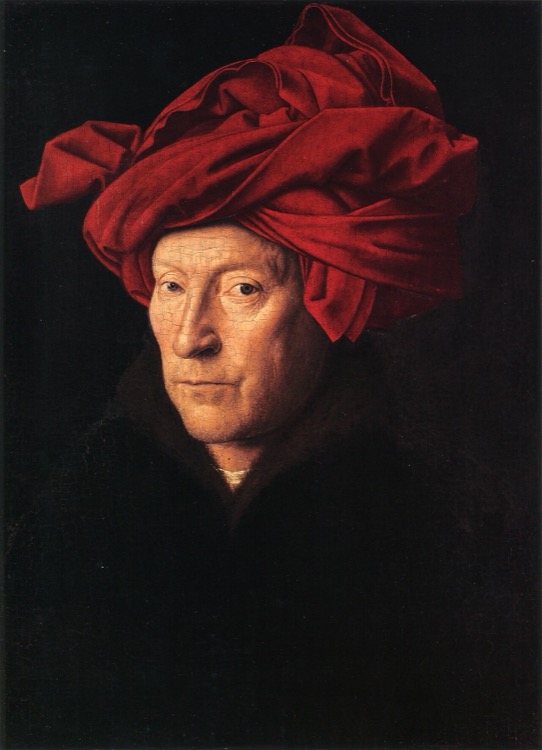
Van Eyck signed an unusual number of his panels, often with elaborate lettering worked directly into the frame, and adopted a personal motto, "Als ich can" ("As I can," or "As best I can"), a modest-sounding phrase widely read as a sly play on his own name. He inscribed it, sometimes disguised in invented Greek-looking letters, on works such as the Portrait of a Man in a Red Turban, long believed to be a self-portrait.
He died in Bruges in July 1441 and was buried in the Church of Saint Donatian; his brother Lambert later moved his remains to a more honored spot within the church. Within a generation Van Eyck's technique and observational precision had become legendary across Europe, discussed by Italian humanists who had never seen his panels firsthand, and he was long -- inaccurately -- celebrated as the outright inventor of oil painting itself.
Five famous paintings
The Arnolfini Portrait 1434
Perhaps the most analyzed panel in Northern European art, this double portrait of a Lucca merchant, likely Giovanni di Nicolao Arnolfini, and a woman traditionally identified as his wife turns a Bruges bedchamber into a puzzle box of symbols -- a single lit candle, a small dog, cast-off wooden clogs, an orange on the windowsill -- all rendered with the same precision as the sitters' faces. At the composition's center hangs a convex mirror reflecting the entire room in miniature, including two unidentified figures at the door, above an inscription reading "Jan van Eyck was here," turning the painter himself into a witness within the scene.
Portrait of a Man in a Red Turban 1433
Widely believed to be Van Eyck's own likeness, this bust-length portrait set against a flat black background isolates the sitter's weathered, faintly amused face beneath an elaborately wound red chaperon, its cloth rendered in such convincing sculptural volume that it seems to project off the panel. The frame carries two inscriptions in the artist's own invented pseudo-Greek lettering: his motto "Als Ich Can" ("As I Can") and the exact date, 21 October 1433 -- among the earliest confidently dated self-portraits in Western painting, and a bold personal claim of authorship in an age when painters rarely signed their work at all.
Madonna of Chancellor Rolin 1435
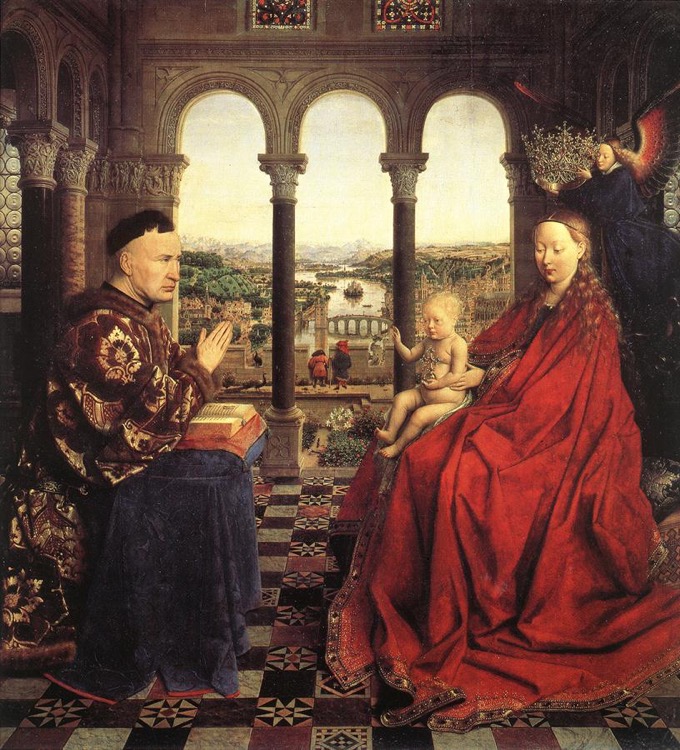
Nicolas Rolin, chancellor to Philip the Good and one of the most powerful men in Burgundy, kneels in private devotion before the enthroned Virgin and Child inside a loggia opening onto a sweeping panoramic river landscape -- one of the earliest true landscape vistas in European painting, complete with a walled city, bridges, boats, and tiny figures going about their business far below. Every inch is worked with the same obsessive finish, from the chancellor's jeweled robe to the carved capitals overhead, while a garden of roses and lilies just beyond the terrace quietly reinforces the Virgin's purity.
Virgin and Child with Canon van der Paele 1436
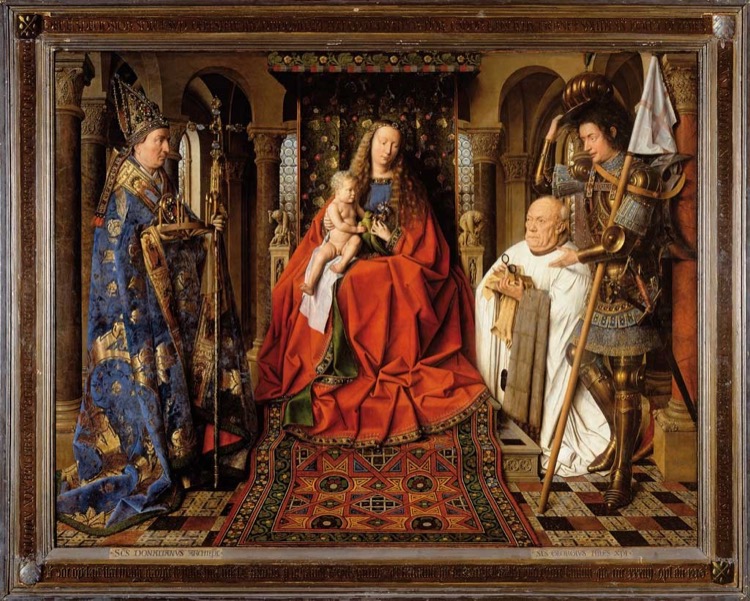
Commissioned by an ailing Bruges canon as an offering for his own salvation, this large, densely detailed panel places Joris van der Paele -- shown gaunt, aged, and clutching spectacles and a prayer book -- in the immediate presence of the enthroned Madonna, flanked by Saint Donatian in gold-embroidered vestments and Saint George, the canon's name-saint, who gestures to introduce him. Regarded by many as Van Eyck's most technically dazzling single achievement, it packs an entire cathedral's worth of textures -- brocade, marble, fur, polished armor -- into one unified, jewel-like space.
Portrait of Margaret van Eyck 1439
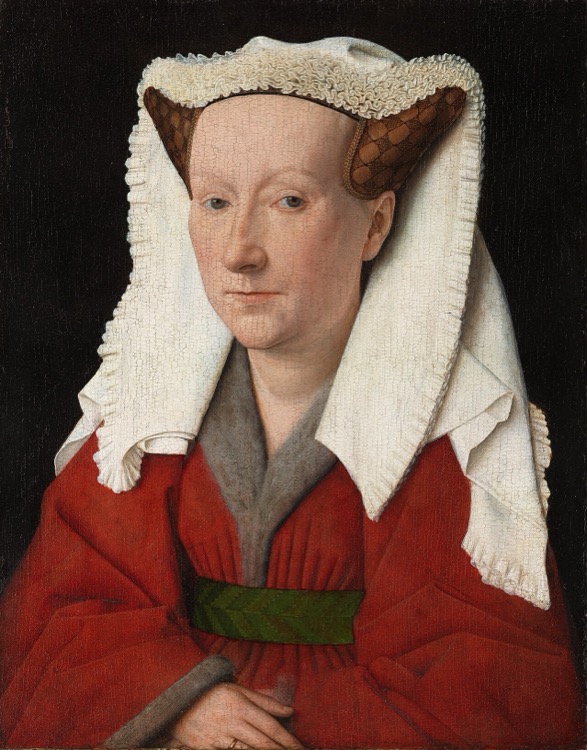
Painted in the last years of the artist's life, this intimate portrait of his wife shows her in an elaborate horned headdress and red gown, her steady gaze meeting the viewer's directly rather than in the three-quarter Burgundian convention he reserved for male sitters. The frame bears his personal motto and an inscription noting her age, 33, and the date, June 1439, making it both a tender private record within his own household and a rare instance of a major Renaissance painter documenting his spouse with the same rigor he brought to dukes, clergy, and merchants.