
Dadaism
Art declared war on itself — and the declaration was the art.
In the winter of 1916, in a small café in Zurich, a group of artists and poets who had fled the carnage of the First World War invented a movement whose central proposition was that art, culture, and rational civilisation had all conspired to produce the war — and therefore all deserved to be destroyed. Dadaism was the most radical artistic revolt of the twentieth century, and one of the most consequential. It lasted barely eight years in its organised form, but in that time it dismantled assumptions about what art was, what it was for, and who had the authority to make it. Marcel Duchamp placed a factory-made urinal in an art gallery; Hannah Höch assembled portraits of politicians from magazine scraps; Hugo Ball dressed in a cardboard costume and recited phonetic poetry composed of invented words to an audience that did not know whether to laugh or flee. Nothing in art was quite the same afterward.
Origin and history
The name Dada has been claimed from multiple etymologies — the French word for a rocking horse, the Romanian and Russian words for 'yes,' a nonsense syllable chosen precisely because it meant nothing — and the confusion about its origins was entirely deliberate. The movement crystallised in Zurich in February 1916 at the Cabaret Voltaire, a performance space opened by the German poet Hugo Ball and his companion Emmy Hennings on the Spiegelgasse. Switzerland was neutral, and its cities had filled with artists and intellectuals fleeing conscription across Europe. The Cabaret Voltaire became a nightly laboratory of anti-art: sound poetry, masked performances, simultaneous readings in multiple languages, collages, and manifestos that contradicted each other and sometimes themselves.
Tristan Tzara, the Romanian poet who emerged as Dada's most energetic publicist, began distributing the movement's aggressive proclamations internationally through the magazine *Dada*, founded in 1917. The ideas spread rapidly to artists already working in related directions: to Marcel Duchamp and Francis Picabia in New York, who had been questioning the premises of fine art since before the war; to Richard Huelsenbeck in Berlin, where Dada took on a sharper political edge in the volatile years of post-war Germany; to Kurt Schwitters in Hanover, who built his domestic environment into a total artwork from found materials and called it the *Merzbau*; and to Man Ray in Paris, where Dada mutated, around 1924, into its successor movement Surrealism.
Concept and philosophy
Dada's central argument was that the rational, progressive, humanist culture that had produced European civilisation had also produced the industrialised mass slaughter of the First World War — and was therefore bankrupt. If science, logic, and aesthetic refinement led to the trenches of the Somme, then irrationality, chance, and aesthetic demolition were more honest responses to reality. This was not nihilism for its own sake but a specific, historically grounded revolt against specific institutions — the academy, the museum, the art market, the belief that beauty was separate from politics and commerce.
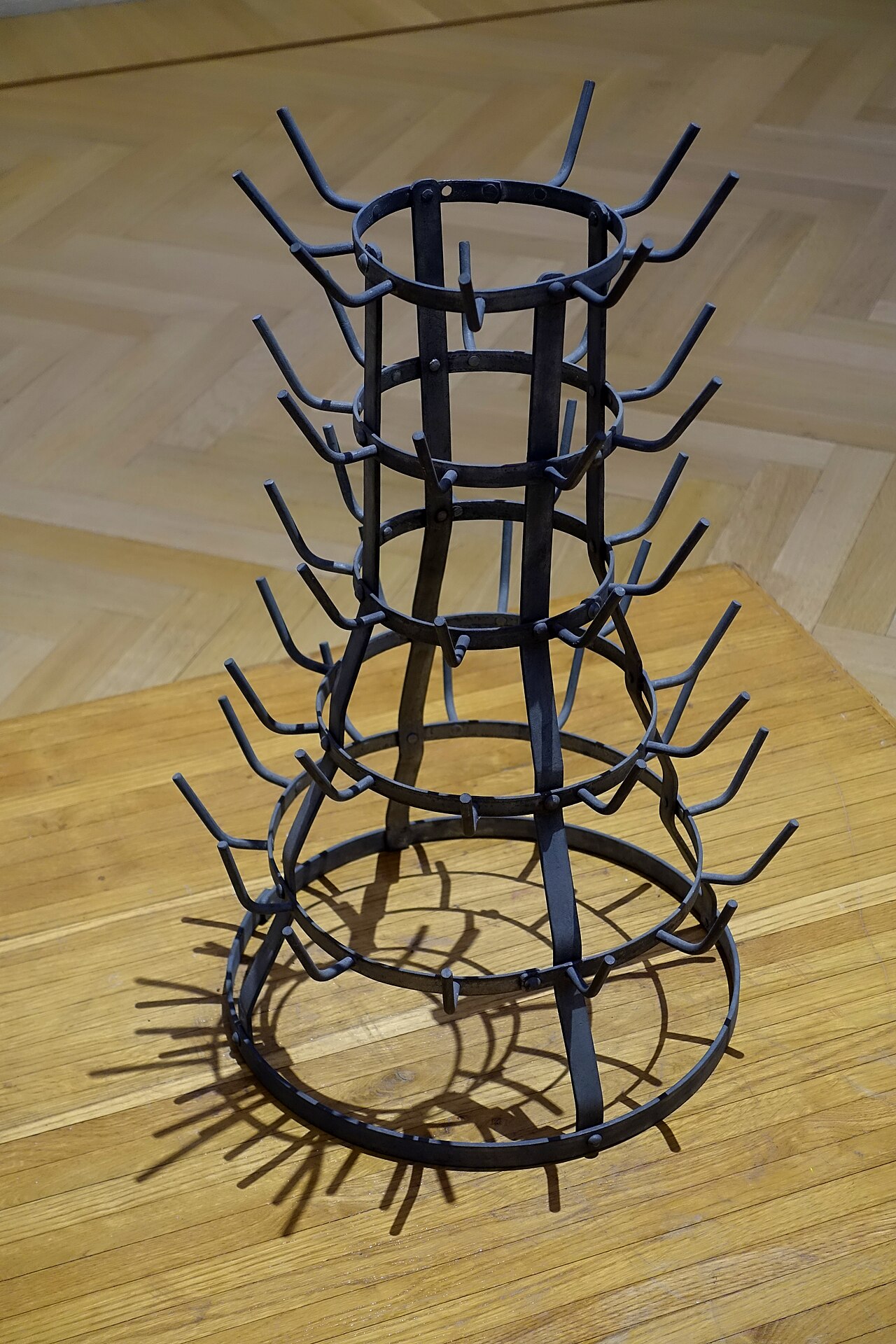
Marcel Duchamp's readymades were the movement's most precise conceptual weapons. A readymade was simply an object selected from commercial manufacture — a bottle rack, a bicycle wheel, most famously a porcelain urinal — signed (or not) and placed in an art context, forcing the question of whether 'art' resided in the object, in the act of selection, in the institutional frame, or in none of these. Duchamp's *Fountain* (1917), submitted to a New York exhibition under the pseudonym R. Mutt and promptly rejected by the organising committee, staged the contradiction between art-institutional rhetoric about openness and its actual conservatism in a single irrefutable gesture.
Photomontage, developed to its greatest complexity by Hannah Höch and the Berlin Dadaists, applied the readymade logic to images: cutting and recombining photographs from mass media to produce images that exposed the constructed, manipulable nature of visual 'reality.' Chance operations — tearing up a poem and reassembling the fragments at random, following the crack in a piece of glass to generate a drawing, dropping objects onto paper and tracing their contours — were used to produce works that bypassed the author's intention and the viewer's trained expectations simultaneously.
How to recognise it
When you see a Dada work, look for deliberate violations of almost every convention that defines 'art' in the traditional sense.
- Manufactured objects presented as art — A readymade is an unmodified or minimally modified commercial object placed in an art context. Duchamp's *Bicycle Wheel* (1913) and *Fountain* (1917) are the canonical examples. The work consists not in making anything but in the act of selection, displacement, and naming. If it looks like a plumbing fixture or a hardware item in a gallery, you are in readymade territory.
- Cut-and-paste photomontage — Photomontage — images assembled from fragments cut from newspapers, magazines, and photographs — was the Dadaists' most politically charged technique. Hannah Höch's *Cut with the Kitchen Knife* (1919) and John Heartfield's anti-Nazi photomontages are the movement's most powerful examples. Look for jarringly incongruous combinations, unexpected scale relationships, and layered media.
- Nonsense text and typography — Dada publications used typography as visual material — mixing fonts, sizes, and orientations on a single page so that the text became a graphic assault before it was a readable message. Manifestos contradicted themselves; poems were made by cutting up newspaper articles and pulling words from a bag. Language as a reliable carrier of meaning was systematically attacked.
- Performance and theatrical absurdism — Dada events at the Cabaret Voltaire and later venues featured performers in elaborate non-functional costumes, recitations of phonetic poetry with no semantic content, simultaneous readings in multiple languages, and deliberate audience provocation. The performance was anti-spectacle — designed to disrupt rather than entertain, to make the audience uncomfortable rather than satisfied.
- Found materials and collage — Kurt Schwitters built entire artworks — and eventually an entire room-sized construction — from discarded bus tickets, wire, wood scraps, torn posters, and urban detritus. Dada collage is distinguished from Cubist collage by its embrace of valueless, discarded materials and its refusal to compose them into harmonious arrangements.
- Deliberate aesthetic ugliness or blankness — Where conventional art aimed at beauty or at least formal resolution, Dada works often aim for the opposite: visual aggression, deliberate bad taste, aggressive plainness, or the deadpan blankness of the readymade. The point is not to fail at beauty but to question whether beauty is what art should be pursuing at all.
Anecdotes and curiosities
**Duchamp's *Fountain* was almost certainly thrown in the rubbish on the night of the opening.** In April 1917, Duchamp submitted the urinal to the Society of Independent Artists exhibition in New York — of which he was a founding board member — under the pseudonym 'R. Mutt.' The board voted to exclude it (Duchamp resigned in protest), and the original object has never been found. All seventeen surviving 'Fountain' sculptures are authorised replicas made from the 1950s onward, each signed by Duchamp. The work exists primarily as a photograph taken by Alfred Stieglitz in the gallery of his journal *The Blind Man*, and as the idea it catalysed.
Hugo Ball's sound poem performance had to be cut short because the audience became genuinely alarmed. On June 23, 1916, Ball took the stage at the Cabaret Voltaire dressed in a cardboard costume that encased him from waist to chin like a bishop's robes, topped by a tall cylindrical hat. He recited *Gadji beri bimba* — a phonetic poem with no words in any known language — in a voice that began as a chant and escalated into what eyewitnesses described as a liturgical wail. He reportedly had to be carried offstage because the costume prevented him from walking. He never performed sound poetry again and left Zurich for a Catholic retreat shortly afterward.
Hannah Höch was systematically excluded from the First International Dada Fair in Berlin in 1920 — by her own movement. Höch, whose *Cut with the Kitchen Knife* was one of the most ambitious works in the exhibition, was initially barred from participating by George Grosz and John Heartfield, who regarded women as peripheral to Dada's political project. She gained inclusion only after her companion Raoul Hausmann threatened to withdraw his own work. Her contribution proved to be among the most enduring works in the show; Grosz's dismissal of her has been cited in feminist art history as evidence that avant-garde movements inherited mainstream culture's gendered hierarchies even while attacking mainstream culture.
Tristan Tzara's instructions for writing a Dada poem were a recipe for chance operations. In his 1920 *Dada Manifesto on Feeble Love and Bitter Love*, Tzara provided instructions: take a newspaper, cut out each word, put the words in a bag, shake it, draw out the words one by one, and copy them in the order they come. 'The poem will resemble you,' he promised. This was simultaneously a mockery of Romantic theories of creative genius, a practical method for generating language, and a philosophical position about authorship and meaning — all three at once, which is typically Dada.
Legacy and influence
Dada's most direct and obvious heir was Surrealism, which absorbed many of its members — Tzara, Arp, Man Ray, Picabia — and many of its techniques (chance operations, automatic writing, found objects) while replacing anarchic nihilism with Freudian psychoanalytic theory and a more systematic aesthetic programme. But Dada's influence extends far beyond Surrealism. Conceptual art — the dominant mode of art-world production since the 1960s — is Duchamp's readymade logic applied systematically to every domain: if selection and framing constitute the artistic act, then anything can be art and the artist's idea is the work. Fluxus, Pop Art, performance art, punk rock, culture jamming, and the entire tradition of politically engaged visual satire all owe a structural debt to Dada's demolition of the boundary between art and life, high and low, made and found. The movement that declared itself against art became, paradoxically, one of art history's most generative sources.
3 artists in this movement
Frequently asked questions
What is a readymade?
A readymade is a term coined by Marcel Duchamp for an ordinary manufactured object — a bicycle wheel, a bottle rack, a urinal — selected by an artist, possibly given a new title, and placed in an art context such as a gallery or exhibition. The move raises the question of whether 'art' is a property of the object, of the making process, of the institutional frame, or of the conceptual act of selection. Duchamp's readymades did not require any craft or manual skill; they required only a decision. This made them the most radical challenge to traditional definitions of art that the twentieth century produced.
Why is Duchamp's urinal so important?
Fountain (1917) matters because it is the most compressed possible statement of a set of questions that have driven art ever since: What is art? Who decides? What is the role of the institution? Does craft matter? Can intention alone constitute an artwork? By submitting a plumbing fixture to an exhibition that had publicly committed to showing 'anything,' Duchamp forced the art world to confront the gap between its stated values and its actual practices — and demonstrated that an artistic gesture need not involve making anything at all. Every work of conceptual art made since 1917 operates in the space Duchamp opened.
What is photomontage?
Photomontage is the technique of cutting fragments from photographs and printed media and combining them into a single composite image — often with deliberately jarring scale relationships, impossible juxtapositions, or politically satirical combinations. The Dadaists, particularly Hannah Höch and the Berlin group, developed it as a way to expose the constructed nature of mass-media imagery and to comment on politics through visual argument. Unlike collage, which uses heterogeneous materials, photomontage works specifically with the authoritative visual language of photography, turning its apparent realism against itself.
How did World War I cause Dada?
The First World War industrialised killing at a scale and efficiency that seemed to invalidate the entire civilisational project that had produced it. The Dadaists — many of them draft-age men who had fled conscription to neutral Switzerland — read the war as proof that the rational, progressive culture of modern Europe was either bankrupt or actively complicit in mass murder. Their response was to attack culture itself: its institutions, its forms, its language, its hierarchies of taste. If reason had produced the Somme, then unreason was more honest. The Cabaret Voltaire was not escapism from the war; it was a direct artistic response to it.
Did Dada end or just transform into Surrealism?
Both, depending on the city and the artist. In Paris, Dada formally dissolved around 1924 when André Breton published the *Surrealist Manifesto*, drawing most of the Parisian Dada group — including Tzara (after initial resistance), Man Ray, Arp, and Picabia — into the new movement. Breton replaced Dada's anarchic negation with a systematic programme based on Freudian dream theory and automatic writing. In Germany, political Dada had already collapsed under the weight of the Weimar Republic's instability. Kurt Schwitters, excluded from Berlin Dada, continued his own idiosyncratic practice in Hanover until the Nazis forced him to flee in 1937. Duchamp simply stopped making art for chess, and returned to it only occasionally thereafter. Dada ended as an organised movement but its questions — about authorship, about the institution of art, about the relationship between art and politics — have never been closed.