Man Ray
The American tailor's son who turned a darkroom into a Surrealist laboratory and made photography think for itself.
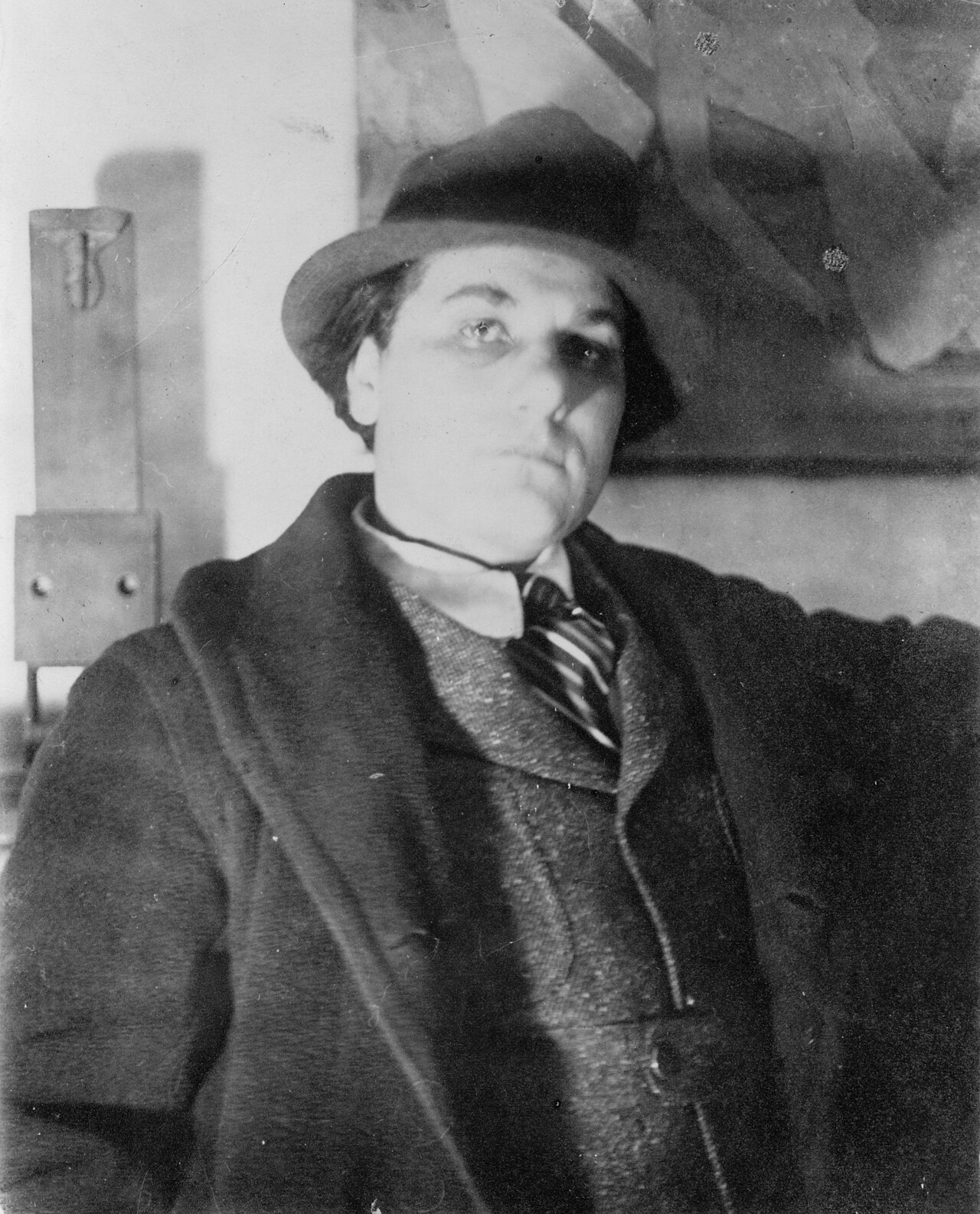
Style and technique
Man Ray refused, his whole life, to be one kind of artist. He painted, he sculpted, he made films, he photographed fashion for Vogue and Vanity Fair, he assembled objects out of nails and metronomes, and he insisted that all of it was the same activity. The medium was a tool you picked up when the idea required it; the idea was everything. He came out of New York Dada with Marcel Duchamp convinced that the readymade had killed the cult of the handmade masterpiece, and he spent the next fifty years proving the point with a camera, a brush, an iron and a pair of scissors.
The heart of his contribution is in the darkroom. In 1921, in a Paris hotel room, he discovered (or rediscovered) the photogram — placing objects directly on light-sensitive paper and exposing them — and renamed the result the rayograph. A funnel, a key, a strip of lace, a hand: laid on the paper, lit for a moment, they leave a ghostly white silhouette on a velvet-black ground. The objects are perfectly themselves and at the same time perfectly strange, floating without scale or gravity. It was photography without a camera, drawing with light, the most automatic of automatic techniques — and it was the first photographic procedure the Surrealists could fully embrace.
Solarisation came next, around 1929, mostly worked out with his lover and assistant Lee Miller. By briefly re-exposing a developing negative to light, the Sabattier effect reverses tonal values along the contours of the figure, ringing every shoulder, every nose, every strand of hair with a thin black line. A nude becomes a drawing of itself. A face acquires an aura. It was Man Ray's other great gift to twentieth-century photography: a way to make the camera lie beautifully.
His work in objects belongs to the same logic. 'Le Cadeau' (1921) is a flatiron with fourteen brass tacks glued to its sole — instantly useless, instantly cruel, a domestic tool turned into a Surrealist visual puzzle. 'L'Énigme d'Isidore Ducasse' (1920) is an unseen sewing machine wrapped in an army blanket and tied with rope, a literal illustration of Lautréamont's line about the chance encounter on a dissecting table. 'Le Violon d'Ingres' (1924) photographs Kiki de Montparnasse from behind, then paints two violin f-holes onto her back: the woman becomes the instrument the painter Ingres famously played as a hobby. The pun is in the title, the body and the image at once.
Four habits run through everything he made.
The hybrid medium. Painting, photography, film and object are interchangeable. A rayograph is a drawing; a portrait is a sculpture; a sculpture is a joke.
The found and the altered. He starts almost always from something already in the world — an iron, a metronome, a face, a cropped nude — and adds the smallest possible intervention to make it impossible.
Gender-bending portraiture. He photographed Duchamp as the female alter ego Rrose Sélavy, dressed his women friends as boys, his men as women, and made the studio a place where identity was a costume.
Unconcerned, free play. He hated the word 'artist' applied solemnly. His own programme, scrawled on a late self-portrait, was simply 'unconcerned, but not indifferent' — a philosophy of free play, of taking nothing too seriously except the idea itself.
Life and legacy
He was born Emmanuel Radnitzky on 27 August 1890 in Philadelphia, the eldest son of Russian-Jewish immigrants Melach 'Max' Radnitzky and Manya 'Minnie' Lourie, who had fled the pogroms of the Pale of Settlement in the 1880s. The family was poor. Max was a tailor; Minnie sewed at home; the apartment smelled of pressing cloth and cooked cabbage. In 1897 they moved to Brooklyn, and in 1912, in a quiet act of immigrant self-protection, the whole family changed its surname to the more American-sounding Ray. Emmanuel had already begun signing himself 'Man Ray', and the new name stuck.
The tailor's shop never left him. The flatirons, the dress dummies, the spools of thread, the cuttings on the floor — they reappear, decade after decade, as the materials of his Surrealist objects. He always said the smell of his childhood home was the smell of his art.
He was a brilliant draughtsman as a schoolboy and won a scholarship to study architecture, which he refused. He worked instead as a technical illustrator and engraver in Manhattan from around 1908, while haunting the modernist scene exploding around him. The decisive place was Alfred Stieglitz's gallery '291' at 291 Fifth Avenue, where he saw Cézanne, Picasso, Brâncuși and Rodin for the first time. He took classes at the Ferrer Center, an anarchist school, where he met Robert Henri and was drawn into the radical bohemian milieu of Greenwich Village.
The Armory Show of 1913 hit him hard, and the meeting that mattered most followed two years later. In 1915 he met Marcel Duchamp, then newly arrived in New York fleeing the war, and the two formed an immediate, lifelong friendship. With the collector Walter Arensberg they became the nucleus of New York Dada — irreverent, anti-aesthetic, in love with chance and the readymade. Man Ray painted, photographed Duchamp's 'Large Glass' for him, helped him invent Rrose Sélavy, and in 1920 the three of them, with Katherine Dreier, founded the Société Anonyme, Inc., the first museum of modern art in the United States.
New York eventually bored him. 'Dada cannot live in New York,' he said: the city was too pragmatic, too rich. In July 1921 he sailed for Paris with a small portfolio and very little French. Duchamp met him at the Gare Saint-Lazare and walked him into the Café Certâ, where the entire Dada group — Tristan Tzara, André Breton, Louis Aragon, Paul Éluard, Philippe Soupault — was waiting at a table. He never really left France again.
In Paris he discovered, almost by accident, the rayograph. Some sheets of unexposed photographic paper had ended up on a table in his hotel darkroom; he placed a funnel, a thermometer and a key on top, switched on the light to find the right paper — and the objects printed themselves on the sheet. Tzara saw the results, called them 'pure Dada creations', and Man Ray published an album, 'Champs délicieux', in 1922. Within a year he was the favourite portraitist of literary Paris and the official photographer of the new Surrealist movement founded by Breton in 1924.
Money came from fashion. From the mid-1920s he photographed regularly for Paul Poiret, then for Vogue and Vanity Fair, inventing along the way the elegant, slightly uncanny visual grammar that fashion photography still uses. In his Montparnasse studio at 31 bis rue Campagne-Première he photographed Joyce, Stravinsky, Picasso, Le Corbusier, Dalí, Schiaparelli, Hemingway, Proust on his deathbed.
His great muse was Alice Prin, the cabaret singer and model known to all of Montparnasse as Kiki. They lived together from 1921 to 1929. He photographed her hundreds of times — most famously as 'Le Violon d'Ingres' (1924) and the African-mask diptych 'Noire et blanche' (1926). When that affair ended, the next assistant who walked into his studio was a 22-year-old American called Lee Miller. They became lovers; she became, briefly, his collaborator; together they refined the solarisation technique around 1929. She left him in 1932 and he was distraught for years.
He also made films — short, jagged, deliberately amateur. 'Le Retour à la raison' (1923) was screened at a Dada riot at the Théâtre Michel, where Tzara and Breton came to physical blows in the audience. 'Emak-Bakia' (1926), 'L'Étoile de mer' (1928) and 'Les Mystères du château du Dé' (1929) followed, the last filmed at the Vicomte de Noailles's villa in Hyères and full of cubic mannequins and dice.
When the Wehrmacht entered Paris in June 1940, Man Ray, an American Jew, fled across France, sailed from Lisbon, and landed in New York in August. He hated being back. He moved on to Hollywood, Los Angeles, in October 1940, settled into a small apartment with his new partner Juliet Browner (whom he married in a double ceremony with Max Ernst and Dorothea Tanning in 1946), and spent the next decade painting and trying — without much success — to convince Americans that he was a painter, not a photographer.
In March 1951 he and Juliet returned to Paris and moved into a studio at 2 bis rue Férou, behind Saint-Sulpice, where he lived for the rest of his life. He kept making rayographs, retouching old objects, signing editions, refusing every retrospective until he was sure it would be on his own terms. He died at home on 18 November 1976, aged 86, of a lung infection. Juliet had him buried in the Cimetière du Montparnasse, where his stone reads, in the inscription she chose for him: 'unconcerned, but not indifferent'.
Five famous paintings
Belle Haleine, Eau de Voilette 1921
A small assisted readymade made jointly with Marcel Duchamp in New York in spring 1921 and now in a private collection (the original perfume-bottle object measures roughly 16.3 × 11.2 cm in its oval box). The pair took an empty bottle of Rigaud's 'Un Air Embaumé' eau de toilette and replaced its label with a new one designed by Duchamp: a photograph by Man Ray of Duchamp himself, dressed as his female alter ego Rrose Sélavy, in fur collar and feathered hat, staring sideways out of the oval. The text — 'Belle Haleine, Eau de Voilette' — is a triple pun: 'belle Hélène' (the opera), 'belle haleine' (beautiful breath) and 'eau de toilette' bent into 'eau de voilette' (veil-water). Signed on the back 'RS', it is one of the foundational gender-bending objects of New York Dada and one of the first photographic portraits in Western art of a man explicitly performing as a woman. In 2009 the bottle sold at Christie's Paris for €8.9 million, then a record for a Duchamp work.
Woman Asleep 1913
Painted in oil on canvas around 1913, in the immediate aftermath of the Armory Show, when Man Ray was twenty-three and still signing his work as a painter from Brooklyn. The canvas, roughly 51 × 61 cm, shows a reclining female nude reduced to faceted, almost Cubist-Fauvist planes — a body assembled from dark green, ochre and brick-red wedges, the head turned away, the limbs flattened against an undefined ground. The model was probably his first wife, the Belgian poet Adon Lacroix, whom he married that year and who introduced him to French Symbolist literature and to the writings of Lautréamont. Stylistically the picture sits halfway between the Ashcan-trained drawing he had learned at the Ferrer Center and the European modernism he was absorbing at Stieglitz's '291' — a transitional work, but already announcing his lifelong interest in the female body as a constructed, almost sculptural object rather than a naturalistic likeness.
Alice B. Toklas and Gertrude Stein 1922
A gelatin silver photograph (around 22 × 17 cm in the original print) made in the salon at 27 rue de Fleurus, Paris, in late 1922 — Man Ray's first commissioned portrait after his arrival in the city the previous summer. Gertrude Stein sits, monumental and Buddha-like in a corduroy coat, in a high-backed chair beneath her wall of paintings; behind her, partly cropped, hangs Picasso's 1906 portrait of Stein herself, so the picture becomes a portrait inside a portrait. Alice B. Toklas stands behind, in shadow, a quiet companion-shape. The photograph established Man Ray as the official portraitist of literary Paris almost overnight: within months he was photographing Joyce, Cocteau, Pound, Hemingway, Satie. Multiple prints exist; major examples are held by the Centre Pompidou, the Yale Beinecke Library and the National Portrait Gallery, Washington. It is also the photograph Stein chose, in 1933, to illustrate the first edition of 'The Autobiography of Alice B. Toklas'.
Louis Aragon 1930
A solarised gelatin silver portrait of the Surrealist poet and novelist Louis Aragon, made in Man Ray's studio at 31 bis rue Campagne-Première in 1930, at the height of his work with the Sabattier effect. The print (around 29 × 22 cm; examples in the Centre Pompidou and the J. Paul Getty Museum) shows Aragon in a sharp suit, head tilted, eyes downcast, every contour of cheek, jaw, lapel and hair ringed by the thin black 'solarisation line' that Man Ray had refined the previous year with Lee Miller. The technique — partial re-exposure of the developing negative to light — reverses tonal values selectively, so that the face seems lit from inside and outlined in ink at the same time. Aragon was by then one of the editors of 'La Révolution surréaliste' and a close friend, and the portrait belongs to a celebrated series of solarised heads that includes Breton, Éluard, Tzara and Meret Oppenheim. It is one of the technical landmarks of twentieth-century photography.
Surface Réglée 1936
An oil on canvas, roughly 60 × 73 cm, painted in Paris in 1936 and now held in a private European collection. The title — 'Ruled Surface' — is taken directly from descriptive geometry, where a 'surface réglée' is a surface generated by the motion of a straight line in space. Man Ray, who had been photographing the plaster mathematical models at the Institut Henri Poincaré since 1934 and exhibiting those photographs alongside the Surrealists, here translates the same forms back into painting: a tilted, ruled, almost ribbon-like geometric body floats in a shallow blue space, its surface modelled by a precise weave of straight lines. The picture belongs to the same family as the photographs reproduced in the Surrealist journal 'Cahiers d'Art' that year, and to the broader Surrealist fascination — shared with Max Ernst and Salvador Dalí — with the idea that pure mathematics could be more strange and dreamlike than any invented image. It is one of Man Ray's clearest demonstrations that, for him, painting and photography were two faces of the same investigation.