
Neo-Expressionism
After Minimalism's silence, painting came back furious, figural and deliberately ugly.
In the winter of 1980, a twenty-year-old from Brooklyn named Jean-Michel Basquiat was tagging walls in lower Manhattan under the pseudonym SAMO — *Same Old Shit* — with cryptic phrases that mixed street poetry with art-historical provocation. Within three years he would be showing at the Gagosian Gallery and appearing on the cover of the *New York Times Magazine*. This trajectory — from the street to the art world at speed — was characteristic of Neo-Expressionism, a movement that erupted more or less simultaneously in New York, West Germany and Italy in the late 1970s and early 1980s, and that declared, loudly and with great visual force, that painting was back. After a decade of Minimalism's cool restraint and Conceptual Art's dematerialised propositions, the new painters insisted on paint as a physical substance, figures as urgent subjects, and the canvas as a site of raw psychological conflict. Kiefer loaded his enormous canvases with lead; Baselitz painted his figures upside down; Schnabel built surfaces from broken crockery. The movement was never a single programme, but its shared temperature — visceral, excessive, deliberately raw — was unmistakable.
Origin and history
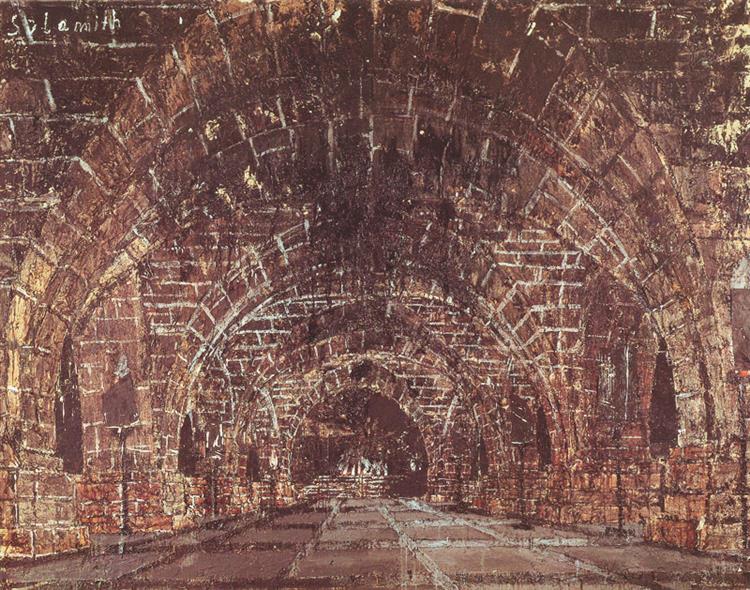
Neo-Expressionism emerged from two distinct but parallel sources. In West Germany, a group of painters including Georg Baselitz, Anselm Kiefer, Markus Lüpertz and A.R. Penck had been developing a figurative language through the 1960s and 1970s that engaged directly with the suppressed history of German Romanticism, Nazi trauma and post-war guilt. Baselitz began inverting his painted figures in 1969 — turning them upside down to detach image from meaning, to make the figure a purely painterly problem. Kiefer was photographing himself performing the Nazi salute in European locations in 1969, then burning the photographs and incorporating the ash into enormous paintings; his canvases from the 1970s onward layer lead, straw, sand and scorched materials over fields of paint in a sustained reckoning with German history that had no precedent in contemporary painting.
In Italy, the critical framework came first. The curator and critic Achille Bonito Oliva coined the term *Transavanguardia* in 1979 to describe a group of Italian painters — Francesco Clemente, Enzo Cucchi, Sandro Chia, Mimmo Paladino — whose work embraced myth, the human body and pre-modernist pictorial tradition with a deliberate irony and sensual excess. They were explicitly post-Minimalist in the sense that they had fully absorbed the Conceptual Art of the 1970s and were choosing to reject its logic.
In New York, the East Village scene provided the social and institutional framework. The city's economic collapse in the mid-1970s had produced cheap studio space and a proliferation of informal galleries; young painters — Basquiat, Julian Schnabel, David Salle, Eric Fischl — were showing work in storefronts and lofts before the uptown galleries arrived. By 1981 the movement had a museum-circuit presence: the *A New Spirit in Painting* exhibition at the Royal Academy in London and *Zeitgeist* at the Martin-Gropius-Bau in Berlin both announced, with considerable fanfare, that figurative painting had returned as the dominant international mode.
Concept and philosophy
The theoretical core of Neo-Expressionism was a rejection of the idea that art history moves in a single progressive direction — toward purity, concept, dematerialisation. The Neo-Expressionists insisted that painting's oldest resources — the body, myth, history, raw feeling — were not exhausted but had simply been suppressed by the dominant critical ideology of the 1960s.
For the German painters, this took a specifically historical dimension. Kiefer's work after 1969 is inseparable from the question of how a German painter could make art that engaged with German Romanticism — Caspar David Friedrich's sublime landscapes, Wagner's mythology — after those traditions had been co-opted by National Socialism. His answer was to occupy that territory again, not naively but with a full awareness of its contamination: massive, ruined canvases that are simultaneously beautiful and devastated, fields of scorched earth and charred straw that evoke both the German landscape and its annihilation.
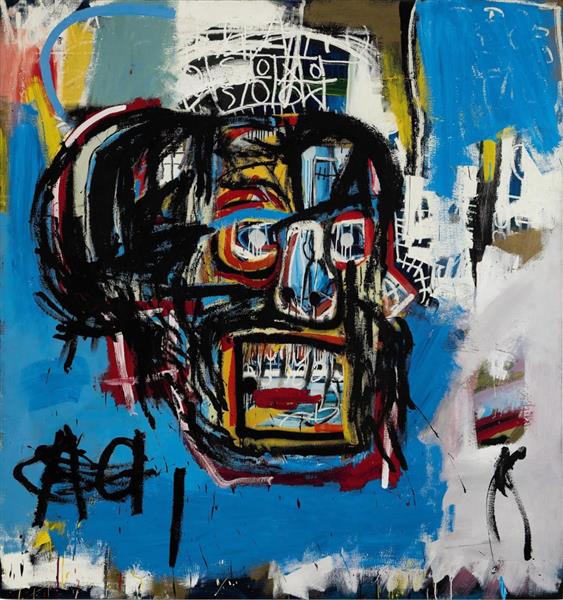
Basquiat worked in a different register but with analogous urgency. His paintings collide graffiti-derived mark-making with anatomical diagrams, cartoon drawing, art-historical reference and social critique. A Basquiat canvas from 1982 or 1983 is a simultaneous record of the street, the museum, the Black American body, the commodified art object and the young man making all of it — barely twenty years old, already dying from the contradictions of the position.
What united these very different painters was a common conviction about the relationship between difficulty and meaning. Minimalism had implied that difficulty was achieved through reduction — that the most demanding art was the most stripped-down. The Neo-Expressionists reversed the logic: their canvases are overloaded, their surfaces physically insistent, their imagery deliberately unresolved. The difficulty is one of excess rather than reduction, of too much feeling rather than too much control.
How to recognise it
Six markers that identify Neo-Expressionist painting — in any of its German, Italian or American variants. Find three together and you are almost certainly in the right territory.
- Large scale, physical urgency — These are big paintings made aggressively. The canvas scale is often architectural — two, three, sometimes four metres on a side — and the marks show speed and physical commitment. Impasto is thick, surfaces are built up in layers, sometimes with non-paint materials embedded or scraped across the ground.
- Figurative but distorted — Bodies return, but not classical or naturalistic ones. Figures are masklike, fragmented, crudely rendered, inverted (Baselitz), or dissolving into their own marks (Clemente). The distortion is not a failure of skill but a deliberate choice — expressive deformation as meaning.
- Myth and personal symbolism — Kiefer draws on Norse myth, Kabbalah, German Romantic poetry. Clemente uses Tarot cards and tantric imagery. Basquiat invents his own system of crowns, crossed-out words and anatomical diagrams. The symbolic weight is heavy and often deliberately obscure — meaning is earned by looking, not given.
- Raw, dissonant colour — Colour is intense without being decorative — harsh yellows, scorched oranges, bruised purples, acid greens. It functions more like a temperature than a palette: you feel the emotional register of the colour before you identify any specific hue. The colour in a Kiefer and the colour in a Basquiat are very different, but both are emphatically not refined.
- Text and mark-making on the surface — Words, numbers, diagrams and graffiti-derived marks appear directly on the painted surface — crossed out, repeated, superimposed. In Basquiat, text is structural: words are images and images are words. In Baselitz, the title often works against the inverted image, creating a productive dissonance.
- Embrace of painterly tradition — Unlike Pop or Conceptual Art, which positioned themselves against painting history, the Neo-Expressionists explicitly claim inheritance: Kiefer quotes Friedrich; Schnabel cites Velázquez; Basquiat references Twombly and the Italian Futurists. The conversation with tradition is not reverential — it is argumentative.
Anecdotes and curiosities
Anselm Kiefer photographed himself doing the Nazi salute in 1969, while still a student at the Karlsruhe Kunstakademie. He sent photographs of himself performing the *Sieg Heil* gesture in front of various European monuments to his teacher Peter Dreher, who was appalled. Kiefer published the images as *Occupations* — a deliberate, uncomfortable confrontation with the gestures that postwar Germany had quietly agreed not to perform. The photographs were widely condemned; they are now recognised as one of the founding provocations of German Neo-Expressionism.
**Julian Schnabel made his first *Plate Paintings* in 1978 after finding broken crockery cheap in the market.** He had the plates smashed and set the shards into bondo on large wooden supports, then painted figural images over the jagged surface. The effect was aggressively anti-refined — a Baroque maximalism applied to junk materials. When the Plate Paintings appeared at the Mary Boone Gallery in 1979, they divided the New York art world with unusual sharpness. The critic Carter Ratcliff called him the most important American painter of his generation; Thomas Lawson called the work self-aggrandising kitsch. Both responses are part of the record.
Georg Baselitz began painting his figures upside down in 1969 — and has continued ever since. The decision was made to force a separation between the image and its subject: if the figure is inverted, the viewer is compelled to look at the painting rather than through it. The upturned forms are disorienting in the way a Rorschach blot is disorienting — they insist on being seen as painted marks first, people second. Baselitz has described the inversion as the most important formal decision of his career.
Basquiat died in August 1988 from a heroin overdose at the age of twenty-seven. He had produced approximately a thousand paintings and two thousand drawings in less than a decade of professional practice. In the months before his death, several people close to him noted that he appeared to be painting at an accelerating rate — as if outrunning something. The estate has been managed contentiously since then, with disputes over attribution, authenticity and the commodification of work that was partly about the commodification of Black creativity. His *Untitled* (1982) sold for $110.5 million in 2017, a record for an American artist at auction.
Legacy and influence
Neo-Expressionism's immediate legacy was commercial as much as artistic. The movement coincided with the boom in the New York art market of the early 1980s and the internationalisation of the gallery system; it produced exactly the kind of large, visually bold, signature-heavy paintings that a newly confident collector class wanted to buy. The backlash, when it came in the mid-1980s, was correspondingly fierce: critics accused the movement of marketplace cynicism, of a staged rebellion that never challenged the institutions it claimed to repudiate.
But the deeper legacy is more durable. Figurative painting, which Minimalism and Conceptual Art had apparently made untenable, has never left the centre of art discourse since. Every generation of painters since the 1980s has had to negotiate with the question the Neo-Expressionists posed: what is a figure doing in a painting now, after everything that has happened? That question was Kiefer's, Baselitz's, Basquiat's — and it remains open.
Specifically, the German painters — Kiefer above all — gave painting back a subject matter it had largely abandoned: history, guilt, the large claims of civilization. The possibility that a canvas could carry the weight of the Holocaust, of German Romanticism, of the long European story, was something that Abstract Expressionism had gestured toward but that Kiefer and his peers made concrete and unavoidable. Contemporary painters like Neo Rauch in Germany and Kerry James Marshall in the United States — both of whom are deeply figurative and deeply historical — are unthinkable without the permission Neo-Expressionism granted.
3 artists in this movement
Frequently asked questions
What is Neo-Expressionism and when did it emerge?
Neo-Expressionism is a broad term for a return to large-format figurative painting with raw, gestural, emotionally intense surfaces that emerged in West Germany, Italy and New York between approximately 1977 and 1985. It was a deliberate reaction against the cool restraint of Minimalism and Conceptual Art. Key figures include Kiefer, Baselitz and Lüpertz in Germany; Clemente, Cucchi and Chia in Italy; and Basquiat, Schnabel and Salle in New York.
What is the difference between Expressionism and Neo-Expressionism?
Expressionism (Die Brücke, Der Blaue Reiter, 1905–1920) was a modernist avant-garde — the first use of distorted colour and form for emotional rather than descriptive ends. Neo-Expressionism arrived sixty years later, fully aware of its predecessor, and added layers of historical self-consciousness and postmodern irony. A Kirchner was being raw because he was discovering that rawness; a Kiefer is raw while knowing exactly what rawness has meant since Kirchner.
Why did Baselitz paint his figures upside down?
Baselitz began inverting his figures in 1969 to sever the connection between image and subject, forcing the viewer to attend to the painting as a physical object rather than reading through it to a represented scene. The upside-down body becomes something between a figure and an abstraction — you can no longer look at it without being aware that you are looking at paint. He has used the device continuously since, describing it as the defining formal decision of his career.
What is the Transavanguardia?
The *Transavanguardia* ('beyond the avant-garde') was the name coined by the Italian critic Achille Bonito Oliva in 1979 for a group of Italian Neo-Expressionist painters — primarily Clemente, Cucchi, Chia, Paladino and De Maria. The term implied a deliberate move through and beyond the historical avant-garde rather than a return to anything naive: these painters had absorbed Conceptual Art and chosen to reject its premises, embracing myth, the body and pre-modernist pictorial tradition with full self-awareness.
How is Basquiat's work related to Neo-Expressionism?
Basquiat shares Neo-Expressionism's commitment to large-scale, physically urgent, emotionally charged painting and to the return of the figure. But his sources — graffiti, street culture, Black music and history, his own body — are distinct from the European painters' engagement with classical mythology and historical trauma. He is Neo-Expressionist in temperature rather than genealogy, which is one reason his work has remained vital while some of his contemporaries' has aged. He is also its most discussed figure and, commercially, by far its most valuable.