Giuseppe Arcimboldo
Milan's court sorcerer of fruit and flowers, who turned still-life vegetables into royal portraits.
Style and technique
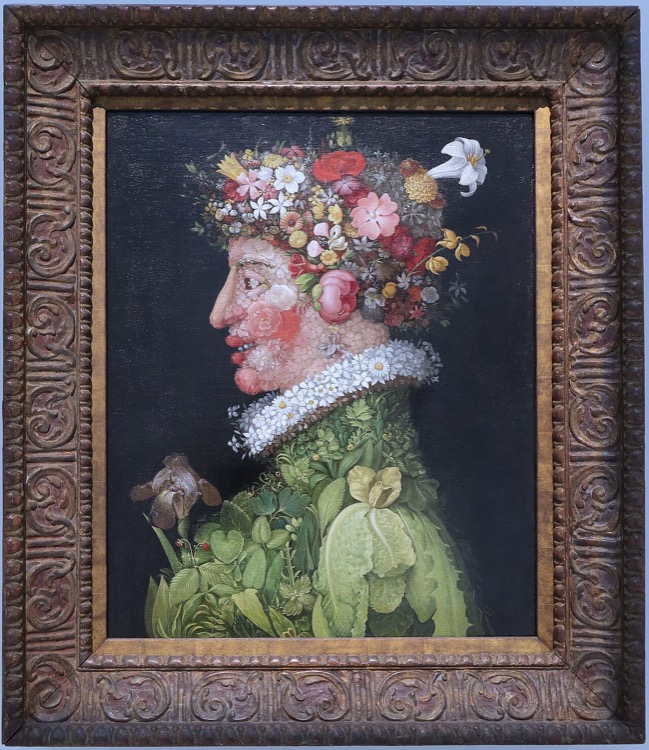
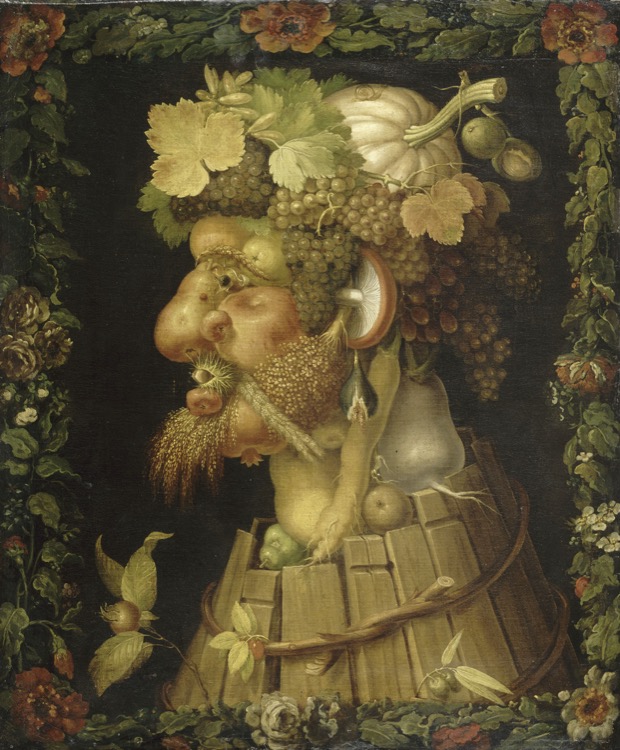
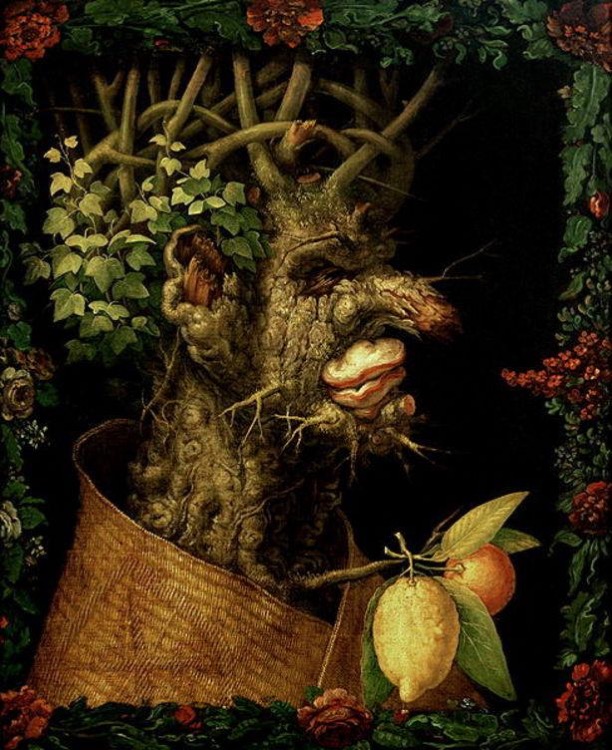
Arcimboldo's signature invention is the testa composta, or composite head: a portrait or allegorical bust built entirely from an assembly of recognizable objects—fruit, vegetables, flowers, fish, shells, birds, books, and tools—arranged with such anatomical precision that a pear becomes a chin, a cauliflower a temple, an open book a torso, and a chestnut burr a beard. Each element is painted with the sober, near-scientific naturalism of a botanical illustration, yet the sum produces an uncanny human face that seems to blink, smile, or scowl back at the viewer.
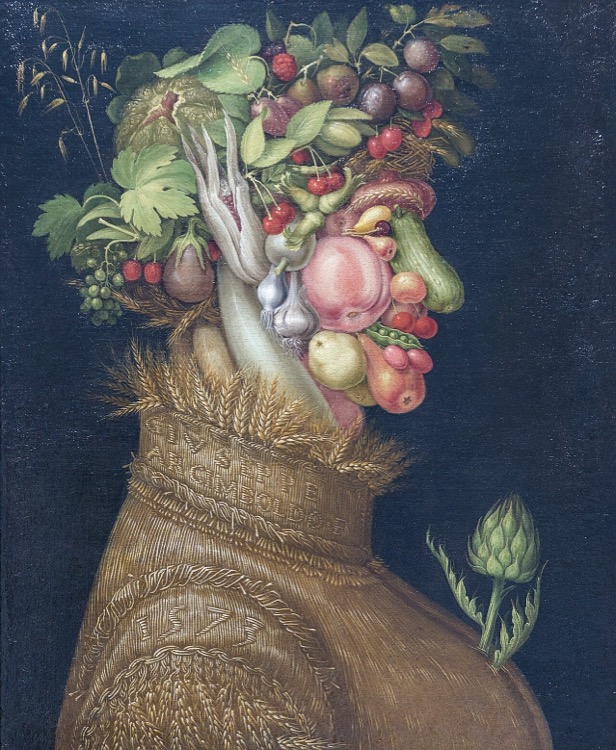
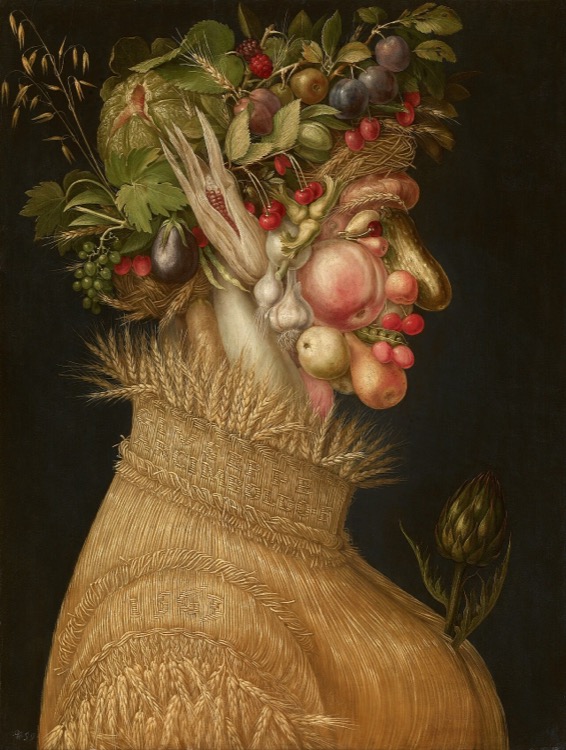
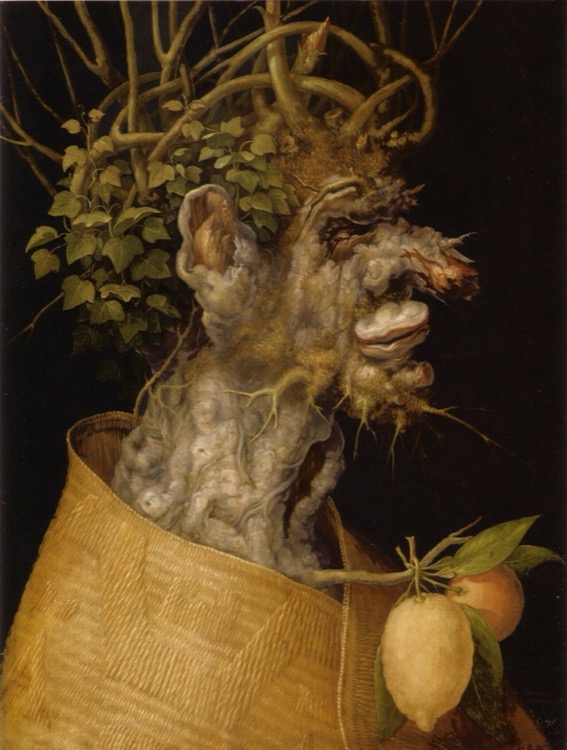
His most celebrated cycles, the Seasons and the Elements, use this device allegorically: Summer is a golden, sunburnt profile woven from wheat, cherries, and squash; Winter a gnarled tree stump sprouting a few stubborn citrus fruits; Water bristles with pearls, coral, and dozens of fish species; Fire glows with candles, flint, and cannon parts. Painted as complementary pairs and gifted to Habsburg allies, they doubled as diplomatic tokens and learned puzzles, flattering the dynasty by implying its rule harmonized the natural world's cycles and substances.
These pictures were never solemn allegory alone—they were court entertainment, designed to provoke delighted recognition at Maximilian II's and Rudolf II's eccentric, curiosity-obsessed courts, alongside cabinets of wonders and alchemical experiments. Arcimboldo also staged tournaments, designed costumes and hydraulic machines, and dabbled in color theory, and this taste for spectacle bleeds into the paintings' theatrical inventiveness. His late masterpiece Vertumnus, portraying Rudolf II as the shape-shifting god of the seasons built from fruit and flowers, pushed the joke into flattery of an emperor's power over nature, while retaining enough ambiguity—praise or gentle mockery?—to keep viewers guessing for centuries.
Life and legacy
Giuseppe Arcimboldo was born in Milan around 1526, the son of Biagio Arcimboldo, a painter attached to the workshop of Milan Cathedral. Trained in that milieu, the young Arcimboldo worked in thoroughly conventional fashion for two decades: he designed stained-glass windows for the Duomo, painted frescoes, and produced tapestry cartoons for Como Cathedral, including a design of the Nativity and a monumental Genealogical Tree of the Habsburgs that likely caught the dynasty's attention.
The turning point arrived in 1562, when Emperor Ferdinand I summoned Arcimboldo to the Habsburg court in Vienna, beginning a career of more than a quarter-century in imperial service. He continued under Ferdinand's son Maximilian II and, from 1576, under Maximilian's son Rudolf II, who moved the imperial seat to Prague and turned it into Europe's most eccentric center of art, science, and curiosity-collecting. There, amid cabinets of naturalia, alchemists, and astronomers, Arcimboldo thrived: beyond conventional court portraits, he devised the composite-head paintings—the Seasons and Elements cycles—that made his name, while also working as a costume and pageant designer, festival engineer, and hydraulic-fountain builder for the Habsburgs' famously theatrical court life. He even wrote on color-sound theories, reflecting the same restless, encyclopedic curiosity that drove Rudolf's court.
In 1587 Arcimboldo, now aging, requested and received permission to retire to Milan. He remained in the emperor's favor from afar: in 1591 he sent Rudolf II Vertumnus, a composite portrait of the emperor as the Roman god of transformation and seasons, assembled from fruit, flowers, and vegetables.
For roughly three centuries afterward, Arcimboldo was all but erased from serious art history, remembered—if at all—as a maker of amusing curiosities unworthy of the Old Masters' canon, his paintings scattered, misattributed, or forgotten in aristocratic storerooms. His rehabilitation began only in the early twentieth century, when Surrealist and proto-Surrealist artists and critics recognized in his uncanny double images a kindred spirit: Alfred Barr included his work in MoMA's landmark 1936 exhibition Fantastic Art, Dada, Surrealism, and Salvador Dalí openly admired his optical games. That rediscovery reframed Arcimboldo from a Mannerist oddity into a visionary precursor of modern ideas about perception, metamorphosis, and the instability of the image—securing the reputation he now holds as one of the most inventive and closely studied painters of the late Renaissance.
Five famous paintings
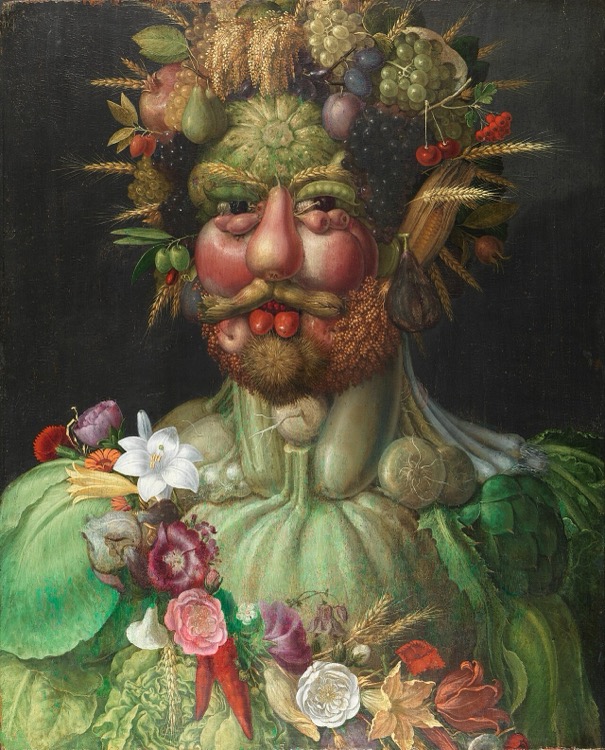
Vertumnus (Rudolf II as Vertumnus) 1591
Arcimboldo's late masterpiece portrays Emperor Rudolf II as Vertumnus, the Roman god of seasons and transformation, his face built entirely from a lush harvest of fruit, vegetables, and flowers—cherries for lips, a pea pod for an eyelid, a squash for a cheek, corn-husk hair crowned with grapes and wheat. Sent to Prague in 1591 as a gift, it flattered the emperor by suggesting his rule brought nature into golden-age harmony. Yet its affectionate absurdity—an emperor made of vegetables—carries a wink of Mannerist irony, leaving open whether this is homage or jest, a tension that still makes Vertumnus Arcimboldo's most celebrated work.
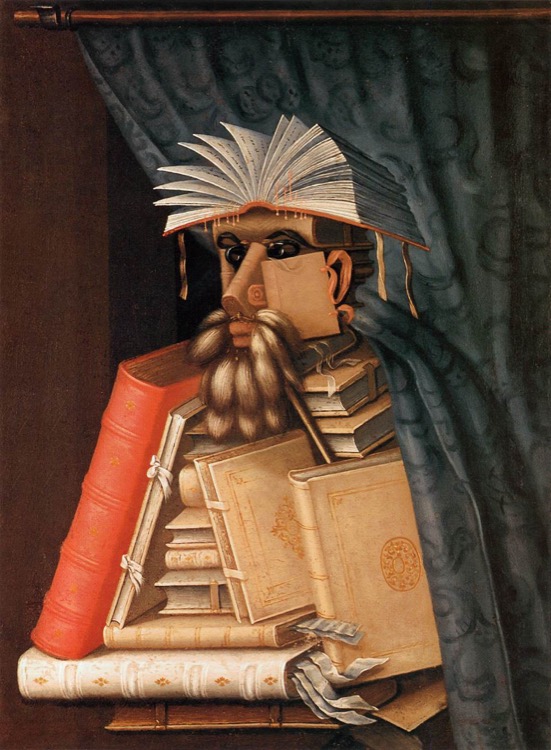
The Librarian 1566
Among Arcimboldo's wittiest inventions, The Librarian assembles a seated scholar entirely from the tools of his trade: a torso of stacked, fanned-open books, a beard of dangling bookmarks, a nose formed from a key, and a coat made from a feather duster standing in for fur. Long read as an affectionate portrait of an imperial librarian—possibly Wolfgang Lazius—or a satire of pedantic bibliophiles who collect books without truly reading them, the painting turns scholarly clutter into comic anatomy. Its dry humor and clever material puns exemplify how Arcimboldo built entire professions, not just seasons, from everyday objects.
Summer (1563) 1563
Painted for Maximilian II as part of Arcimboldo's first great Seasons cycle, this Summer presents a sunburnt profile built from the fruits of high harvest: a peach cheek, a cucumber nose, a corn-cob ear, and a collar of woven wheat sheaves bearing his signature and the date, worked into the fabric like a courtly seal. Every specimen is rendered with crisp, near-scientific botanical accuracy, yet together they snap into a proud, faintly smiling face radiating the season's abundance. Paired originally with Winter as a Habsburg gift, this panel remains the most reproduced of Arcimboldo's seasonal inventions.
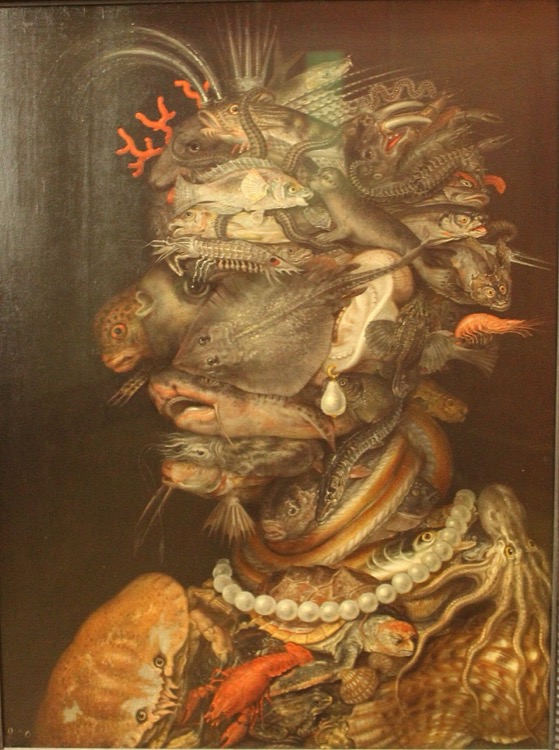
Water 1566
Part of the Four Elements series Arcimboldo painted as a companion set to the Seasons, Water conjures a bejeweled, faintly comic bust entirely from creatures of the sea: a turtle-shell shoulder, an eel curling as a mouth, a ray for a cheek, and a glittering crown built from pearls, coral, and a coiled octopus. The sheer zoological density—dozens of accurately observed fish and shellfish species crammed edge to edge—turns the panel into both a portrait and an inventory of a curiosity cabinet's marine wonders. Gifted alongside Fire, Water flaunted Arcimboldo's naturalist eye and the Habsburgs' claimed dominion over creation.
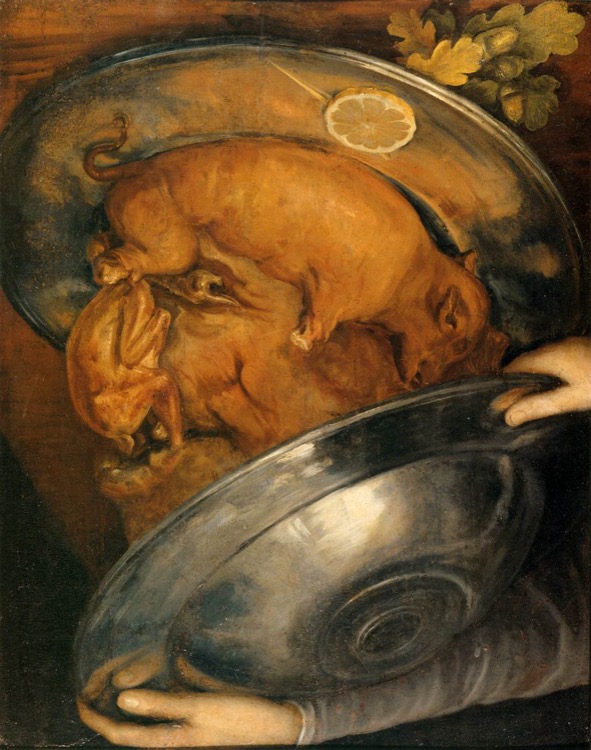
The Cook 1570
One of Arcimboldo's sly reversible pictures, The Cook shows a still life of roasted meat, a suckling pig, and poultry heaped on a platter—until the panel is flipped upside down, at which point it resolves into a grinning, red-faced cook wearing the platter as a helmet. Rooted in a long tradition of comic reversible imagery, the painting adds slapstick humor to Arcimboldo's usual visual wit, suggesting the cook's face is quite literally made of his own cooking. Likely intended for private amusement at court rather than public display, it reveals a playful, cartoonish side to an artist chiefly remembered for solemn allegory.