Tintoretto
Venice's tireless dynamo, who shattered Renaissance calm with plunging perspective and breathtaking speed.
Style and technique
Tintoretto painted as if racing the clock, and by long-standing Venetian legend he sometimes finished in a day what other masters spent a week merely priming. His guiding ambition, summed up in a motto attributed to him — to unite 'the drawing of Michelangelo with the colour of Titian' — pushed his art toward movement rather than repose. Where the earlier Venetian Renaissance favored calm, frontal, harmoniously balanced compositions, Tintoretto sent his figures hurtling along steep diagonals, tumbling through space in violent foreshortening, and colliding with the picture plane from impossible angles, so that a saint might plunge headfirst out of the sky or an apostle's arm thrust straight toward the viewer's face. He treated the canvas as a stage rather than a window, engineering multiple, often unnaturalistic light sources — a lamp, a halo, a sudden shaft from an unseen window — that rake across bodies and gouge deep, theatrical shadows, heightening drama rather than describing ordinary daylight.
Tintoretto worked directly on darkened, toned grounds, slashing in highlights of white and ochre with loaded, visible brushstrokes that can look almost unfinished up close yet resolve, from a distance, into flickering, electric light. A large family workshop helped him meet a staggering volume of commissions, but the boldest passages — a hand catching torchlight, drapery whipped by unseen wind — remain unmistakably his own rapid hand at work. He was equally audacious in scale and ambition, chasing and often winning Venice's largest, most prestigious jobs by underbidding rivals or, famously, by installing a finished painting where only a sketch had been requested. That hunger for scale led him to cover entire walls and ceilings with sprawling narrative cycles across decades, and to paint canvases of genuinely enormous size, among the largest ever produced.
Life and legacy
Jacopo Robusti was born in Venice around 1518, one of many children of a cloth dyer — a tintore — whose trade gave the boy a nickname that outlasted his real name entirely: Il Tintoretto, 'the little dyer.' Venetian tradition, recorded decades later by the biographer Carlo Ridolfi, holds that young Jacopo was briefly sent to study in Titian's workshop but was dismissed within days, allegedly because the older master recognized a dangerous rival in the boy's precocious talent and wanted no competition under his own roof. Modern scholars doubt the anecdote's details, but it captures something true about Tintoretto's whole career: however it began, his relationship with the aging, internationally celebrated Titian remained one of wary distance rather than friendship, and Tintoretto seems to have taught himself largely by drawing obsessively from plaster casts of Michelangelo's sculptures and by his own bold experiments with perspective and lamplight.
Unlike Titian, who worked for popes, emperors, and kings across Europe, Tintoretto spent virtually his entire career in Venice, rarely if ever leaving the city, and built his reputation instead through sheer productivity and audacity in winning local commissions. He announced himself in 1548 with The Miracle of the Slave, a sensationally dynamic altarpiece that shocked and thrilled Venetian audiences and set him on a collision course with Paolo Veronese, the era's other dominant Venetian painter; the two competed for decades over the city's most prestigious jobs, their rivalry becoming one of the defining dynamics of late-sixteenth-century Venetian art. Tintoretto's greatest coup came in the 1560s, when the confraternity of the Scuola Grande di San Rocco held a competition for a ceiling painting and Tintoretto, rather than submitting a sketch like his rivals, secretly installed a completed canvas in place and then donated it outright, a maneuver within the letter of the scuola's rules that outflanked his competitors entirely.
Tintoretto ran a large family workshop, and his daughter Marietta Robusti, trained by him from childhood and, according to tradition, sometimes dressed as a boy to accompany him on portrait commissions, became a gifted painter in her own right before her early death in 1590; his sons Domenico and Marco also worked at his side, helping the aging master complete his final, enormous commissions.
Five famous paintings
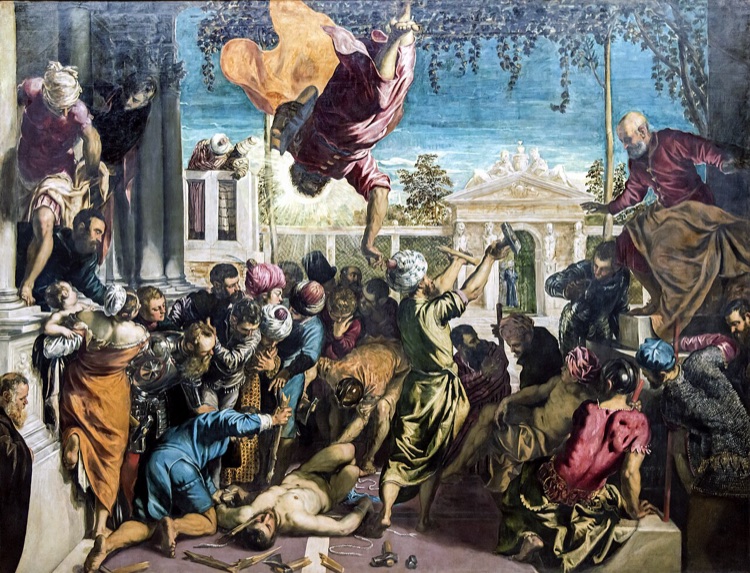
The Miracle of the Slave 1548
Tintoretto announced himself to Venice with this sensational altarpiece, showing Saint Mark plunging headlong from the sky to save a Christian slave from torture for venerating his relics. The saint hurtles down in violent foreshortening, robes whipping, as the astonished crowd below recoils in a swirl of twisting limbs; broken instruments of torture litter the ground, proof the miracle is already accomplished. Contemporaries were stunned by its audacity and speed of execution. Now in Venice's Gallerie dell'Accademia, it made the young painter's reputation overnight and set the explosive tone for the rest of his career.
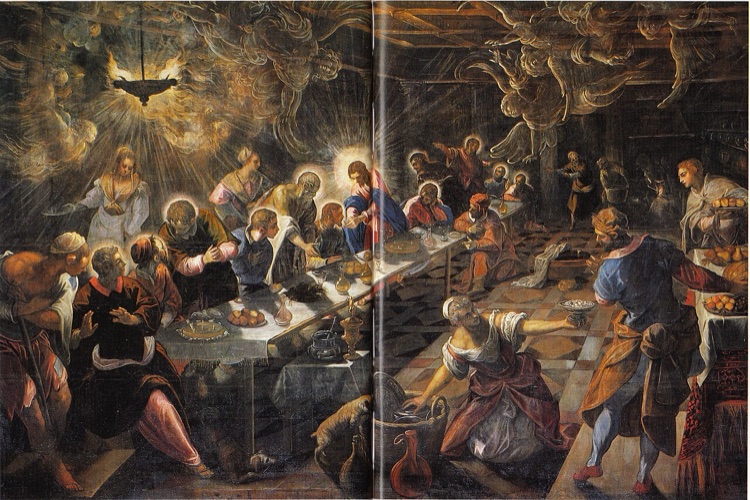
The Last Supper 1592-1594
Painted in his final years for the church of San Giorgio Maggiore, this Last Supper abandons the calm, frontal banquet scenes earlier Renaissance painters favored. Tintoretto sets the table on a steep diagonal receding into smoky darkness, crowds the room with bustling servants, and fills the air above the apostles with translucent, blazing angels barely distinguishable from an oil lamp's smoke. Christ, small and off-center, distributes bread amid the commotion rather than presiding over frozen ceremony. Utterly unlike Leonardo's serene, symmetrical version, the painting's restless light marks one of the great late statements of Venetian art.
Susanna and the Elders c. 1555-1556
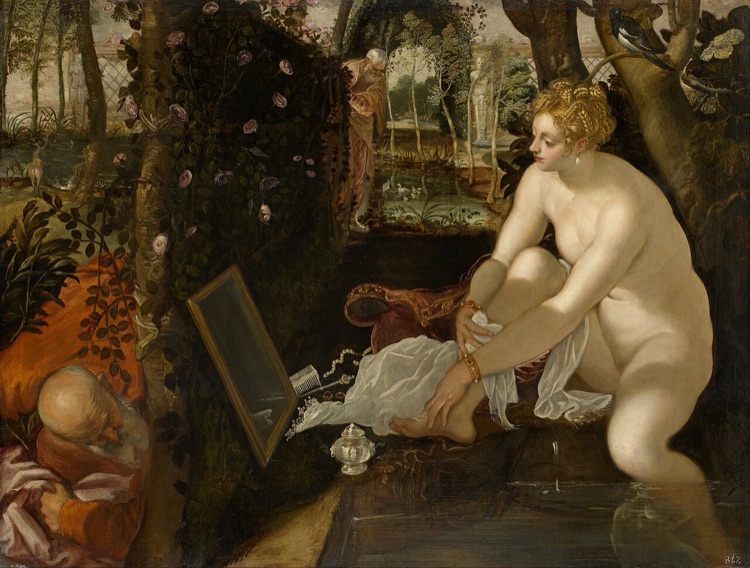
In a lush garden enclosed by a rose trellis, a nude Susanna leans toward her own reflection in a mirror propped among jars of oil, unaware that two elders spy on her from behind a hedge and a low stone wall. Tintoretto builds the scene around a tension between innocence and surveillance, using the mirror, a pearl necklace, and dappled golden light across her skin to draw the eye toward the hidden threat at the picture's edge. The subject, a popular vehicle for the female nude, becomes here as much psychological suspense as sensuous painting. Now in Vienna's Kunsthistorisches Museum, it ranks among the finest nudes of the Venetian Renaissance.
The Origin of the Milky Way c. 1575
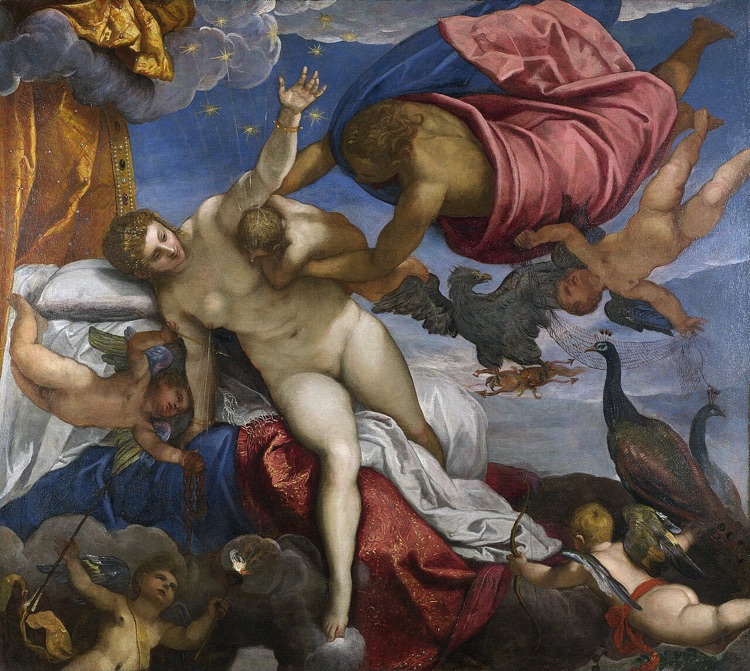
A sudden cosmic drama unfolds as the sleeping Jupiter secretly holds the infant Hercules to the breast of his wife Juno, hoping a goddess's milk will grant the child immortality; Juno wakes with a start, and her spray of milk arcs across the heavens to form the Milky Way, while falling droplets blossom into lilies below. Tintoretto arranges the scene as a swirling wheel of bodies, drapery, and startled peacocks around Juno's arm, Jupiter's eagle tangled among them, so the canvas seems to spin on its own axis. Surviving only in part, now in London's National Gallery, it remains one of the era's most inventive mythological paintings.
Paradise c. 1588-1592
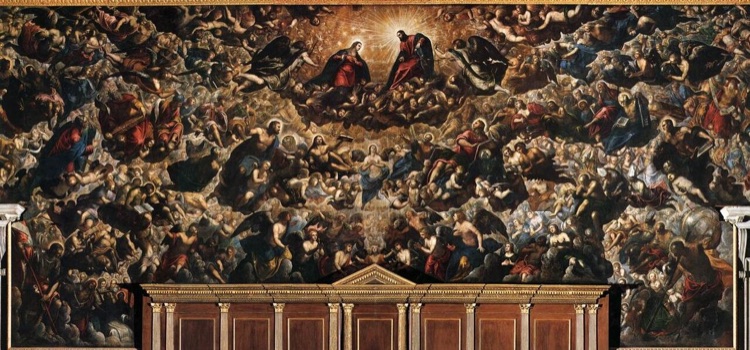
Commissioned to fill the end wall of the Sala del Maggior Consiglio in the Doge's Palace, where Venice's Great Council convened, this staggering canvas, among the largest ever painted, crowds several hundred figures into a swirling vision of paradise centered on Christ crowning the Virgin amid saints and angels rising in luminous tiers. Tintoretto, in his seventies, designed the composition and oversaw its execution with his son Domenico and a large workshop, orchestrating the immense cast into rippling waves of movement rather than static rows. It stood as the culminating statement of decades of work for the Venetian state.