Gustave Doré
The 19th century's most prolific illustrator, desperate to be remembered instead as a serious painter.
Style and technique
Gustave Doré is one of the most reproduced artists in history, yet almost none of that fame comes from paint. He was the most prolific book illustrator of the nineteenth century, turning out thousands of wood engravings for Dante's Inferno, the Bible, Don Quixote and Coleridge's The Rime of the Ancient Mariner — sharp black-and-white worlds of crowds, monsters and cathedral-sized skies that shaped how generations pictured hell, heaven and even Victorian London. This site sets those famous engravings aside. It profiles the rarer, less known side of Doré: the oil painter he spent his adult life fighting to be recognized as.
His painted style borrows the theatrical instincts of the engravings — vast crowds, plunging diagonals, a taste for the sublime and the terrible — but translates them into thick, painterly brushwork and a dark, smoldering palette closer to Eugène Delacroix than to any printmaker. Where the engravings work in pure line and contrast, the oils build atmosphere from layered glazes and murky shadow, chasing Romantic history painting rather than the crispness of a printed page.
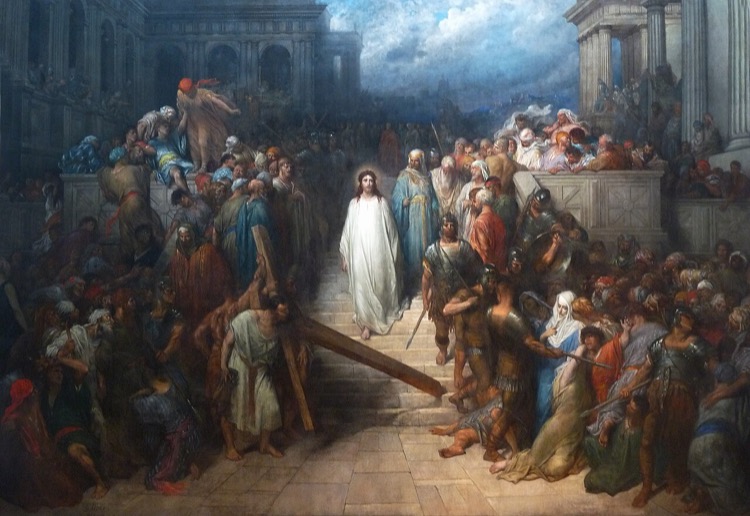
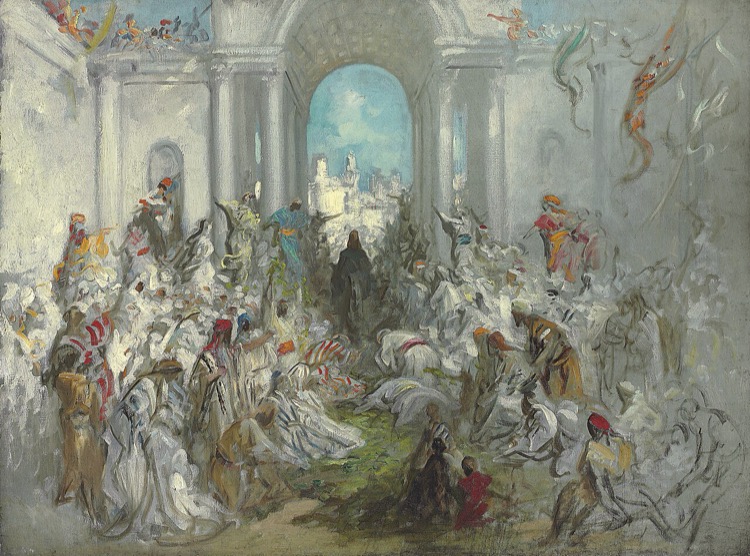
Three subjects dominate his canvases. Religious epics — Christ condemned, entering Jerusalem — painted at overwhelming scale, dense with anonymous crowds around a single illuminated figure. Mythological and literary drama, like a chained Andromeda awaiting her monster, or Dante's doomed lovers swept through hell's whirlwind, subjects he had often already made famous in engraved form and now revisited in color. And, after his travels through Scotland, brooding, mist-choked landscapes of lochs and highland peaks, painted in the grand sublime tradition rather than as illustration.
Paris never fully granted him that wish; critics kept treating his oils as an illustrator's expensive hobby. So Doré built his own stage: a gallery in London, opened in 1868, hung floor to ceiling with his largest religious canvases, where paying crowds — if not the critics — could judge for themselves.
Life and legacy
Paul Gustave Doré was born in Strasbourg on 6 January 1832, the son of a civil engineer, and was drawing obsessively almost before he could write. By eleven he had produced his own illustrated book; at fifteen, newly arrived in Paris, he walked into the offices of publisher Charles Philipon and talked his way into a contract for the satirical paper Le Journal pour rire. His family soon moved to Paris so the teenager could keep working. He never attended formal art school.
What followed was one of the most productive careers in publishing history. Doré illustrated Rabelais, Balzac, and Cervantes' Don Quixote; his 1861 edition of Dante's Inferno made him internationally famous overnight, its cavernous, monster-choked hellscapes becoming the definitive visual Dante for over a century. He followed it with an illustrated Bible, Milton's Paradise Lost, Coleridge's Rime of the Ancient Mariner, and, in 1872, London: A Pilgrimage, a survey of the city's slums made with journalist Blanchard Jerrold. He sketched directly onto woodblocks for teams of engravers to cut, and grew wealthy almost beyond precedent for an illustrator.
French critics would not oblige him. To the Paris Salon establishment, he remained "the engraver" playing dress-up as a history painter, and his enormous religious and mythological canvases were reviewed, when reviewed at all, with condescension. Doré responded by building his own audience. In 1867 he helped found a gallery in London's Bond Street, a permanent exhibition space where his largest oils hung floor to ceiling for a paying public that, unlike the Salon jury, came in droves.
His most ambitious painting by far was Christ Leaving the Praetorium, a monumental canvas he worked on for years, crowding an enormous cast of soldiers, priests, mockers and mourners around a single serene figure of the condemned Christ. Unveiled in 1872, it drew immense crowds in Paris and London alike, even as critics kept questioning whether its maker had any business calling himself a painter. Alongside it he produced biblical scenes like The Neophyte, mythological subjects such as Andromeda, and, after journeys through Scotland with Jerrold, brooding Highland landscapes of lochs and mist-wrapped peaks.
Doré never married and lived his whole life with his adored mother, Alexandrine, in Paris; her death in 1881 broke him. He kept working, exhausted and increasingly ill, until he collapsed and died of heart disease in Paris on 23 January 1883, aged fifty-one. His engravings stayed in print for generations; his paintings, the recognition he wanted most, were largely forgotten until museums began reclaiming them a century later.
Five famous paintings
Christ Leaving the Praetorium 1872
Doré's single most ambitious painting, a monumental canvas he labored over for years as his answer to critics who dismissed him as a mere engraver. Christ, condemned and calm, moves through a vast, churning crowd of Roman soldiers, priests and mourners that fills nearly every inch of the canvas, his illuminated figure the one still point in the surrounding chaos. Unveiled in 1872, it drew astonished public crowds in both Paris and London, proof that ordinary viewers, whatever the Salon jury thought of him, still recognized real scale and ambition when they saw it in front of them.
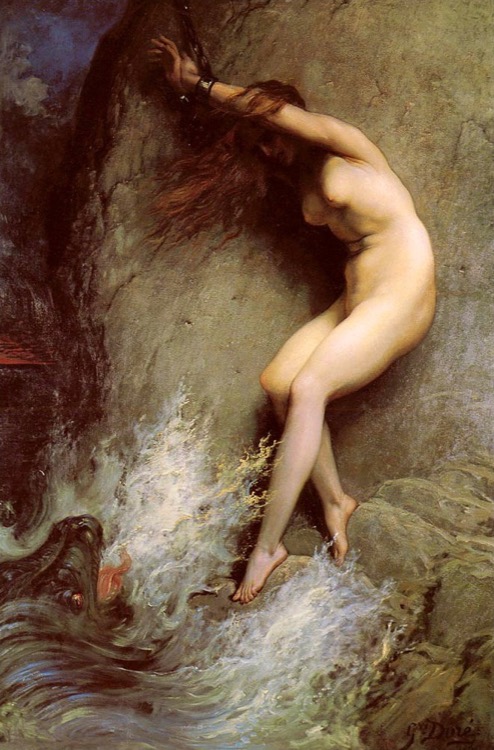
Andromeda 1869
Andromeda, the mythological princess chained to a sea rock as punishment for her mother's vanity, waits for the monster that will devour her unless Perseus arrives in time. Doré paints her pale, twisting body isolated against a churning, storm-lit sea, the kind of tempestuous sky and violent water he had spent years rendering in engraved shipwrecks and sea monsters. It is one of his rare ventures into the academic nude, a genre other Salon painters built careers on but that Doré, absorbed in religious epics and book work, almost never touched. The drama here comes from weather and darkness as much as from the exposed figure herself.
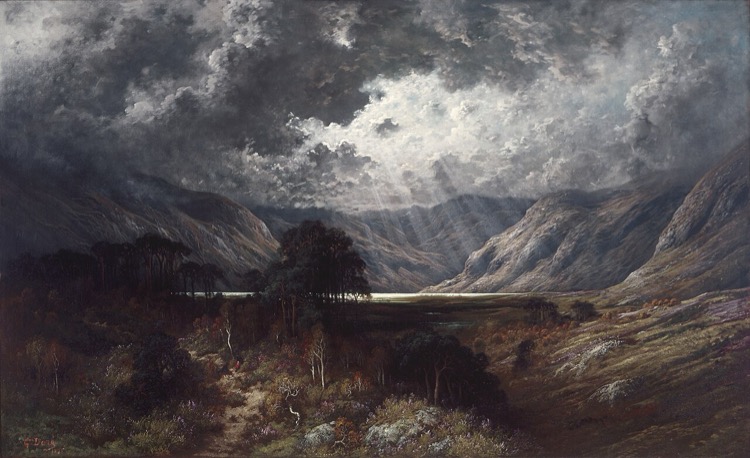
Loch Lomond 1875
After touring Scotland with journalist Blanchard Jerrold, Doré returned with a series of Highland landscapes, and this brooding view across Loch Lomond is among the finest. Layered mountains recede into mist and cloud, softening the further they sit from the viewer, while the loch's still, dark water mirrors the dim sky above almost without a ripple. There is no crowd here, no biblical drama, no illustration to serve — only weather, distance and scale, handled with the same appetite for the sublime that shaped his engraved storms, but now given a painter's color instead of a printmaker's line, in one of his quietest and least theatrical works.
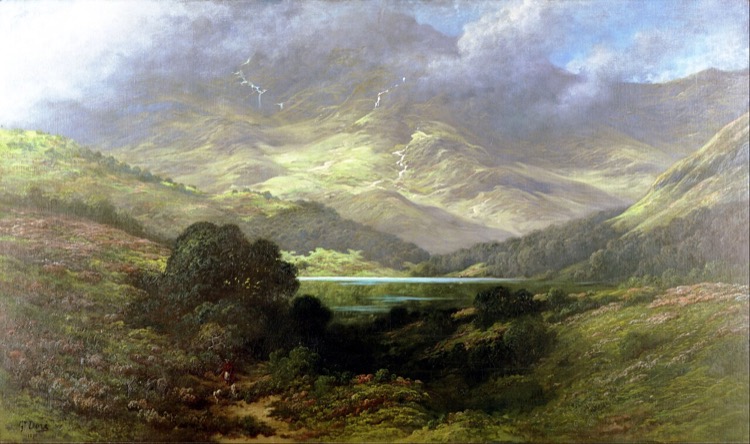
Scottish Highlands 1875
A companion to Doré's other Highland views, this sweeping panorama trades human incident entirely for the raw scale of the landscape itself: rugged peaks and rocky slopes recede into a hazy, cloud-streaked distance, the wild terrain dwarfing any trace of a human presence. Painted from sketches made during his Scottish travels with Blanchard Jerrold, it shows Doré working closer to the sublime tradition of Salvator Rosa than to his own famous engravings, favoring loose, atmospheric brushwork over fine printed line, proof that his ambitions reached well beyond the biblical epics for which he remains best known today.
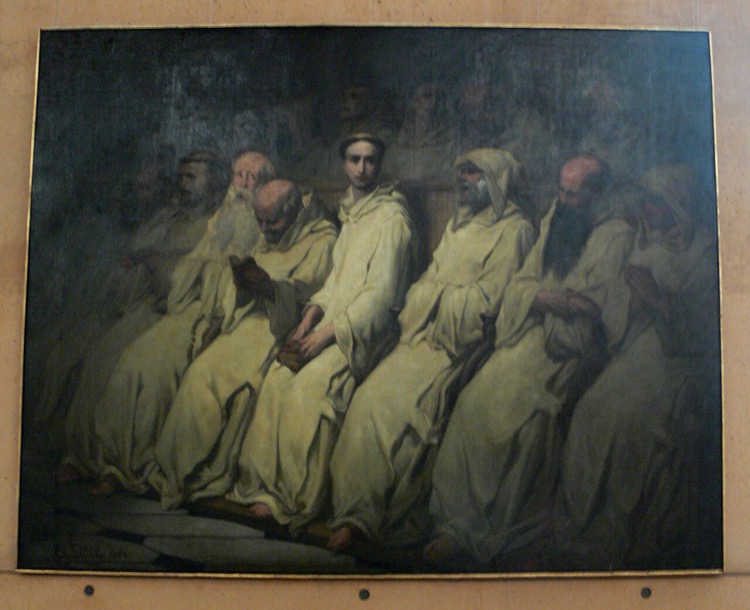
The Neophyte (First Experience of the Monastery) 1868
A young novice sits stiffly in the choir stalls of a dim monastery chapel, flanked by older monks in heavy dark robes, and his uncertain, anxious face stands out immediately from theirs. Doré gives each elder a distinct expression — one lost in genuine devotion, one dozing, one wearing something closer to sly complacency — turning a quiet scene of communal prayer into a subtle study of doubt and vocation. Painted the same year he opened his own gallery in London, it shows his painterly ambitions were not limited to spectacle, working instead at an intimate, psychological scale rare among his crowded religious epics.