Giotto
He gave painting weight and grief a century early — the shepherd boy who became its first modern master.
Style and technique
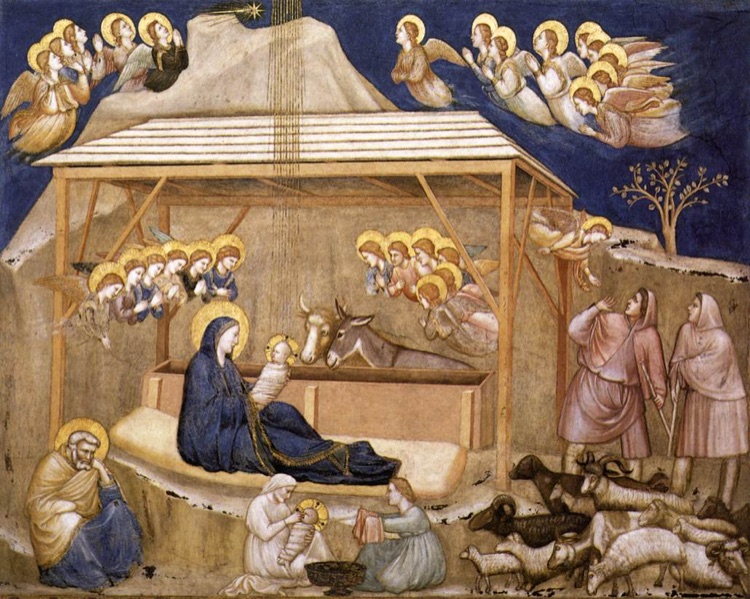
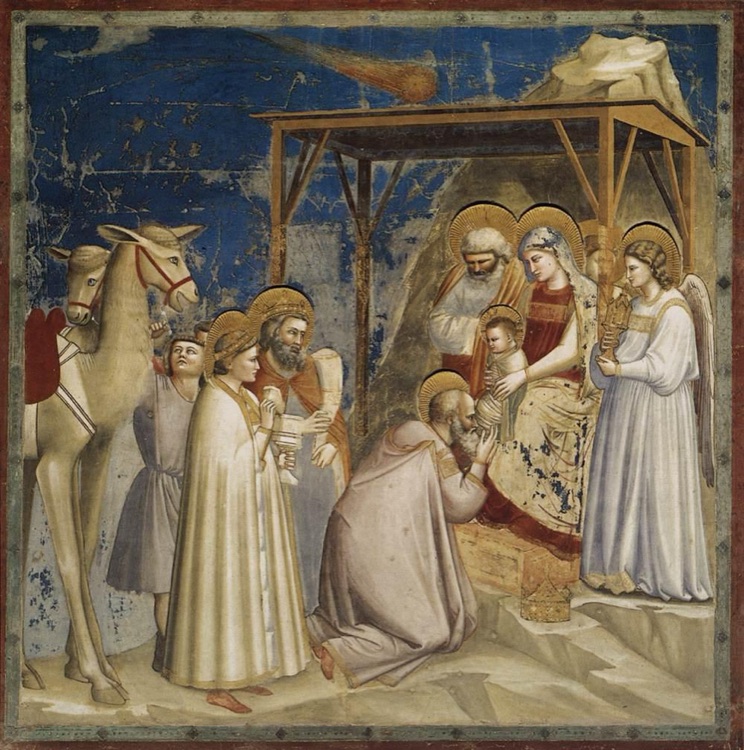
Giotto's great subject is weight. Before him, Italian painting spoke the maniera greca — the Byzantine-derived manner of Cimabue and Duccio, in which saints hovered against flat gold grounds, bodies stacked in schematic drapery that carried no sense of flesh underneath. Giotto broke that spell. His figures stand the way real bodies stand: knees push forward through fabric, shoulders carry the weariness of a long walk, a mourner's back curves under the actual pull of grief. Contemporaries said it plainly — the writer Cennino Cennini claimed Giotto had "translated the art of painting from Greek into Latin," meaning he replaced an inherited symbolic code with something that looked like observed life.
Three things make that translation visible.
Solid, sculptural bodies. Giotto models form with light and shadow rather than outline, so drapery falls over a believable body instead of floating in front of an implied one.
Believable pictorial space. Rocky hillsides recede at a plausible angle, buildings work as convincing stage-sets rather than flat symbols, and figures sit at different depths instead of lining up along the picture plane.
Emotional truth. This is his deepest innovation. Christ, mourners, saints register specific, legible feeling — a clenched jaw, a flung-back arm, an angel visibly shrieking in the sky — at a time when painted faces mostly held one fixed, iconic expression regardless of the story around them.
All of this had to be achieved fast. Giotto worked in true fresco (buon fresco), pigment bound into wet plaster that set within hours. Walls were planned ahead and divided into patches called giornate — "day's works" — each finished before the plaster dried; the seams are still visible up close in the Scrovegni Chapel. That discipline forced compositional clarity: every gesture had to read instantly.
Giotto's solidity and psychological directness are the foundation Masaccio, and eventually the whole Florentine Renaissance, built on. He is not himself a Renaissance painter — he died more than a century before Botticelli was born — but he is the reason a Renaissance was thinkable at all.
Life and legacy
The most famous story about Giotto di Bondone is probably not true, but it is worth telling because it captures something real. Giorgio Vasari, writing two centuries later, claims the painter Cimabue was riding through the countryside near Vespignano, north of Florence, when he came across a shepherd boy scratching a perfectly lifelike drawing of one of his sheep onto a flat rock with a pointed stone. Astonished, Cimabue asked the boy's father for permission to take him to Florence as an apprentice. That boy, the legend says, was Giotto. Modern scholars treat the anecdote as apocryphal — a tidy origin myth Vasari inherited from earlier writers like Ghiberti and Boccaccio and polished for effect — but it endures because it captures a truth everyone agreed on: Giotto's talent looked less like training and more like a natural force that had simply been waiting to be noticed.
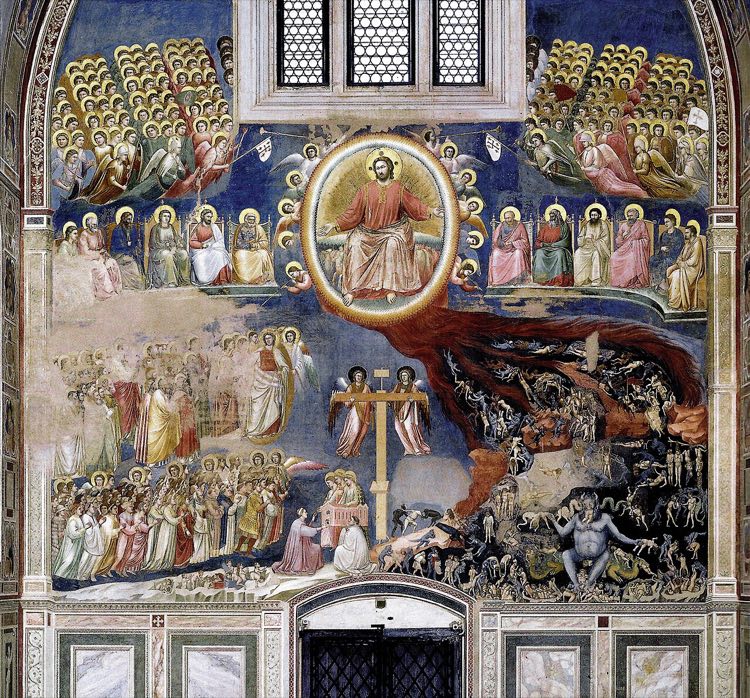
What is documented is that Giotto di Bondone was born around 1267, probably in the Florentine countryside, and that he did pass through Cimabue's orbit before establishing an independent reputation by his thirties. His career took him well beyond Florence. In Assisi, the upper church of San Francesco houses a monumental fresco cycle on the Legend of Saint Francis traditionally attributed to Giotto and his workshop, though the attribution has been debated by scholars for over a century. In Padua in 1303, the banker Enrico Scrovegni hired him to fresco an entire private chapel — built, in part, to atone for the usury of Enrico's father Reginaldo, whom Dante had already condemned to Hell for the same sin. The result, the Scrovegni Chapel, completed around 1305, is Giotto's masterpiece: floor to ceiling, it tells the lives of Mary and Christ in some forty scenes of unprecedented emotional and spatial force.
Back in Florence, Giotto frescoed the Bardi and Peruzzi chapels in Santa Croce with further scenes from the lives of Saint Francis and Saint John, and painted the towering Ognissanti Madonna around 1310 for the church of Ognissanti.
His fame reached poetry itself. Dante, a contemporary and reportedly a friend, paused the Purgatorio to note that Cimabue once thought he led the field of painting, "and now Giotto has the cry, so that the other's fame is dimmed" — a startling tribute to a living artist inserted into an epic about the afterlife. Boccaccio later wrote that Giotto had brought back to light an art that had lain buried for centuries.
In 1334, Florence appointed him chief architect of the cathedral, and he designed its campanile, still known as Giotto's Tower, though he did not live to see it finished. He died in Florence on 8 January 1337, leaving behind a visual vocabulary — weight, space, human feeling — that the next two centuries of Italian painting, from Masaccio to the full Renaissance, would spend refining.
Five famous paintings
The Lamentation of Christ 1305
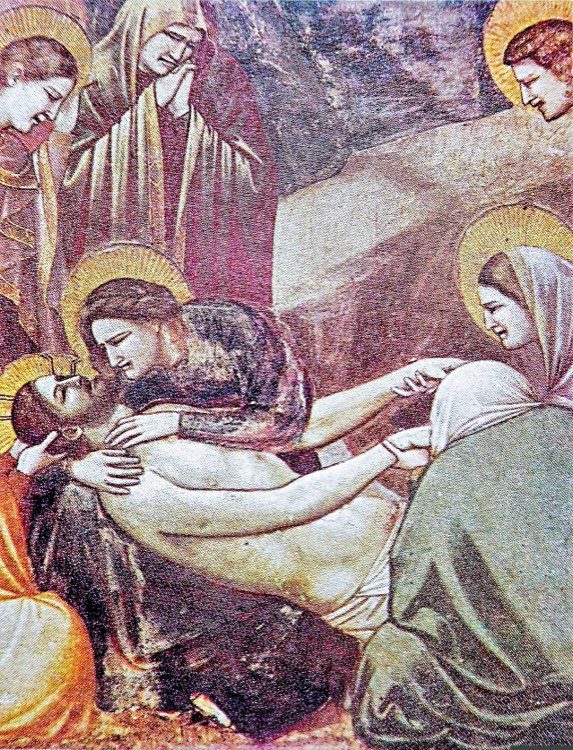
Fresco, Scrovegni Chapel, Padua, part of the cycle Giotto completed around 1303–1305. Christ's body has just been lowered from the cross and lies diagonally across the foreground, his mother cradling his head against her own in a gesture of unbearable, private tenderness. John the Evangelist flings both arms backward; Mary Magdalene holds his feet. A bare rocky ridge slopes down toward the group like a stage direction, while overhead ten grief-stricken angels twist and wail against blank sky, each caught in a different, specific attitude of anguish. It remains one of the most reproduced images in Western art.
The Kiss of Judas 1305
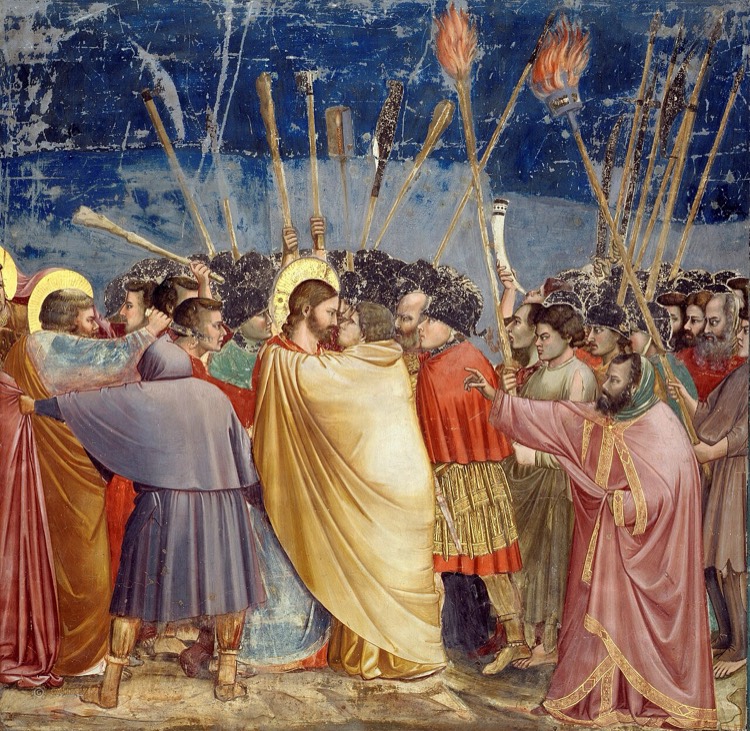
Fresco, Scrovegni Chapel, Padua. Judas envelops Christ inside his own voluminous yellow cloak, pulling their faces close for the betraying kiss — and Giotto stages the whole drama around the locked, unflinching eye contact between the two men, Christ calm and resolute, Judas's face a mask of guilt he cannot hide. Around them the scene erupts into chaos: a forest of spears and torches held by the arresting crowd, shouting mouths, a soldier's face turned mid-shout. In the lower right, Peter draws his knife and slices off the ear of the servant Malchus, a violent aside rendered with total clarity amid the crowd.
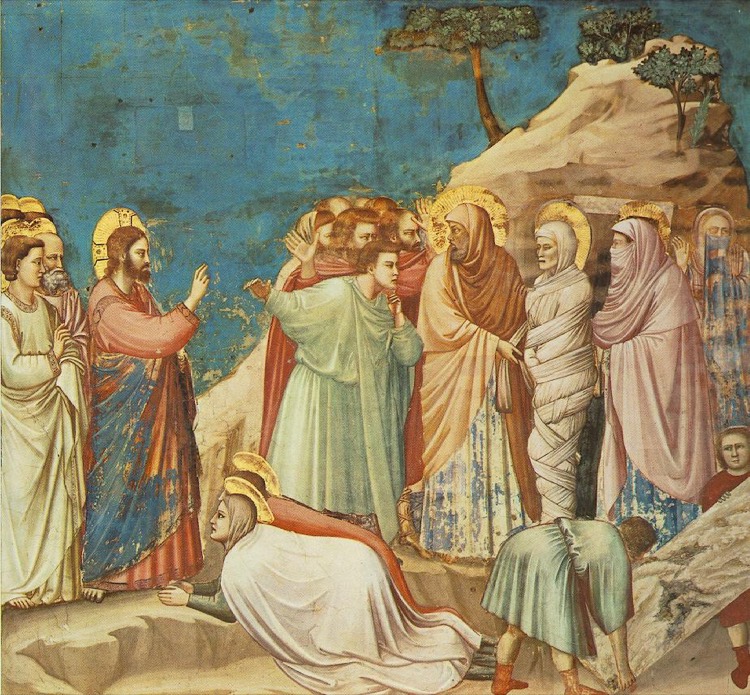
The Raising of Lazarus 1305
Christ stands before the rock-cut tomb of Lazarus, raising his hand in command as two straining men lift away the stone slab. Lazarus himself stands upright at the tomb's mouth, still wrapped head to foot in white burial bands, while his sisters kneel at Christ's feet and a crowd of onlookers reacts with astonishment. One bystander presses a cloth to his nose against the smell of decay — a detail lifted straight from the Gospel text and rendered with blunt physical honesty rather than discreet omission. The crowd's overlapping heads and varied individual reactions turn a miracle into a believable public event with real spectators rather than passive witnesses, exactly the kind of psychologically grounded staging that made Giotto's Scrovegni Chapel frescoes so radical for their time.
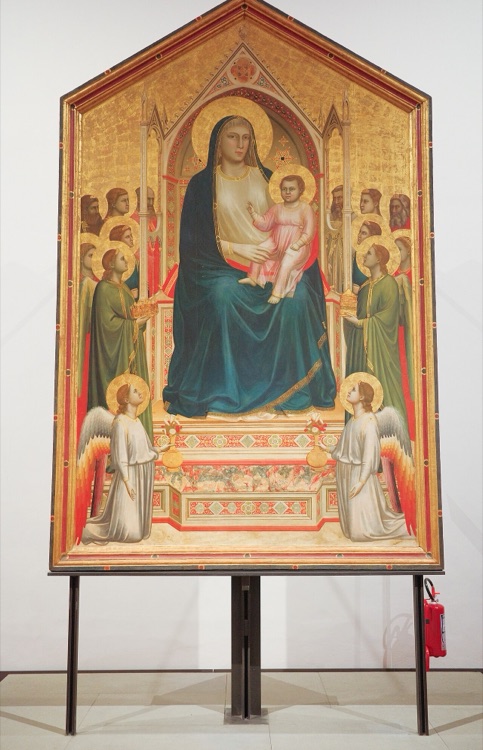
Ognissanti Madonna 1310
Tempera on panel, roughly 3.25 by 2 metres, painted around 1310 for the church of Ognissanti in Florence and now in the Uffizi. The Virgin sits enthroned with the Christ Child on her knee, flanked by angels and saints — a format every Florentine painter attempted, and the Uffizi hangs this panel beside Cimabue's and Duccio's versions of the same subject, inviting comparison. Next to theirs, Giotto's Madonna reads as startlingly physical: her knees push through the drapery, her throne is built from real, receding architecture, and her heavy-lidded face carries the gravity of a real woman rather than a hovering icon.
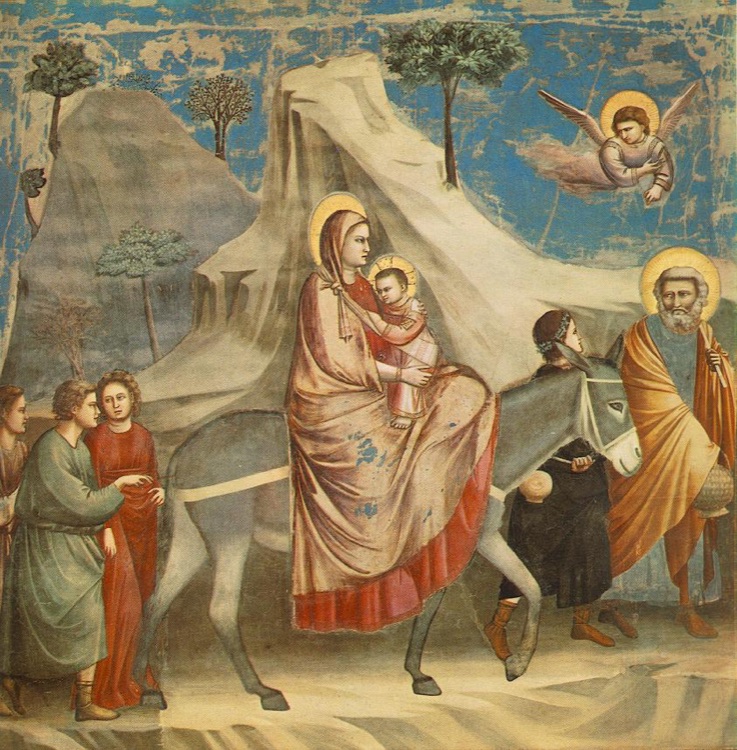
The Flight into Egypt 1305
Fresco, Scrovegni Chapel, Padua. Warned of Herod's massacre, the Holy Family flees toward Egypt across a barren, sharply receding landscape rendered with Giotto's characteristic geological solidity. Mary sits sidesaddle on a plodding donkey, wrapping the infant Christ against the cold, her face set in quiet, determined resolve rather than serene detachment; Joseph strides ahead, glancing back to guide the animal. Behind them a small retinue presses forward, one attendant carrying a bundle on his shoulder, compressing the desperate journey into a single, tightly triangular composition.