Sandro Botticelli
He painted Venus stepping out of the sea — and a Florence so beautiful it has been being copied ever since.
Style and technique
Botticelli is the painter of the line. While the Florentine generation just before him had been obsessed with mathematical perspective and three-dimensional volume, Botticelli pulled the eye back to a flat, decorative surface in which the contour of every body, every veil, every curl of hair is drawn with a long, supple, almost calligraphic line. His Venus does not really stand on her shell — she floats on it, weightless, all silhouette.
This was a deliberate choice. He had been trained in Filippo Lippi's workshop in Florence and absorbed the older master's love of graceful drapery and elegant posture, then pushed that style further than anyone else. By the early 1480s his way of painting was unmistakable: pale, slightly elongated figures, heads tilted gently to one side, expressions melancholy and remote, set against meadows or golden flat backgrounds borrowed from Byzantine and Sienese tradition.
Four fingerprints make a Botticelli unmistakable.
Continuous, flowing line. Trace any contour with your finger — the silhouette of a figure, the edge of a robe, the wave of hair — and you will find a single curve that runs uninterrupted for an extraordinary distance. He drew the outline first, in chalk; the colour came afterwards.
Pale, melancholy faces. His Madonnas, his Venuses, even his portraits of Florentine merchants — all share the same slightly downcast eyes, the same small mouth, the same air of having just remembered something sad.
Decorative flatness. The figures stand in shallow space, often against a flat green meadow or gold background. Perspective is suggested, never aggressive. The picture stays a picture.
Mythology rendered like religion. When he painted Venus, he treated her with the same reverence Florentine painters had been giving to the Virgin Mary for centuries. The mythological scenes are devotional in tone.
He ended his career in religious crisis. After Savonarola's apocalyptic preaching swept Florence in the mid-1490s, Botticelli is said to have burned some of his own pagan paintings on the great Bonfire of the Vanities in 1497. His late style turned darker, more anxious, almost gothic. By the time he died in 1510, his earlier graceful manner was already considered out of date — Leonardo and Michelangelo had moved painting in a different direction. He was not really rediscovered until the Pre-Raphaelites in 19th-century England fell in love with him and made him famous all over again.
Life and legacy
Alessandro di Mariano di Vanni Filipepi was born in Florence around 1444 or 1445. The nickname 'Botticello' — 'little barrel' — was first applied to his older brother Giovanni, a heavy-set wool broker, and stuck to the whole family. Sandro inherited it. He was the youngest of four sons, his father a tanner working out of a shop in the Ognissanti district, the family neither rich nor poor.
He trained first as a goldsmith, briefly, before being apprenticed at fifteen to Filippo Lippi, the great Carmelite friar-painter who had famously eloped with a nun. Lippi taught Botticelli everything he would later use — the translucent veils, the calm Madonnas, the long elegant line. The two were close. When Lippi died in 1469, Botticelli probably finished some of his master's last works.
By 1470 Botticelli had his own workshop in Florence. He was 25.
The Medici — Cosimo, then Piero, then Lorenzo the Magnificent — had been running Florence as a de facto monarchy for forty years through their bank and their political alliances. They were not flashy patrons. They preferred to commission art for their villas and family chapels rather than for huge public commissions. Botticelli, soft-spoken and elegant, fit them perfectly. From the late 1470s through the 1480s he painted dozens of works for the Medici and their inner circle — wedding panels, chapel altarpieces, portraits, and the two huge mythological allegories he is now most famous for: 'Primavera' (around 1482) and 'The Birth of Venus' (around 1485).
Both paintings were probably designed for Lorenzo di Pierfrancesco de' Medici, a younger cousin of Lorenzo the Magnificent, for his country villa at Castello. Both depend on Neoplatonic philosophical ideas circulating in the Medici intellectual circle — Marsilio Ficino's notion of love as a spiritual ascent — wrapped in mythological imagery the patrons would have understood.
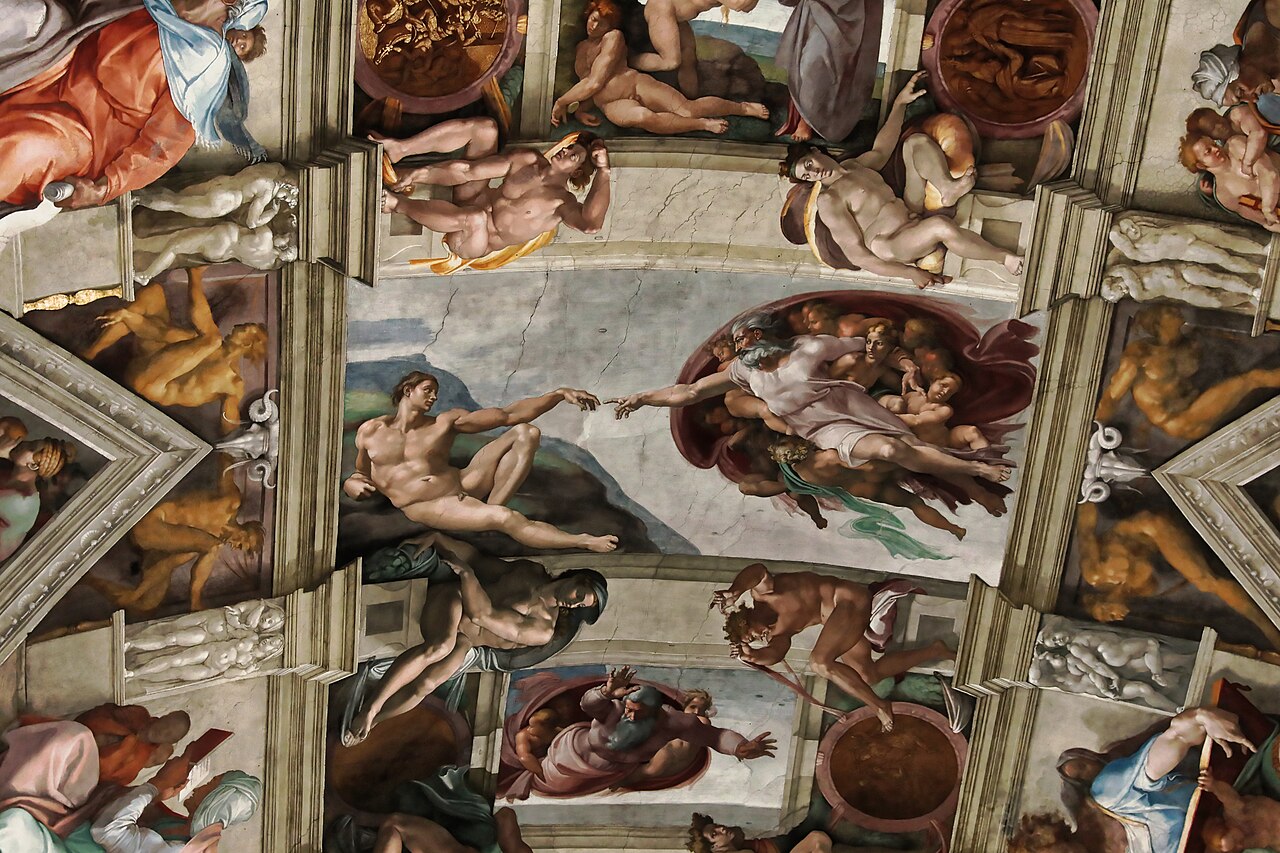
In 1481 Pope Sixtus IV summoned Botticelli to Rome, along with Ghirlandaio and Perugino, to paint frescoes on the side walls of the Sistine Chapel — twenty years before Michelangelo would arrive to paint the ceiling. Botticelli's three frescoes are still there, slightly overshadowed in the conversation by what came after.
The 1490s broke Florence. Lorenzo the Magnificent died in 1492. The French invaded Italy in 1494. The Medici were expelled. Girolamo Savonarola, a Dominican friar, took political and spiritual control of Florence and started preaching apocalyptic sermons against the moral corruption of the Medici, the Catholic Church, and pagan art. In 1497 his followers held the famous Bonfire of the Vanities, burning books, mirrors, jewellery, dresses, and paintings in the central Piazza della Signoria. Vasari claims Botticelli — who had become a fervent Savonarolan — threw some of his own pagan canvases onto the fire. Whether that is exactly true is debated; what is certain is that Botticelli's style changed sharply after 1497. The graceful pagan goddesses disappeared. The late paintings are darker, more frantic, full of crowded religious scenes and apocalyptic visions.
Savonarola was excommunicated, then hanged and burned in 1498. The Medici eventually returned in 1512. Botticelli died on 17 May 1510, two years before they came back, at the age of 65. He was buried in the cemetery of Ognissanti, the same parish church where he had been baptised. Vasari, writing forty years later, says he died poor and somewhat forgotten, and was 'so good a man that he could not bear to refuse anyone'.
For three centuries his work was unfashionable. The early Pre-Raphaelite painters in 1850s London — Dante Gabriel Rossetti, Edward Burne-Jones — fell upon him with religious fervour, copied his line, and made him famous all over again. Today the Uffizi in Florence holds the largest collection of his work, with the Birth of Venus and the Primavera as its centrepieces.
Five famous paintings
The Birth of Venus 1485
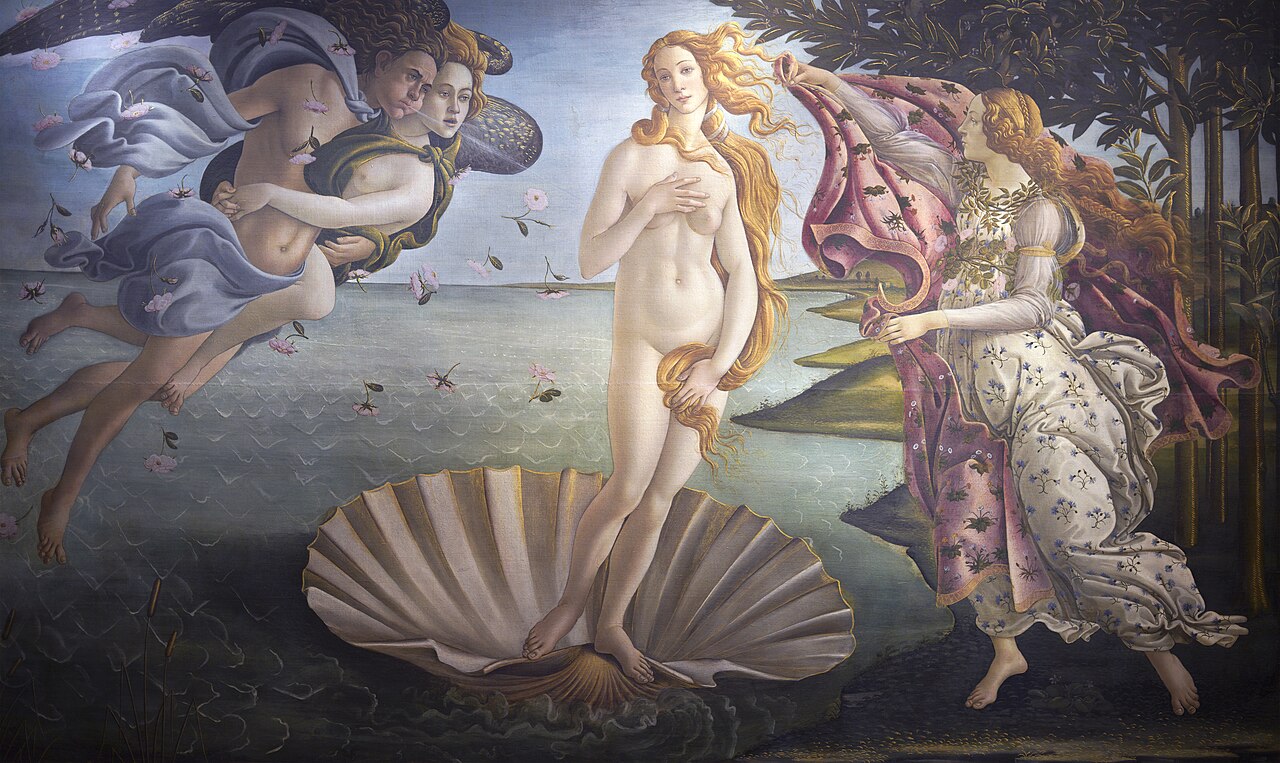
Probably the most famous mythological painting of the entire Renaissance. Painted around 1485 on canvas (unusual for the time — most large works of this scale were on wooden panels), it shows Venus, the goddess of love, born adult from the foam of the sea, blown to shore on a giant scallop shell by Zephyrus and Aura while a season-nymph holds out a flowered cloak. The figure is pale, almost weightless, modelled on the Knidian Aphrodite — a famous lost Greek sculpture Botticelli would have known only from copies. Venus's pose, her hand modestly placed, is the Venus Pudica formula. The painting was made for the Medici villa at Castello and is now in the Uffizi in Florence. It is roughly 1.7 by 2.8 metres.
Primavera 1482
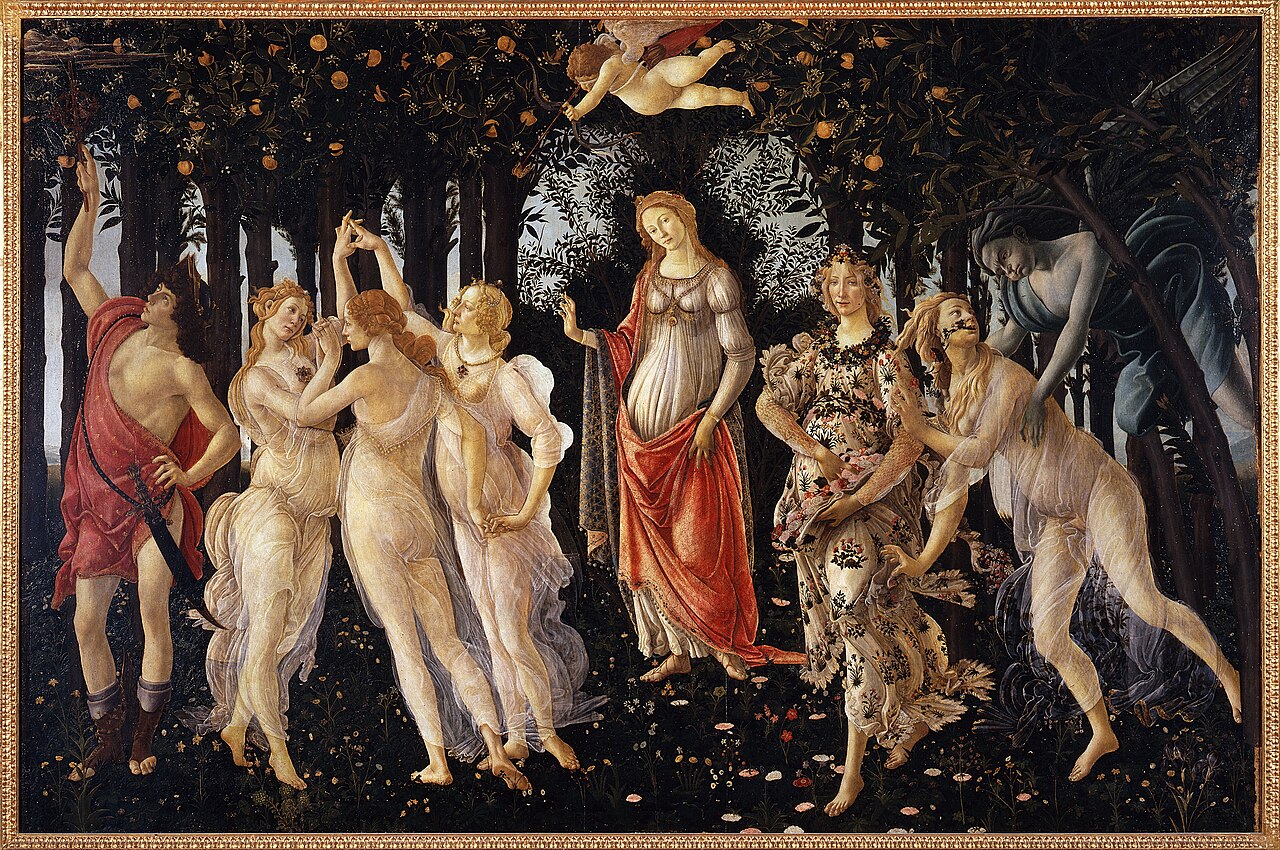
Botticelli's most ambitious mythological allegory before the Birth of Venus, painted around 1482 in tempera on a wooden panel of about two by three metres. Now in the Uffizi, it was probably commissioned for Lorenzo di Pierfrancesco de' Medici and hung in his Florentine villa. Nine figures crowd an orange grove: Venus presides at the centre, her hand raised in benediction; the Three Graces dance at left in transparent veils; Mercury at the far left dispels the clouds with his caduceus; at right, the wind god Zephyr seizes the nymph Chloris and Flora scatters blossoms across the meadow. The iconography draws on Ovid and Lucretius filtered through Marsilio Ficino's Neoplatonism — a courtly allegory of love as the path that returns the soul to divine beauty. Underfoot, botanists have identified one hundred and thirty-eight distinct plant species painted with near-scientific precision.
The Adoration of the Magi 1475
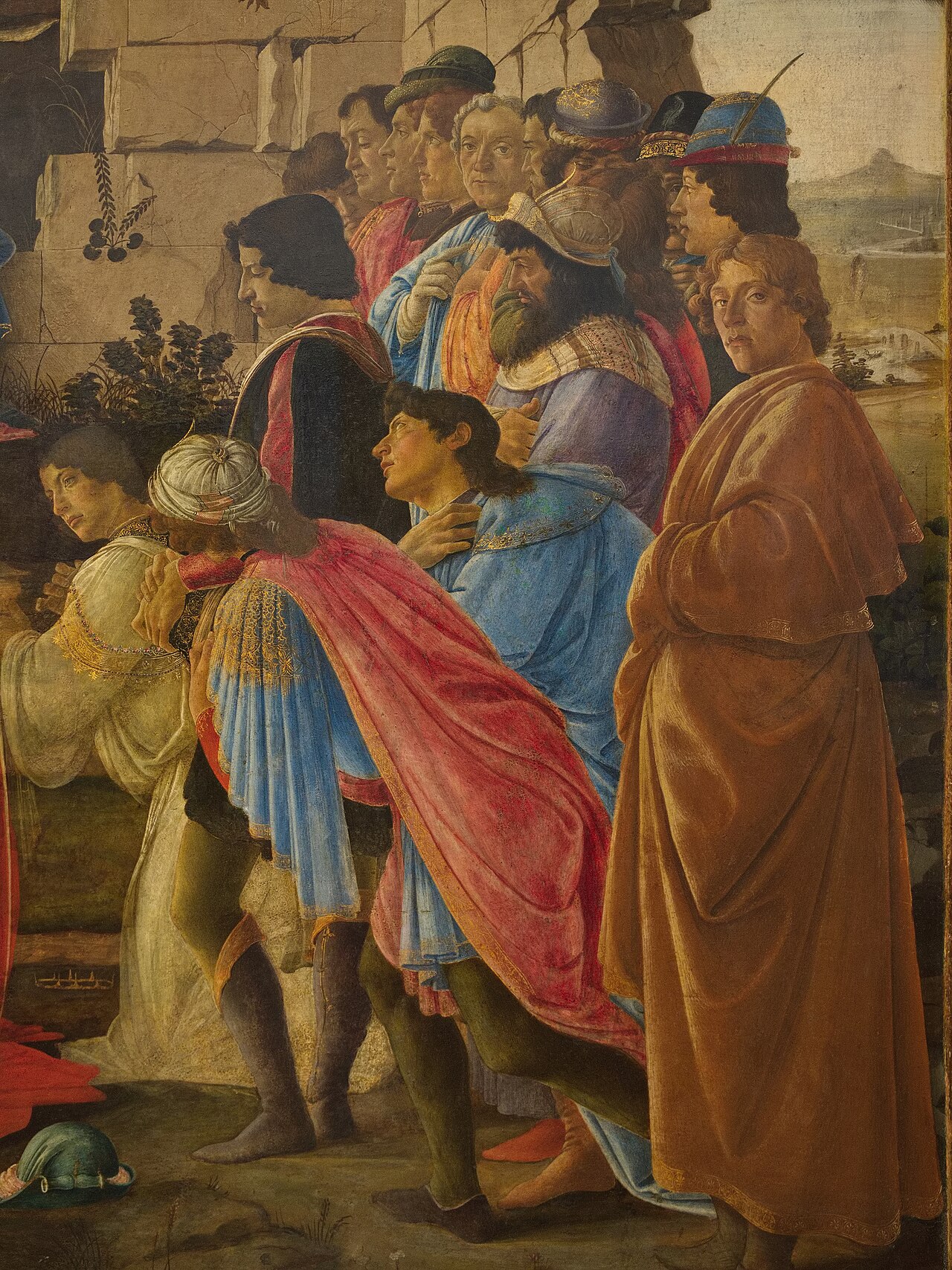
Tempera on panel, 111 × 134 cm, Uffizi. Commissioned around 1475 by Gaspare di Zanobi del Lama for his funerary chapel in Santa Maria Novella, it became something more remarkable than a devotional altarpiece: a virtual Medici family portrait disguised as the kings of the East. Cosimo il Vecchio kneels at the Christ Child's feet — the eldest king, the patriarch of the dynasty, already dead when Botticelli painted him. His sons Piero il Gottoso and Giovanni stand foreground centre. Lorenzo il Magnifico, twenty-six years old, holds a sword at the right edge. The painting also contains the earliest signed self-portrait Botticelli ever inserted into a religious work: at the far right, in a long yellow cloak, a bearded man looks straight out at the viewer. The picture is, in effect, a Medici advertisement and a painter's calling card in one frame.
The Calumny of Apelles 1495
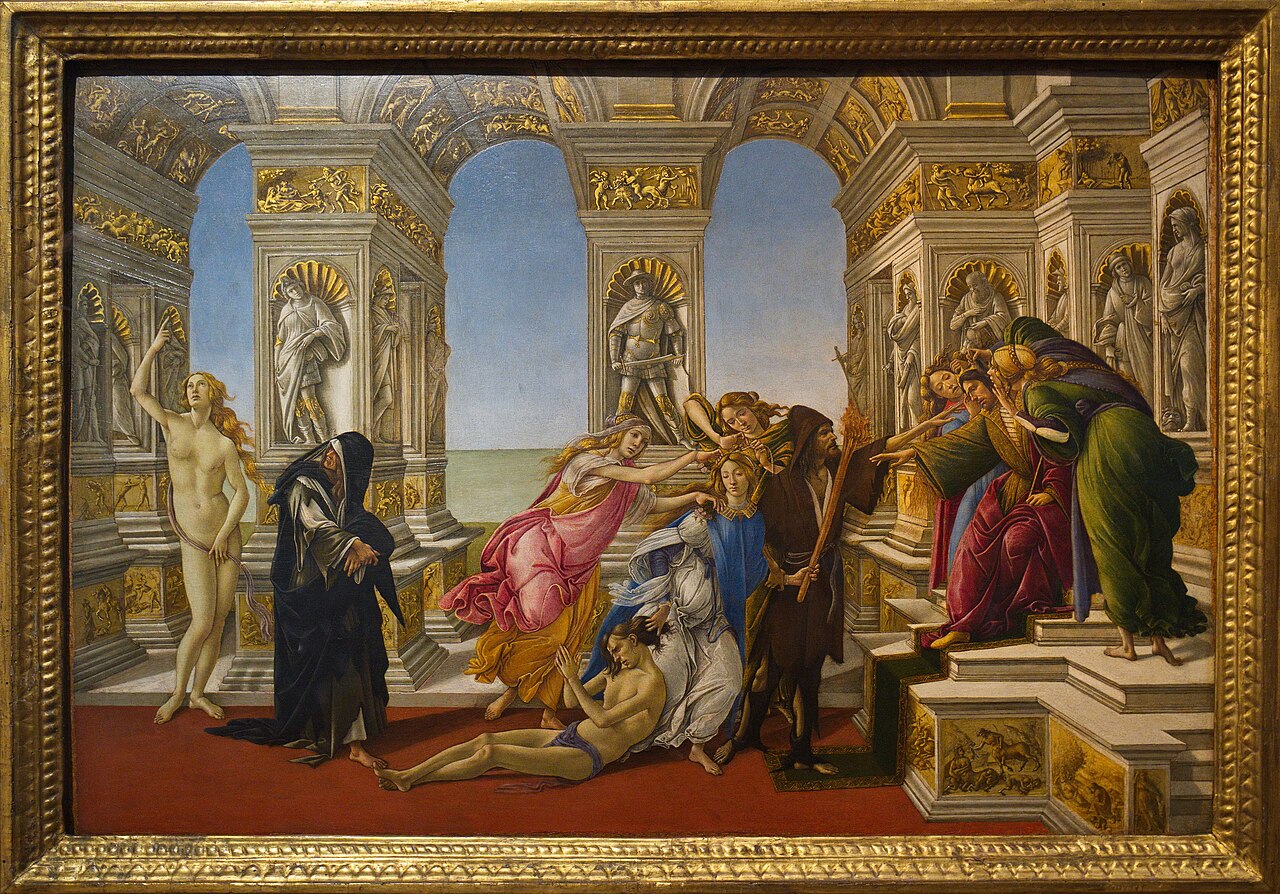
Tempera on panel, 62 × 91 cm, Uffizi. A late, troubled work from after the Savonarola crisis that swept Florence in 1494. The painting reconstructs a lost ancient masterpiece described by Lucian of Samosata: King Midas with ass's ears sits enthroned at right, flanked by personifications of Ignorance and Suspicion whispering in his ears. At centre, the figure of Calumny — a beautiful young woman holding a torch — drags an innocent victim by the hair, accompanied by Envy, Treachery and Fraud. At the far left, Penitence in dark mourning turns toward a naked figure of Truth, who points to heaven. The architecture behind is dense with classical reliefs Botticelli has invented in marble. Compared to the Primavera or the Birth of Venus, the painting is darker, more brittle, more pessimistic — the work of a man who has watched his city burn its vanities and is asking what art is for.