John Constable
He turned the ordinary fields and skies of native Suffolk into landscape painting's quiet revolution.
Style and technique
Constable painted almost nothing but the landscape he had known since boyhood: the water meadows, locks, and towpaths of the River Stour around East Bergholt, Dedham, and Flatford, a stretch of Suffolk-Essex countryside so closely bound to his work that it is still called "Constable Country." Where the Royal Academy's prevailing taste favored landscapes composed after Claude Lorrain — golden, generalized, arranged for picturesque effect — Constable insisted on the particular: a specific lock at Flatford, a specific bend of the river below Dedham church tower, a specific mill his own family owned.
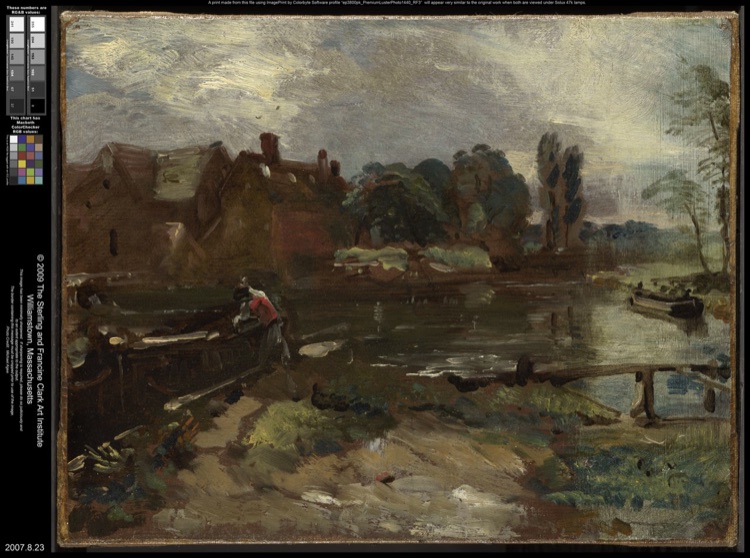
Central to that ambition was his working method. Constable made dozens of small oil sketches directly outdoors, worked rapidly and thickly to seize transient effects of light, wind, and weather, then used them as raw material for large studio canvases. For his major "six-footers" he went further still, producing full-size oil sketches — as large as the finished exhibition paintings — to test composition and tone before committing to the final work, a practice virtually unheard of at the time.
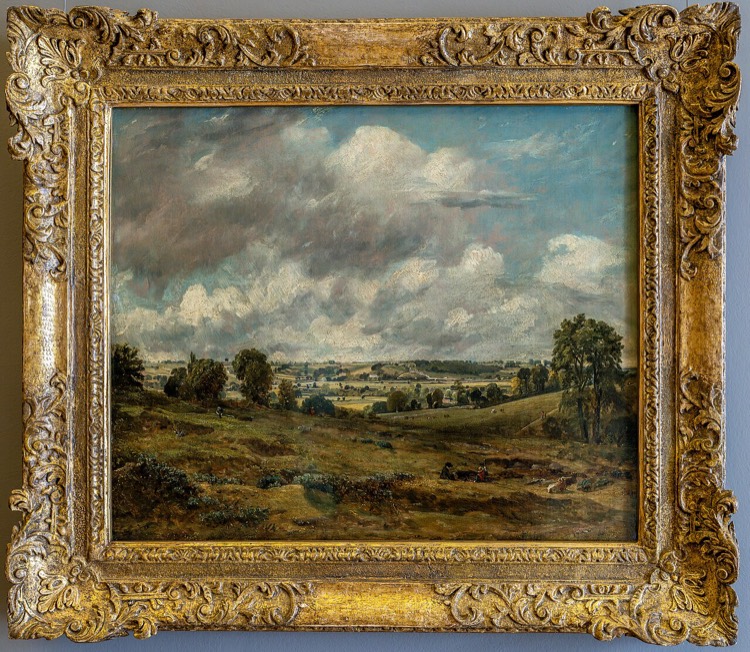
From around 1821 he undertook a sustained campaign of cloud studies on Hampstead Heath, annotating them with date, hour, and wind direction like a meteorologist, convinced that the sky was "the chief organ of sentiment" in any landscape. That same physical attentiveness shows in his handling of paint itself: rain-freshened foliage and sparkling water are built from thick, broken touches of white and pale pigment, often dragged and flicked across the surface with a palette knife, a technique so distinctive that contemporaries nicknamed its scattered highlights "Constable's snow." The result was a landscape art that felt observed rather than composed — damp, changeable, and alive with weather — and it was precisely this unvarnished naturalism, resisted at home, that electrified French painters when The Hay Wain reached the 1824 Paris Salon.
Life and legacy
John Constable was born on 11 June 1776 in East Bergholt, a village in the Stour valley on the Suffolk-Essex border, the second son of Golding Constable, a prosperous corn merchant and mill owner, and one of six children. Golding Constable expected his son to inherit the family business, and for a time young John dutifully learned the trades of milling and grain, walking the towpaths and watching the machinery of Flatford Mill, which his father owned. But the landscape itself — the locks, the barges, the elms, the endlessly shifting Suffolk sky — had already claimed him.
Against his family's wishes he enrolled at the Royal Academy Schools in London in 1799, arriving as a provincial outsider in an art world that prized Claude Lorrain's idealized Italianate landscapes and had little patience for unglamorous English fields.
He supported himself with portrait commissions he found tedious, all the while developing, through hundreds of outdoor oil sketches, a method of recording exact atmospheric conditions — cloud, light, and moisture — with a directness no English landscape painter had attempted. He was not elected a full Royal Academician until 1829, at fifty-two, and then only by a single vote. Meanwhile he had fallen in love with Maria Bicknell, granddaughter of the rector of East Bergholt; her family, wary of an ill-paid painter, opposed the match for years. The couple finally married in 1816, after Constable's father died and left him a modest income, and settled into a devoted, financially strained marriage that produced seven children.
Recognition arrived first from abroad. When The Hay Wain was exhibited at the 1824 Paris Salon, it won a gold medal and stunned French critics and painters alike with its unvarnished truth to nature; Delacroix reportedly reworked a canvas after studying its broken brushwork, and the coming generation of Barbizon painters absorbed its lessons directly. In England, sales remained scarce and honors grudging. Then, in 1828, Maria died of tuberculosis, leaving Constable, by his own account, in mourning for the rest of his life. His late paintings — stormier, more turbulent, built up with a palette knife in restless flecks of white some called "Constable's snow" — carry a melancholy largely absent from his sunnier earlier Stour valley scenes. He died suddenly in Hampstead on 31 March 1837, still relatively unrecognized at home, leaving a body of work that would only later be understood as one of the founding achievements of modern landscape painting.
Five famous paintings
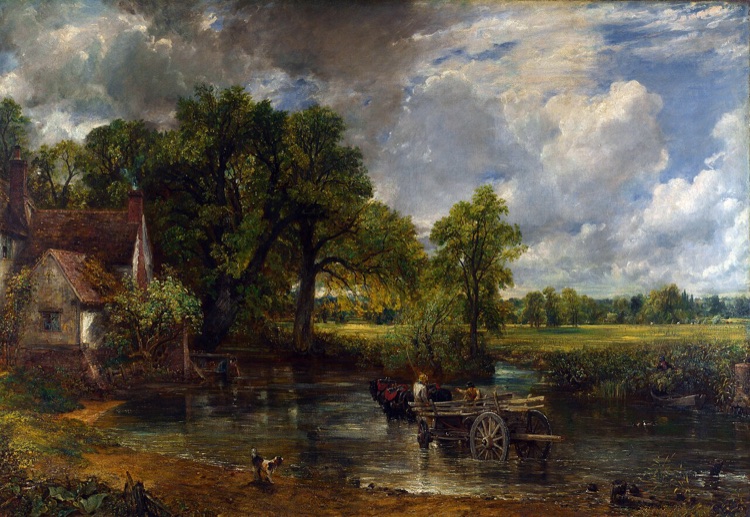
The Hay Wain 1821
Constable's best-known work shows a wooden hay wain, a horse-drawn cart, standing in the shallows of the River Stour beside Willy Lott's cottage at Flatford, with reapers working a golden field beyond. Built from studies gathered over several years and exhibited at the Royal Academy in 1821 to muted response, it caused a sensation three years later at the 1824 Paris Salon, winning a gold medal and reportedly prompting Delacroix to rework a canvas after studying its broken, luminous brushwork. Its unhurried, cloud-flecked realism became the founding image of "Constable Country" and a touchstone for the French Barbizon painters who followed.
The White Horse 1819
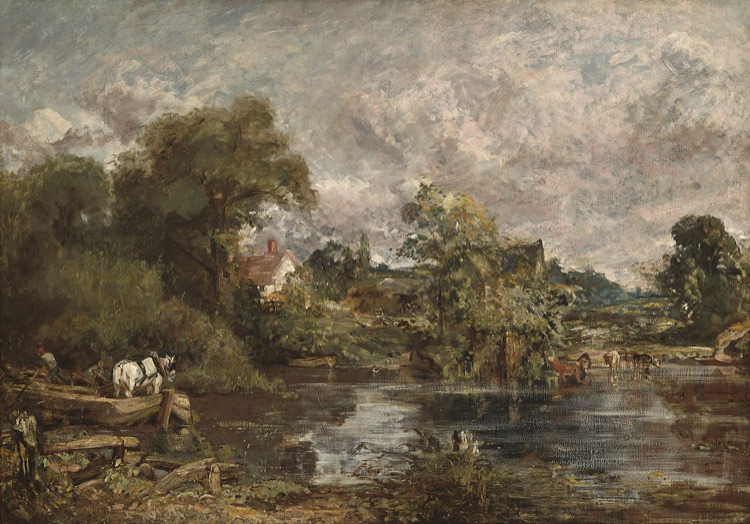
The first of Constable's ambitious "six-foot" Stour valley canvases, The White Horse shows a barge horse being ferried across the river near Flatford, framed by overhanging trees and a wide, cloud-scudded sky. Constable prepared it with a full-size oil sketch, testing tone and composition before the exhibition picture itself, a method he repeated for every subsequent major work. Shown at the Royal Academy in 1819, it helped secure his election as an Associate that year, his first real institutional recognition after two decades of largely unrewarded effort, and remains a defining statement of his lifelong devotion to the Stour.
Salisbury Cathedral from the Meadows 1831
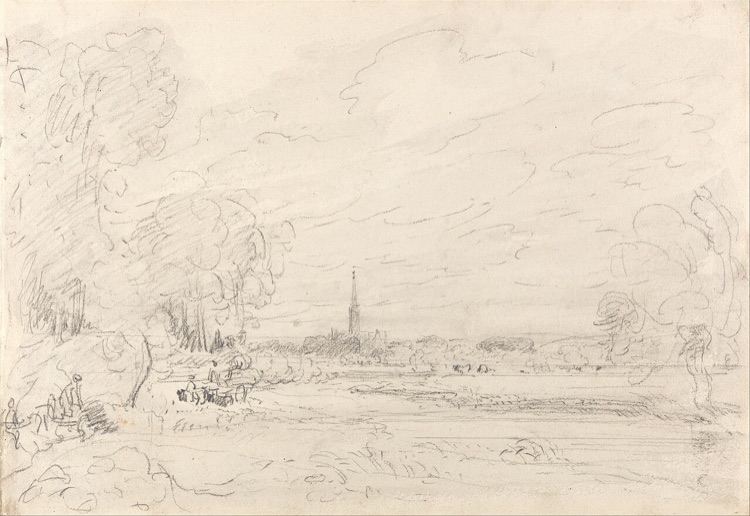
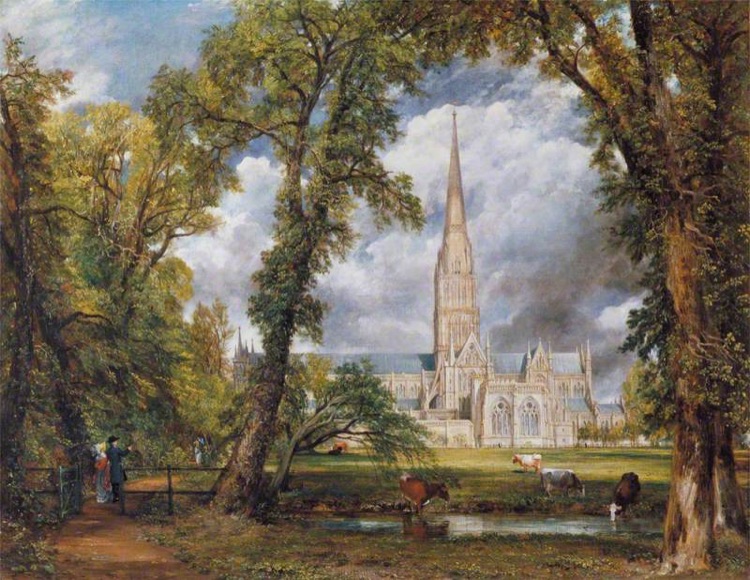
Painted for Constable's close friend Archdeacon John Fisher, this canvas frames Salisbury Cathedral's spire through dense, wind-tossed trees, with a dark rain cloud looming above and a rainbow arcing beside it. Begun after the 1828 death of Constable's wife Maria, its turbulent sky and stormy, palette-knife handling mark the more anxious register of his later career, a marked departure from the calmer, sunlit scenes of his earlier Stour valley work. Exhibited in 1831, it stands among the most emotionally charged of his cathedral views and a lasting testament to his bond with the Fisher family.
Dedham Vale 1802
One of Constable's earliest mature statements, this view looks from high ground near East Bergholt down across the wooded Stour valley toward Dedham church tower in the distance, consciously echoing the composition of Claude Lorrain's idealized landscapes while replacing their invented Italian light with the particular, damp atmosphere of Suffolk. Painted in 1802, the year Constable resolved to pursue "a pure and unaffected representation" of nature rather than borrowed picturesque formulas, it announces the guiding conviction of his career: that the closely observed English countryside of his childhood was subject enough for serious art.
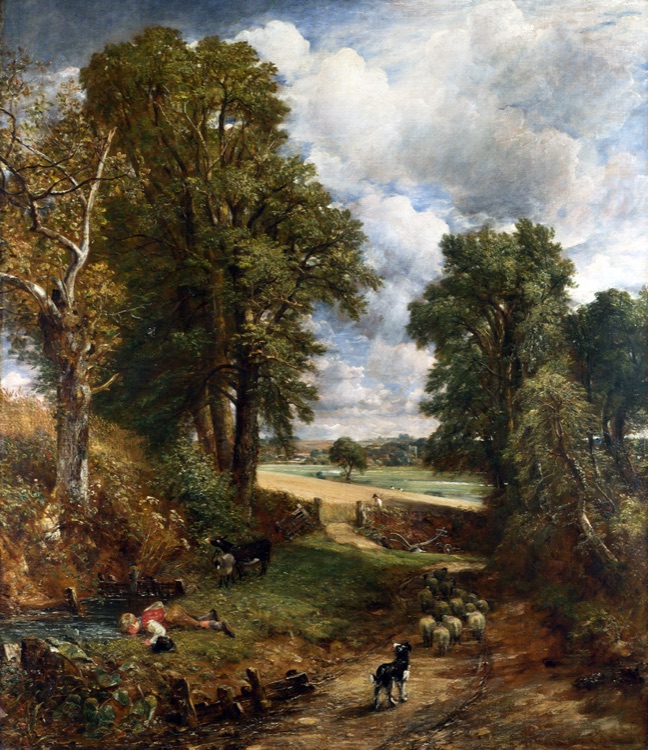
The Cornfield 1826
The Cornfield shows a boy pausing to drink from a stream along a sunken lane near East Bergholt while sheep stream past toward a ripening wheat field and a distant church tower. More anecdotal and overtly pastoral than Constable's river scenes, it was among the first of his major works purchased by public subscription for the National Gallery in 1837, shortly after his death, a gesture of posthumous institutional recognition that had eluded him for most of his working life. Its warm, harvest-time light and lingering, affectionate detail have made it one of his most reproduced and beloved images.