Alphonse Mucha
A Sarah Bernhardt poster made him Paris's decorative genius; a 20-canvas Slavic saga became his true legacy.
Style and technique
Mucha's style is instantly recognizable: women with impossibly long, wave-like hair that flows outward to fill every corner of the composition, as if line itself were growing like a vine. He set these figures against circular haloes borrowed from Byzantine icons, or inside decorative frames of interlaced flowers, stars, and jewel-like medallions, flattening space into pure pattern in the manner of Japanese prints. Palettes stayed soft and chalky — muted golds, dusty pinks, sage greens — printed by lithography in tones gentler than the gaudy commercial posters around them, which is exactly why his advertisements for cigarette papers, biscuits, champagne, and theatre bills read as fine art rather than street clutter. He called the whole vocabulary le style Mucha, though the public simply called it 'the Mucha woman': a serene, goddess-like beauty draped in flowing robes, often personifying an abstract idea — a season, an art form, a flower, a time of day, a sign of the zodiac — rather than a real person.
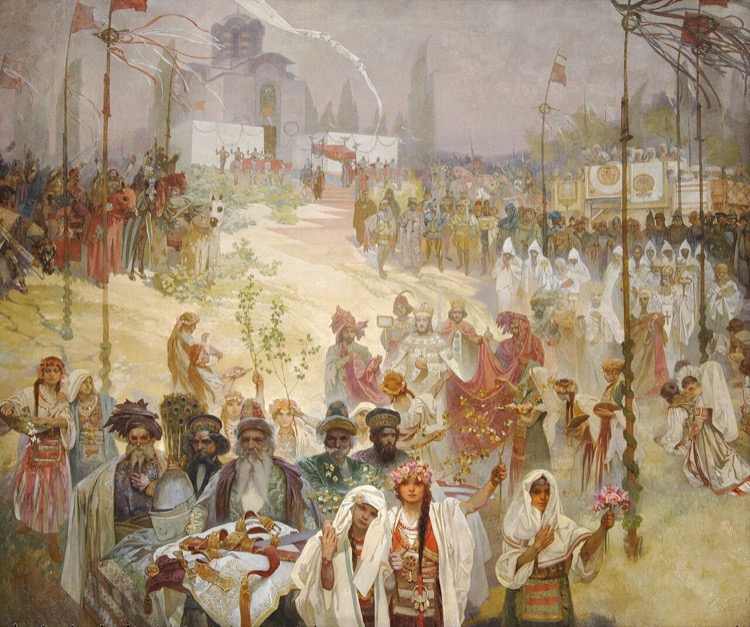
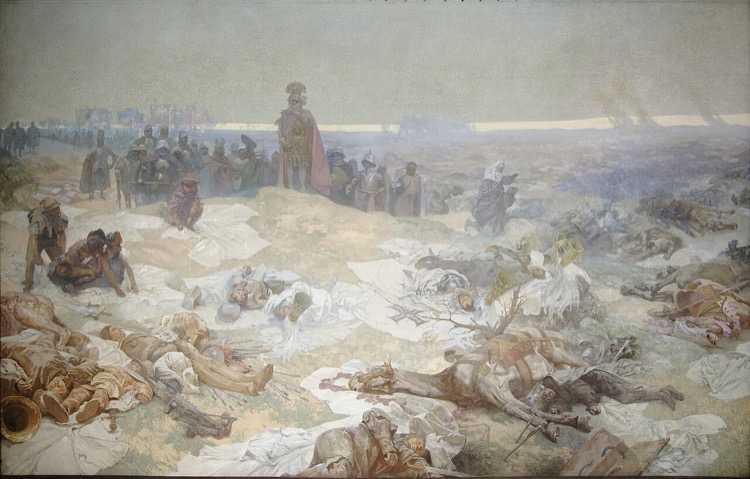
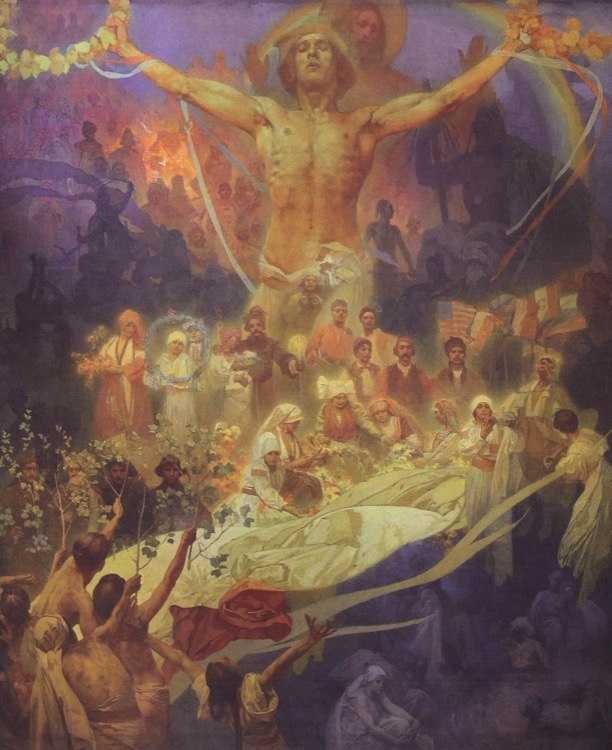
That same linear, ornamental instinct never left him, but after 1910 he bent it toward a very different purpose. In The Slav Epic, the swirling hair and floral borders give way to vast, somber canvases of crowds, firelight, and ritual, where individual mourners, warriors, and saints replace the single decorative maiden. The palette darkens into smoky blues, ochres, and torch-lit oranges; symbolic haloes and glowing apparitions still hover over the action, but now they crown historical rulers and allegorical figures of Slavic destiny instead of advertising slogans.
Life and legacy
Alfons Maria Mucha was born in 1860 in the small Moravian town of Ivančice, and after a singing scholarship, provincial stage-painting jobs, and studies in Munich and Paris left him broke, he was scraping by as an illustrator for Parisian magazines and the printer Lemercier when, on 26 December 1894, fortune intervened. Sarah Bernhardt, the most famous actress in Europe, needed an emergency poster for her play Gismonda and every other artist at the printworks was on holiday. Mucha took the commission, and the tall, jewel-toned, Byzantine-framed poster he produced in a matter of days caused a sensation when it appeared on New Year's Day 1895. Parisians reportedly tore copies from walls overnight to keep them for themselves.
The years that followed were extraordinarily productive. Mucha designed a stream of posters for theatres, cigarette papers, bicycles, biscuits, and champagne houses, alongside decorative panel series such as The Seasons, The Arts, The Flowers, and Zodiac that were sold as prints for middle-class homes across Europe and America. He branched into jewelry design with the goldsmith Georges Fouquet, illustrated books, and designed the Bosnia-Herzegovina pavilion at the 1900 Paris World's Fair, an assignment that immersed him in Slavic history and folklore and left him increasingly uneasy that his fame rested on frivolous advertising rather than work of lasting national meaning.
A turning point came through Charles R. Crane, an American industrialist and philanthropist who shared Mucha's fascination with Slavic culture and agreed to finance the project the artist had long dreamed of: a cycle of monumental canvases tracing the history of the Slavic peoples. From 1912 onward Mucha devoted himself almost entirely to The Slav Epic, traveling through the Balkans and Russia to research historical costumes and settings and painting in a specially built studio on a borrowed Bohemian estate. When the independent state of Czechoslovakia was founded in 1918, Mucha designed its first banknotes, stamps, and official documents without charging a fee, treating the commissions as a patriotic duty rather than paid work. He finally completed all twenty Slav Epic canvases in 1928 and donated the entire cycle to the city of Prague.
Five famous paintings
Job 1896
Commissioned to advertise Job cigarette rolling papers, this lithograph shows a dark-haired woman in profile, a lit cigarette between her lips as smoke curls upward and merges with her own impossibly long, wind-blown hair. The hair spreads across the entire upper field like a living arabesque, turning a simple advertisement into a hypnotic decorative pattern around the stylized 'JOB' lettering. It became one of Mucha's best-selling, most imitated commercial posters, reprinted for years after its 1896 debut, and remains a textbook case of Mucha dissolving the line between fine art and street advertising.
The Seasons: Spring 1896
The opening panel of Mucha's four-part Seasons series personifies spring as a barefoot young woman plucking blossoms from an overhead branch while birds gather at her feet in a sunlit grove. Conceived as a purely decorative print rather than an advertisement, it let Mucha indulge his ornamental instincts without any product message to accommodate, resulting in one of his most fluid, musical compositions. Delicate pastel color and rhythmic drapery give it the quality of a stained-glass window. Sold individually or as a matched set, the Seasons prints became hugely popular home decor across Europe and America.
Portrait of Josephine Crane Bradley as Slavia 1908
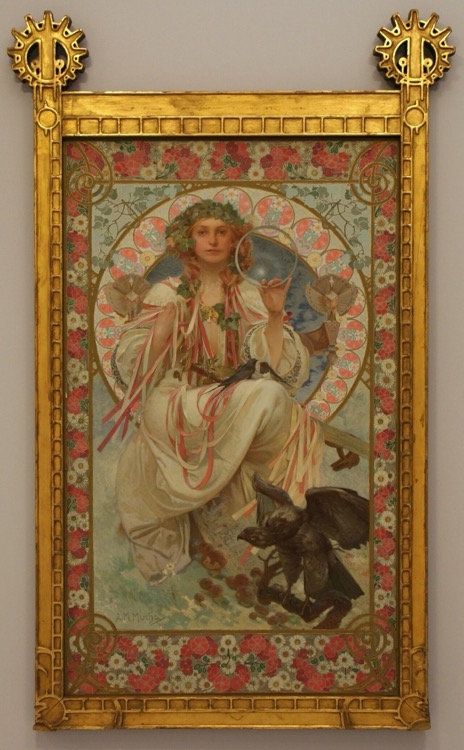
Painted in oil rather than printed as a poster, this portrait shows Josephine Crane Bradley, daughter of Mucha's future patron Charles R. Crane, transformed into Slavia, the allegorical goddess of the Slavic peoples. Wrapped in a fur-trimmed cloak and crowned with a wreath, she gazes out with calm dignity against a deep blue ground, a heraldic bird at her shoulder. The picture bridges Mucha's two careers: decorative Paris elegance in her flowing hair, but a subject already pointing toward the nationalist project of his final decades. Mucha later reused Slavia's face on Czechoslovak banknotes.
The Slavs in Their Original Homeland 1912
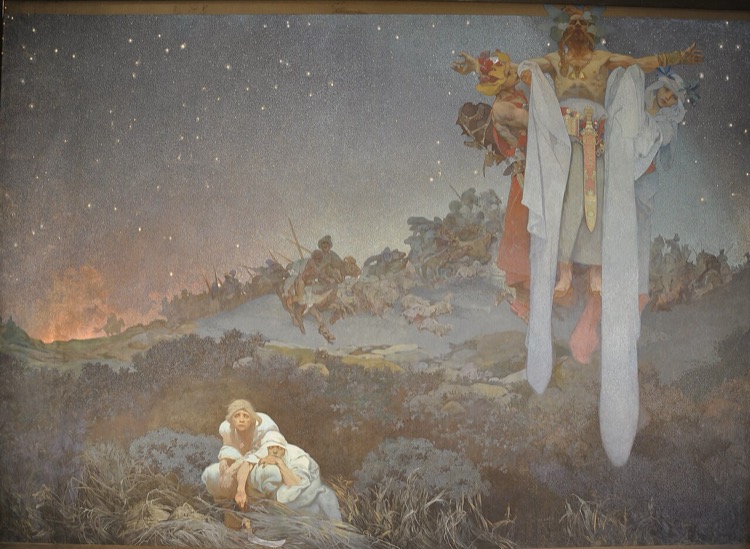
The first of twenty monumental canvases in The Slav Epic plunges viewers into darkness: ancient Slavic villagers crouch hidden among tall marsh reeds at night, terrified as raiders burn a settlement on the horizon. Above them, two ghostly, luminous figures of Peace and War hover in the black sky, presiding silently over the people's suffering. At nearly six by eight meters, the canvas overwhelms viewers physically as well as emotionally, replacing Mucha's single decorative heroine with an anonymous, huddled crowd. It set the tone for the entire cycle he spent sixteen years painting and then donated to Prague.
King Přemysl Otakar II of Bohemia 1924
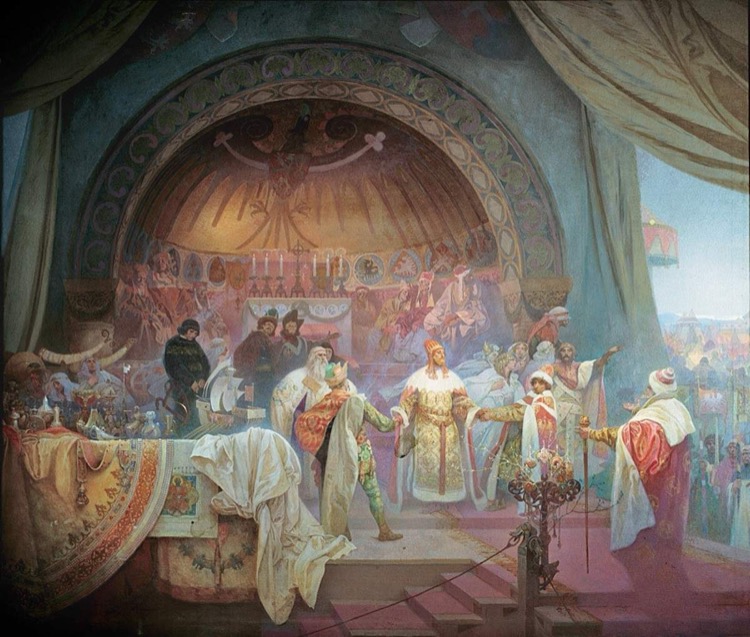
Painted well into the Slav Epic project, this canvas returns to the medieval Bohemian court to honor Přemysl Otakar II, the thirteenth-century king whose military and economic power briefly made Bohemia a leading Central European state. Mucha stages a crowded ceremonial gathering of nobles, clergy, and soldiers beneath heraldic banners, rendered with the same painstaking research into historical costume he brought to every panel of the cycle. Compared to his slender, single-figure 1890s posters, the composition is dense and almost documentary, aimed at giving the new Czechoslovak state a visual history of its own greatness.