
Avant-gardes 1910 (Cubism / Futurism)
Picasso shattered the object; Boccioni set it in motion — the decade that broke Western perspective.
In the winter of 1907–08, Pablo Picasso kept his studio at the Bateau-Lavoir in Montmartre locked. He was working on a large canvas he would not show anyone — not Matisse, not Apollinaire, not Braque, who had become his closest interlocutor. When he finally showed the painting, the reaction was bafflement: five angular female figures, their faces fractured into simultaneous frontal and profile views, two of them wearing African or Iberian masks. *Les Demoiselles d'Avignon* was not exhibited publicly until 1916 and not widely reproduced until 1925, but it was the fuse. The Cubism that Picasso and Braque developed over the following years — working in such close dialogue that they called themselves "roped together like mountaineers" — dismantled the single viewpoint that had governed Western painting since the Renaissance and replaced it with a simultaneous, multi-angle analysis of form. At almost the same moment, in Milan, the poet Filippo Tommaso Marinetti published his Futurist Manifesto (1909) and a group of painters — Umberto Boccioni, Carlo Carrà, Gino Severini, Giacomo Balla — began developing a visual language to celebrate everything Cubism left out: speed, noise, machines, the city in motion.
Origin and history
Cubism grew directly from two sources: Cézanne and African art. Cézanne's late work — his *Mont Sainte-Victoire* series, his *Bathers*, the geometric simplifications of his still lifes — had shown that a painting could fracture observed reality into interlocking planes without losing coherence. After his death in 1906, a major retrospective at the Salon d'Automne (1907) reached Picasso and Braque at a decisive moment. The second source was the collection of African and Oceanic objects that Picasso encountered in the Trocadéro ethnographic museum in Paris in 1907 — masks whose multiple simultaneous viewpoints and radical simplification of the human face showed that representation could operate by entirely different rules.
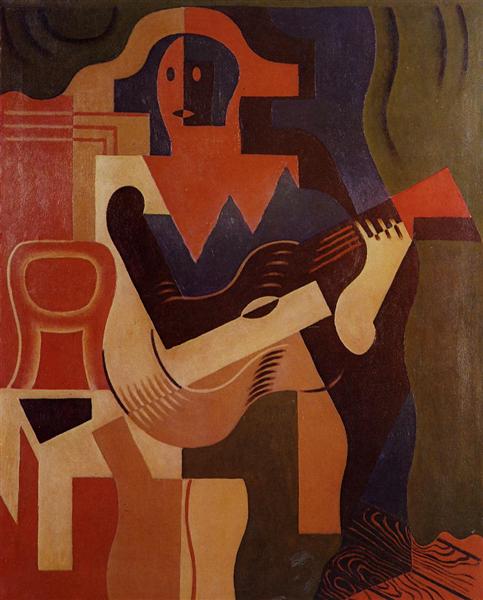
Braque and Picasso's collaboration from 1908 to 1914 produced what critics later divided into two phases. Analytic Cubism (c.1908–12) is the movement's most extreme and rigorous form: a severely limited palette of ochres, greys and brown-blacks; form fractured into small, overlapping facets; figure and background woven into a continuous shallow space from which conventional depth has been eliminated. The paintings from this period — Picasso's *Portrait of Ambroise Vollard* (1910), Braque's *Violin and Candlestick* (1910) — are among the most demanding objects in Western art: beautiful, cerebral, almost entirely non-representational despite their nominal subjects. Synthetic Cubism (c.1912–14) opened the movement's possibilities: Braque introduced collage (*papier collé*) in 1912, pasting newsprint directly onto the picture surface; Picasso followed; colour returned; the vocabulary expanded to include lettering, stencilled textures and flat decorative areas. Juan Gris brought a more systematic, crystalline quality to the same vocabulary.
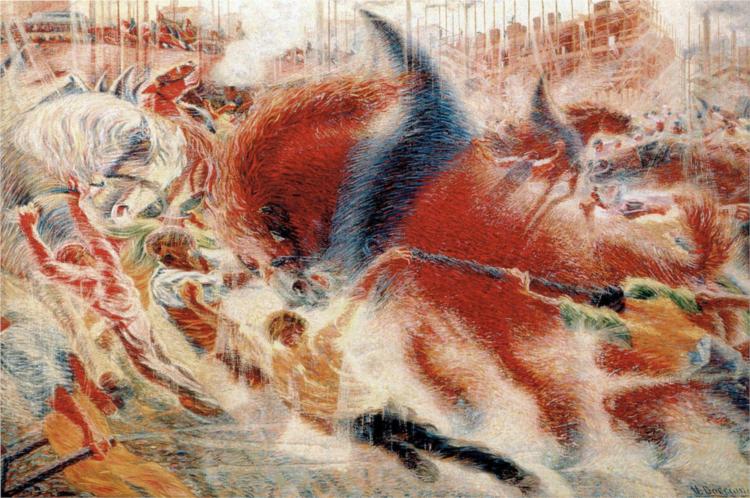
Futurism began as a literary movement — Marinetti's 1909 manifesto in *Le Figaro* celebrated war, machines, speed, the destruction of museums — and became a visual programme when Boccioni, Carrà, Severini, Balla and Russolo published their own painting manifesto in 1910. Where Cubism analysed a still object from multiple viewpoints simultaneously, Futurism analysed a moving object through multiple successive positions — the same figure in five consecutive moments, overlapping like a multiple-exposure photograph. Boccioni's *States of Mind* triptych (1911), *The City Rises* (1910–11), and the extraordinary bronze sculpture *Unique Forms of Continuity in Space* (1913) are the movement's defining works. Severini brought an almost pointillist quality to Futurist motion; Balla's *Dynamism of a Dog on a Leash* (1912) captured the blurred multiple positions of a dachshund's legs with playful scientific precision.
Concept and philosophy
Both Cubism and Futurism were, at root, answers to the same modern question: how should painting respond to a world that Newtonian physics and traditional perspective could no longer adequately describe? Einstein's relativity (1905), Bergson's philosophy of time as subjective experience, the blurring speed of automobiles and aeroplanes — all suggested that the stable, single-viewpoint image of the Renaissance was as much a convention as the stories it depicted.
Cubism's answer was analytical simultaneity: to show an object as the mind knows it rather than the eye sees it in any one moment. A guitar rendered in Analytic Cubism is present in its multiple aspects — front, back, side, cross-section — assembled on a flat surface. This is not a depiction of the guitar as seen from a particular angle at a particular time; it is a conceptual portrait of the guitar as a three-dimensional object existing in space. The philosophical implications were enormous: if perception is constructed rather than passively received, then every tradition of representation is a choice, not a given.
Futurism's answer was kinetic simultaneity: to show an object as the eye and body experience it in motion. The Futurists were fascinated by the cinema, by multiple-exposure photography (Etienne-Jules Marey's chronophotography was a direct influence), by the sensation of riding in an early automobile. Their paintings do not freeze motion but evoke it — a body in several positions at once, a crowd that interpenetrates with its surroundings, a street that seems to vibrate. The Futurist manifesto declared that "a galloping horse has not four legs but twenty, and their movements are triangular."
The combined legacy of these two answers — the conceptual analysis of form and the kinetic analysis of movement — gave the twentieth century most of its visual grammar. Every logo that suggests speed through diagonal blur, every architectural rendering that shows a building from multiple angles simultaneously, every film edit that suggests time passing through overlapping images, owes something to the 1907–1914 revolution in Montmartre and Milan.
How to recognise it
Cubist and Futurist works are visually distinct from each other, but both share the fractured plane as a common departure point — here are the six markers that will orient you.
- Fractured, faceted planes — The fundamental Cubist and Futurist gesture: solid objects broken into overlapping geometric facets, reassembled on a flat surface. In Analytic Cubism the facets are small, close-valued and interlocking; in Synthetic Cubism they are larger and more clearly bounded; in Futurism they are stretched and blurred by motion.
- Restricted palette (Analytic Cubism) — Analytic Cubist paintings use an extremely narrow range of ochres, grey-browns and blacks — deliberately avoiding colour to force attention onto form and space. If a painting looks like a monochrome puzzle of interlocking planes, you are looking at Analytic Cubism.
- Collage and mixed media — Synthetic Cubism introduced collage as a painting technique: newsprint, wallpaper, sheet music, labels pasted directly onto the picture surface alongside paint. The effect is a controlled clash between depiction and reality — the newspaper IS newspaper, but the guitar it accompanies is only painted.
- Shallow, ambiguous space — Both Cubist and Futurist paintings eliminate or drastically compress *deep perspective*. Figure and background interpenetrate: forms pass through and behind each other without conventional spatial logic. The viewing position is multiple and unstable.
- Motion blur and dynamic sequences (Futurism) — Futurist paintings show a single moving form in multiple successive positions — a running figure, a spinning wheel, a galloping animal. The result is a stroboscopic shimmer. Speed lines, trail effects and the splintering of a single contour into its consecutive moments are Futurist fingerprints.
- Letters, numbers and text fragments — Synthetic Cubism routinely incorporated stencilled or collaged lettering — newspaper headlines, wine labels, musical notation. This was partly a formal decision (the flat, readable letter contrasts with the illusion of depth) and partly a conceptual one: language and image occupy the same pictorial space.
Anecdotes and curiosities
Picasso and Braque worked in such close dialogue that they signed canvases on the back to avoid confusing them. During the height of their Analytic Cubist collaboration (1910–12), the two painters were producing work so formally similar that they occasionally could not immediately identify which of them had made a particular canvas. Both later described the period as a kind of creative symbiosis unlike anything they experienced before or after. Braque compared it to a mountain climb: two climbers roped together, each depending on the other's judgment.
Juan Gris paid his rent to Picasso in paintings. When the Spanish painter Juan Gris arrived in Paris in 1906, he moved into the Bateau-Lavoir building in Montmartre — the same ramshackle complex where Picasso had his studio. For several years, Gris paid part of his rent to his landlord (and eventually Picasso) in canvases. The arrangement gave Picasso an early collection of Gris's work; it also ensured Gris lived in daily proximity to the movement he would later refine into the most systematically rigorous form of Synthetic Cubism.
Umberto Boccioni visited Paris in 1911 and was simultaneously inspired and furious. When the Futurist painters arrived in Paris in November 1911 — on their way to their first major exhibition — Boccioni visited Picasso's studio and saw Analytic Cubist works he had not previously known. He returned to Italy in a state of competitive excitement, immediately reworked several of his paintings to incorporate the fractured-plane vocabulary, and then spent the next three years insisting publicly that Futurism was fundamentally different from and superior to Cubism. The debate between the two movements about priority and influence was fierce and never fully resolved.
The Futurists declared war on pasta. In 1930, Marinetti — the movement's founder and its most relentless publicist — published the *Futurist Cookbook*, which declared that pasta ("pastasciutta") was anti-Futurist: it made Italians heavy, nostalgic and unfit for modern dynamism. The manifesto called for its abolition and the replacement of traditional cooking with a cuisine of sensory adventure. Italian public opinion was outraged. The pasta industry responded with statistics. Mussolini, who depended on agricultural production for his political programme, was not pleased. Marinetti continued to eat pasta in private.
Legacy and influence
Cubism is arguably the single most consequential formal revolution in the history of Western painting since the Renaissance invented perspective. Its dismantling of single-viewpoint representation opened every subsequent form of modernism: without Analytic Cubism, no abstract art; without Synthetic Cubism, no collage-based practice from Dada to Rauschenberg; without Cubist spatial ambiguity, no De Stijl, no Constructivism, no Bauhaus. Picasso and Braque's 1910–14 collaboration essentially rewrote the grammatical rules of painting for the century that followed. Futurism's direct legacy was smaller but no less real: its kinetic vocabulary fed Constructivism and Vorticism; its embrace of technology and mass media anticipated Pop Art; its celebration of the city in motion fed into the visual language of modernist graphic design and, eventually, cinema. More troublingly, Futurism's glorification of violence, nationalism and masculine energy made it the aesthetic natural ally of Italian Fascism — a cautionary entanglement that complicates but cannot erase the movement's genuine formal contributions.
5 artists in this movement
Frequently asked questions
What is the difference between Analytic and Synthetic Cubism?
Analytic Cubism (c.1908–12) is the movement's most rigorous phase: a narrow palette of ochres and grey-browns, form fractured into small overlapping facets, depth nearly eliminated. The paintings are cerebral and visually demanding. Synthetic Cubism (c.1912–14 onward) reversed several of these choices: colour returned, the planes became larger and more clearly defined, and collage — pasted newsprint, wallpaper, labels — entered the picture surface. The two phases represent the movement's analytical and constructive impulses.
Who were the main Cubist painters?
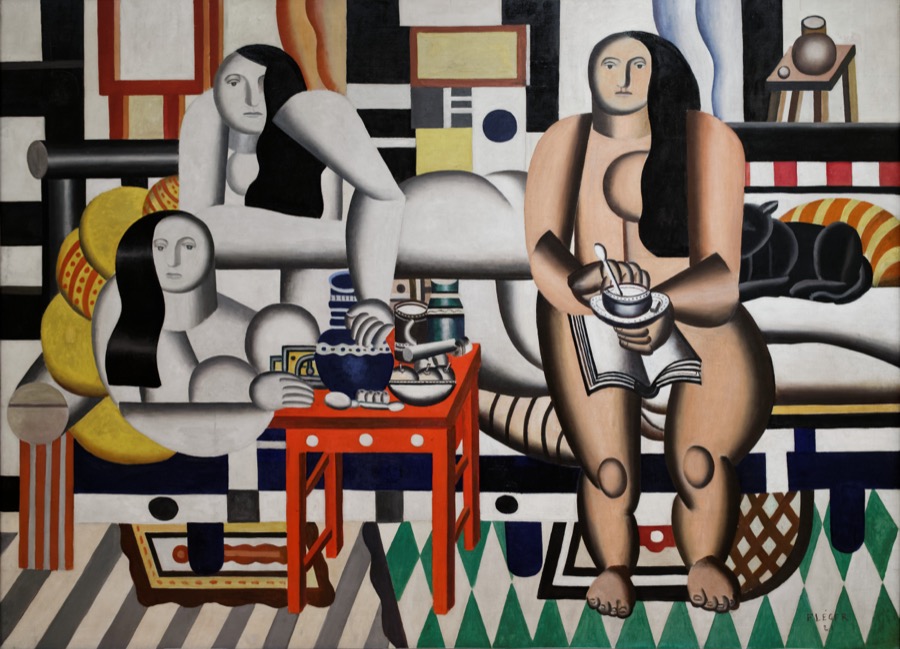
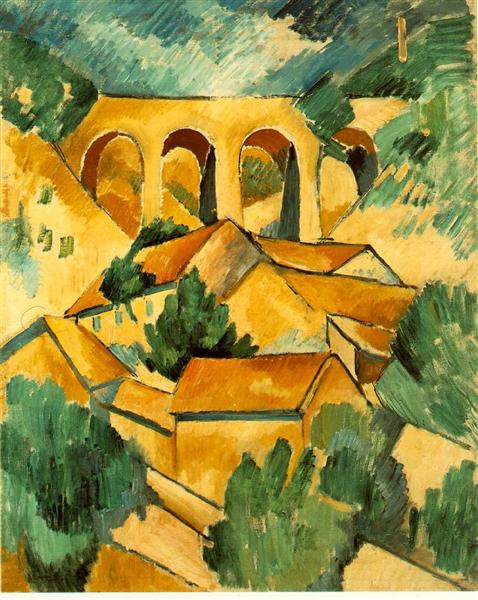
Pablo Picasso (1881–1973) and Georges Braque (1882–1963) developed Cubism in their Montmartre studios from 1907 onward. Juan Gris (1887–1927) brought a more systematic, almost architectural quality to Synthetic Cubism from around 1912. Fernand Léger (1881–1955) developed a parallel "tubist" vocabulary, applying Cubist fracturing to industrial subjects. Robert Delaunay moved Cubism toward pure colour abstraction through his *Orphist* variant.
Who were the main Futurist painters?
Umberto Boccioni (1882–1916) was the movement's most original visual intelligence — his *States of Mind* triptych and the sculpture *Unique Forms of Continuity in Space* are its masterpieces. Giacomo Balla (1871–1958) brought scientific precision to the representation of motion. Gino Severini (1883–1966) mediated between Futurism and Parisian painting. Carlo Carrà (1881–1966) later moved toward Metaphysical Painting with de Chirico.
How did Cubism relate to African art?
Picasso's visit to the Trocadéro museum in Paris in 1907 — where he encountered African and Oceanic masks and sculpture — was a decisive moment, though its exact influence on *Les Demoiselles d'Avignon* remains debated. What Picasso found in these objects was a system of representation based on conceptual rather than optical truth: a face shown simultaneously in frontal and profile, form simplified to its essential geometry. He later described the encounter as a revelation. Critics have long debated whether this constitutes creative borrowing, cultural appropriation, or a misreading of objects removed from their original context.
What was the relationship between Futurism and Fascism?
Marinetti, Futurism's founder, was an early supporter of Mussolini and Italian Fascism, and many Futurists participated in the first *Fascio di Combattimento* meeting in 1919. The movement's glorification of violence, nationalism, technology and masculine dynamism made it a natural ideological ally of the Fascist project. Mussolini, however, eventually preferred a more classical aesthetic for official state representation, and Futurism never became the official art of the regime. The entanglement remains one of the most uncomfortable chapters in twentieth-century art history.