Bartolomé Esteban Murillo
The Sevillian master who gave heaven a human face and poverty an unexpected tenderness.
Style and technique
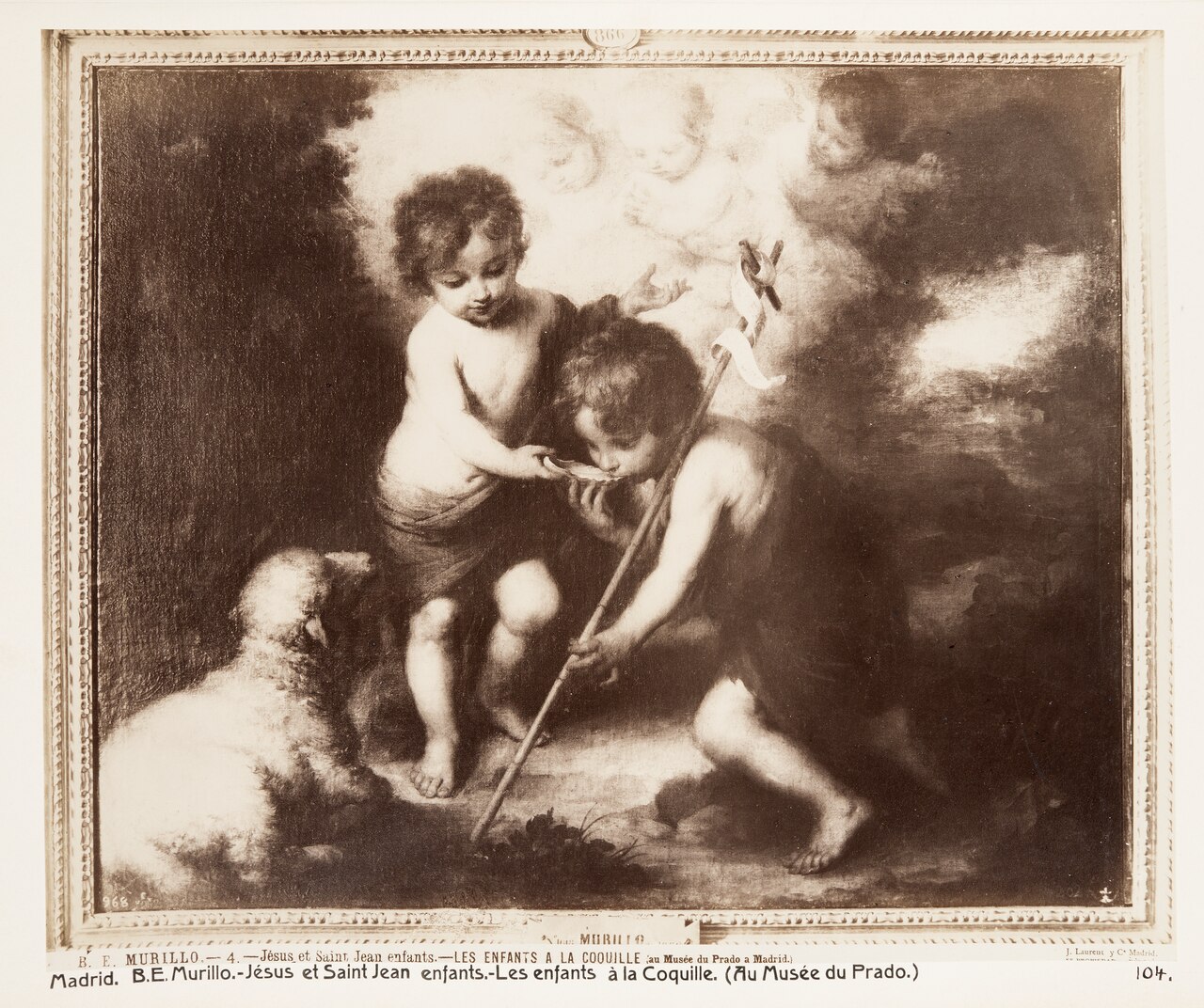
Stand before a Murillo and you feel, before you think. The light does not arrive from any identifiable window; it seems to emanate from the figures themselves, from the cloth of the Virgin's robe, from the skin of a barefoot child, from the feathers of angels caught in mid-descent. This is the quality that seventeenth-century critics were groping toward when they coined the term estilo vaporoso — the vaporous style — to describe what set Murillo apart from every other painter working in Seville.
The technique behind the effect is precise even when the result looks effortless. Murillo worked in thin, overlapping glazes of oil, building luminosity through transparency rather than through impasto. Where his older rival Francisco de Zurbarán carved his saints from solid blocks of light and shadow, Murillo dissolved the boundaries. Edges blur. Drapery flows into background. The transition from flesh to shadow is so gradual it seems not a painted decision but a natural fact.
His palette reinforces the softness: warm ochres, dove-greys, powder-blues, rose-pinks — colours that recede from one another gently rather than clashing. He almost never reaches for the hard contrasts of Caravaggesque Baroque. The effect is closer to the diffuse light of an overcast Andalusian noon than to the theatrical spotlight beloved by his contemporaries.
Four elements make a Murillo unmistakable.
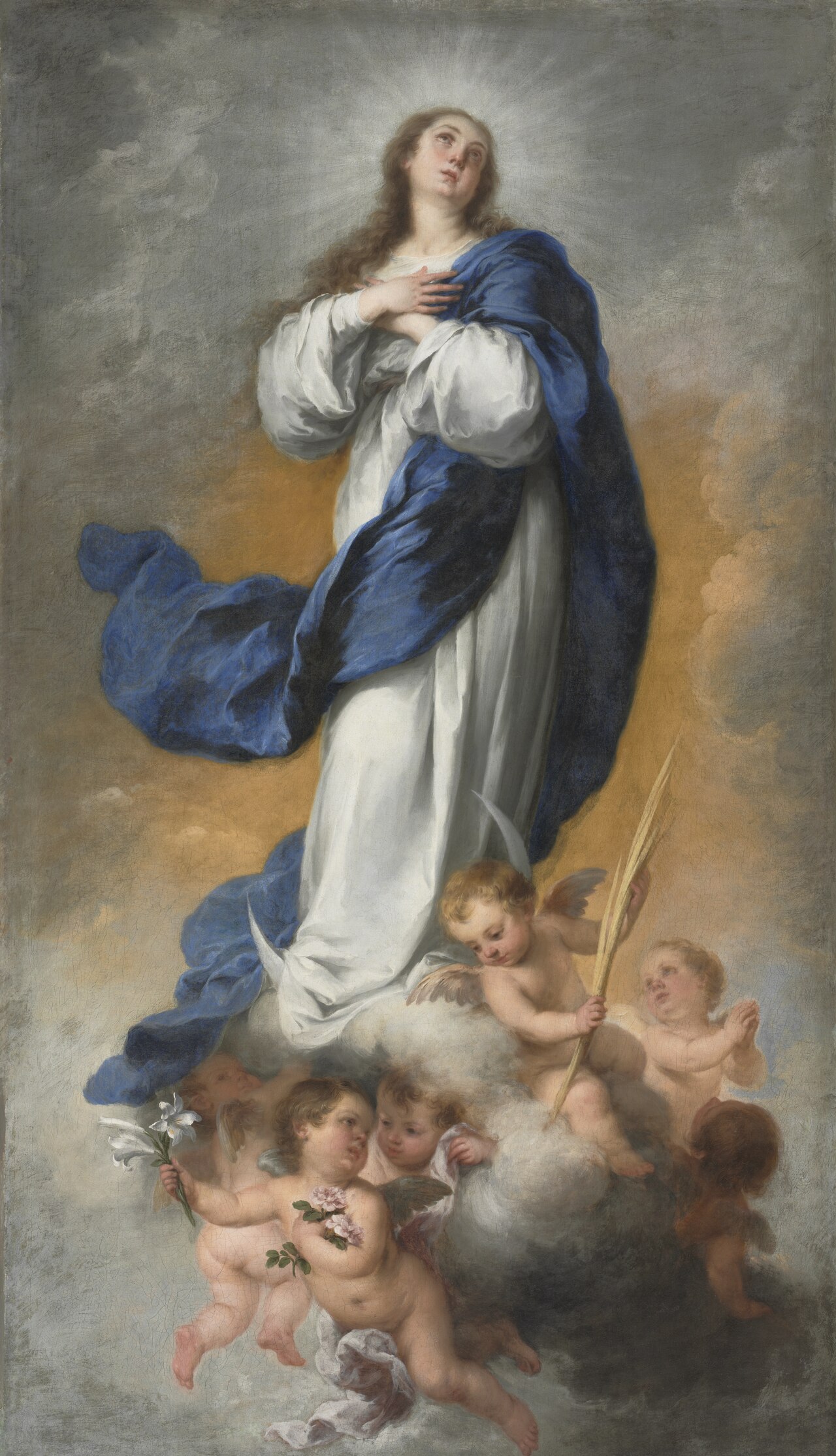
Aerial figures. His angels and ascending Virgins are bathed in a golden-warm luminosity that seems to come from no earthly source. The bodies lose weight. Clouds become architecture. In his great Immaculate Conception canvases the Virgin does not so much float as belong to another order of gravity entirely.
Tender observation of childhood. His genre scenes of Sevillian street boys — eating melons, catching fleas, playing dice, sharing a meal — are watched with the eye of someone who actually looked at poor children rather than idealising them. The dirt on their feet is real. So is the laughter.
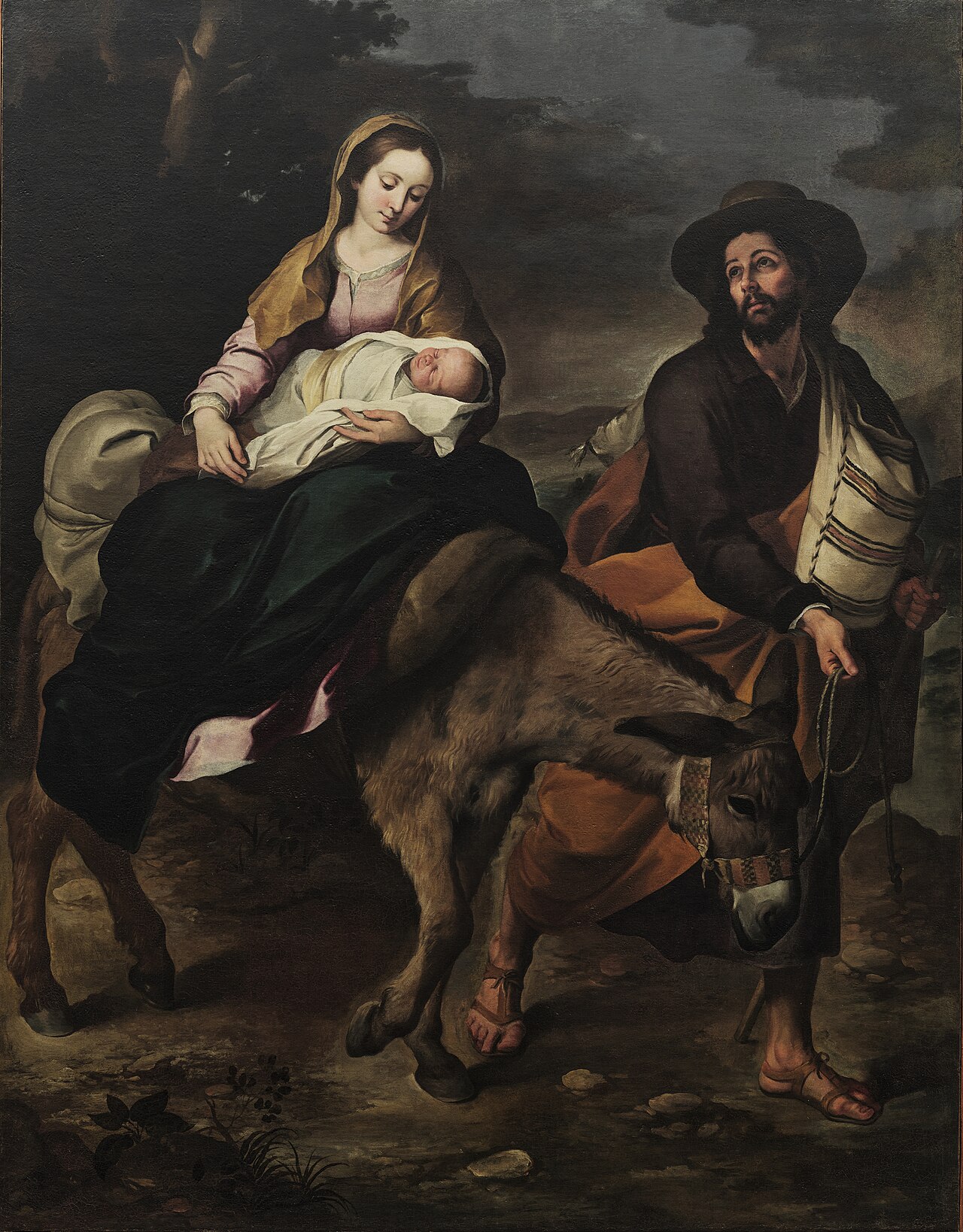
Warmth of religious feeling. Murillo's sacred figures are never remote. His Holy Families occupy domestic spaces that feel lived-in: a carpenter's workshop with wood shavings on the floor, a kitchen where the Christ Child plays with a pet bird. Theology arrives through intimacy rather than awe.
Soft, dissolved finish. The sfumato-adjacent handling of edges — far softer than Leonardo's, closer to a Flemish watercolourist's — means that forms blend into their surroundings in a way that reinforces the sense of spiritual permeability between the earthly and the divine.
He was, in his own century, the most internationally famous Spanish painter alive — more collected in London and Paris than Velázquez, more reproduced than any of his countrymen. The Romantic period adored him. The nineteenth century plastered his Immaculate Conceptions and beggar-boy genre scenes across every bourgeois drawing room in Europe. Then the tide turned: the twentieth century found him too sweet, too easy, too consoling. The pendulum is swinging back. What the twentieth century called sentimentality, the twenty-first is beginning to recognise as a radical insistence that mercy is a legitimate subject for art.
Life and legacy
He was baptised in Seville on 1 January 1618, born the previous day — the feast of Saint Sylvester, which may account for the 31 December birth date recorded in some sources. He was the youngest of fourteen children. His father, Gaspar Esteban, was a barber-surgeon; his mother, María Pérez Murillo, died when Bartolomé was about nine, and both parents were gone before he was eleven. He was taken in and raised by an aunt and uncle, a modest artisan household in the heart of a city that was, in the early seventeenth century, the wealthiest and most cosmopolitan in the Spanish empire: the port through which all American silver flowed.
His first training was under Juan del Castillo, a competent Sevillian painter and a relative by marriage, in whose workshop the young Murillo learned the fundamentals of oil painting while watching how a working studio in a Counter-Reformation city operated. The commissions that kept studios alive in Seville were overwhelmingly religious: altarpieces for convents, devotional paintings for the great charitable confraternities, images of the Virgin for private oratories. He absorbed this world before he could fully articulate it.
Sometime around 1645 — precise dates are elusive — Murillo completed the cycle of eleven large canvases for the small cloister of the Franciscan convent of San Francisco in Seville, his first major independent commission. The series depicted the life of Franciscan saints and the works of mercy, and it established him overnight as a painter of serious ambition. Visitors came from across Andalusia to see them. A contemporary account describes the canvases as so lifelike that the friars believed they were looking through windows, not at paint.
It was probably in the late 1640s that Murillo made what historians believe was a single extended journey to Madrid, where he had access to the royal collections — Titian, Rubens, van Dyck, Velázquez — and to the paintings accumulating in the great private collections of the court. No documentary evidence survives for this trip, but the transformation visible in his work from around 1650 onward — the warmer palette, the softer handling, the increasingly Flemish-inflected luminosity — is hard to explain without it.
Through the 1650s and 1660s the commissions accumulated. The Hospital de los Venerables, the Hospital de la Caridad — for whose Brotherhood of Mercy, founded by the reformed libertine Miguel de Mañara, Murillo painted some of his most theologically serious works — and a succession of Sevillian convents all sought his hand. His Immaculate Conception paintings became objects of particular devotion: the doctrine of Mary's sinless conception, contested between Dominicans and Franciscans for centuries, had become the defining theological passion of Seville, and Murillo gave it a visual form that no other painter had matched.
In 1660 Murillo co-founded the Real Academia de Bellas Artes de Sevilla together with Francisco Herrera the Younger, becoming its first president. The Academy was modelled on the Roman and Florentine academies, intended to elevate painting from craft to liberal art and to provide systematic training for a new generation. It was, among other things, an act of professional ambition — a declaration that Seville's painters deserved the same institutional recognition as their counterparts in Italy.
His personal life was settled and relatively prosperous. In 1645 he had married Beatriz de Cabrera y Villalobos, daughter of a Sevillian notable, and together they had nine children, though only four survived infancy — a typical grief of the seventeenth century. Beatriz died in 1663, leaving Murillo a widower for the remaining two decades of his life. He never remarried. The tenderness visible in his paintings of mothers and children is not, perhaps, only an artistic convention.
The last great commission of his life came from Cadiz, where the Capuchin friars of the church of Santa Catalina contracted him for a cycle of altarpieces. He travelled to Cadiz in 1682 to oversee the installation and to complete the final large canvas, a 'Mystic Marriage of Saint Catherine'. While working at height on the scaffolding erected inside the church, he suffered a serious fall. He was carried back to Seville, nursed through the winter by his daughter, and died in his house on the Calle de Dos Hermanas on 3 April 1682. He was sixty-four years old.
His will, signed a few days before his death, distributed his possessions with careful piety: paintings to the convents that had formed him, a pension to his surviving daughter, prayers for his wife dead twenty years. He was buried in the church of Santa Cruz in Seville. When the Napoleonic troops dismantled the church in 1810, his tomb was lost. The paintings survived, scattered across Europe in the wave of looting that accompanied the French occupation, many of them ending up in the Louvre, the Prado, and the great English country-house collections — where a generation of Romantic collectors would discover him and declare him, without much exaggeration, the greatest painter who had ever lived.
Five famous paintings
The Immaculate Conception 1680
Murillo returned to the subject of the Immaculate Conception dozens of times over his career — it was the defining theological image of seventeenth-century Seville — but the late version of circa 1678–1680, now in the Prado (274 × 190 cm), represents his most complete realisation of the type. The Virgin stands not on solid ground but on a crescent moon and a bank of cloud, her feet just touching the upper air. She is young — almost adolescent — dressed in white and blue, the colours of purity and heaven. Her hands are crossed at the breast or gently opened; her gaze is cast upward into a light that seems to have no source. Around her, angels and cherubim tumble in a vortex of gold and cream, some carrying lilies and palm branches, the traditional symbols of her sinlessness. What distinguishes this canvas from Murillo's earlier Concepción treatments — and from those of every other painter who attempted the subject — is the quality of the aerial luminosity. The Virgin does not float so much as belong to the light itself; her white robe bleeds into the surrounding cloud and the surrounding cloud bleeds into the celestial gold behind it. The sfumato-adjacent handling of edges makes the boundary between the human and the divine literally invisible. When this painting left Seville in the Napoleonic looting of 1813, the citizens lined the streets and wept.
Saint Rose of Lima 1670
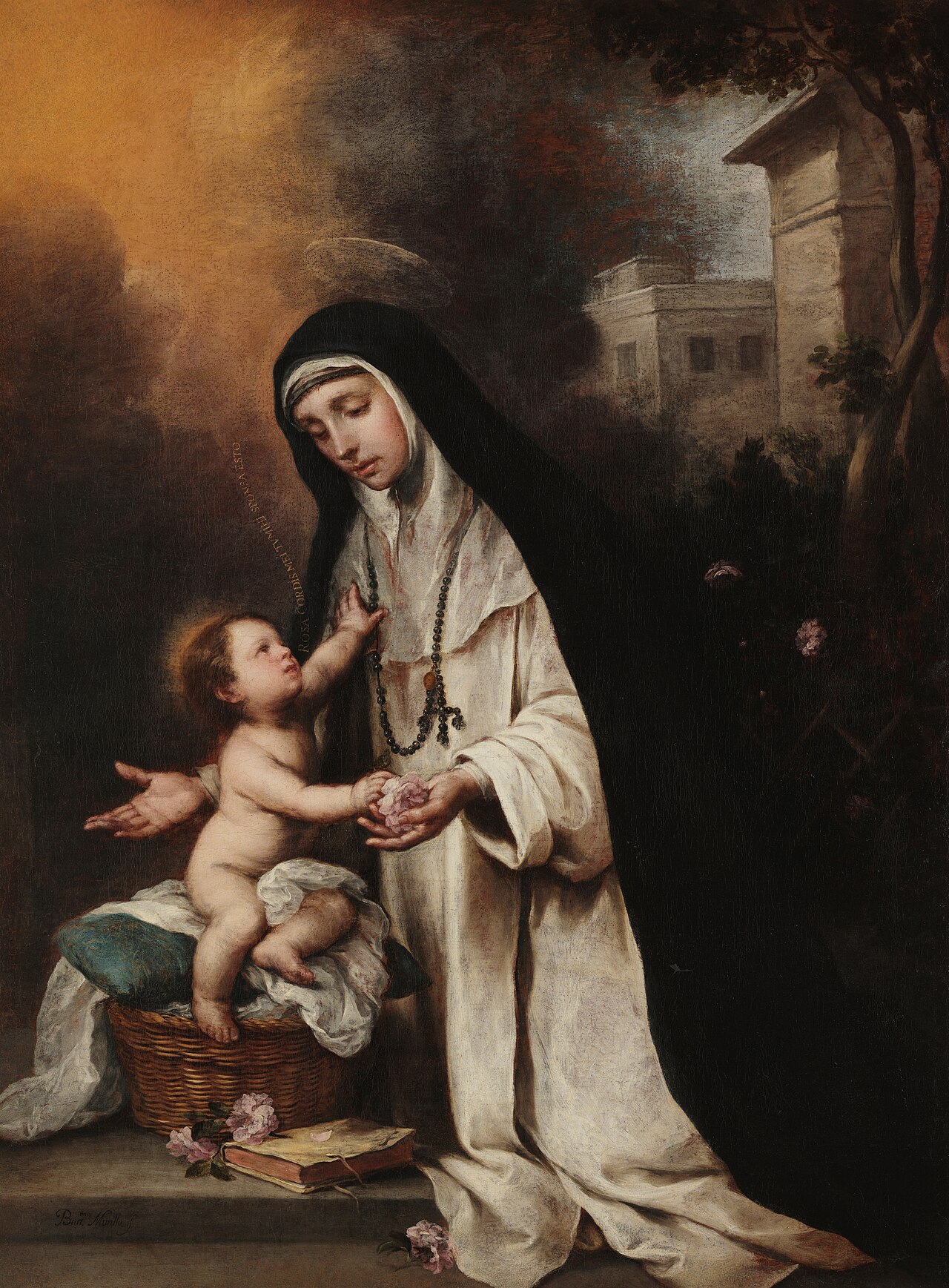
Saint Rose of Lima (1586–1617) was the first person born in the Americas to be canonised by the Catholic Church, declared a saint in 1671 — almost exactly when Murillo painted this canvas. The timing was not accidental: her canonisation was a major event in the Spanish Catholic world, and commissions for her image proliferated across Spain and its colonies. Murillo's version, now in the Hermitage in Saint Petersburg (164 × 110 cm), shows the young Peruvian mystic in the white habit of the Dominican tertiary, a crown of roses on her head — the attribute that gave her her name — and an expression of rapt, interior absorption that is entirely characteristic of Murillo's mature religious portraiture. A small Christ Child, luminous and weightless, appears in the upper right corner, reaching down toward her. The painting demonstrates Murillo's gift for combining doctrinal precision with emotional warmth: this is not an icon but a encounter, and the saint's upturned face conveys the specific quality of mystical transport — beyond happiness, beyond pain — that the Counter-Reformation Church wanted its faithful to aspire toward. The handling of the white habit is a technical tour de force, the vaporous whites modulated through dozens of near-invisible glazes.
Four Figures on a Step 1655
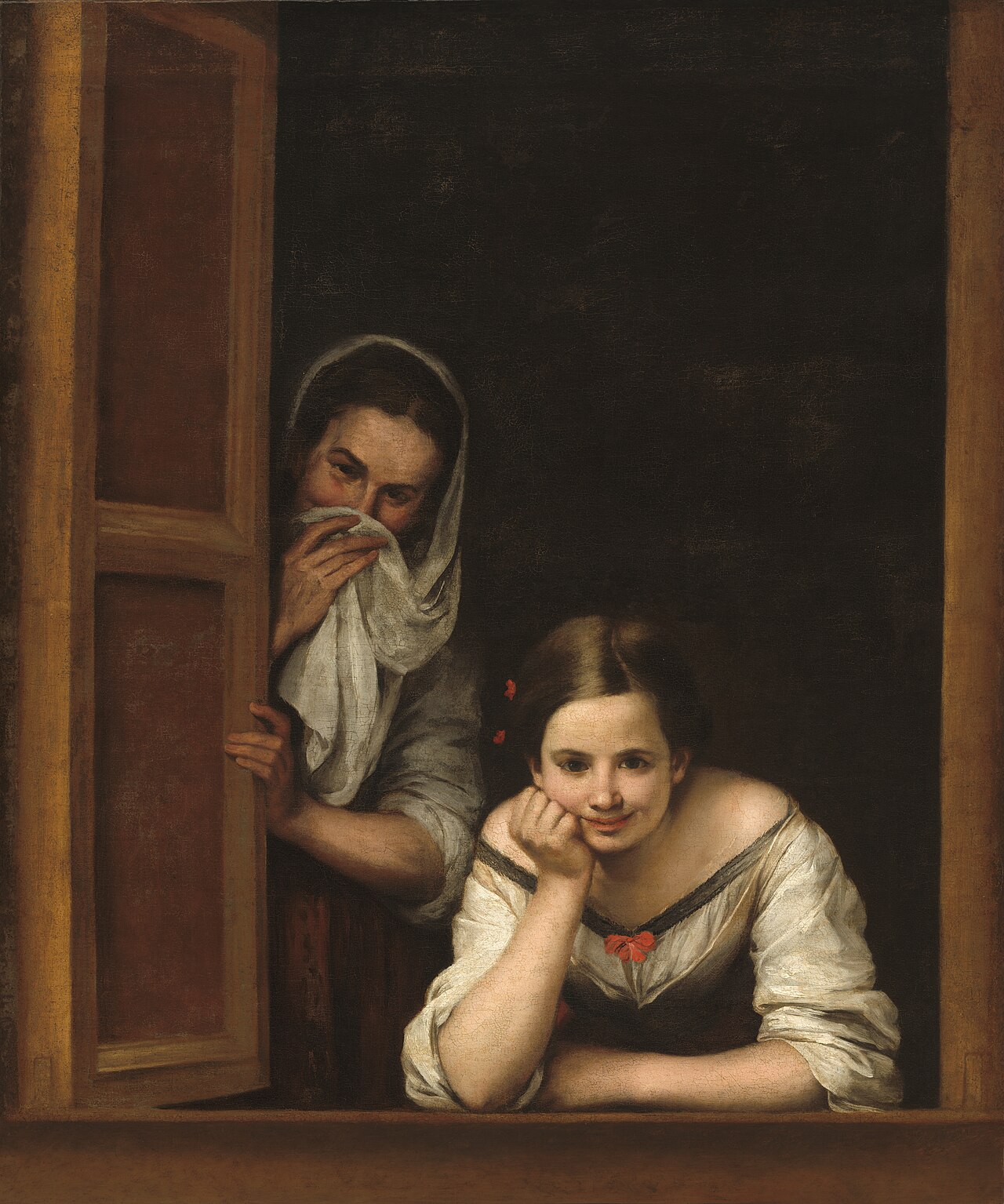
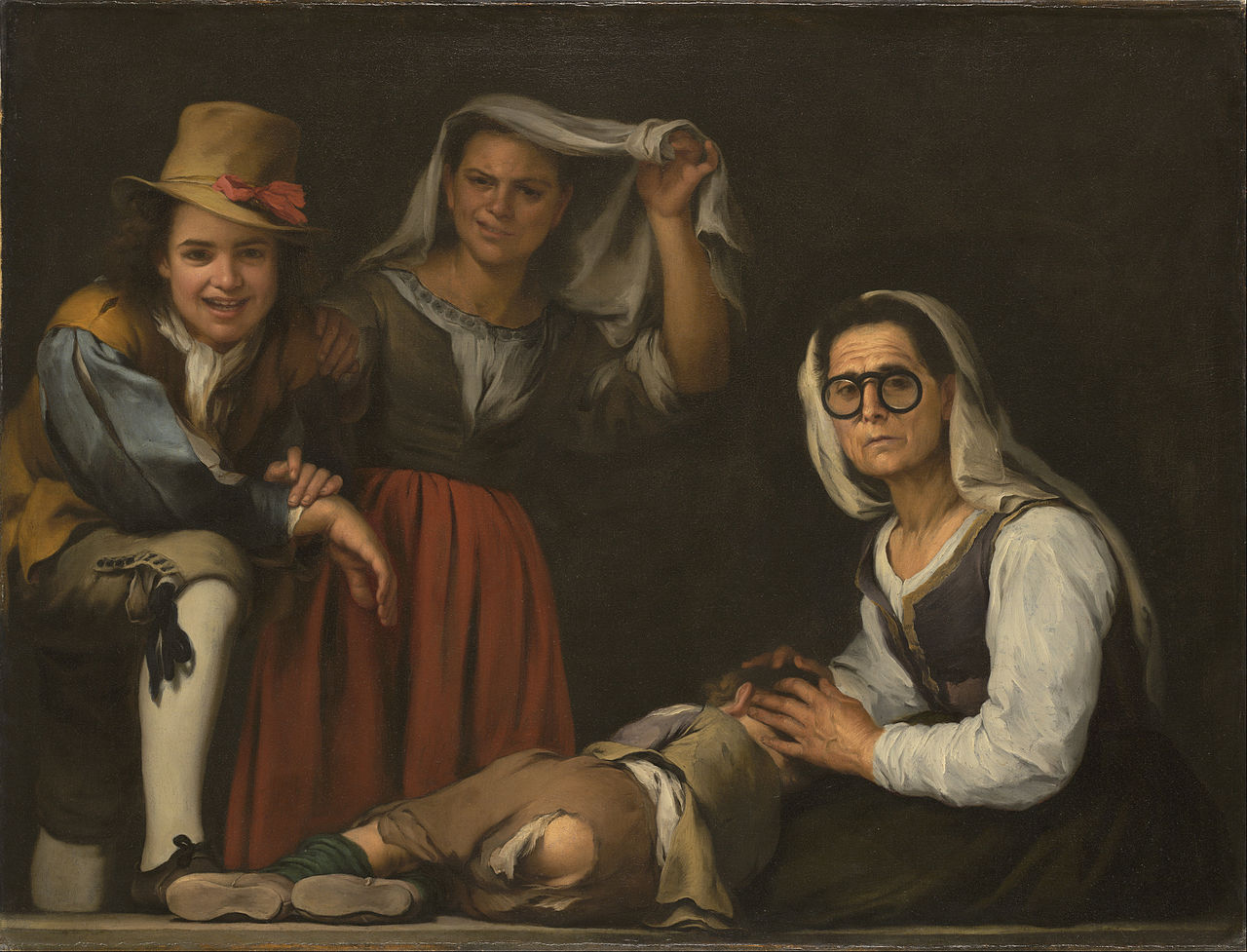
This is one of the most enigmatic paintings in Murillo's oeuvre, and one of the most purely pleasurable (Kimbell Art Museum, Fort Worth; 109 × 143 cm). Four figures occupy a shallow space just above a stone step: two young women — one dark-haired, one lighter, both wearing the layered skirts and loose blouses of Seville's working poor — and behind them, almost in shadow, an older woman and a laughing boy. The two women look directly out at the viewer with an expression that is neither coy nor challenging but something harder to name: aware, amused, completely at ease with being looked at. The boy beside the older woman appears to be pulling back a curtain or leaning around a doorframe. The painting has been read as genre scene, as brothel scene (the term used in early inventories is sometimes translated as such), as an image of a picaresque household, and as a straightforward portrait of Murillo's own neighbours. None of these readings fully accounts for the warmth and specificity of the characterisation. What is certain is that these four people are actually seen — observed with the kind of attention that only comes from genuine interest rather than sociological distance. The palette is muted: ochres, greys, warm whites — entirely typical of Murillo's genre work and entirely unlike his religious canvases.
The Holy Family with a Bird 1670
There are two versions of this composition — an earlier one in the Prado (144 × 188 cm, c. 1650) and a later variant; the Prado canvas is the canonical image. The setting is unmistakably domestic: a carpenter's workshop, implied by the tools and timber visible in the background, where Joseph sits to one side reading or resting while Mary, seated on the ground with her skirts spread around her, watches the Christ Child play with a small dog. The child holds a bird — a goldfinch, the traditional symbol of the Passion — which it dangles just out of the dog's reach. He is laughing. Mary watches with an expression that mingles delight and the faintest shadow of foreknowledge. Joseph, slightly apart, is benign and a little sleepy. What makes this painting remarkable is not its theology but its temperature: it feels warm. The light falls softly from the left, picking out Mary's red dress and blue mantle, the Christ Child's chubby limbs, the dog's eager nose. The Holy Family are not performing divinity; they are spending an afternoon together, and we have been allowed to watch. It is this quality — sacred intimacy without loss of reverence — that made Murillo's domestic religious scenes the most beloved images in Counter-Reformation Spain.
Young Man Drinking Wine 1670
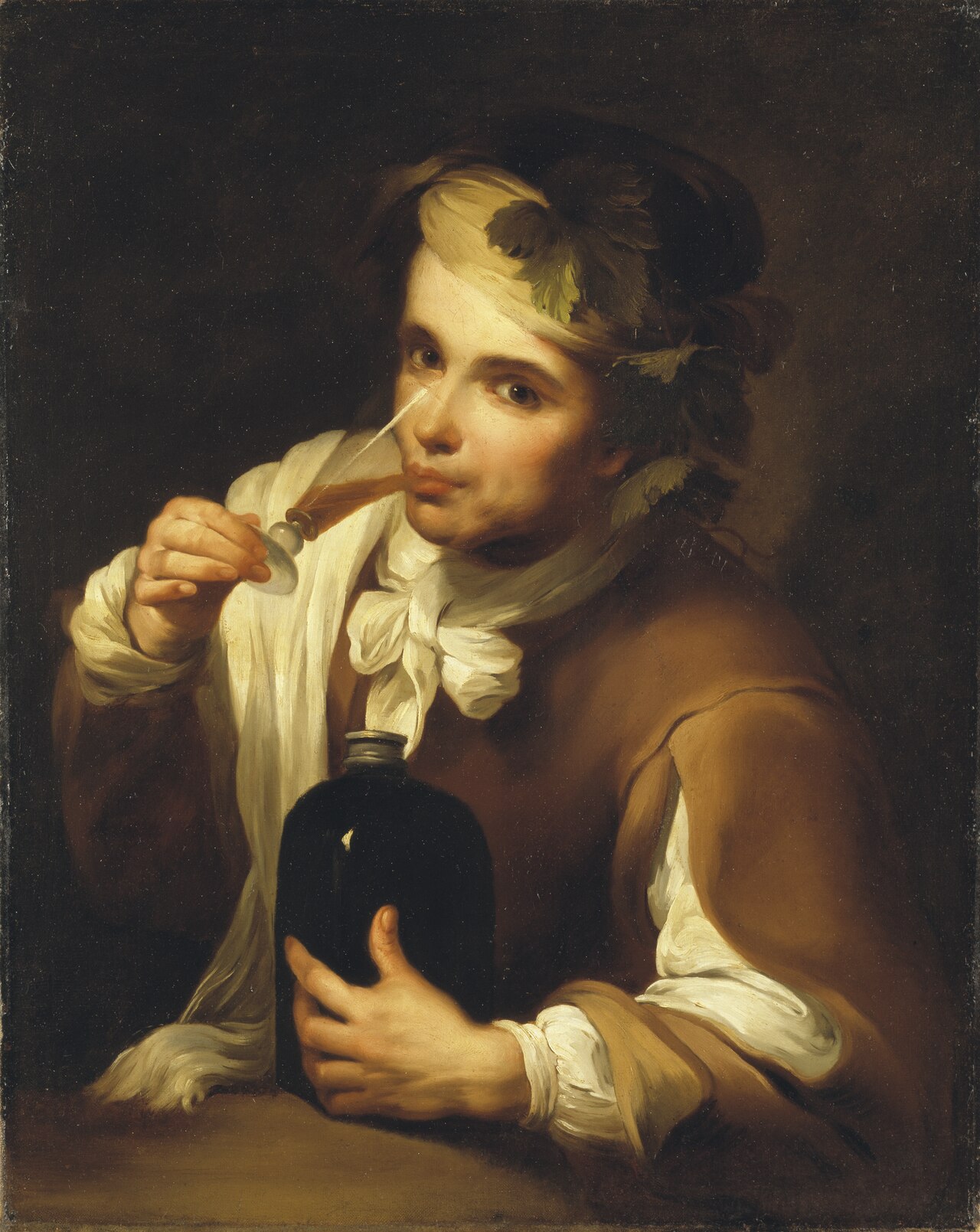
Among Murillo's genre scenes of Sevillian street life, this canvas (Hermitage, Saint Petersburg; c. 1670–1675) stands out for its directness and its complete lack of moralising. A boy — perhaps twelve or thirteen, barefoot, in ragged clothing — tilts his head back to drink from a ceramic jug. His eyes are half-closed with pleasure. Behind him, slightly out of focus in the warm brown ground, another figure watches or waits. That is the entirety of the image. There is no rebuke, no cautionary framing, no indication that the painter finds anything in the scene to deplore. The boy is simply enjoying his drink, and Murillo records the fact with the same attentiveness he brings to an Immaculate Conception. This was the quality that Velázquez — who had spent much of his early career painting similarly unidealized Sevillian genre subjects — might have recognised in the younger painter. The handling is looser than in Murillo's religious work: bravura brushwork in the clothing, a few rapid strokes for the jug, the face built up in warm transparent glazes over a reddish ground. The Romantic period adored these pictures above almost everything else Murillo painted, and prints after them circulated across Europe in the tens of thousands.