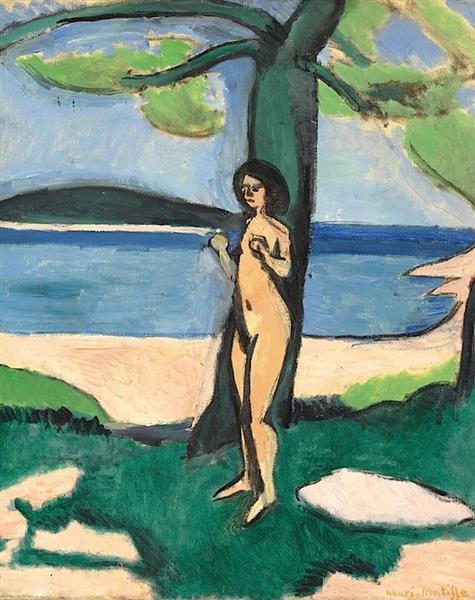
André Derain
The Fauvist who set London ablaze with color, then walked away from the wild beasts he helped create.
Style and technique
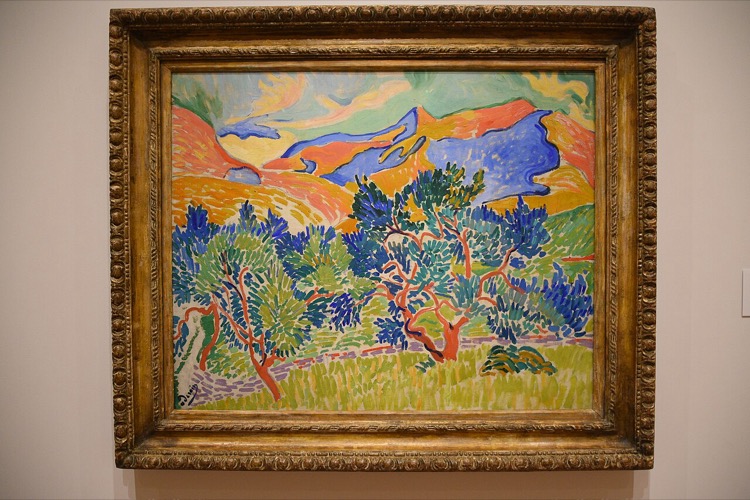
Derain's Fauvist style, forged alongside Henri Matisse in the summer of 1905 at Collioure, abandoned any pretense of describing the world as the eye perceives it. Color became an autonomous, expressive force: skies turn orange or violet, water runs in stripes of pink and green, tree trunks flare cobalt blue against fields of raw vermilion. Derain applied paint in short, urgent strokes and broad slashing patches, often leaving bare canvas visible between marks, building surfaces that vibrate with unresolved, high-key contrasts rather than naturalistic harmony. He worked from the motif but treated what he saw as raw material for arrangements of pure pigment, following Signac's divisionist theory only loosely before breaking it into freer, more agitated rhythms.
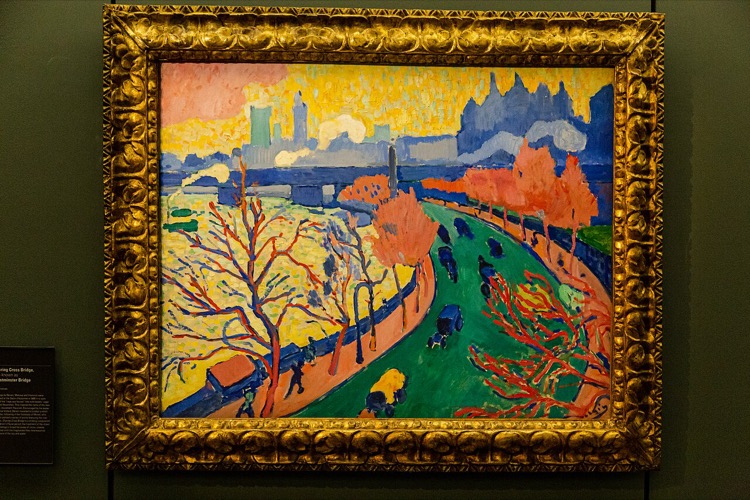
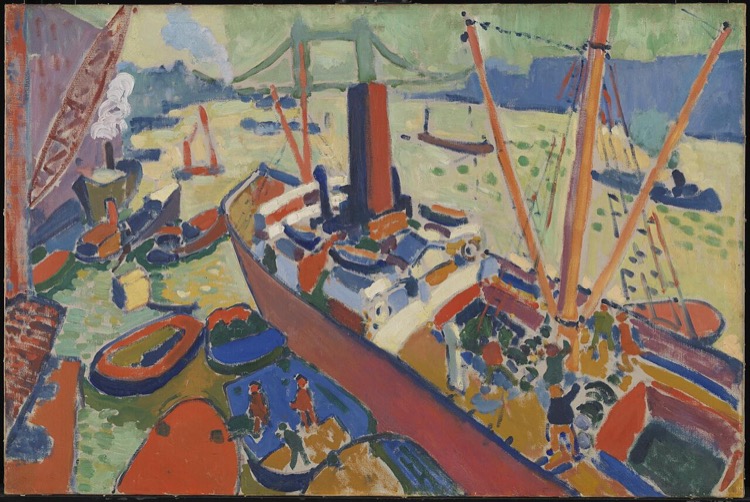
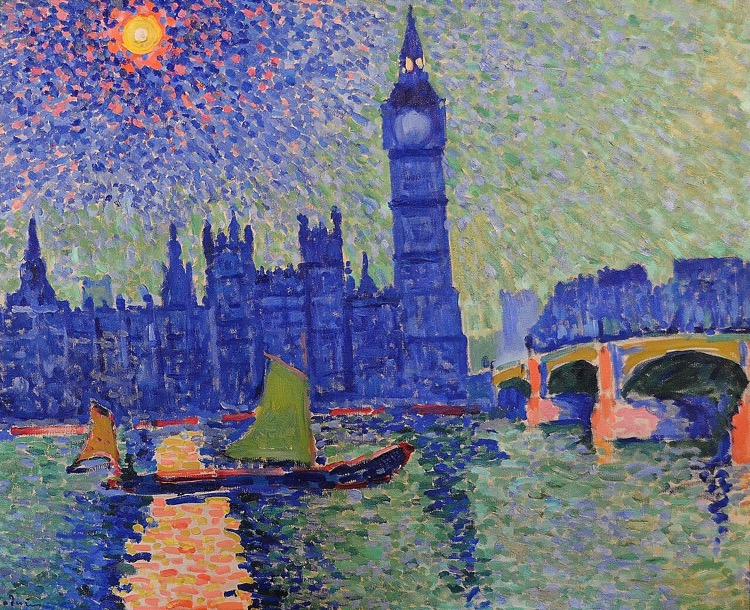
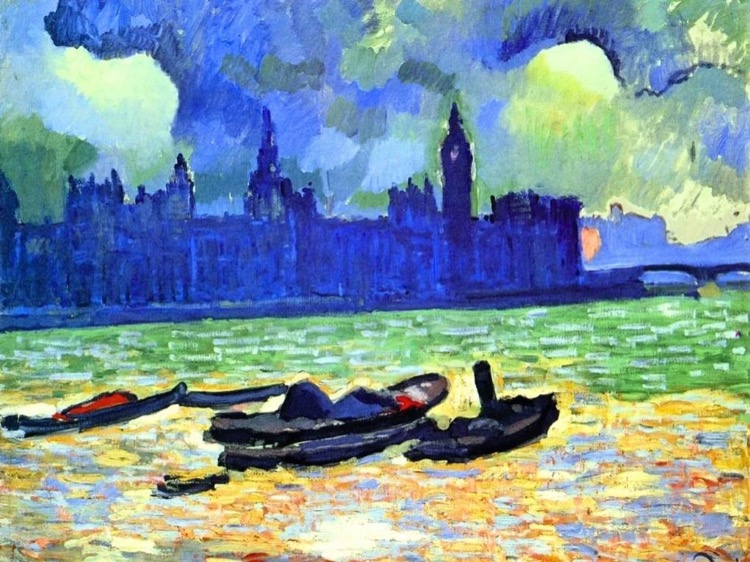
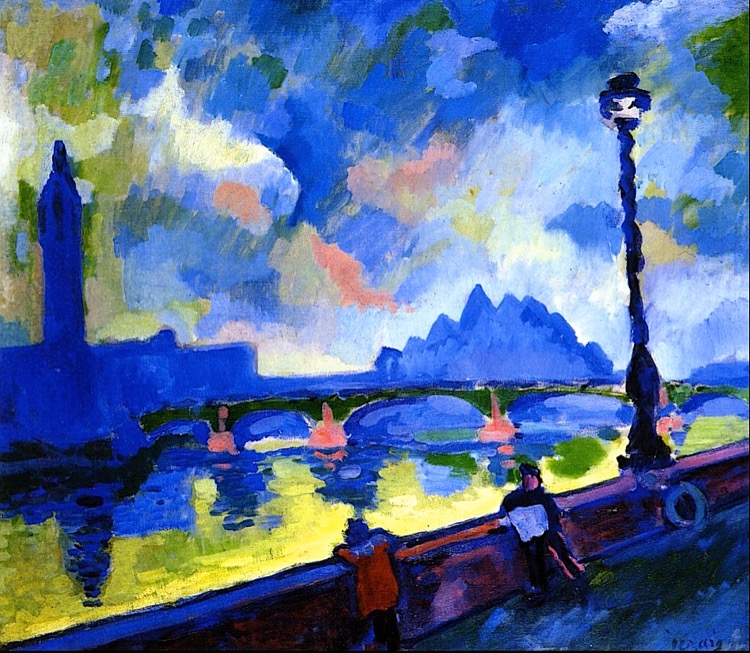
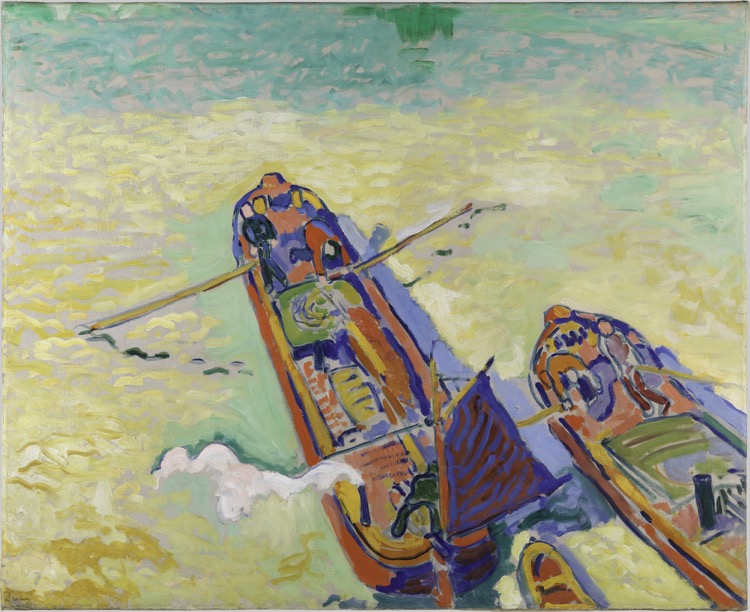
This approach reached its most spectacular expression in the London series of 1906, thirty canvases commissioned by dealer Ambroise Vollard in deliberate homage to Monet's earlier views of the Thames. Where Monet dissolved the city in atmospheric haze, Derain reinvented it in jarring, arbitrary hues — Charing Cross Bridge glows acid orange, the Houses of Parliament burn against a violet sky, barges and water are patched with unmixed reds, greens, and blues laid side by side.
By 1907, exposure to Cézanne and to African sculpture pulled Derain toward greater structure. His landscapes grew more architectonic, forms simplified into faceted planes, and his palette cooled from Fauvist brilliance toward earthier ochres, greens, and grays — a shift that anticipated Cubism even as Derain soon retreated from radical experiment. Through the 1910s and beyond he increasingly looked to the old masters, favoring somber tonality, firm draftsmanship, and classical composition over raw sensation. The still lifes, portraits, and landscapes of his later career trade the wild dissonance of Collioure and London for a deliberate, museum-conscious gravity, though the confident touch he developed as a young 'wild beast' never entirely left his hand.
Life and legacy
André Derain was born on June 10, 1880, in Chatou, a riverside town just west of Paris popular with weekend boaters and painters. As a young man studying engineering, he began painting along the Seine, and in 1900 he met Maurice de Vlaminck after a minor train derailment left them stranded together; the two soon shared a makeshift studio in Chatou and painted constantly side by side. Around 1901, Derain introduced Vlaminck to Henri Matisse, whom he had met at the Académie Carrière, forming the nucleus of what would become Fauvism.
The decisive summer came in 1905, when Derain joined Matisse in the small Mediterranean fishing port of Collioure. Working together through the hot months, the two painters pushed color toward pure, unmixed intensity, freed from any duty to describe local hue or atmosphere. The canvases they brought back to Paris — Derain's Mountains at Collioure among them — appeared that autumn at the Salon d'Automne, hung in a single room alongside works by Vlaminck, Braque, and others.
Fauvism's peak was brief but intense. In 1906 the dealer Ambroise Vollard sent Derain to London to paint a series of views deliberately echoing Monet, and Derain answered with some of the movement's most audacious canvases: bridges, barges, and Parliament rendered in arbitrary, blazing hues.
Cézanne's example, African and Iberian sculpture, and his growing friendship with Picasso and Braque pushed him toward firmer structure and a cooler, more subdued palette — a shift some of his former allies saw as a retreat from the movement he had helped launch.
Derain spent the 1910s through the 1930s consolidating a reputation as a leading French avant-gardist turned classicist, respected for landscapes, portraits, and stage designs steeped in old-master gravity. That standing was badly damaged during the Second World War, when in 1941 Derain accepted an invitation, along with several other French artists, to travel to Germany on a Nazi-organized cultural trip. Framed by the occupying regime as a goodwill and propaganda gesture, the journey associated Derain with collaboration and cost him dearly at the Liberation, when he was shunned by parts of the art world despite never having endorsed Nazi ideology outright. He continued painting in relative isolation at his home in Chambourcy until his death on September 8, 1954, in Garches, his reputation permanently complicated by choices made in Fauvism's disorienting aftermath and in wartime France.
Five famous paintings
Charing Cross Bridge 1906
Commissioned by the dealer Ambroise Vollard as a deliberate rival to Monet's earlier views of the same bridge, this canvas turns London's famously grey light into a firework of arbitrary color. The sky burns acid orange and pink, the Thames runs in slashing bands of turquoise, violet, and gold, and the bridge's ironwork dissolves into a rhythm of short, urgent brushstrokes rather than descriptive detail. Boats and pedestrians are reduced to quick patches of pure pigment. Painted during Derain's celebrated 1906 stay in London, it stands among the most audacious canvases of the entire Fauvist movement and now hangs in the Musée d'Orsay, Paris.
Mountains at Collioure 1905
Painted during the pivotal summer of 1905, when Derain worked side by side with Matisse in the small Catalan fishing port of Collioure, this landscape shows the hills above the town rendered in unmixed reds, oranges, and violets that owe nothing to observed local color. Short, choppy strokes of raw pigment build the mountainside into a vibrating mosaic of heat and light, bare canvas visible between marks. Shown that autumn at the Salon d'Automne alongside Matisse's own Collioure canvases, it was among the works that prompted critic Louis Vauxcelles to brand the room's painters 'fauves' — wild beasts — giving Fauvism its name.
Big Ben 1906
Derain paints the most official, most photographed monument in London as a fever of clashing color: the clock tower's Gothic silhouette rendered in near-violet shadow against a sky streaked with acid yellow and orange, the Thames below reduced to quick, unmixed dashes of pigment. Painted during his 1905-06 stay commissioned by the dealer Ambroise Vollard (who sent Derain to London hoping to repeat Monet's earlier success with the same subject), the canvas shows how far Fauvism could push a landmark associated with imperial permanence into something restless and purely optical. Nothing here is descriptive; the tower reads not as stone but as a vertical accent holding together a canvas built entirely from the friction between hot and cool color.
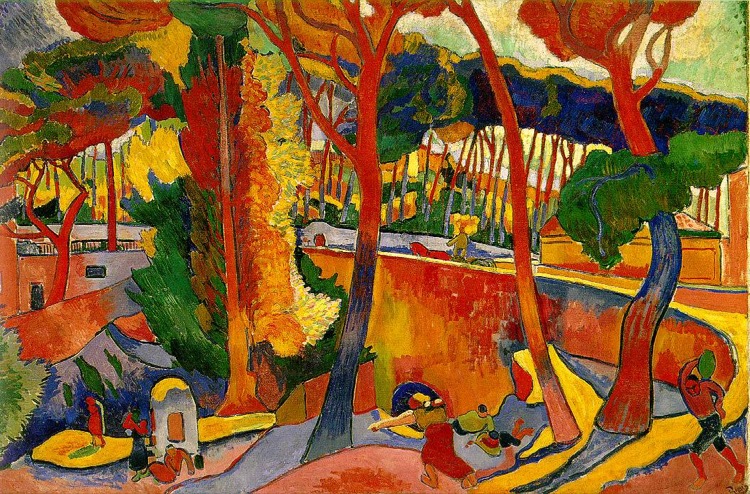
The Turning Road, L'Estaque 1906
Painted on a return visit to the Provençal coast near Marseille, this landscape shows Derain's Fauvist color cooling toward greater structure. A road curves through orange and green hillsides dotted with simplified houses and trees, trunks reduced to bold, near-geometric silhouettes recalling Cézanne. The high-keyed palette of the Collioure years survives, but loose brushwork gives way to firmer patches of color organizing the composition into planes. Painted the same year as the London series, it captures Derain at the hinge between Fauvist sensation and the architectonic style he would soon adopt, now in the Museum of Fine Arts, Houston.
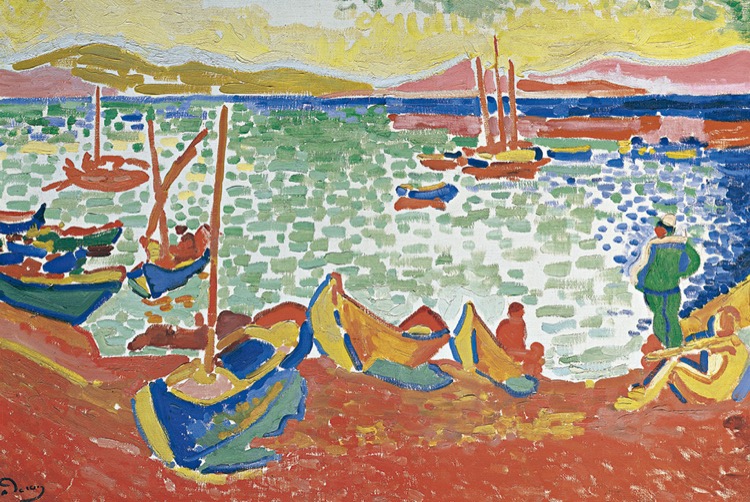
Boats in the Harbour of Collioure 1905
Small fishing boats crowd the harbour at Collioure, their hulls, masts and reflections dissolved into ribbons of pure, unmixed color — pink, turquoise, orange — laid side by side rather than blended. Painted during the pivotal summer of 1905 that Derain spent working alongside Matisse in this small Catalan fishing port, the canvas is one of the foundational documents of Fauvism: proof that a real, sunlit Mediterranean motif could be rendered through color with no descriptive obligation to the actual local hues of water, wood or sail. The brushwork stays loose and rapid, each boat summarised in a few confident strokes, the whole scene humming with the heat and light of the harbour rather than recording its literal appearance.