
Expressionism / Fauvism
Colour as a weapon, feeling as the only fact — Matisse's joy and Kirchner's dread, one generation apart.
In October 1905, the Salon d'Automne in Paris hung a marble bust of the Renaissance sculptor Donatello in a room surrounded by canvases painted in raw, shrieking colour — reds applied to a face where no red belonged, orange oceans, violet shadows on green skin. A critic, Louis Vauxcelles, looked at the incongruity and coined a phrase: "Donatello surrounded by wild beasts" (*fauves*). The name stuck, and Fauvism entered the dictionary of modern art. Matisse, Derain, Vlaminck and their circle had not planned a movement; they had simply followed a conviction — that colour should be freed from the obligation to describe what things look like and used instead for what it could make you feel. In Germany, almost simultaneously, the painters of Die Brücke were reaching the same conclusion from a darker direction. Kirchner, Heckel, Schmidt-Rottluff, founded their group in Dresden in 1905, and saw in colour's violence not a Mediterranean pleasure but an existential necessity: the scream against urban alienation, industrial modernity, the creeping anxiety of a continent edging toward catastrophe. Expressionism — German and Austrian, Kirchner and Schiele — and Fauvism — French and bright — are the two poles of the same discovery.
Origin and history
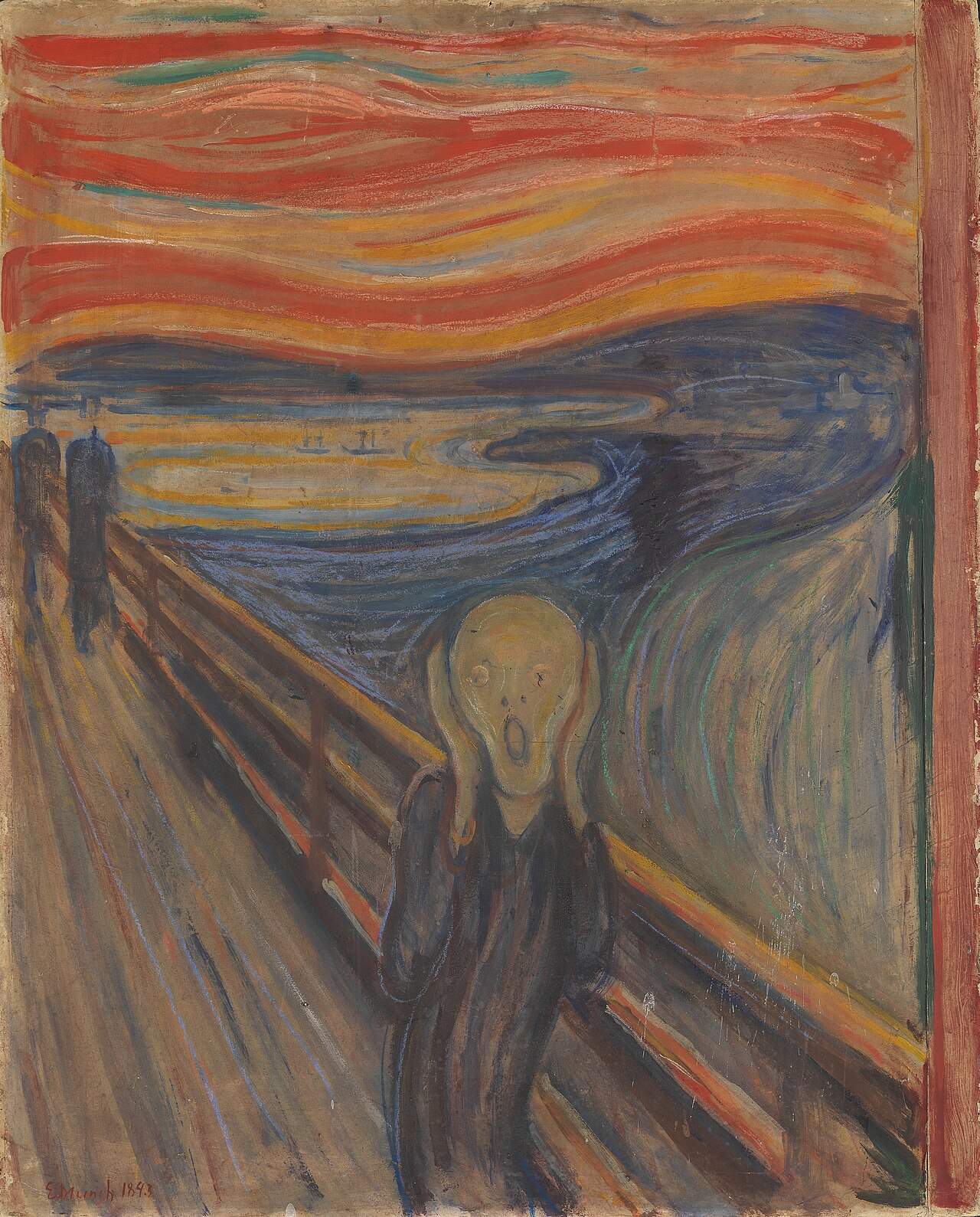
The roots of both movements lie in the same generation of precursors: van Gogh, Gauguin, Munch. All three had shown, in the 1890s, that paint could carry emotional rather than optical truth — that a cypress could writhe with anxiety, that a Tahitian sky could flatten into blocks of spiritual colour, that a human face against a blood-red sky could transmit existential dread. By 1900 these lessons were common knowledge in the studios of Paris and Berlin.
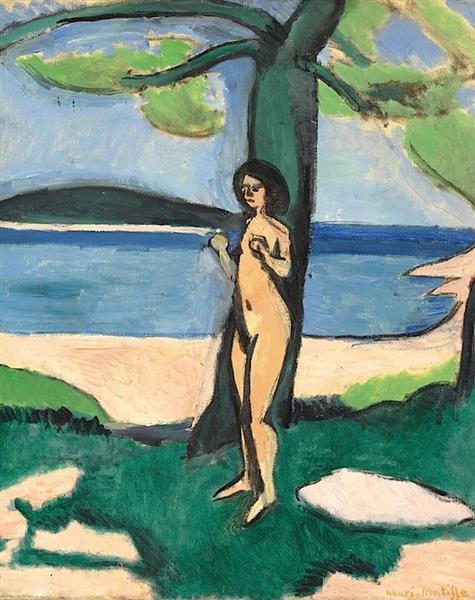
Fauvism crystallised in France between roughly 1904 and 1908. Matisse had already pushed his palette far beyond naturalism in his 1904 *Luxe, Calme et Volupté* and the incandescent *Bonheur de Vivre* (1905–06). His summer in Collioure in 1905 with André Derain — both men applying colour in flat, unblended strokes under the southern light — produced the pair of paintings that would define the Fauvist moment. Derain's *Mountains at Collioure* and Matisse's *Open Window, Collioure* (both 1905) are essentially colour-field paintings avant la lettre, all sensation and no description. Maurice de Vlaminck, who claimed he had never visited the Louvre and had no interest in tradition, pushed the paint application to a still more violent impasto. The group dissolved almost as quickly as it formed: by 1908 Braque had moved toward Cubism, Derain toward classical gravity, and Matisse was developing the serene decorative language that would occupy him for the next fifty years.
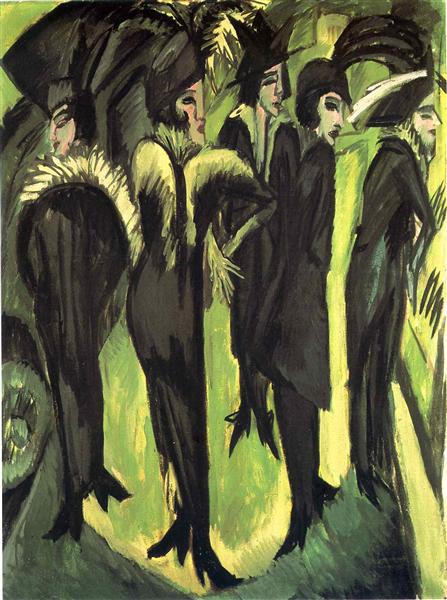
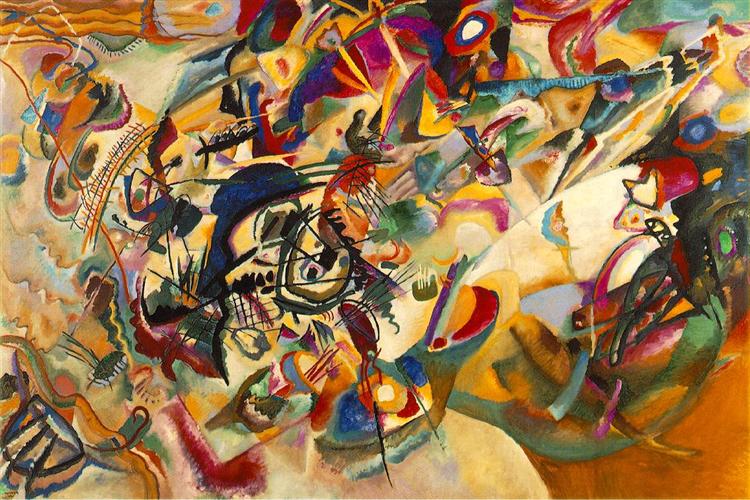
German Expressionism has a different mood and a longer arc. Die Brücke ("The Bridge") was founded in Dresden in June 1905 by four architecture students — Kirchner, Heckel, Schmidt-Rottluff and Bleyl — who wanted to bridge the distance between present art and a freer future. Their exhibitions were raw and physically aggressive: hand-carved woodcut prints, paintings on sackcloth, studios decorated with their own work. Kirchner's street scenes — *Street, Dresden* (1908), the harrowing *Berlin Street Scene* (1913–14) — capture the nervous energy and sexual anxiety of urban modernity with a palette of acid colours and jagged, angular line. Der Blaue Reiter ("The Blue Rider"), founded in Munich in 1911 by Kandinsky and Franz Marc, was the movement's more spiritually oriented branch: less interested in urban anxiety than in colour's metaphysical potential. Kandinsky's path toward pure abstraction began here. Egon Schiele in Vienna, working in radical isolation, took the Expressionist figure to its most psychologically raw extreme — emaciated bodies, raw contour, unflinching sexuality.
Concept and philosophy
The core claim that unites Fauvism and German Expressionism is that colour carries feeling independently of form. A tree painted red is not a mistake; it is a statement about what the painter feels in the presence of that tree. Both movements were declaring war on the same enemy: the centuries-old convention that painting's job was to approximate the appearance of the visible world.
Fauvism pursued this liberation through pleasure. Matisse, the movement's intellectual centre, spoke of art as an armchair for the tired businessman — a place of rest, order and Mediterranean joy. His *La Danse* (1910) — five figures in a circle against a flat blue-green ground — is among the most joyful images in modern art, utterly unconcerned with weight, shadow, depth or narrative. The Fauvist brushstroke is confident, swift, sensuous: paint applied with evident delight in the physical act of painting.
German Expressionism pursued the same liberation through anguish. Where Matisse's line is fluid and releasing, Kirchner's is angular and trapped. Where Derain's colour sings, Schiele's contour accuses. The German Expressionists were painting a world they experienced as hostile — industrial cities, prostitution, spiritual emptiness, impending war. Munch's *The Scream* (1893), though technically pre-Expressionist, is the movement's founding image: a figure whose face has become a wound, screaming into a sky that screams back.
Both currents shared a crucial formal innovation: the deliberate simplification and distortion of form in the service of expression. Perspective was abandoned or drastically compressed. Bodies were elongated, compressed, twisted. The painting surface became a field of decisions, every mark a choice about feeling rather than accuracy. This radicalism was not decorative: it was a claim about the limits of descriptive realism and the priority of subjective experience. The twentieth century's subsequent art — from Abstract Expressionism to Neo-Expressionism to today's figuration — cannot be understood without it.
How to recognise it
Whether you are looking at a French Fauvist canvas or a German Expressionist print, six visual markers will orient you — and the differences within those markers are as telling as the similarities.
- Non-naturalistic colour — The loudest signal: colour chosen for emotional truth rather than optical accuracy. Red shadows, orange skin, violet trees. In Fauvist work the palette tends to be bright and warm; in German Expressionism, harsher and more strident — acid greens, smouldering reds, poisonous yellows.
- Bold, visible brushwork — Paint applied in emphatic, readable strokes with no blending. In Matisse and Derain, strokes are often broad, flat and almost sensuous; in Kirchner and Schmidt-Rottluff they are *jagged, angular and urgent* — the difference in touch reflects the difference in emotional temperature.
- Distorted or simplified form — Figures and objects are flattened, elongated or compressed. Perspective is drastically reduced or eliminated. The Fauvist distortion is usually gentle and decorative; the Expressionist distortion is often violent and psychologically charged.
- Flat, unmodelled areas — Shadow as a separate form, not as a gradient. Faces may be split into flat planes of contrasting colour. Both movements drew on Gauguin's lesson: colour areas can be bounded by dark contour like cloisonné enamel or stained glass, without any illusion of volume.
- Emotional or symbolic subject — Fauvism preferred landscapes, figures in nature, still lives — subjects that gave colour maximum freedom. Expressionism pushed into anxiety, sexuality, alienation and the urban uncanny: Kirchner's prostitutes, Schiele's raw self-portraits, Beckmann's carnival of cruelty.
- Visible primitivism — Both movements consciously borrowed from non-Western art: African masks, Oceanic sculpture, medieval German woodcuts, Japanese prints. The "primitive" was prized not as exotic decoration but as a form of visual directness that academic European painting had suppressed. Look for simplified contours, bold outlines, and a rejection of Renaissance spatial illusion.
Anecdotes and curiosities
Matisse's portrait of his wife had a green stripe down the middle of her face. *Portrait of Madame Matisse* (also called *The Green Stripe*, 1905) is now one of the most admired paintings in the Statens Museum for Kunst in Copenhagen. At the time, it was received as an act of aggression or insanity. The green stripe divides the lit and shadow sides of the face — a colour decision with no precedent in academic portraiture. Matisse's wife, Amélie, reportedly said nothing when she saw it. It sold to the Danish collectors Michael and Sarah Stein, who helped carry Fauvism's reputation to an international audience.
Ernst Ludwig Kirchner destroyed his own health trying to avoid the First World War. Conscripted into the German army in 1914 and sent to train as a motor transport driver, Kirchner suffered a mental and physical breakdown that left him hospitalised for much of the war. He spent the years 1917–1938 in Davos, Switzerland, recovering — and painting the alpine landscape with the same neurotic intensity he had brought to Berlin's streets. When the Nazis declared his work *entartet* (degenerate) in 1937 and removed 639 of his works from German museums, he destroyed a large number of his own paintings and shot himself in June 1938.
Egon Schiele was imprisoned for displaying erotic drawings in a room accessible to children. In April 1912, Schiele was arrested in the small Austrian town of Neulengbach on charges that included the abduction of a minor (later dropped) and the public display of indecent images. He spent 24 days in custody. During those days he made a series of small watercolours of his cell, his orange blanket, and his own hands — among the most moving works he ever produced. The judge burned one of his drawings in the courtroom as an example of public corruption.
André Derain and Maurice de Vlaminck discovered van Gogh together in a Paris retrospective and immediately changed how they painted. The 1901 van Gogh retrospective at the Galerie Bernheim-Jeune in Paris hit both men with the force of a revelation. Vlaminck reportedly said he loved van Gogh better than his own father. Within weeks, both painters had adopted the swirling, loaded brushstroke and heightened colour that would become the Fauvist signature. It is one of the clearest documented examples of a single exhibition changing the course of art history.
Legacy and influence
The legacy of Expressionism and Fauvism runs through the twentieth century as a double current — one joyful, one anguished — that never quite ran dry. Matisse's liberation of colour fed directly into the decorative boldness of late Picasso, the flat planes of Pop Art, the colour-field painters of the 1950s and 60s. His cut-paper *gouaches découpées* of the 1940s and 50s — made when arthritis prevented him from painting — are among the most influential images in modern design, visible in everything from corporate branding to contemporary textile pattern. German Expressionism's impact was equally vast but more subterranean: it fed the nightmare imagery of Otto Dix and George Grosz in the Weimar Republic, survived the Nazi period in exile, re-emerged as Neo-Expressionism in the 1970s and 80s (Kiefer, Baselitz, Basquiat) and continues in the raw figuration of painters like Cecily Brown and Dana Schutz today. The Expressionist woodcut — cheap, democratically reproducible, violently direct — became the medium of political protest art across the twentieth century. More broadly, both movements established a principle that art's first obligation is to feeling rather than appearance — a claim so thoroughly absorbed into contemporary practice that it is now almost invisible.
9 artists in this movement
From the blog
Frequently asked questions
What is the difference between Fauvism and Expressionism?
Both movements freed colour from descriptive obligation, but their emotional registers are opposite. Fauvism (Paris, 1904–08) is predominantly joyful — Matisse pursued a Mediterranean warmth, Derain a visual pleasure. German Expressionism (Berlin, Dresden, Munich, 1905–33) is driven by anxiety, alienation and spiritual urgency. The Fauvist brushstroke tends to be fluid and sensuous; the Expressionist mark is often angular and violent. Both inheritances proved equally fertile for the century that followed.
Who were the key Fauvist painters?
Henri Matisse (1869–1954) was the movement's intellectual centre and its most enduring figure. André Derain (1880–1954) and Maurice de Vlaminck (1876–1958) were its most committed collaborators in the 1905–08 years. Raoul Dufy, Albert Marquet and Georges Braque (before his Cubist turn) also worked within the Fauvist circle. The group formed quickly and dissolved just as fast — most members were "Fauvist" for only two or three years.
Who were the key Expressionist painters?
Ernst Ludwig Kirchner (1880–1938), Erich Heckel (1883–1970) and Karl Schmidt-Rottluff (1884–1976) founded Die Brücke in Dresden in 1905. Wassily Kandinsky (1866–1944) and Franz Marc (1880–1916) led Der Blaue Reiter in Munich from 1911. Egon Schiele (1890–1918) in Vienna worked in brilliant isolation. Max Beckmann (1884–1950) and Emil Nolde (1867–1956) are the movement's most powerful figures outside the founding groups.
What does 'degenerate art' mean?
In 1937, the Nazi government organised the *Entartete Kunst* ("Degenerate Art") exhibition in Munich — a deliberately demeaning display of Expressionist, Dadaist and abstract works confiscated from German public collections. Over 650 works were shown, labelled as evidence of racial and moral corruption. The exhibition drew enormous crowds. Many of the displayed works were subsequently sold at auction or destroyed. Kirchner, Nolde, Beckmann, Klee, Kandinsky and Marc were all targeted. The episode remains one of the most brutal state assaults on modern culture in history.
Why did the Expressionists use woodcut so often?
The woodcut — a relief printing technique in which the artist gouges a design into a wooden block — suited the Expressionist temperament perfectly. Its technical demands push toward bold simplification and strong contrast; its marks are inherently angular and forceful; and prints could be produced cheaply and distributed widely. The German Expressionists also saw the woodcut as a connection to the *Dürer era* — a specifically German tradition. Kirchner, Heckel, Schmidt-Rottluff and Nolde all made woodcuts of extraordinary power.