Frans Hals
Haarlem's virtuoso of the fleeting moment, whose slashing brushwork froze laughter and motion mid-instant.
Style and technique
Frans Hals painted as if racing against time itself, and in a sense he was: his subject was never a static pose but a fleeting instant — a laugh mid-breath, a hand mid-gesture, a head turned to catch someone entering the room. To seize that instant he worked alla prima, wet paint into wet paint, in slashing, visible strokes left undisguised on the canvas rather than smoothed into the polished, enamel-like finish most contemporaries prized.
This economy of means became his signature, and it demanded extraordinary confidence: there was no glazing over mistakes, no reworking a stroke that missed its mark.
That speed served a deeper purpose. Where most portraitists of his era aimed for dignified permanence, Hals chased psychological immediacy — genuine, unguarded expression, including the open-mouthed smiles and laughter that convention held undignified for painted portraits.
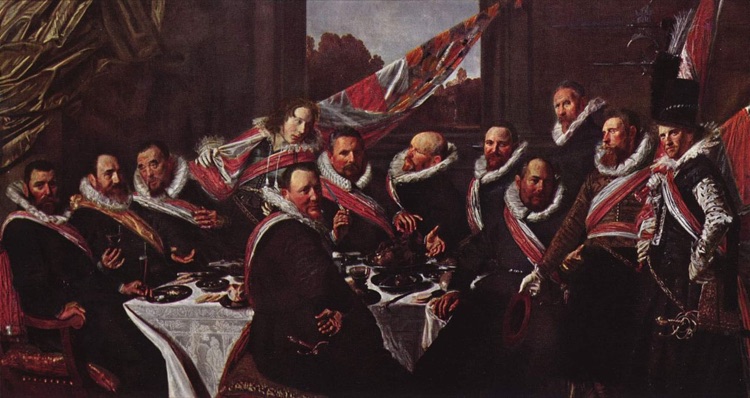
He brought the same energy to his ambitious group portraits of Haarlem's civic guard companies, arranging a dozen or more individually characterized officers across a single canvas without lapsing into the stiff rows typical of the genre, instead choreographing overlapping gestures and glances that give the whole composition the feel of a real gathering caught in motion.
This gestural bravura lay dormant in critical esteem for two centuries, dismissed as careless. It was rediscovered in the 1860s, when critics and painters — Édouard Manet chief among them, after a pilgrimage to see Hals's canvases in Haarlem — recognized in his visible brushwork a direct ancestor of their own break from finish and illusion. Manet, and later the Impressionists, absorbed Hals's lesson that a picture could register the sensation of a moment through the trace of the hand that made it, cementing him as a crucial bridge between Baroque portraiture and modern painting.
Life and legacy
Frans Hals was born around 1582 or 1583 in Antwerp, then part of the Spanish Habsburg Netherlands, into a family of Flemish textile workers. His birth came at a fraught moment: Antwerp was besieged and eventually fell to Spanish forces in 1585, and like thousands of other Protestant families, the Hals household fled north to the newly independent Dutch Republic, settling in Haarlem by the mid-1580s. Hals would spend virtually his entire working life in that prosperous textile and brewing town, becoming as identified with Haarlem as Vermeer is with Delft or Rembrandt with Amsterdam.
He trained under the Haarlem painter, poet, and biographer Karel van Mander, whose 1604 book on Netherlandish artists became an essential source for later art history, though little of van Mander's careful, mannerist finish survives in his pupil's mature work. Hals joined Haarlem's Guild of St Luke in 1610 and married that same year; after his first wife's death he remarried in 1617, eventually fathering at least ten children, several of whom became painters themselves. His breakthrough came with the group portrait, a distinctly Dutch civic genre in which companies of militia guardsmen — men who had once defended their towns from Spain and now dined and paraded as a social and political elite — commissioned grand canvases of themselves banqueting together. Hals's 1616 Banquet of the Officers of the St George Civic Guard announced a radical new energy for the form, and he returned to the militia-portrait genre repeatedly over the following decades, alongside a thriving practice painting individual and pair portraits of Haarlem's merchants, brewers, and their wives.
Despite steady commissions and civic standing — he served on the Guild's governing board and trained numerous pupils — Hals struggled financially for much of his life, frequently in debt to his baker and other creditors, likely owing to his large family, irregular payment for work, and a declining taste for his increasingly loose, unfashionable brushwork as smoother, more classicizing styles gained favor at midcentury. By the 1650s and 1660s, commissions had dwindled sharply.
Hals's reputation lay dormant for roughly two centuries until French and English critics rediscovered him in the mid-1800s, championed above all by Théophile Thoré-Bürger and by Édouard Manet, who traveled to Haarlem in 1868 specifically to study his canvases.
Five famous paintings
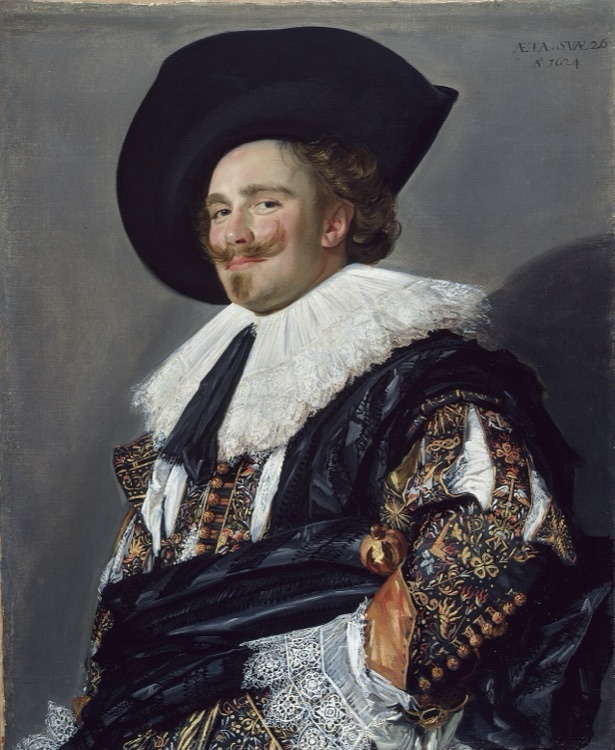
The Laughing Cavalier 1624
Despite its title — coined only in the nineteenth century — this young man is not laughing but wears a knowing, upturned half-smile beneath his moustache, gaze fixed on the viewer with unnerving confidence. Hals lavishes obsessive detail on the doublet, embroidered with bees, arrows, flaming torches, and lovers' knots, a virtuosity that contrasts with the freer handling of the face and ruff. The identity of this dandy, likely a wealthy Haarlem merchant in his mid-twenties, remains unknown, but his swagger made the picture, now in London's Wallace Collection, one of the most reproduced portraits in Western art.
Banquet of the Officers of the St George Civic Guard 1616
Hals's first great group portrait crowded twelve officers of Haarlem's St George militia company around a banqueting table laid with ham, bread, and glinting silver, breaking from the static, row-by-row arrangements that had governed the genre. Rather than lining his sitters up like a class photograph, he staggered them at different depths and angles, caught mid-gesture, ruffs tilting, hands reaching for glasses. Orange, white, and blue command sashes thread through the scene, unifying two dozen faces into one convivial event. In Haarlem's Frans Hals Museum, it is the picture that launched his reputation as the era's foremost painter of collective life.
The Gypsy Girl c. 1628-1630
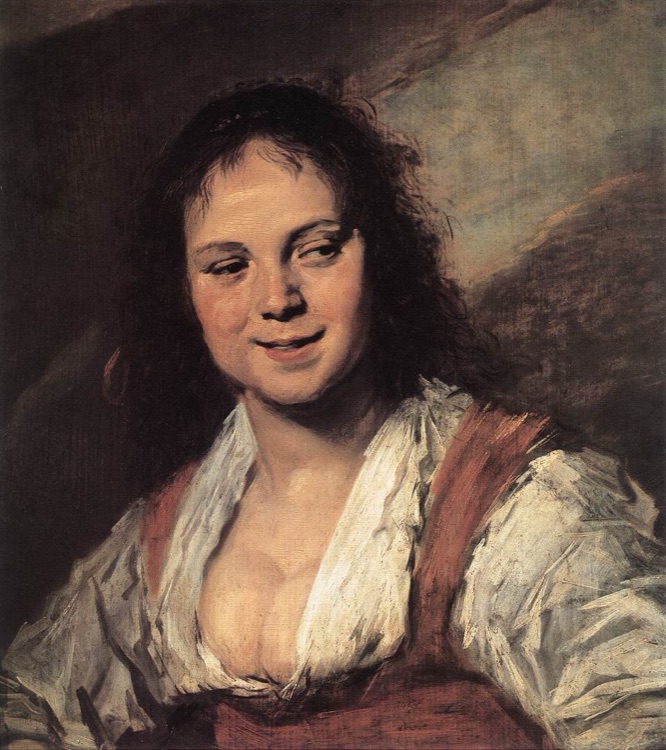
A young woman with tousled dark hair, a loosened chemise slipping from one shoulder, and an unmistakably knowing smile looks out with an intimacy that scandalized and delighted in equal measure. The traditional title reflects old associations between itinerant women and loose morality, though Hals likely intended a generic image of youthful allure. What astonishes is the technique: her flushed cheeks and half-open mouth are built from rapid, overlapping strokes applied wet into wet, capturing laughter as though caught by a camera. Now in the Louvre, it exemplifies Hals's genius for informal characterization outside commissioned portraiture.
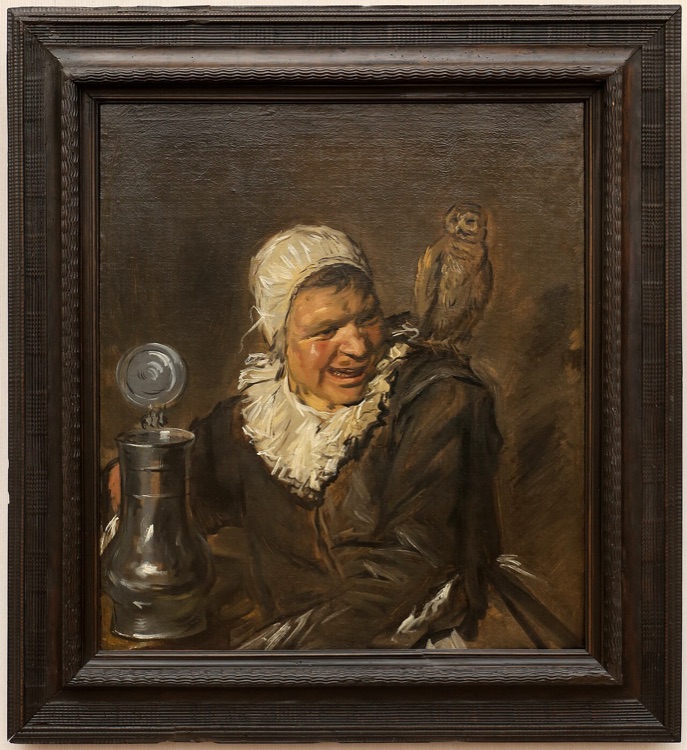
Malle Babbe c. 1633-1635
Known in Haarlem as 'Crazy Barbara,' the elderly woman in this startling study clutches a beer tankard and turns to the viewer with a raucous, gap-toothed cackle, an owl on her shoulder as a folk emblem of foolishness. Hals attacks the canvas with unprecedented speed, dragging thick, dry strokes across her sleeve and dashing in her face with jagged, calligraphic marks that vibrate with laughter. Rather than flattering or moralizing, the picture confronts the viewer with raw humanity — read variously as satire, tavern portraiture, or a study of an almshouse inmate. In Berlin's Gemäldegalerie, it is prized by modern painters for its painterly audacity.
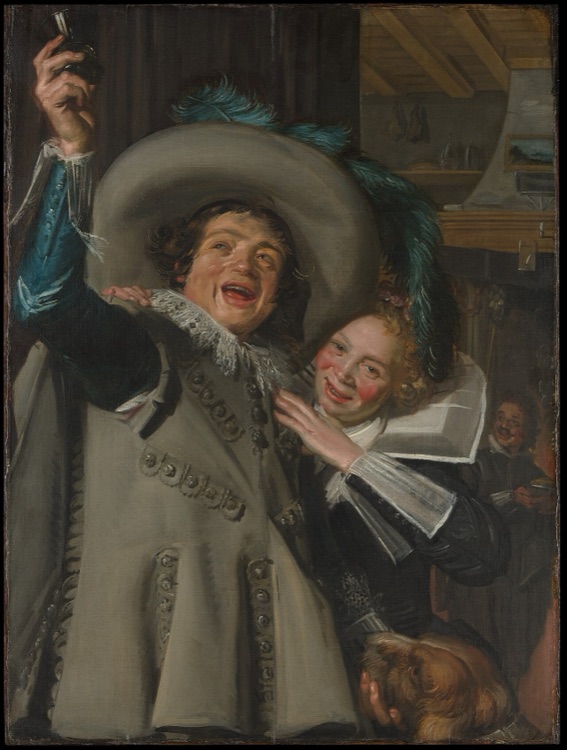
Yonker Ramp and His Sweetheart 1623
A grinning young dandy, glass raised and arm draped familiarly around a smiling woman's waist, embodies Hals's gift for translating tavern conviviality into serious portraiture. The composition borrows its arm-in-arm intimacy from theatrical scenes of the Prodigal Son squandering his inheritance, a popular moralizing subject, yet Hals paints the pair with such warmth — the froth of her lace collar, the wine's glint in the glass, his flushed, roguish face — that any moral lesson dissolves into sheer delight. The swift brushwork shows Hals, by his early forties, at the height of his powers. It now hangs in New York's Metropolitan Museum of Art.