Ivan Aivazovsky
He conjured nearly six thousand luminous seascapes from memory alone, without ever painting the sea from life.
Style and technique
Aivazovsky broke with the basic method of his craft: he almost never painted the sea while looking at it. After early sketching trips along the Crimean coast and later voyages through the Mediterranean, he worked almost entirely from memory in the studio, sometimes finishing a canvas years after the scene that inspired it. He insisted that water, light, and cloud moved too continuously to be copied from a fixed model, and that only a trained, retentive eye working through imagination could render their perpetual change — the motion of living elements, he argued, could not be captured from nature, only recalled and reinvented.
He was also astonishingly fast. Students and visitors described him completing a large seascape in a matter of hours, working the whole canvas at once rather than area by area, laying in sky, sea, and foam within a single sustained session and almost no preliminary drawing. Over roughly sixty years, this method, combined with a large studio practice and a genuinely compulsive productivity, produced something close to six thousand paintings — one of the largest bodies of work any painter has left behind.
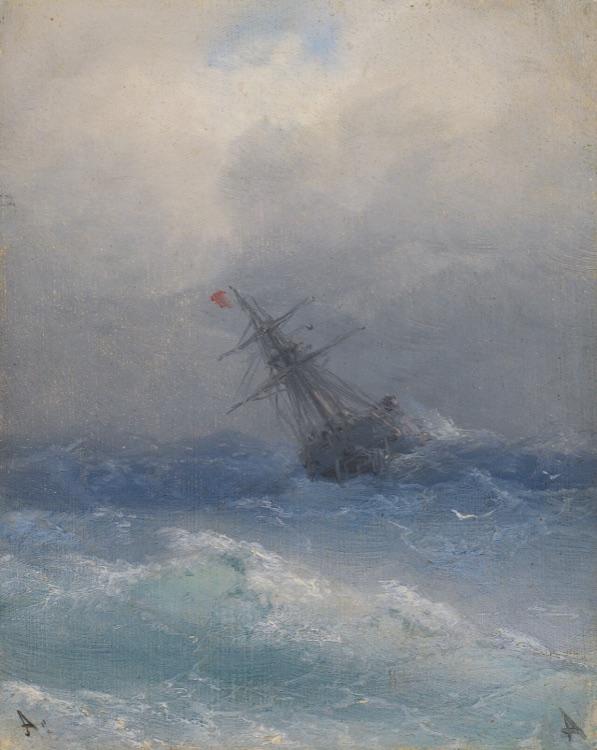
His technical signature was transparency. He built his waves in thin, layered glazes so that light seems to travel through the crest of a wave rather than merely bounce off it — the sensation of looking into moving water lit from behind by a rising or setting sun. Foam is rendered not as opaque white but as a scrim of near-translucent strokes that let the color beneath show through, so that a wave about to break can look genuinely lit from within, as though the sun itself were suspended just under the surface.
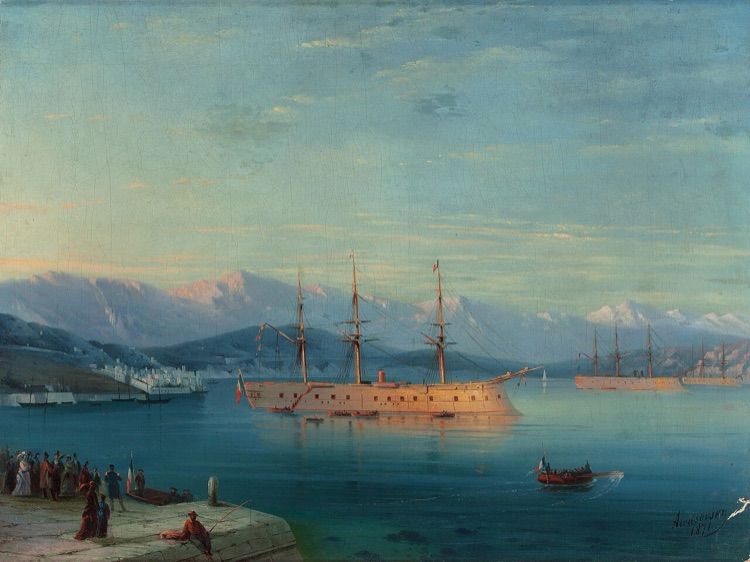
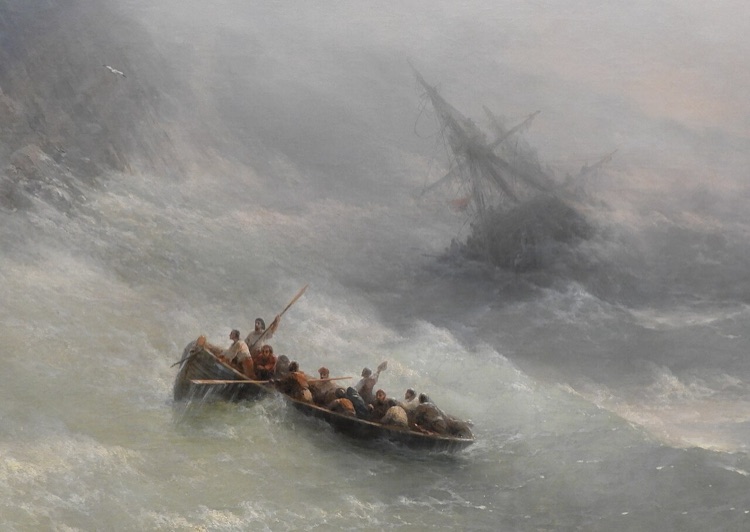
His compositions favor a steep diagonal thrust of wave against a low, wide horizon, with tiny human figures — sailors clinging to wreckage, a rowboat of survivors — dwarfed by walls of water that seem to keep rising past the frame's edge. Storms, shipwrecks, and burning ships recur obsessively, but so does their opposite: flat calm seas at dawn or under moonlight, rendered with the same translucent glazing so that stillness glows as intensely as violence. Roaring or silver-still, his water is always, unmistakably, lit from inside.
Life and legacy
Ivan Konstantinovich Aivazovsky was born on 29 July 1817 in Feodosia, a once-great Crimean port fallen on hard times, to Konstantin (Gevork) Gaivazovsky, an Armenian merchant, and his wife Hripsime. The family was poor enough that the boy is said to have drawn his first pictures in charcoal on the whitewashed walls of their house. His talent caught the attention of the town's architect and later its governor, Alexander Kaznacheev, who arranged for him to study at the Simferopol gymnasium and then helped secure him a place, at sixteen, at the Imperial Academy of Arts in St Petersburg.
At the Academy he studied landscape under Maxim Vorobiev and briefly under the visiting French marine specialist Philippe Tanneur, absorbing a training grounded in careful observation that he would soon push in his own, largely memory-based direction. He won the Academy's gold medal years ahead of schedule and, still in his early twenties, was sent abroad on a state pension — through Italy, France, England, Holland, and Germany — where his seascapes were bought by European collectors and admired by, among others, J.M.W. Turner, who is said to have written a poem in his honor after seeing one of his Neapolitan scenes. He returned to Russia decorated, internationally known, and barely past twenty-five.
Tsar Nicholas I and his successors commissioned battle scenes and fleet reviews, and Aivazovsky accompanied naval expeditions to record actions firsthand. Honors accumulated steadily — full academician status at twenty-seven, membership in academies across Europe, imperial orders — even as he produced at a pace that startled contemporaries, often finishing an entire canvas in a single sitting.
Rather than settle permanently in the capital, he chose to return to his native Feodosia, building a house and studio overlooking the sea he painted obsessively. He became the town's great benefactor: funding its first public art museum, built around his own gallery and among the oldest in the Russian Empire, an art school, a concert hall, an archaeological museum, and — his proudest civic achievement — an aqueduct piping fresh spring water from his own estate into the drought-starved town.
His personal life included two marriages: to Julia Grevs, an English governess, with whom he had four daughters before their divorce, and later to Anna Burnazyan, a young Armenian widow, in his final years. He died in Feodosia on 2 May 1900 (19 April, old style), leaving an unfinished canvas of a burning Turkish warship on his easel — still, at eighty-two, painting the sea from memory.
Five famous paintings
The Ninth Wave 1850
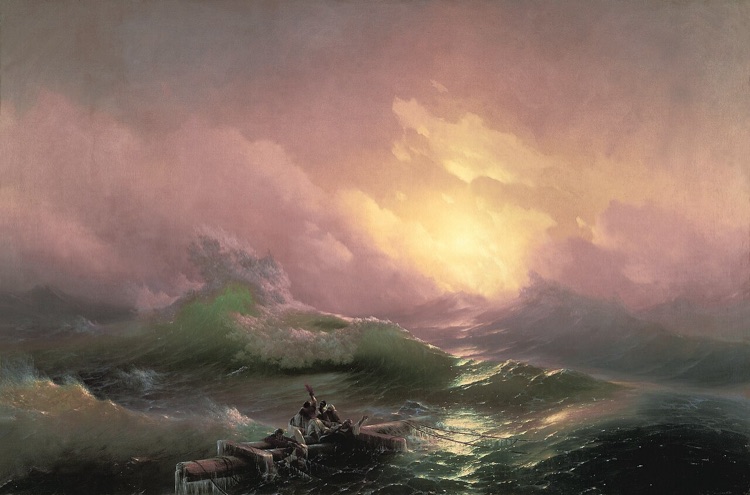
Painted when Aivazovsky was thirty-three, this became the single image most identified with him worldwide. Survivors of a shipwreck cling to the broken mast of their sunken vessel as a colossal wave — the mythical 'ninth wave', believed by sailors to be the largest and most dangerous in any storm sequence — rears above them, lit from behind by a rising sun in improbable oranges and pinks. The optimism of that light, breaking through the very water that has just destroyed them, is the painting's real subject: even mid-catastrophe, dawn insists on arriving. It hangs in the State Russian Museum, St Petersburg.
The Black Sea 1881
One of Aivazovsky's most radically stripped-down compositions, painted when he was sixty-four. There is no ship in distress, no rescue, barely any incident at all — only a heaving expanse of dark water under an overcast sky, with a single small sailing vessel barely visible near the horizon. Ivan Kramskoi, a leading Russian realist and no natural ally of Aivazovsky's romantic bravura, called it one of the most soulful works in Russian art. Stripped of drama and narrative, it becomes a pure study of one grey mass in restless motion — proof that his gift for transparency needed no storm to justify it. It hangs in the Tretyakov Gallery, Moscow.
Rainbow 1873
A ship breaks apart on rocks in a violent storm while survivors struggle toward shore in a lifeboat — a subject Aivazovsky had painted many times before. What distinguishes this version is the pale, barely-there rainbow arching faintly through the spray above the wreck, so delicately rendered it looks like an optical event thrown up by the storm itself rather than a symbol imposed on it. Aivazovsky deliberately kept its colors muted, wanting it to emerge from the chaos of foam and rain as something glimpsed rather than announced — a fragile promise of survival dissolving in the same spray that could kill. It hangs in the Tretyakov Gallery, Moscow.
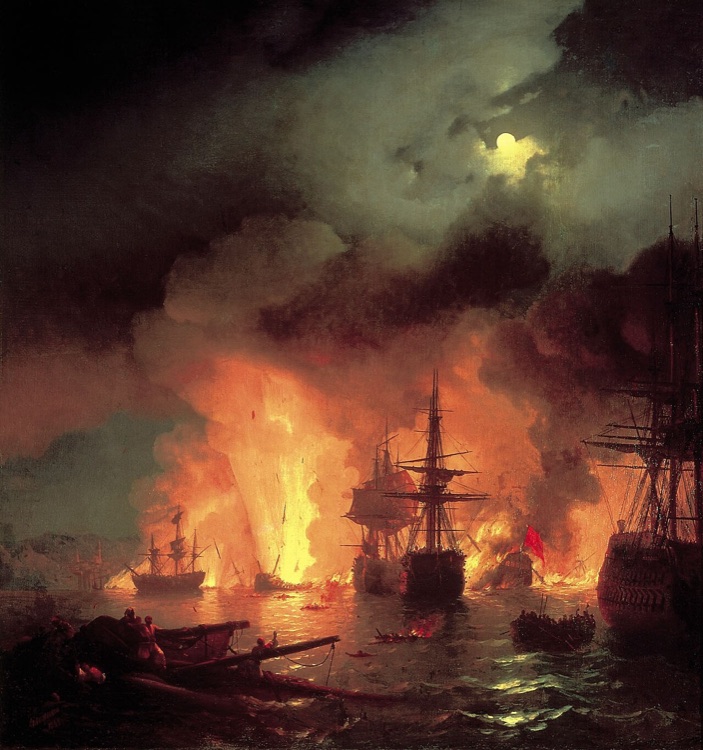
The Battle of Chesma 1848
A night scene of the 1770 Battle of Chesme, where the Russian fleet annihilated a far larger Ottoman force in the Aegean, commissioned as part of Aivazovsky's long service to the Imperial Navy. The composition abandons daylight entirely: ships burn and explode against total darkness, their fires the only light source, throwing bronze and orange across smoke and water while the wrecked Turkish hulls founder in the foreground. It reads less as a factual record than a study in combustion as destructive luminosity — the same fascination with light that drives his calmest moonlit seascapes, turned violent. It hangs in the Feodosia Aivazovsky Gallery.
Among the Waves 1898
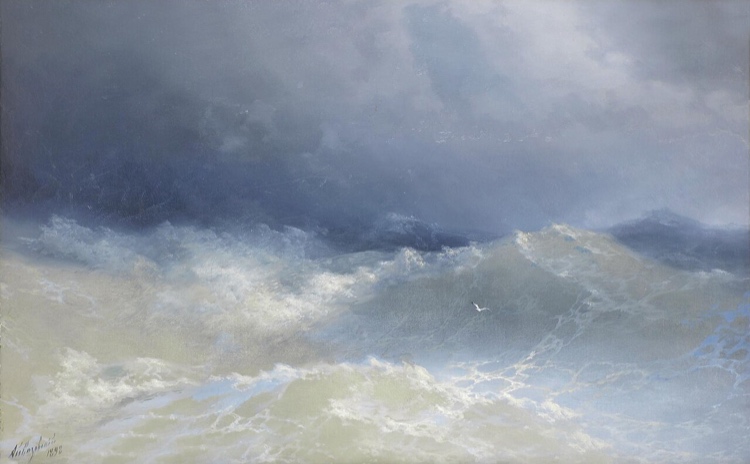
Painted two years before his death, when Aivazovsky was eighty-one, and considered by many historians his late masterpiece — a counterpart, nearly fifty years on, to The Ninth Wave. There is no ship, no survivor, no wreckage this time, only the sea itself in full, uninterrupted storm, an enormous grey-green wave curling and breaking under a churning sky with nothing else in frame to give it scale. Freed from any narrative pretext, the canvas becomes pure meteorology and pure paint, decades of practiced glazing compressed into one sustained roar of water. It now hangs, fittingly, in the museum he founded in his native Feodosia.