William-Adolphe Bouguereau
The Salon's supreme technician, whose porcelain nudes made him the era's richest, then most reviled, painter.
Style and technique
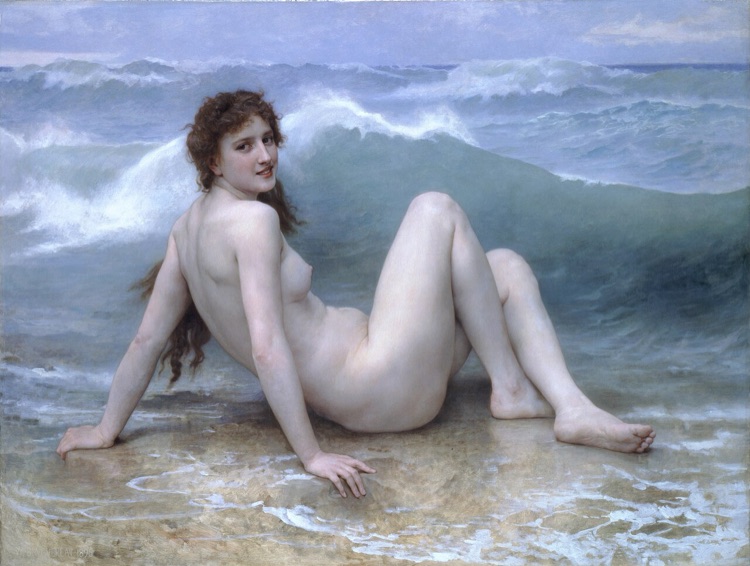
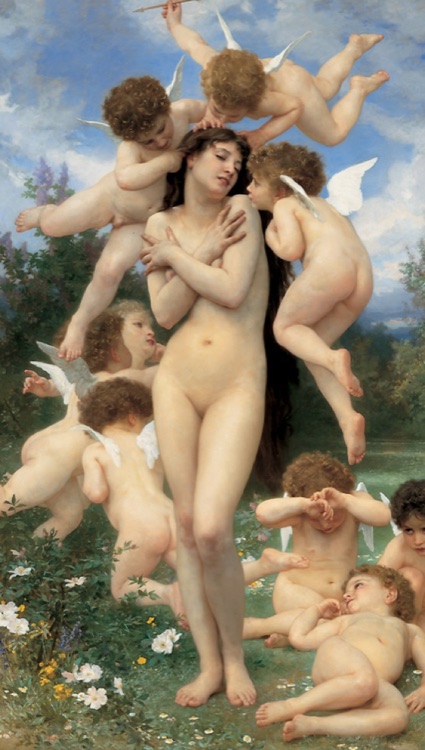
Bouguereau's technique represented the Salon system's highest ideal: a surface so smooth, so free of visible brushstrokes, that critics said his figures looked less painted than born, flesh rendered in porcelain and pearl rather than pigment. He built each canvas through a rigorous academic method inherited from Ingres and the neoclassical tradition — meticulous preparatory drawings, careful modeling from posed models, and thin, blended layers of paint, the notorious fini léché, or "licked finish," that erased every trace of the hand that made it. The result was an illusionism so complete that a Bouguereau nude could seem to have weight, warmth, even breath, while remaining entirely, deliberately unreal: bodies without blemish, skies without weather, grief without disfigurement.
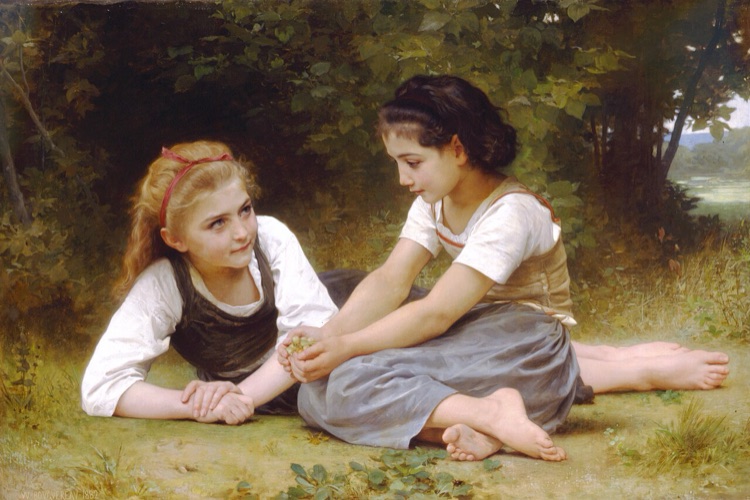
His subjects fell into two beloved registers. On one side stood mythology — Venus rising from the sea, nymphs wrestling a satyr into a woodland pool, cupids besieging reluctant maidens — antique fables that let him paint the nude female body with the moral alibi respectable Salon audiences required. On the other stood sentiment: barefoot peasant children, orphaned siblings, mothers cradling infants, rendered with the same silken finish and just enough wistfulness to move a bourgeois buyer without ever coarsening into real hardship.
It was precisely this — the invisible labor, the sweetened subject matter, the Salon jury's endorsement of it as the summit of French art — that Manet, Degas, and their circle rebelled against. Where Bouguereau erased the brushstroke, the Impressionists flaunted it; where he idealized, Courbet and the Realists insisted on the coarse and specific; where he painted timeless myth, they painted modern Paris as it actually looked.
Life and legacy
William-Adolphe Bouguereau was born in 1825 in La Rochelle, a provincial Atlantic port, to a family of wine and olive-oil merchants who expected him to join the trade. It was his uncle, a priest with a passion for classical literature and natural history, who diverted him toward art, tutoring the boy in Latin and mythology and helping arrange drawing lessons at Bordeaux's municipal art school. That provincial training proved unusually rigorous, and by his early twenties Bouguereau had saved enough — partly by painting portraits of local notables — to move to Paris in 1846 and enter the studio of François-Édouard Picot at the École des Beaux-Arts.
He thrived within the academic system precisely because he mastered its rules so completely. In 1850 he won the Prix de Rome, the state's most coveted prize, earning four years' residence at the Villa Medici, where he immersed himself in Raphael, the Renaissance masters, and the antique sculpture that would shape his ideal of the human body for the rest of his career. Returning to Paris, he began exhibiting at the Salon in the mid-1850s and rose with startling speed to become one of the most successful painters in Europe. Represented by the powerful dealer Goupil & Cie, he sold prolifically to wealthy French and American collectors, earned government commissions and medals, and was elected to the Institut de France, accumulating a fortune and a grand Montparnasse studio that made him, by the 1880s, arguably the best-paid painter alive. He also taught extensively at the Académie Julian, mentoring hundreds of students and notably welcoming women into serious academic training at a time when the École des Beaux-Arts still barred them; one student, the American painter Elizabeth Jane Gardner, became his second wife in 1896, years after private tragedy — the deaths of his first wife and two young sons within a single decade — had shadowed his outwardly serene career.
Modernist critics, ascendant through the twentieth century, dismissed his glossy finish and sentimental subjects as kitsch, and "Bouguereau" turned into shorthand for everything the academic Salon had suppressed.
Only in the 1970s and 1980s did dealers, collectors, and a landmark 1984 retrospective begin rehabilitating his technical reputation; today his major canvases command multimillion-dollar prices at auction, and museums that once shunned him now hang his work as the definitive statement of academic art's ambitions.
Five famous paintings
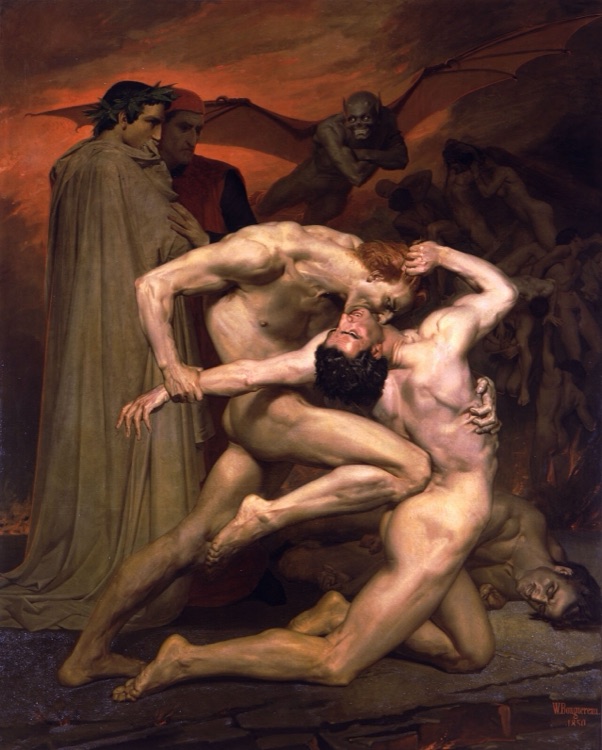
Dante and Virgil in Hell 1850
Long before he became the Salon's poet of serene nudes and cherubic children, the young Bouguereau announced himself with startling violence. Illustrating Dante's Inferno, he shows the alchemist Capocchio locked in a savage, teeth-baring wrestling match with the forger Gianni Schicchi, their straining, anatomically exact bodies lit with theatrical harshness while Dante and Virgil look on and a demon hovers overhead. The brutal musculature and dramatic chiaroscuro, closer to Géricault than to the honeyed idealism of his later career, won him early acclaim; the canvas now hangs in the Musée d'Orsay.
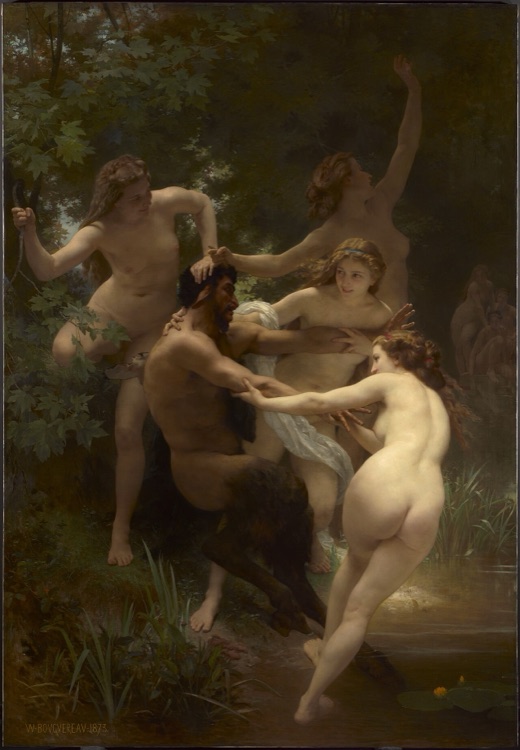
Nymphs and Satyr 1873
Four laughing wood-nymphs seize a startled satyr by the arms and horns, dragging him toward a moonlit pool while he braces his cloven feet against the bank in mock resistance — a playful inversion of mythology's usual predatory satyr, here overpowered by mischievous nudes in Bouguereau's silkiest, most luminous flesh tones. The blend of classical alibi and frank eroticism made it enormously popular in America, where for decades it hung above the bar of New York's Hoffman House Hotel, ogled by generations of patrons before entering, more respectably, the Clark Art Institute in Massachusetts.
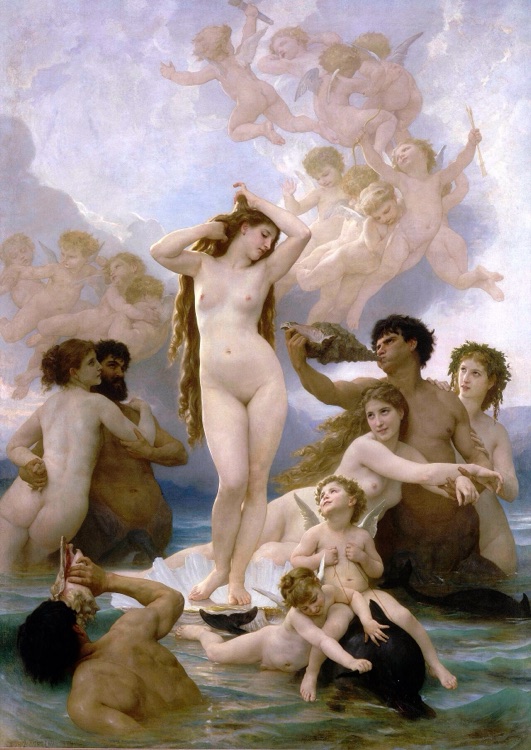
The Birth of Venus 1879
Bouguereau's most celebrated mythological nude reimagines Botticelli's subject through a hyper-refined academic lens: Venus stands weightless atop a drifting shell, her pale, flawless body echoing the ancient Venus de' Medici, while tritons blow conch-shell trumpets and cherubs tumble through the sky above her. Every wave crest and strand of golden hair carries glassy precision, an illusion of soft flesh and salt spray achieved through meticulously blended, invisible brushwork. Exhibited at the Salon of 1879 to enormous acclaim, it remains, in the Musée d'Orsay, the definitive image of his classicizing ideal.
The First Mourning 1888
Stripped of his usual honeyed color, Bouguereau confronts mortality directly: Adam and Eve sit huddled on bare ground, the lifeless body of their son Abel stretched across their laps, Eve's face buried in grief while Adam stares into the distance, jaw locked, unable even to weep. Painted in near-monochrome grays and browns, the composition draws deliberately on Michelangelo's Pietà, transposing Christian mourning imagery onto humanity's first death and first murder. Bouguereau, who had already lost his own wife and two young sons in the preceding decade, brought unmistakable personal grief to this somber canvas.
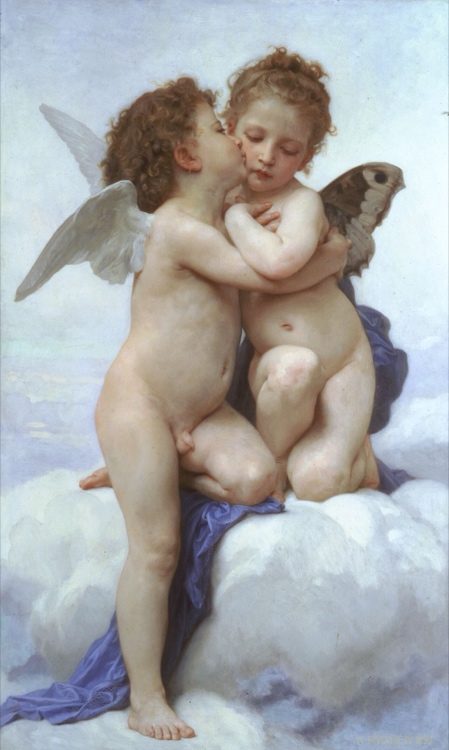
Cupid and Psyche as Children 1890
Reimagined as small children rather than adult lovers, Cupid and Psyche stand pressed close together in a tender embrace, his small feathered wings folded behind him, her face tilted up to receive his kiss on the cheek. Bouguereau strips the myth of Eros and Psyche's romantic and erotic charge, replacing it with pure childhood innocence rendered in his flawless, almost photographic academic technique. He painted several versions of this beloved subject, part of his enormously popular market for sentimental, mythologically-licensed images of children. By shrinking the gods' famous love story into a toddlers' embrace, he let Salon collectors enjoy classical subject matter and cherubic sweetness simultaneously, without a hint of the original tale's darker trials.