
Post-Impressionism
Four painters who absorbed Impressionism and shattered it into four different futures.
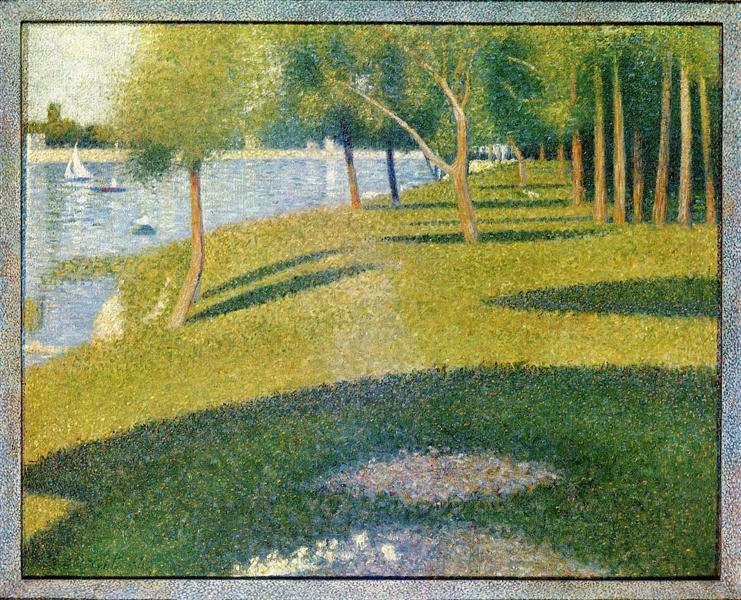
By 1885 several of the most gifted painters working in France had a problem: they had learned everything Impressionism had to teach about light and colour, and they wanted more. Impressionism had liberated the eye — had proved that paint could vibrate and shimmer and flood a canvas with sensation. But it had, in doing so, let structure dissolve, meaning evaporate, and permanence slip away into the next passing cloud. Paul Cézanne, working in the solitude of Aix-en-Provence, wrote to a friend in 1904 that he was trying to "treat nature by the cylinder, the sphere, the cone" and make something "solid and durable, like the art of the museums." Across the decade, Vincent van Gogh was pouring psychological urgency into every brushstroke, making landscape and portraiture serve as instruments of emotional autobiography. Paul Gauguin was moving toward Brittany, then Martinique, then Tahiti, searching for a world less corrupted by European modernity. And Georges Seurat was applying pure colour in tiny systematic dots, turning sensation into science. Post-Impressionism is not a movement at all in the strict sense; it is a shorthand for four very different answers to the same question: *what comes after sensation?*
Origin and history
The term 'Post-Impressionism' was coined by the English critic Roger Fry for an exhibition he organised in London in 1910 — *Manet and the Post-Impressionists* at the Grafton Gallery. Fry needed a word for the group of painters who had come after Impressionism without belonging to any single programme, and he invented one. The painters themselves did not use it and would have found it puzzling; Cézanne had been dead for four years, van Gogh for twenty.
The historical reality behind Fry's label was a decade of restlessness in Parisian and provincial painting, roughly 1880 to 1905. Impressionism's last group exhibition was held in 1886. By then the founding generation had scattered: Monet retreated to Giverny and his water garden; Renoir declared that Impressionism had been a dead end and began studying Raphael; Pissarro temporarily adopted Seurat's pointillist method. The younger painters who had grown up with Impressionism as their starting point were pulling in wildly different directions.
Cézanne virtually withdrew from Paris after 1877 and spent the rest of his life in Provence, working on the same subjects — Mont Sainte-Victoire, the Bibemus quarry, card players in the local cafés — from multiple viewpoints simultaneously, trying to reconcile the Impressionist sensation of colour with a structural solidity he felt Impressionism had sacrificed. His late work, almost entirely unknown in Paris until the retrospective held the year after his death (1907), gave the Cubists their direct grammar. Van Gogh arrived in Paris in 1886, absorbed Impressionism and Neo-Impressionism in eighteen months, moved to Arles in 1888 and spent the remaining two years of his life producing work of extraordinary psychological intensity. Gauguin followed his own increasingly anti-European programme, developing the synthetist style he called *cloisonnism* — dark contours enclosing flat planes of colour — in Pont-Aven in 1888 alongside Émile Bernard. These were not colleagues but individuals: what Post-Impressionism describes is a generation defined by its departures.
Concept and philosophy
If Impressionism was about seeing, Post-Impressionism was about feeling, building and meaning. The painters it groups together share almost no technique; what they share is a conviction that pure perceptual sensation was insufficient — that painting needed to do something more, or something different, with the visual world it had been freed to observe.
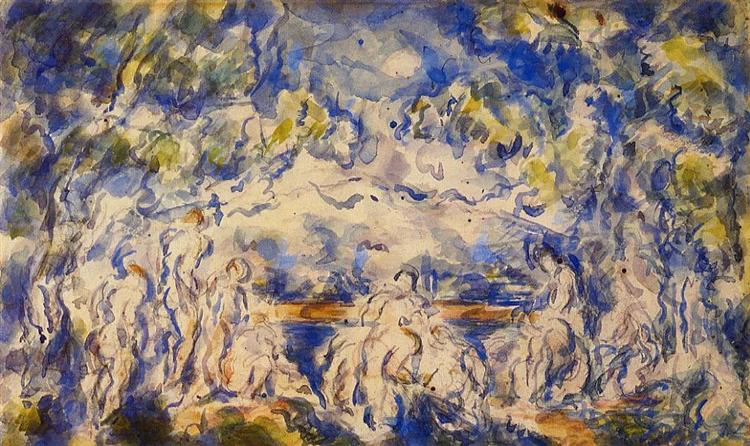
Cézanne's programme was fundamentally architectural. He believed that Impressionism had traded structural solidity for atmospheric shimmer, and he wanted both at once. His solution was to observe the same motif from subtly shifting viewpoints and render all of those viewpoints simultaneously on the flat surface — which is why his apples look like they are seen from both slightly above and slightly from the side, and why his landscapes feel both immediate and monumental. He painted the same Mont Sainte-Victoire more than sixty times. The geometric simplification of form this produced — planes interlocking across the picture surface — was the direct ancestor of Analytic Cubism.
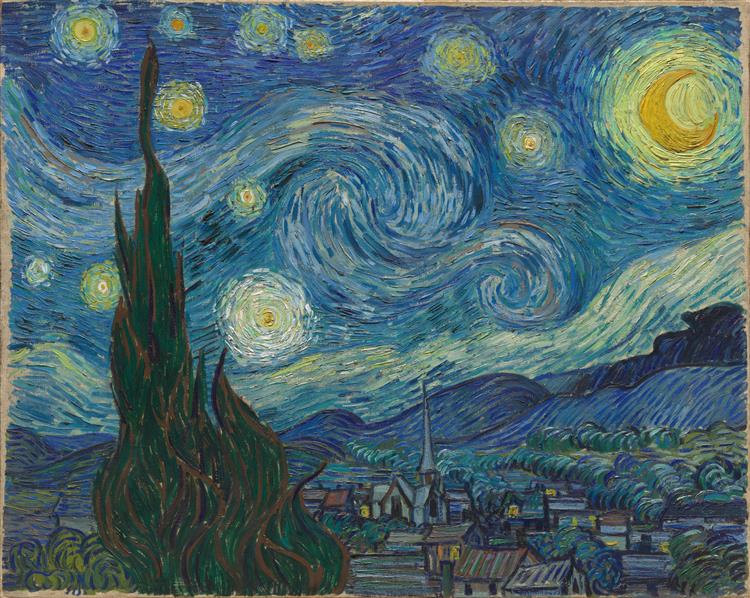
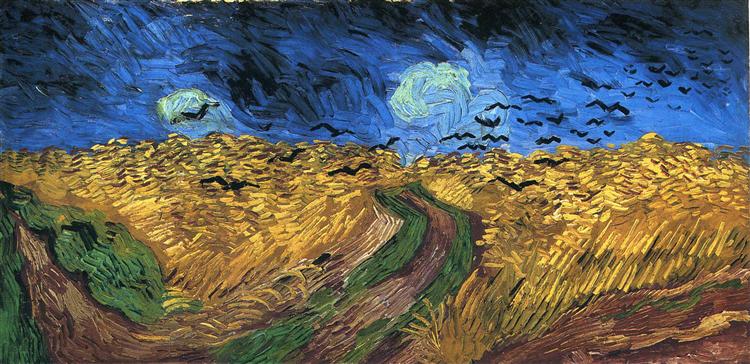
Van Gogh's programme was psychological. He used colour not to describe natural appearance but to express emotional states — the oppressive heat of the south in the violent yellows of *Wheatfield with Crows* (1890), the comforting intimacy of lamplight in *The Night Café* (1888), the cosmic longing of *The Starry Night* (1889). His urgent, swirling, directional brushstrokes are not records of observation but records of feeling. Expressionism — Kirchner, Munch, Kokoschka — descends directly from this.
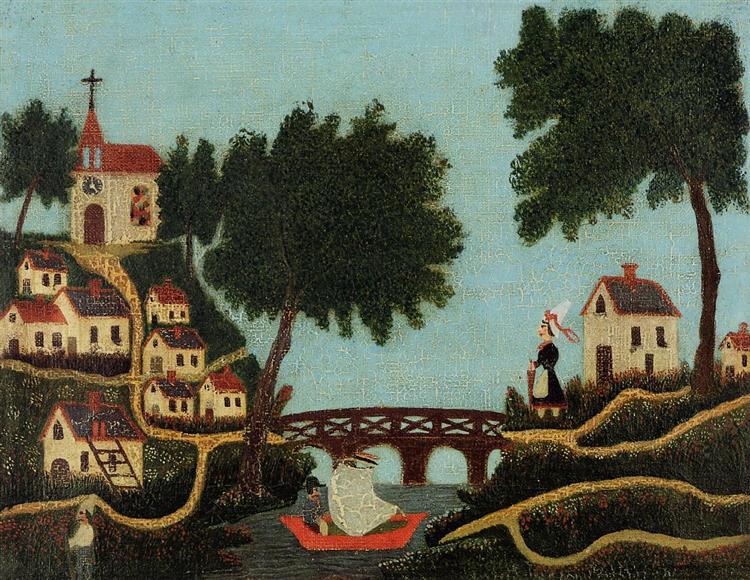
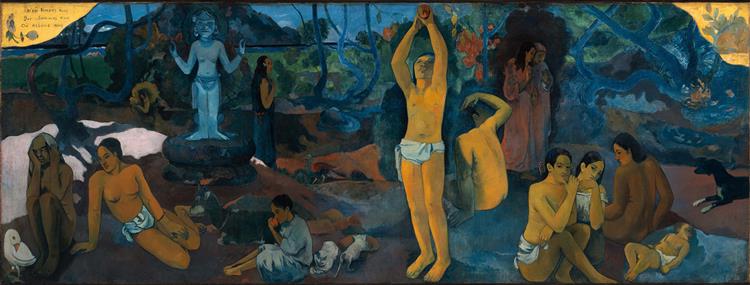
Gauguin's programme was symbolic and primitivist. He believed that European painting had been corrupted by materialism and rationalism, and that authentic artistic expression required a return to what he called 'savage' modes of seeing — flat colour, strong contour, pattern over illusion. His Tahitian canvases are not ethnographic records but mythological fantasies, painted in colours that glow like stained glass. They fed directly into the Fauvists and, through them, into Matisse.
How to recognise it
Post-Impressionism is a family of styles rather than a single look — but the three main strands each have clear visual signatures.
- Cézanne: geometric planes — Landscapes and still lifes broken into interlocking, slightly tilted colour planes that suggest solidity without traditional shading. A cool greenish-grey palette dominates; paint is applied in short, parallel hatching strokes called *constructive brushstrokes*. Multiple viewpoints are combined so that objects feel seen-in-the-round even on a flat surface.
- Van Gogh: urgent directional strokes — Brushstrokes that are thick, energetic and directional — swirling in the sky, rippling in wheat, curling in cypress trees — as if the paint records not just colour but emotional pressure. The palette is charged with yellows, blues and vivid oranges that push beyond naturalism into psychological territory.
- Gauguin: flat colour and dark contour — Broad, unmodulated planes of colour enclosed by strong dark outlines, like a stained-glass window or a Japanese print. Figures are simplified into decorative shapes; spatial depth is flattened. Colours are often non-naturalistic — pinks, crimsons, acid greens — chosen for emotional and symbolic rather than descriptive value.
- More resolved form than Impressionism — Compared to Impressionist canvases, Post-Impressionist work tends to have more deliberate composition: objects are more clearly defined, the picture surface more carefully organised. The sense of immediate, accidental notation is replaced by something more studied and intentional.
- Emotion or structure as explicit intent — Where an Impressionist painting looks *seen*, a Post-Impressionist painting looks *made* — with a clear agenda, whether Cézanne's quest for permanence, van Gogh's for expression, or Gauguin's for symbolic depth. The painter's intention is visible on the surface.
- Non-naturalistic colour choices — Colour is used to convey meaning or structure rather than to accurately record appearance. Van Gogh's skies are too intensely blue; Gauguin's earth is too magenta; Cézanne's shadows too green. This deliberate departure from optical truth is one of the clearest differences from Impressionism.
Anecdotes and curiosities
Cézanne sent Monet an apple in the post. The two men remained friends long after they had taken painting in completely different directions. When Cézanne saw Monet's series paintings — thirty versions of the same haystack, twenty of the same poplar row — he reportedly wept, believing Monet had found exactly what he himself was looking for. Cézanne's own 'series' of Mont Sainte-Victoire (over sixty versions, 1882–1906) is the most sustained investigation of a single motif in the history of painting, and it remains the direct link between Impressionism and the Cubism that would transform art twenty years later.
Van Gogh sold exactly one painting in his lifetime. *The Red Vineyard* (1888), painted at Arles, was bought by the Belgian painter Anna Boch at the Les XX exhibition in Brussels in February 1890 for 400 francs — about equivalent to £1,700 today. Van Gogh died four months later. Within a generation his paintings were among the most expensive in the world; *Portrait of Dr. Gachet* (1890) sold at Christie's in 1990 for $82.5 million, then the highest price ever paid at auction for a painting. The gap between his reception in life and death is one of the most extreme in art history.
Gauguin and van Gogh's shared house ended in crisis. In October 1888, Gauguin moved into the Yellow House in Arles at van Gogh's invitation, hoping the two men could found an artists' colony in the south. Within nine weeks, the arrangement collapsed: on the night of 23 December, following a violent argument, van Gogh cut off the lower part of his own left ear with a razor, wrapped it in newspaper and delivered it to a woman at a local brothel. Gauguin left immediately and the two never met again. The incident did not diminish van Gogh's output — he produced over 150 works from the Saint-Paul-de-Mausole asylum the following year.
Cézanne's 1907 retrospective launched Cubism. When the Salon d'Automne held a major retrospective of Cézanne's work in 1907, a year after his death, the young Pablo Picasso and Georges Braque visited it repeatedly, studying the way Cézanne had fragmented form into interlocking planes. Picasso later said that Cézanne was "my one and only master" and "the father of us all." Within two years, the first Cubist paintings had been made, directly translating Cézanne's multiple-viewpoint technique into an entirely new visual language.
Legacy and influence
Post-Impressionism was the hinge on which all of modern art turned. Cézanne's planes gave Braque and Picasso the grammar of Cubism (1907–14), which in turn seeded abstraction and all the fragmented visual languages of the twentieth century. Van Gogh's expressive distortion gave the German Expressionists their licence to distort form and colour in the service of psychological truth — a licence that ran from Die Brücke (1905) through Bacon and de Kooning to the contemporary figuration of Lucian Freud. Gauguin's primitivism and flat colour fed directly into Fauvism (1905) and, through Matisse, into the decorative abstraction of the century. The Post-Impressionists did not plan a revolution; they were each trying to solve a personal problem with painting. The solutions they arrived at were so powerful that the entire next century of art lived inside them.
6 artists in this movement
From the blog
Frequently asked questions
When did Post-Impressionism occur?
Post-Impressionism is loosely dated from around 1886 — when the last Impressionist group exhibition was held — to about 1906, by which time Cézanne was dead and his successors (the Fauves, the proto-Cubists) had moved fully into the next generation. In practice the term describes work made between roughly 1880 and 1905 by a specific group of painters who had all begun as Impressionists or close observers of Impressionism. It is a retrospective category, not a period artists lived in consciously.
Who are the key Post-Impressionist painters?
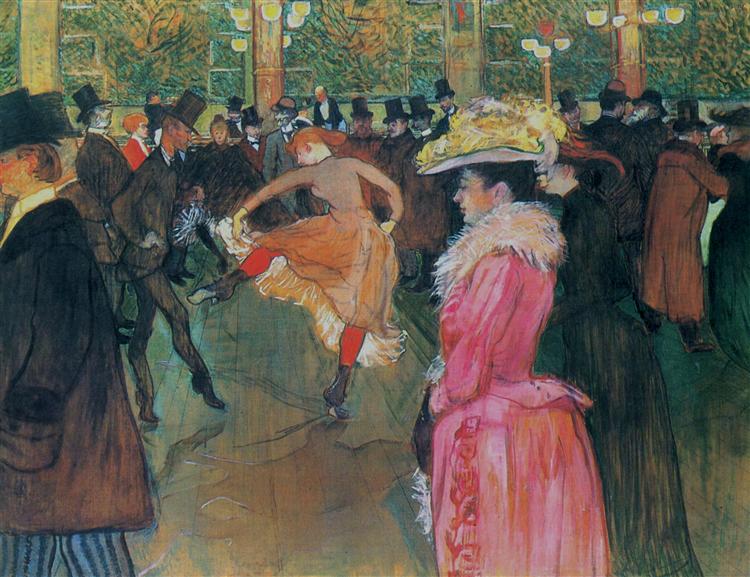
The four canonical figures are Paul Cézanne (1839–1906), who sought structural permanence; Vincent van Gogh (1853–90), who pursued psychological expression; Paul Gauguin (1848–1903), who chased symbolic and 'primitive' truth; and Georges Seurat (1859–91), who applied colour scientifically (though Seurat is also claimed by Neo-Impressionism). Around them: Émile Bernard, Paul Signac, Toulouse-Lautrec, and the later work of Camille Pissarro, who briefly adopted Seurat's method.
What technique defines Post-Impressionism?
There is no single technique — that is precisely the point. Cézanne used short *constructive brushstrokes* and multiple viewpoints. Van Gogh used thick, swirling, directional impasto. Gauguin used flat planes of colour enclosed by dark contours (*cloisonnism*). Seurat used tiny, systematic dots of pure colour (*pointillism*). What unites them is the deliberate move beyond sensation toward structure, expression or symbolism — each painter turning the Impressionist toolkit toward a different goal.
How does Post-Impressionism differ from Impressionism?
Impressionism prioritised immediate visual sensation — the flickering, momentary appearance of things in a specific quality of light, recorded with loose, rapid brushwork. Post-Impressionism accepted that starting point but found it insufficient. Cézanne wanted structural solidity; van Gogh wanted emotional intensity; Gauguin wanted symbolic meaning; Seurat wanted scientific rigour. Where an Impressionist painting looks observed and immediate, a Post-Impressionist painting tends to look constructed and intentional. The brushstroke is no longer just a record of light — it is also a record of thought.
Why is it called 'Post-Impressionism'?
The term was invented by the British critic Roger Fry in 1910 for the exhibition catalogue of *Manet and the Post-Impressionists* at the Grafton Gallery in London. Fry needed a neutral label for painters who came *after* Impressionism without forming a coherent movement of their own. 'Post' simply means after: these painters absorbed Impressionism, reacted against its limitations, and moved beyond it in different directions. The term is a historian's convenience rather than an identity the painters would have claimed.