
Pre-Raphaelite
Seven rebel students vowed to paint truer than Raphael — jewel colour and hard truth over academic polish.
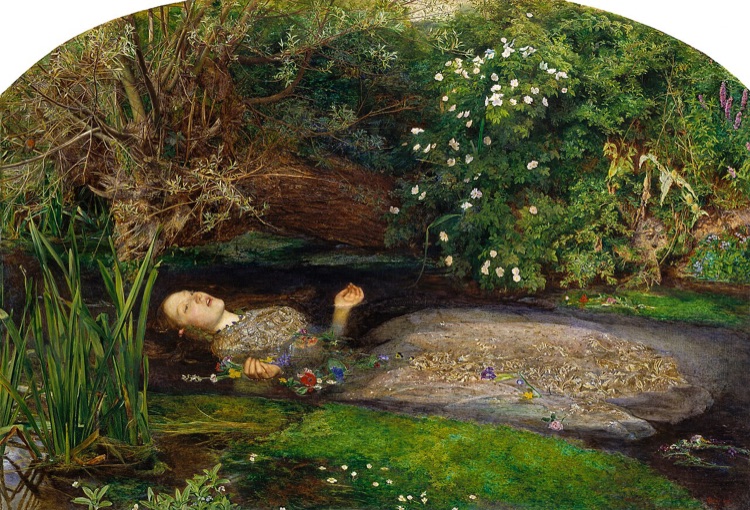
In the winter of 1851, a milliner's assistant named Elizabeth Siddal lay fully dressed in a bathtub of water in a London studio, modelling the drowned Ophelia for a young painter named John Everett Millais. Oil lamps beneath the tub kept the water warm — until they guttered out unnoticed while Millais lost himself in the willow leaves and floating flowers he had spent months painting from life on a Surrey riverbank. Siddal caught a violent chill; her furious father sent Millais the doctor's bill. The result, Ophelia (1851–52), is one of the most obsessively detailed and hauntingly beautiful pictures of the century — and a perfect emblem of the Pre-Raphaelite Brotherhood, a secret society of London art students who in 1848 resolved to paint with a truth, intensity and jewel-like colour they believed British art had abandoned since the High Renaissance, whatever it cost their models, their reputations, or the Royal Academy's patience.
Origin and history
The Pre-Raphaelite Brotherhood was founded in September 1848 in the Gower Street house of John Everett Millais's parents, London, by three students at the Royal Academy Schools: Dante Gabriel Rossetti (poet and painter, then twenty), William Holman Hunt, and Millais himself, at nineteen already the youngest student ever admitted to the Academy. They were soon joined by four more members — the sculptor Thomas Woolner, the painter James Collinson, the critic Frederic George Stephens, and Rossetti's brother William Michael Rossetti, who kept the group's diary — making seven in all. They signed their canvases with the cryptic initials "PRB," a secret monogram whose meaning the press spent two years trying to decode.
The name "Pre-Raphaelite" stated the group's argument outright: they believed that painting had gone wrong with Raphael and his immediate followers, whose idealised grace had hardened, through three centuries of academic imitation, into empty formula. Before Raphael, in the sincere, minutely observed panels of the early Italian and Flemish masters — Fra Angelico, Van Eyck, the young Giotto — they saw an unspoiled devotion to nature and truth that the Grand Manner had buried under brown varnish and borrowed poses. Their particular target was Sir Joshua Reynolds, founding president of the Royal Academy, whose lectures on generalised ideal beauty the Brotherhood considered a licence for laziness; they mockingly nicknamed him "Sir Sloshua" for the murky bitumen glazes he taught students to slosh over their canvases in place of clean, truthful colour.
The public reception was savage. When Millais exhibited Christ in the House of His Parents in 1850 — a carpenter's workshop rendered with unflinching, unglamorous realism, Christ himself a real barefoot boy with a real, bloodied hand — critics recoiled at what they read as blasphemous ugliness. Charles Dickens, writing in Household Words, described the young Christ as "a hideous, wry-necked, blubbering, red-headed boy in a nightgown" and the Virgin as a figure so hideous she would be remarkable in the lowest gin-shop in England. The Brotherhood might have collapsed under the ridicule had John Ruskin, already England's most powerful art critic, not intervened. In two letters to The Times in May 1851, Ruskin defended the young painters' "truth to nature" and meticulous execution, and his patronage transformed the group's fortunes almost overnight.
The original Brotherhood was short-lived as a formal body. The members published four issues of a literary magazine, The Germ, in 1850, then drifted apart within a few years: Hunt travelled to the Holy Land in 1854 seeking authentic biblical settings, Millais moved toward mainstream Academy success — and, in an irony that scandalised Victorian London, married Ruskin's former wife Effie Gray after her marriage to the critic was annulled in 1854. Yet the style outlived the society. A second generation — Edward Burne-Jones and William Morris, who met Rossetti at Oxford in the 1850s — carried Pre-Raphaelite ideals into a more dreamlike medievalism, and decades later painters such as John William Waterhouse were still working in a recognisably Pre-Raphaelite vein, proof that the movement had become less a brotherhood than a lasting way of seeing.
Concept and philosophy
The Pre-Raphaelites built their programme on a single conviction: that art must return to truth to nature, observed and rendered with a fidelity the academic tradition had abandoned. Where Reynolds taught students to idealise — to compose a generalised, flattering beauty out of the best parts of many models — the Brotherhood insisted on painting exactly what stood in front of them, blemishes, asymmetries and all. This meant working, wherever possible, directly from nature rather than from memory or convention: Millais spent eleven weeks painting the riverbank background of Ophelia on location near the Hogsmill River before adding the figure in the studio, and Hunt travelled to Palestine so that his biblical scenes would depict authentic landscape and costume rather than invented, generically "Oriental" backdrops.
This fidelity extended to a near-obsessive attention to detail — botanical accuracy in every leaf and flower, textile patterns rendered thread by thread, surfaces of glass, metal and fabric each given individual, almost forensic scrutiny. Nothing in a Pre-Raphaelite canvas is background filler; every object is painted with the same intensity of focus, front to back, which is part of why the pictures can feel so airless and flattened compared with academic painting's soft recession into atmospheric distance.
Subject matter mattered as much as method. The Brotherhood turned to medieval romance, Shakespeare, Dante, Keats and Tennyson, and biblical narrative, treating these sources not as costume drama but as vehicles for serious moral and spiritual meaning — Rossetti, who idolised his poetic namesake, returned obsessively to Dante and Beatrice; Hunt loaded his pictures with symbolic objects meant to be read like a sermon.
Their most distinctive technical innovation was painting on a wet white ground. Hunt and Millais applied a layer of wet white paint to the canvas each morning and worked their colours directly into it before it dried, section by section, so that light seemed to glow up through the pigment from underneath rather than sitting dully on top of it. Combined with pure, unmixed colour applied in place of muddy academic glazes, this technique gave Pre-Raphaelite paintings their unmistakable jewel-like saturation — colour so vivid it startled a public accustomed to the brown gravies of the Grand Manner.
How to recognise it
Pre-Raphaelite paintings announce themselves through colour, detail and mood long before you clock a specific subject — six giveaways to watch for.
- Jewel-toned, saturated colour — Colours look almost lit from within — deep reds, greens and blues with a glowing intensity that comes from the wet-white-ground technique, in sharp contrast to the brownish, varnished palette of academic painting.
- Obsessive botanical and textile detail — Every leaf, petal, jewel and woven pattern is rendered with near-scientific precision. Backgrounds are as sharply focused as faces, giving the whole canvas a flattened, almost photographic clarity.
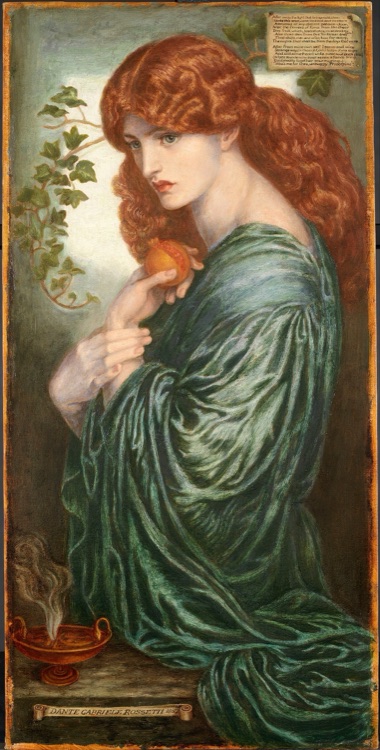
- Red- or auburn-haired women with full lips — The Brotherhood's favourite models — Elizabeth Siddal, Jane Morris, Fanny Cornforth, Alexa Wilding — established a recurring physical type: long, loose, often reddish hair, heavy-lidded eyes and full, sensuous mouths.
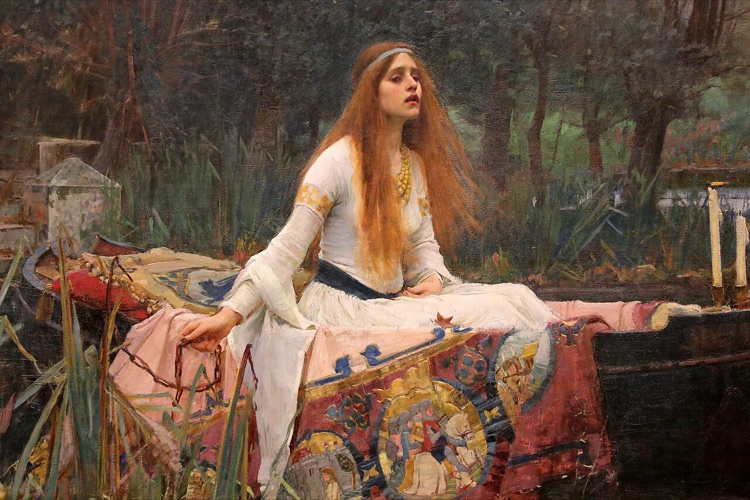
- Medieval, literary or biblical subjects — Expect Arthurian legend, Dante, Shakespeare's Ophelia and Mariana, Tennyson's Lady of Shalott, or biblical scenes rendered with unglamorous, everyday realism rather than academic grandeur.
- Flattened, compressed space — Figures and objects crowd close to the picture plane with little atmospheric recession; the eye reads the canvas almost like a densely patterned tapestry rather than a window with deep, receding perspective.
- Symbolic objects loaded with meaning — Flowers, birds, mirrors and household objects are rarely decorative alone — a lily signals purity, a broken thread signals fate, a caged bird signals confinement, inviting the viewer to read the picture like a moral text.
Anecdotes and curiosities
Elizabeth Siddal nearly died posing for Ophelia. Millais kept her submerged in a bathtub warmed by oil lamps for hours at a stretch while he painted; when the lamps went out unnoticed, Siddal stayed silently in the freezing water rather than interrupt the artist, and fell seriously ill afterward. Her father threatened legal action, and Millais paid her medical bills — a small price for what became one of the most reproduced images in British art.
Rossetti buried his poems with his wife, then dug them up again. When Elizabeth Siddal — by then his wife, model and a talented painter and poet in her own right — died of a laudanum overdose in 1862, a grief-stricken Rossetti placed the only manuscript copies of his unpublished poems in her coffin, wound into her hair, at Highgate Cemetery. Seven years later, persuaded by friends that the poems deserved publication, he had her grave secretly exhumed at night to retrieve the notebook. The recovered poems were published in 1870 to considerable acclaim.
"Sir Sloshua" was the Brotherhood's private insult for the president of the Royal Academy. Sir Joshua Reynolds's lectures preached generalised, idealised beauty and the free use of dark bitumen glazes to unify a composition's tone. The young rebels considered this an excuse for muddy, dishonest colour and nicknamed him "Sir Sloshua" — the joke that gave the group its enduring reputation as enemies of the art establishment they had, in fact, all trained inside.
The Brotherhood's most powerful champion lost his wife to one of its founders. John Ruskin's marriage to Effie Gray was never consummated; while Millais painted Ruskin's portrait during a family holiday in Scotland in 1853, he and Effie fell in love. The marriage was annulled in 1854 on grounds of non-consummation, and Effie married Millais the following year — a scandal that shook Victorian London without, remarkably, ending Ruskin's championing of Pre-Raphaelite painting.
Legacy and influence
Pre-Raphaelite ideas branched in several directions after the Brotherhood itself dissolved. Rossetti's later, more sensuous canvases of single female figures — Bocca Baciata (1859) onward — dropped moralising narrative in favour of pure physical beauty for its own sake, feeding directly into the Aestheticism of the 1870s and 1880s and its credo of "art for art's sake," an outlook shared by Whistler and later the Decadent writers of the 1890s. William Morris, who had trained as a painter alongside Burne-Jones, redirected Pre-Raphaelite conviction into design, founding Morris, Marshall, Faulkner & Co. in 1861 and becoming the central figure of the Arts and Crafts movement, which carried the Brotherhood's reverence for medieval craftsmanship into wallpaper, textiles, furniture and the printed book. On the Continent, Burne-Jones's dreamlike, sexless figures were a direct influence on Symbolist painters, who prized the same mood of trance-like reverie over narrative clarity.
The style has also enjoyed a long afterlife in popular visual culture, largely because it photographs and reproduces so well: Waterhouse's Lady of Shalott and Hylas and the Nymphs remain among the best-selling postcards and posters in any British museum shop. Pre-Raphaelite colour, medievalism and languid, red-haired heroines fed directly into twentieth-century fantasy illustration, from book covers to film and game design, and the Brotherhood's tangled love lives have furnished material for biographies, novels and the BBC drama Desperate Romantics (2009). Tate's blockbuster 1984 and 2012 retrospectives confirmed what had once been reviled as ugly and blasphemous was now, for millions of visitors, simply beautiful.
3 artists in this movement
Frequently asked questions
When did the Pre-Raphaelite Brotherhood flourish?
The original Brotherhood was active from its founding in 1848 until roughly 1853, when the members went their separate ways. Its style and spirit persisted far longer, however: a second generation led by Burne-Jones and Morris carried it through the 1860s–80s, and painters such as John William Waterhouse were still producing recognisably Pre-Raphaelite work into the early 1900s.
Who were the members of the Pre-Raphaelite Brotherhood?
The founding seven were Dante Gabriel Rossetti, William Holman Hunt and John Everett Millais, plus Thomas Woolner, James Collinson, Frederic George Stephens and William Michael Rossetti. John Ruskin was the group's crucial early champion rather than a member, and later associates working in Pre-Raphaelite style included Edward Burne-Jones, William Morris and, a generation on, John William Waterhouse.
Why is it called "Pre-Raphaelite"?
The name declares the group's central argument: that painting had been led astray by Raphael and his followers, whose idealised grace hardened over three centuries of academic imitation into hollow formula. The Brotherhood looked instead to the sincerity and close observation of art made before Raphael — the early Italian and Flemish masters — as their true model.
How can you recognise a Pre-Raphaelite painting?
Look for intensely saturated, jewel-like colour; obsessively detailed botany, textiles and surfaces rendered with equal focus throughout the canvas; a flattened, compressed sense of space; and subjects drawn from medieval romance, Shakespeare, Dante, Tennyson or the Bible, often featuring red-haired women with heavy-lidded eyes and full lips.
Is Pre-Raphaelitism Victorian, Romantic, or something else?
It is best understood as a distinctly Victorian movement that borrowed Romanticism's reverence for emotion, nature and the medieval past while rejecting Romanticism's loose, painterly technique for something far more linear and hard-edged. It sits outside the mainstream academic Victorian tradition it was founded to attack, yet it remains inseparable from the era's literature, morality and taste.